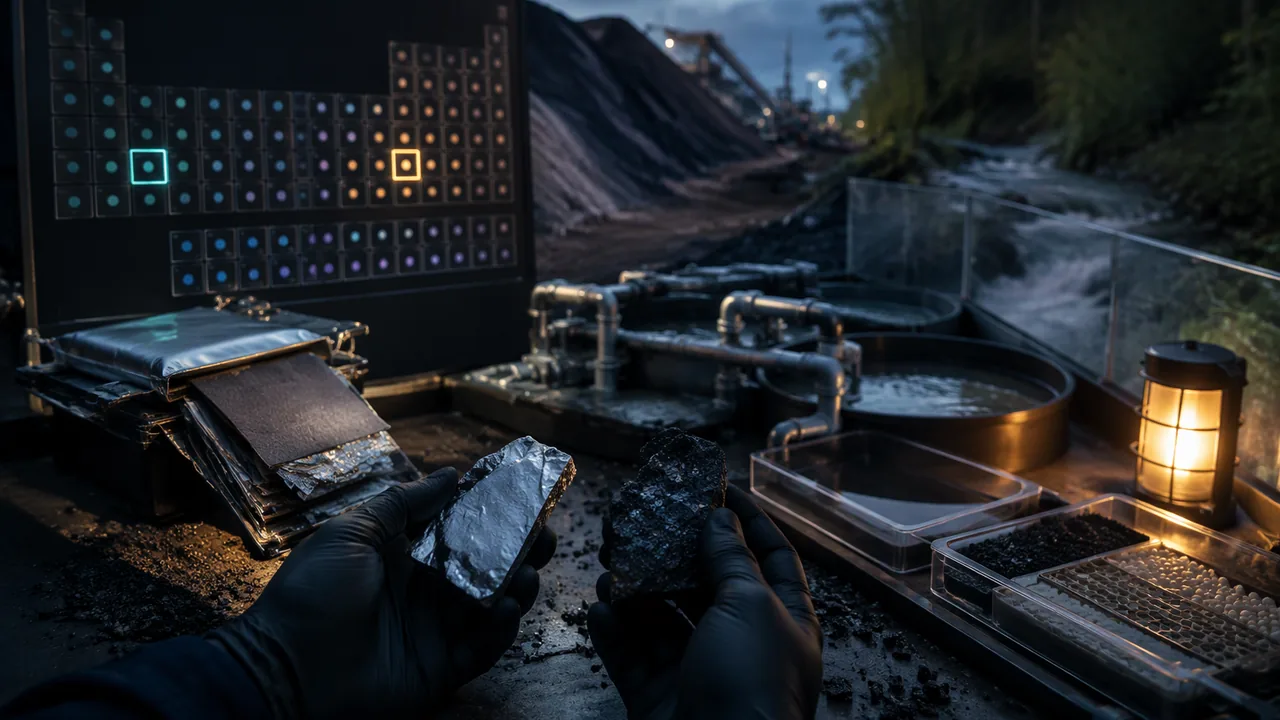
use the periodic table as a model to explain lithium’s properties, compare it with neighboring elements, and state criteria and constraints for recovering a battery metal responsibly.
Instruction
The context. A lithium-ion battery needs more than lithium. Many cathodes are built from lithium cobalt oxide, LiCoO2, or from mixes of lithium with nickel, manganese and cobalt. The United States imports most of both metals: the U.S. Geological Survey (USGS) reports net import reliance above 50% for lithium and 79% for cobalt in 2025, and U.S. lithium production came from a single brine operation in Nevada. Missouri has no lithium mine, but it has cobalt. The Missouri Geological Survey calls the state one of only a few areas in the continental United States known to have produced cobalt, and the Mine LaMotte-Fredericktown district in Madison County is the only Missouri district with known cobalt production. Since 2019 a company has processed old lead-mine tailings at the Madison Mine near Fredericktown to recover cobalt, nickel and copper (USGS). Those tailings lie within an EPA Superfund site because of the lead they contain. Whether and how to recover battery metals there raises questions of chemistry, engineering and community health.
Your job. Write an element brief that explains, from the periodic table, why lithium behaves as it does, connects it to the cobalt it is paired with in LiCoO2, and then frames the engineering challenge of recovering cobalt from Missouri mine waste. You are not asked to decide whether the project should go ahead; you are asked to explain the science and to specify criteria and constraints, which is how engineers begin (9-12.ETS1.A.1).
What the science section must do. Lithium is element 3, in group 1, period 2, with shell arrangement 2, 1. Use that to predict (a) the ion it forms, (b) the formula of its compounds with chlorine and oxygen (LiCl, Li2O), (c) how its reactivity compares with sodium and potassium, with NIST ionization energies (Li 5.39, Na 5.14, K 4.34 eV) as evidence, and (d) why it is found in nature as Li+ ions, dissolved in brines or bonded in minerals, rather than as a shiny metal in the ground. Include its average atomic mass computed from isotopes (7.59% Li-6 at 6.01512 u, 92.41% Li-7 at 7.01600 u gives 6.94 u) and show the calculation. Then (e) use charges to check LiCoO2: with Li+ and two O2−, cobalt must be Co3+; and compare cobalt’s NIST ionization energy (7.88 eV) with iron’s (7.90 eV) and gold’s (9.23 eV) to explain why Missouri’s cobalt, like its iron, is found combined in minerals, such as the sulfide siegenite (CoNi2S4), rather than as native metal. Tie at least one claim to your Lesson 1.2 lab evidence about metal reactivity.
What the engineering section must do. Name at least two criteria (what a good recovery process must achieve, such as the share of the cobalt in the tailings that is recovered, or battery-grade purity) and at least two constraints (limits, such as cost when the cobalt price swings, keeping lead-bearing dust and water out of nearby yards and streams, energy and water use, and consultation with Fredericktown residents). Say which criteria you would make quantitative and how they could be measured. Use sources: OpenStax Chemistry 2e, NIST data, USGS mineral summaries, Missouri Geological Survey fact sheets and EPA material, all hosted in this lesson’s reading. Cite each source you use, and do not state figures you cannot source; label any estimate as illustrative.
Quality bar. Strong briefs connect every property claim to outer electrons, distance from the nucleus and charge, the same reasoning as Lesson 1.3. They compare findings from two different sources (RST.9-10.9), for example a textbook table and NIST, and say whether they agree.
Stages. You will plan, draft, review the draft against a criteria list (on your own, or with a parent, guardian or other reader), revise, and present. The presentation is four minutes, recorded, and ends with your answer to a defense question about your evidence.
📖 Read for this lesson
The reading opens over the lesson; close it to come back to exactly where you were. The checks below draw on it.
Formative check
Work through these before moving on. They are not graded — they tell you whether the standard below has landed yet.
Why is lithium found in nature as Li+ ions, dissolved in brines or bonded in minerals, rather than as lithium metal?
‘The process must recover cobalt from the tailings with water use below a set limit’ is an example of a constraint.
Draft your plan: list three property claims about lithium, the evidence you will use for each, and one criterion and one constraint for recovering cobalt from the Fredericktown mine tailings.
How confident are you that you can use the periodic table to explain an element’s properties and frame an engineering problem with criteria and constraints?
Unit 1 checkpoint
Do this before you start the task. It covers the whole unit and tells you what to review first.
A neutral atom has 17 protons and 18 neutrons. What is its mass number?
Which pair are isotopes?
Which element is most reactive?
Magnesium bubbled vigorously in vinegar and copper did not. The best explanation is that
Aluminum forms Al3+ and oxygen forms O2−, so aluminum oxide is AlO.
The number of protons in an atom is its number.
First ionization energy generally increases across a period from left to right.
A weighted average atomic mass lies closer to the mass of the least common isotope.
Chlorine is 75.76% Cl-35 (34.97 u) and 24.24% Cl-37 (36.97 u). Its average atomic mass is about
In an engineering problem, ‘the process must not use more than a set amount of fresh water’ is a
Graphite conducting electricity means carbon is a metal.
Which statement is a testable scientific question?
Submit: Battery Metals Element Brief (900-1,200 words) + four-minute presentation
Task: Explain lithium’s properties from its position on the periodic table, compare it with sodium and potassium using NIST ionization energies, compute its average atomic mass, use ion charges to check the cathode formula LiCoO2, and specify criteria and constraints for recovering cobalt from historic lead-mine tailings near Fredericktown, Missouri. Include one data table and at least three cited sources (OpenStax Chemistry 2e, NIST, USGS, Missouri Geological Survey or EPA pages).
Submission workflow
- Stage 1 — Plan. Outline with your claims, the evidence for each (lab data, NIST values) and a list of sources.
- Stage 2 — Reviewed draft. Check each property claim for electron-based reasoning and each number against its source using the criteria list, or ask a parent, guardian or other reader to check it with you; submit the marked-up checklist and your revision plan.
- Stage 3 — Final brief. 900-1,200 words with a data table, the average-atomic-mass calculation, the LiCoO2 charge check, and criteria and constraints.
- Stage 4 — Presentation and defense. Four minutes, recorded, ending with your answer to a defense question about your evidence.
How it is scored
| Criterion | What proficient looks like |
|---|---|
| Periodic table as a model (9-12.PS1.A.1) | Predicts ion, formulas and relative reactivity from outer electrons and position, with correct reasoning. |
| Use of data (SEP.8, RST.9-10.1) | Cites NIST values and lab evidence accurately and compares two sources. |
| Calculation (CCC.3) | Average atomic mass computed correctly with the method shown. |
| Criteria and constraints (9-12.ETS1.A.1) | At least two criteria and two constraints for cobalt recovery, including community-health and environmental ones, with ways to measure them. |
| Communication (SEP.8) | Clear structure; the recorded presentation answers the defense question with evidence. |
Battery Metals Source File: Lithium, Missouri Cobalt and NIST Data
USGS Mineral Commodity Summaries 2026 (Lithium; Cobalt); USGS Mineral Industry Surveys, Cobalt in February 2022; Missouri Geological Survey, Cobalt fact sheet (PUB2893); EPA news release on the Madison County Mines Superfund Site (April 1, 2019); NIST atomic data; public domain U.S. government works and a Missouri state publication; all retrieved Nov. 5, 2026 · Public domain (U.S. government works) and a Missouri state publication summarized, with SLS commentary
Why this reading. The brief must cite at least three sources, compare two of them, and state no figure it cannot source. This file hosts the figures: the U.S. Geological Survey’s 2026 summaries for lithium and cobalt, the Missouri Geological Survey’s cobalt fact sheet, a USGS industry report on the Fredericktown tailings project, an EPA report on the lead cleanup there, and NIST’s atomic data. Every number below carries its source. The engineering section at the end lists what the sources say about constraints and what they do not.
Source 1: USGS, Mineral Commodity Summaries 2026, Lithium
Published February 2026. Quantities are metric tons of lithium content unless stated.
| Item | Figure |
|---|---|
| U.S. commercial production, 2025 | One continental brine operation in Nevada; production withheld (company proprietary) |
| U.S. net import reliance, 2025 | More than 50% of apparent consumption |
| World production, 2024 → 2025 (excluding U.S.) | 222,000 t → about 290,000 t (+31%) |
| Global end uses | Batteries 88%; ceramics and glass 4%; lubricating greases 2%; air treatment 1%; casting mold flux 1%; medical 1%; other 3% |
| Battery-grade lithium carbonate price, annual average (dollars per metric ton) | 2021: 11,700; 2022: 63,700; 2023: 39,000; 2024: 11,800; 2025: 9,000 |
| U.S. import sources, 2021–24 | Chile 54%; Argentina 43%; other 3% |
| Reserves | World about 37 million t; United States 4.4 million t |
| Measured and indicated U.S. resources | 30 million t, “from continental brines, claystone, geothermal brines, hectorite, oilfield brines, and pegmatites” |
Missouri appears nowhere in the lithium summary: the state has no lithium production. Its battery-metal story is cobalt.
Source 2: USGS, Mineral Commodity Summaries 2026, Cobalt
Published February 2026. Metric tons of cobalt content; 2025 values are USGS estimates.
| Item | 2024 | 2025 |
|---|---|---|
| U.S. mine production | 200 t | 300 t |
| U.S. secondary (scrap) production | 2,050 t | 2,000 t |
| U.S. imports for consumption | 10,800 t | 14,000 t |
| U.S. apparent consumption | 7,960 t | 9,600 t |
| Net import reliance (% of apparent consumption) | 74% | 79% |
| U.S. spot price, cobalt cathode (dollars per pound) | 16.77 | 21 |
Other USGS statements in the same summary: the U.S. spot price averaged $30.78 per pound in 2022; lithium-ion batteries are “the leading global use for cobalt,” and their cobalt content was being decreased, with cobalt-free iron-phosphate cells holding significant market share in China; Congo (Kinshasa) supplied an estimated 73% of world mined cobalt in 2025; U.S. reserves are 70,000 t; and identified U.S. cobalt resources are about 1 million tons, mostly in Minnesota, with Missouri among the states that have other notable occurrences.
Read two rows together. U.S. mine production in 2025 (300 t) was 300 ÷ 9,600 = 3.1% of apparent consumption. And the price fell from $30.78 to $16.77 per pound between 2022 and 2024, a factor of 30.78 ÷ 16.77 = 1.84. A recovery process that pays at the first price may not pay at the second; cost is a constraint that moves.
Source 3: Missouri Geological Survey, Cobalt fact sheet
| Item | As the Survey states it |
|---|---|
| Missouri’s standing | One of only a few areas in the continental United States known to have produced cobalt and to contain potentially significant cobalt reserves |
| Where | Southeast Missouri Lead District: the Viburnum Trend (1955 to present) and Mine LaMotte-Fredericktown (1720–1961); Mine LaMotte-Fredericktown is the only district with known cobalt production, along with nickel |
| Grade | Cobalt and nickel amounts at Mine LaMotte-Fredericktown are generally 10 times higher than in the Viburnum Trend; ore lies about 250 to 400 feet below the surface |
| Minerals | Mainly siegenite (CoNi2S4), bravoite ((Fe,Ni,Co)S2) and millerite (NiS) at Fredericktown; also cobaltite (CoAsS) |
| Production history | Attempts in 1903–1910, 1917–1920 and 1944–1961 were generally not economic; 1,443 tons of cobalt were delivered under a federal contract from 1954 to 1961 |
| Uses named | Superalloys, magnets, corrosion-resistant alloys, high-speed steels, cemented carbides and battery electrodes |
Two checks. Siegenite, CoNi2S4, has a molar mass of 58.933 + 2(58.693) + 4(32.06) = 304.56 g/mol, of which cobalt is 58.933 ÷ 304.56 = 19.4%. Even a pure crystal of the main ore mineral is less than a fifth cobalt, and the ore is mostly other rock. And 1,443 tons over the eight years 1954–1961 averages about 180 tons a year. The fact sheet does not say which ton it uses, and USGS reports metric tons, so compare the two only roughly: Missouri’s 1950s output was of the same order as U.S. mine production in 2025.
Source 4: USGS, Mineral Industry Surveys, Cobalt in February 2022
USGS reported that since 2019 Missouri Cobalt, LLC had processed tailings left by earlier mining of lead and other metals at the Madison Mine near Fredericktown, producing a bulk concentrate containing cobalt, copper and nickel; that the company was building a hydrometallurgical plant to produce battery-grade cobalt and nickel; and that its parent company had been renamed United States Strategic Metals. The plant’s status after 2022 is not hosted here, so do not claim it is operating unless you have read a current source that says so.
Source 5: EPA, Madison County Mines Superfund Site (April 1, 2019)
| Item | Figure |
|---|---|
| Residential cleanup in and around Fredericktown | Over 626,000 cubic yards of soil at more than 1,900 residential properties |
| Mine waste cleaned up | About 87 acres |
| Children tested in Madison County with elevated blood lead | About 27% in 1996; less than 2% in 2019 |
| Plan for the Anschutz Mine property | New owners intended to reopen a former cobalt mine after a property-wide cleanup of historical mine waste |
The lead in these tailings is the same chemistry you have been studying: lead from the ore ended up in the waste rock, and from there in yard soil. Any process that digs up and reprocesses the tailings has to keep that lead out of the air, the soil and the streams.
Source 6: NIST atomic data for lithium, its neighbors, and cobalt
| Quantity | Lithium | Sodium | Potassium | Source |
|---|---|---|---|---|
| Atomic number, shells | 3; 2, 1 | 11; 2, 8, 1 | 19; 2, 8, 8, 1 | shell model |
| First ionization energy | 5.39 eV | 5.14 eV | 4.34 eV | NIST Atomic Spectra Database |
| Standard atomic weight | [6.938, 6.997] | 22.98977 | 39.0983 | NIST Compositions |
| Isotopes (mass u, fraction) | Li-6: 6.01512, 0.0759; Li-7: 7.01600, 0.9241 | Na-23 only | K-39 0.9326; K-40 0.0001; K-41 0.0673 | NIST Compositions |
| Metal | First ionization energy (NIST) | How it is found in nature |
|---|---|---|
| Iron | 7.90 eV | combined, as oxides (hematite, magnetite) |
| Cobalt | 7.88 eV | combined, as sulfides (siegenite) and arsenide-sulfides (cobaltite) |
| Nickel | 7.64 eV | combined, as sulfides (millerite, siegenite) |
| Gold | 9.23 eV | commonly native metal (USGS) |
The average atomic mass, worked: 0.0759 × 6.01512 + 0.9241 × 7.01600 = 0.4565 + 6.4835 = 6.940 u. NIST’s interval [6.938, 6.997] brackets it; 6.94 is the value to report.
The cathode formula, checked with charges: in LiCoO2, lithium is Li+ (+1) and the two oxide ions give 2 × (−2) = −4, so cobalt must carry +3 for the total to be zero: Co3+. By mass (Li 6.94, Co 58.933, O 15.999), LiCoO2 is 97.87 g/mol, of which cobalt is 58.933 ÷ 97.87 = 60.2% and lithium only 6.94 ÷ 97.87 = 7.1%. A cathode named for lithium is mostly cobalt by mass, which is why cobalt supply matters to lithium batteries.
Comparing two sources (RST.9-10.9)
NIST publishes two lithium pages that do not agree exactly. The older Handbook page lists an atomic weight of 6.941 and abundances of 7.5% Li-6 and 92.5% Li-7. The current Compositions table lists 7.59% and 92.41% and gives an interval instead of one number. The difference is not an error: lithium’s isotope ratio varies measurably between natural sources (some industrial lithium has had Li-6 removed), so the newer table reports a range. Your brief can say: the two NIST tables agree to three figures (6.94), and the newer one explains why a fourth figure cannot be promised. A second comparison: the Missouri Geological Survey’s 2020 fact sheet says the United States imports more than 70% of the cobalt it uses, and USGS’s 2026 summary gives 74% for 2024 and 79% for 2025. The sources describe different years and agree that most U.S. cobalt is imported.
Why lithium is Li+ and cobalt is in sulfides
Use the ionization energies and the shell model. Lithium’s one outer electron is easily lost (5.39 eV, far below gold’s 9.23 eV), and lithium metal reacts with water, so lithium in nature is always the ion, bonded in minerals or dissolved in brines. Cobalt holds its outer electrons more tightly than lithium but about as tightly as iron (7.88 eV against 7.90 eV), well below gold. Like Missouri’s iron, Missouri’s cobalt is found combined, here with sulfur, and has to be separated chemically from minerals that also hold nickel, iron, copper and lead.
Criteria and constraints: what the sources support
- Criterion, quantifiable: the share of the cobalt in the tailings that the process recovers, measured as cobalt out divided by cobalt in. No tailings grade is hosted here, so state how it would be measured, not what it is.
- Criterion, quantifiable: battery-grade purity of the cobalt product, which USGS names as the plant’s goal; measured as percent cobalt in the product.
- Constraint: cost, in light of the cobalt price row above (a factor of 1.84 between 2022 and 2024) and the shift toward cobalt-free cells.
- Constraint: lead. The tailings sit in a Superfund site where EPA cleaned soil at more than 1,900 homes; reprocessing must not raise lead in nearby air, soil or streams, which can be measured by soil and water sampling and by children’s blood-lead testing.
- Constraint: water and energy use, and consultation with Fredericktown and Madison County residents. No figures are hosted here, so state that limits are needed and how they would be measured (cubic meters of water or kilowatt-hours per ton of cobalt), not what they are.
Label any number you estimate as illustrative, and keep the sourced numbers above attached to their sources.
Sources: USGS, Mineral Commodity Summaries 2026: Lithium (February 2026) (pubs.usgs.gov); USGS, Mineral Commodity Summaries 2026: Cobalt (February 2026) (pubs.usgs.gov); Missouri Geological Survey, Cobalt (fact sheet PUB2893, 2020) (dnr.mo.gov); USGS, Mineral Industry Surveys: Cobalt in February 2022 (May 2022) (apps.usgs.gov); U.S. EPA news release, EPA Administrator Wheeler Recognizes Progress at Madison County Mines Superfund Site (April 1, 2019) (epa.gov); NIST Atomic Spectra Database (ver. 5.12), Ionization Energies Data: Li, Na, Mg, K, Fe, Co, Ni, Cu, Zn, Rb, Cs, Au, Pb (physics.nist.gov); NIST, Atomic Weights and Isotopic Compositions with Relative Atomic Masses (Physical Measurement Laboratory) (physics.nist.gov); NIST, Handbook of Basic Atomic Spectroscopic Data (ground states and first ionization energies) (physics.nist.gov)