explain rusting from outer electrons, use mole calculations to predict the mass of rust and show mass is conserved, and evaluate strategies for protecting steel against prioritized criteria.
Instruction
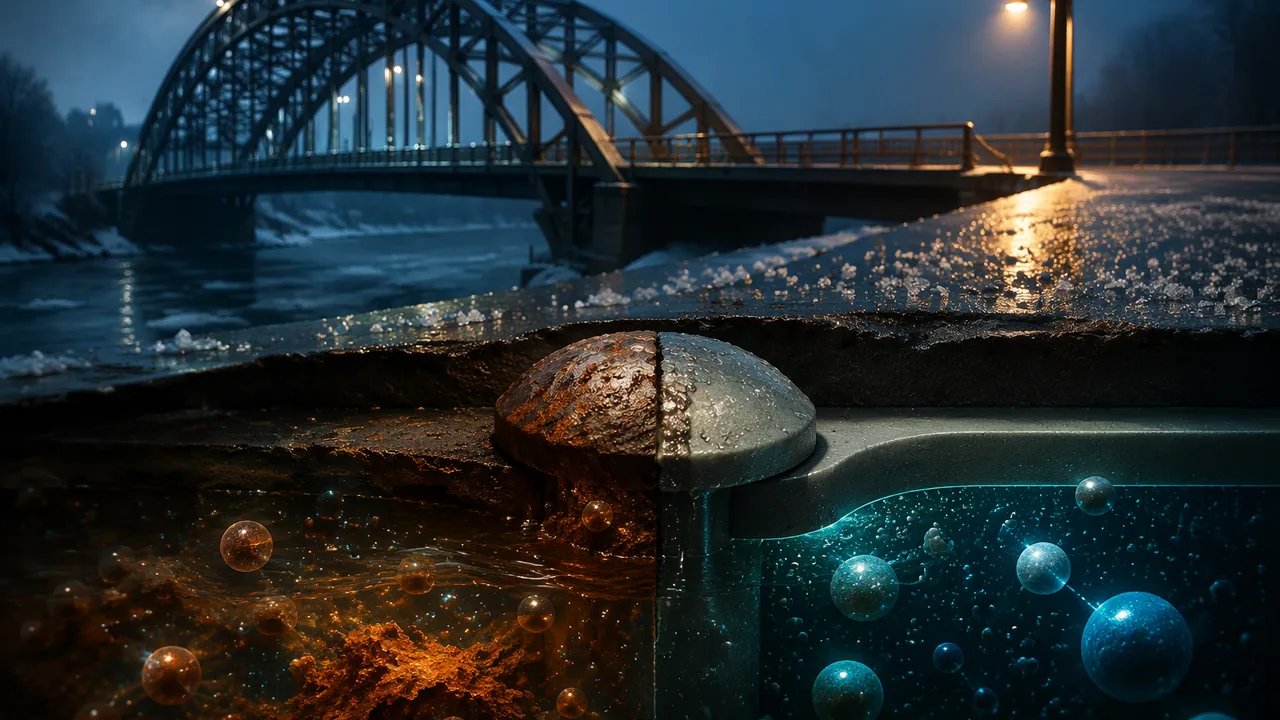
The context. A bridge is a machine for resisting forces, but in a state that salts its roads every winter its biggest long-term enemy is chemistry. Every square meter of steel on a Missouri bridge such as the Eads Bridge must be protected from rust, and every protection method costs money, time, energy and materials. The Eads Bridge’s 2012-2016 rehabilitation cost $48 million; nationally, the Federal Highway Administration estimates the direct cost of corrosion to highway bridges at about $8.3 billion a year. Your report is the kind of technical explanation an engineer writes before recommending a maintenance plan.
Part 1: Explain the reaction (9-12.PS1.A.2). Write the balanced equation 4Fe + 3O2 → 2Fe2O3, show the atom count, and explain the product from outer electrons: iron loses electrons to become Fe3+, oxygen gains them to become O2−, and the charges set the formula. Explain why winter road salt speeds the process (dissolved ions let charge move between the places where iron gives up electrons and where oxygen accepts them).
Part 2: Calculate (9-12.PS1.B.3). Choose one of three sample masses of iron. All three earn full credit and take the same three steps; pick the one whose scale interests you. Option A: 25.0 g, about a handful of bolts. Option B: 250 g, about one large bridge rivet. Option C: 1.50 kg, a short piece of steel bracing strut like those replaced on the Eads Bridge. For the mass you chose, predict the mass of Fe2O3 it would form and the mass of oxygen it would take from the air, using the three-step path (grams of iron → moles of iron → moles of product → grams of product), with Fe 55.845, O2 31.998 and Fe2O3 159.688 g/mol. Check yourself: Option A gives about 35.7 g of rust from 25.0 g of iron plus 10.7 g of oxygen; Option B is ten times that; Option C gives about 2,145 g of rust from 1,500 g of iron plus 645 g of oxygen. Show every step, because the rubric scores the path, not the answer. Show that iron plus oxygen equals rust. Then connect to your sealed-bag data: explain why the bag’s mass stayed nearly constant and why a rusting bolt gains mass, using the same principle.
Part 3: Evaluate protection strategies (9-12.ETS1.B.1). Compare at least three: (a) paint systems like the Eads Bridge’s rust-inhibiting coating, which keep water, salt and oxygen away from the steel; (b) zinc galvanizing, where a zinc coating corrodes first because zinc gives up electrons more easily than iron (recall Unit 1’s reactivity series), protecting the steel even where scratched; (c) stainless steel (like the Gateway Arch’s Type 304 skin) or weathering steel, alloys that form a thin protective oxide layer. Rank at least three criteria (for example, service life, cost, ease of repair in place, and environmental impact of maintenance) and build a table scoring each strategy. State the trade-offs and say which strategy fits which part of a bridge. You do not need real costs; describe them as higher or lower and cite where you found any figure you use.
Quality bar. Every number is calculated and shown with units. Every mechanism is explained with electrons. Every recommendation names its trade-off. Cite at least three sources (RST.9-10.1) such as OpenStax Chemistry 2e, the National Park Service’s Gateway Arch fact sheet or Metro’s Eads Bridge information, and a federal source on corrosion such as the Federal Highway Administration.
Stages. Plan, draft, self-check (at least a day later, re-do your calculation from scratch on a clean page without looking at the draft, and compare), revise, and record a four-minute defense that answers one question from the defense question list.
📖 Read for this lesson
The reading opens over the lesson; close it to come back to exactly where you were. The checks below draw on it.
Formative check
Work through these before moving on. They are not graded — they tell you whether the standard below has landed yet.
Why does a zinc coating protect steel even where it is scratched?
25.0 g of iron is mol (Fe 55.845 g/mol), which forms mol of Fe2O3.
Draft your plan: write the three-step calculation for the iron mass you chose (with units), list three protection strategies, and rank your criteria with one reason for the top one.
How confident are you that you can explain corrosion with electrons, predict rust mass with moles, and evaluate protection strategies?
Unit 3 checkpoint
Do this before you start the task. It covers the whole unit and tells you what to review first.
Which equation is balanced?
In rusting, iron atoms
An open cup of vinegar and baking soda loses mass during the reaction because
A nail gains mass as it rusts.
A reaction is exothermic when
Broken bonds total 1,370 kJ and formed bonds total 1,856 kJ, so the energy change is kJ.
Breaking chemical bonds releases energy.
What is the molar mass of CO2 (C 12.011, O 15.999)?
In 2H2 + O2 → 2H2O, how many moles of water form from 3.0 mol of H2 with excess O2?
The reactant that runs out first and limits the amount of product is the reactant.
Zinc galvanizing protects steel because
One mole of iron atoms has a mass of about 55.8 g.
Submit: St. Louis Bridge Corrosion Report (900-1,300 words) + four-minute recorded defense
Task: Explain why a Missouri bridge’s steel rusts, from the balanced equation and the outer electrons of iron and oxygen; predict the mass of rust and of oxygen for whichever of the three iron masses in the lesson you chose, and show that mass is conserved; connect to your sealed-bag lab data; and evaluate at least three protection strategies in a prioritized criteria table with trade-offs. Cite at least three sources.
Submission workflow
- Stage 1 — Plan. Outline the three parts, name which of the three iron masses you chose and set up the calculation for it, and list criteria and sources.
- Stage 2 — Self-checked draft. At least a day after drafting, re-do your mole calculation independently from a clean page and compare it with your draft; check each mechanism for electron-based reasoning against the rubric. Submit your re-done calculation, the differences you found and your revision plan.
- Stage 3 — Final report. 900-1,300 words with the equation, calculations, lab connection and criteria table.
- Stage 4 — Presentation and defense. Record a four-minute presentation that ends by answering one question from the defense list: (1) Why does the rust weigh more than the iron? (2) Why does road salt speed rusting? (3) Why would you not galvanize the whole Eads Bridge today? (4) Why does the Gateway Arch’s skin stay silver? Choose any one.
How it is scored
| Criterion | What proficient looks like |
|---|---|
| Conservation calculation (9-12.PS1.B.3, SEP.5) | Correct mole path with units; shows iron + oxygen = rust; connects to lab data. |
| Reaction explanation (9-12.PS1.A.2) | Explains the product and the role of salt water from outer electrons and charges. |
| Evaluation (9-12.ETS1.B.1) | At least three strategies scored against ranked criteria with honest trade-offs. |
| Use of sources (RST.9-10.1) | At least three sources cited accurately; no unsourced figures. |
| Communication (CCC.5) | Clear flow of matter through the system; the defense answers a question with evidence. |
Corrosion Protection Source File: Paint, Galvanizing and Stainless Steel on the St. Louis Riverfront
Eads Bridge rehabilitation facts (Metro, as summarized in the Eads Bridge reference article); NPS Gateway Arch Fact Sheet; FHWA-HRT-11-060; American Galvanizers Association ISO 9223 zinc-rate table; standard electrode potentials and stainless-steel composition from reference articles; all retrieved 2026-11-05; SLS commentary, service-life arithmetic and criteria table · Public domain (U.S. federal agency facts) and cited reference values, with SLS commentary
Why this reading. The performance task asks you to compare paint, galvanizing and corrosion-resistant alloys against ranked criteria. This source file gives real figures for each strategy, from structures you can see on the St. Louis riverfront, so your criteria table scores real trade-offs instead of guesses.
Strategy 1: paint systems (the Eads Bridge)
Paint protects by forming a barrier that keeps water, oxygen and salt away from the steel; it does not change the metal’s chemistry. Its weakness is that the barrier is only as good as its weakest scratch. On the Eads Bridge (opened 1874), Metro’s 2012–2016 rehabilitation removed all paint and corrosion from the superstructure, replaced 1.2 million pounds of struts, bracing and other support steel, and repainted with a rust-inhibiting coating, at a total cost of $48 million, to keep the bridge in service to at least 2091. Paint can be renewed in place, section by section, but it must be renewed.
Strategy 2: hot-dip galvanizing (sacrificial protection)
Galvanizing coats steel with zinc. Zinc’s standard electrode potential (−0.7618 V for Zn2+/Zn) is more negative than iron’s (−0.44 V for Fe2+/Fe), so zinc gives up electrons more readily. Where the coating is scratched, the zinc around the scratch corrodes first and protects the exposed steel: sacrificial protection, which paint cannot do. The American Galvanizers Association gives a typical minimum hot-dip coating of 100 µm on structural steel and publishes ISO 9223 first-year zinc corrosion rates:
| ISO 9223 category | Typical outdoor environment (summarized) | First-year zinc corrosion rate (µm/year) |
|---|---|---|
| C1, very low | Dry or cold zone, very low pollution and wetness (some deserts, polar regions) | < 0.1 |
| C2, low | Temperate rural area, minimal pollution, short time of wetness | 0.1 – 0.7 |
| C3, medium | Urban area with medium pollution or some effect of chlorides (salt) | 0.7 – 2.1 |
| C4, high | Industrial pollution or substantial chloride (salt) effect | 2.1 – 4.2 |
| C5, very high | Very high industrial pollution or significant chloride deposits | 4.2 – 8.4 |
| CX, extreme | Extreme pollution or extended chloride deposits, splash zone of salt water | 8.4 – 25 |
A simple estimate (coating thickness ÷ corrosion rate, assuming a steady rate) shows how much the environment matters. In a C3 environment (0.7–2.1 µm/year), 100 µm of zinc lasts about 100 ÷ 2.1 = 48 to 100 ÷ 0.7 = 143 years. In a salty C4 environment (up to 4.2 µm/year) the worst case drops to 100 ÷ 4.2 = 24 years. The AGA’s own field data for a Midwestern city, Cedar Rapids, Iowa, show about 1.00 µm/year, or about 100 years for 100 µm. Galvanizing is usually applied once, in a factory, before a part is installed; it cannot simply be re-dipped on a finished bridge. The FHWA notes that because deicing salts can reach bridge reinforcing steel within the first year, that steel must be protected at the time of construction, and coated or galvanized reinforcing bars are among the options it studies.
Strategy 3: stainless steel and weathering steel (the Gateway Arch)
Stainless steel is iron alloyed with at least 10.5% chromium; the most common grade, Type 304, has about 18% chromium. The chromium forms a very thin, tightly attached oxide film that re-forms by itself when scratched, unlike the thick, flaking iron oxide that forms on plain steel. The Gateway Arch’s outer skin is 886 tons of Type 304 stainless plate, 1/4 inch thick, and has never been painted, though the National Park Service has studied stains and deposits on it. Weathering steel (such as the alloy trademarked COR-TEN) works differently: it forms a stable, tightly attached rust layer that slows further corrosion and is left unpainted by design. Both alloys cost more per kilogram than plain carbon steel and are chosen once, at design time.
A criteria table to build from
| Strategy | Mechanism | Typical maintenance pattern | Where it fits |
|---|---|---|---|
| Paint | Barrier; no change to the steel’s chemistry | Repeated reapplication; fails at any scratch | Large, inspectable existing structures such as the Eads Bridge’s trusses |
| Galvanizing | Sacrificial: zinc corrodes first (−0.76 V vs. iron’s −0.44 V) | Applied once before installation; protects scratches automatically; life shortens as salt exposure rises | Guardrails, sign posts, fasteners and reinforcing bars that are hard to repaint |
| Stainless / weathering steel | Self-healing chromium oxide film (stainless) or stable protective rust layer (weathering) | Chosen once, at design time; little routine coating work | High-value or hard-to-reach surfaces, such as the Arch’s skin |
Using this source file
Rank your own criteria (for example service life, cost, ease of repair in place, and environmental impact of maintenance) and score each strategy using the mechanisms and numbers above. Cite the electrode-potential values whenever you explain why galvanizing works, show the coating-life arithmetic if you use it, and state which part of a structure you would protect each way.
Sources: Eads Bridge (opened 1874; 2012-2016 Metro rehabilitation, $48 million, 1.2 million pounds of steel replaced, paint and corrosion removed, service to at least 2091), summarizing Metro and press sources (en.wikipedia.org); National Park Service, Gateway Arch Fact Sheet (stainless-steel skin 886 tons, Type 304, #3 finish, 1/4 in plate) (nps.gov); Federal Highway Administration, Multiple Corrosion-Protection Systems for Reinforced Concrete Bridge Components (FHWA-HRT-11-060), Chapter 1: $8.3 billion direct annual cost of bridge corrosion; deicing salts reaching reinforcing steel (fhwa.dot.gov); American Galvanizers Association, HDG Corrosion Rates for ISO Categories C1-C5/X (ISO 9223 first-year zinc corrosion rates; 100 micrometer typical minimum coating; Time-to-First-Maintenance city data) (galvanizeit.org); Standard electrode potential (data page): Zn2+/Zn -0.7618 V; Fe2+/Fe -0.44 V (en.wikipedia.org); Stainless steel (chromium content of 10.5% or more; Type 304 about 18% chromium) (en.wikipedia.org)