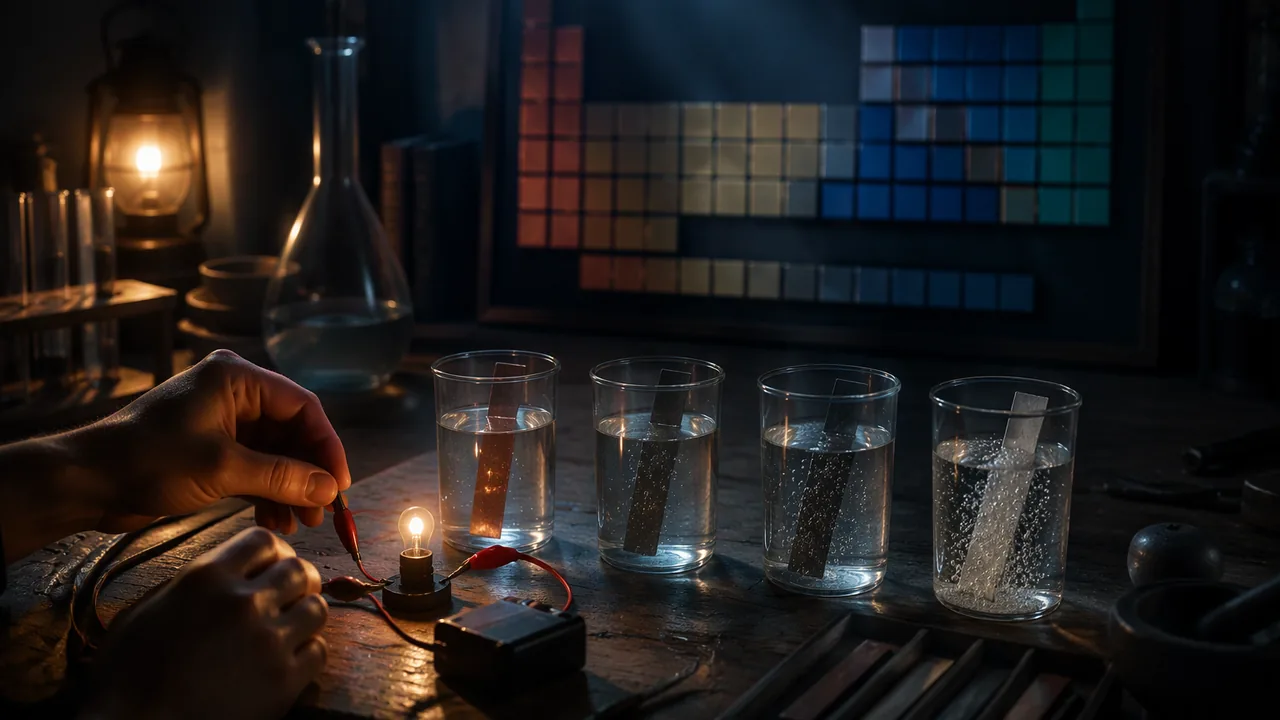
test household samples of elements for conductivity and reactivity with vinegar, add recorded data for magnesium, and relate the patterns I observe to each element’s position on the periodic table.
Instruction
Why a lab here. The periodic table is a model, and a model is only useful if it predicts what we observe. Today you test that model at home with household samples. You will measure two properties: whether a sample conducts electricity, and how vigorously a metal reacts with an acid (white vinegar, about 5% acetic acid).
Metals and nonmetals. About three-quarters of the elements are metals. They sit to the left of the staircase line on the periodic table. Metals are shiny when freshly cut, conduct electricity and heat, and can be bent or hammered without shattering. Nonmetals sit to the right of the line; as solids they are usually dull and brittle and conduct poorly. Elements along the line (such as silicon) are metalloids, with intermediate properties. Graphite, a form of carbon, is the famous exception: a nonmetal that conducts. You will test it.
What the model says about reactivity. Metals react by losing their outer electrons. Elements in the same group (column) have the same number of outer electrons, so they react in similar ways. Metals that give up electrons easily react more vigorously. Magnesium is in group 2 near the top left; zinc and iron are transition metals in the middle; copper is also a transition metal but holds its electrons more tightly; gold holds them most tightly of all. The model predicts this order of reactivity with acid: magnesium > zinc > iron > copper.
The reaction. A reactive metal in vinegar gives off bubbles of hydrogen gas. For magnesium: Mg + 2CH3COOH → Mg(CH3COO)2 + H2. A 0.10 g piece of magnesium ribbon that reacts completely makes only about 0.0083 g of hydrogen, a small amount that escapes harmlessly in a ventilated room. Magnesium ribbon is not a household material, so magnesium’s results come from the recorded data set in this lesson’s reading. At home you test zinc (a galvanized washer or nail), iron (a sanded steel nail) and copper (bare copper wire). The bubbles are your evidence. You can compare metals by how fast bubbles form, and by timing how long a small piece takes to disappear.
Controlling variables. A fair comparison changes one thing at a time. Here the independent variable is the metal. Keep the controlled variables the same: the same volume of vinegar (10 mL), the same temperature (room temperature), and pieces of about the same surface area (1 cm strips or small squares). The dependent variable is the rate of bubbling, which you will score on a 0-3 scale and describe in words. Scoring by eye is a source of uncertainty; that is why you score each cup twice, once live and once from a phone video replayed later (or a household member scores independently), and then compare.
Reading the result. In the recorded data, magnesium bubbles vigorously within seconds. At home, expect slow bubbles on zinc, very few on iron (a nail may take many minutes), and none on copper. If your iron shows nothing, that is not a failed lab: note it, and think about what you could change (time, temperature, cleaning the surface) to detect a slow reaction. Iron’s slowness in vinegar and its rusting in wet air are both real; rusting needs oxygen and water together and happens over days.
Safety. Vinegar splashes sting the eyes, so safety glasses stay on from start to clean-up. Work at a kitchen table with an adult at home, in a ventilated room. Vinegar is the only acid you use; never mix vinegar, or any other product, with bleach or ammonia. Do not smell or taste anything.
📖 Read for this lesson
The reading opens over the lesson; close it to come back to exactly where you were. The checks below draw on it.
Lab: Conductivity and Reactivity of Metals and Nonmetals
Question. Do the conductivity and reactivity of element samples follow the patterns predicted by their positions on the periodic table?
Materials
- Samples: bare copper wire, aluminum foil, a steel nail (sanded), a zinc-plated (galvanized) washer or nail, graphite pencil lead (a mechanical-pencil refill), a plastic straw. Magnesium and sulfur are not household materials; their rows come from the recorded data set in this lesson’s reading.
- Conductivity tester: 2 AA batteries in a holder (or taped end to end), an LED or small flashlight bulb, and three wires with alligator clips or bare ends. No tester parts? Do the conductivity step in the PhET Circuit Construction Kit: DC, which includes a pencil lead and household objects.
- White vinegar (5% acetic acid), 10 mL (2 teaspoons) per test
- Three clear plastic cups or small glasses, measuring spoons, sandpaper or a nail file
- Phone timer and camera, magnifying glass if you have one, safety glasses
- Wear safety glasses for the whole lab: vinegar stings if splashed in the eyes.
- Have an adult at home while you work, and work in a ventilated room.
- Use only the low-voltage battery tester; never connect anything to a wall outlet.
- Vinegar is the only acid in this lab; never mix vinegar or any other household product with bleach or ammonia.
- Do not taste or smell samples; wash hands after the lab, pour spent vinegar down the sink with plenty of water, and wrap used metal pieces in a paper towel for the trash.
Procedure
- Record the appearance of each sample (luster, color) and whether it bends or snaps.
- Touch both tester leads to each solid sample (or test the same materials in the PhET Circuit Construction Kit: DC). Record whether the LED lights (conducts) or not.
- Pour 10 mL (2 teaspoons) of vinegar into each of three labeled cups. Add one metal sample (Zn, Fe, Cu) to each at the same moment, start the timer and start a phone video.
- Observe for 5 minutes. Score bubbling at 30 s, 2 min and 5 min on a 0-3 scale (0 none, 1 a few, 2 steady, 3 vigorous). Later, replay the video and score again without looking at your first scores, then compare the two sets.
- Cover the cups, leave them overnight out of reach of children and pets, and record what you see the next morning; slow reactions such as iron’s often show only then. Copy the magnesium row, including its time to disappear, from the recorded data set in the reading.
- Locate each element on the periodic table and record its group and period next to your data.
Data
| Sample | Group, period | Luster / bends? | Conducts? | Bubbling 30 s / 2 min / 5 min (0-3) | Notes |
|---|---|---|---|---|---|
| Mg (recorded data) | |||||
| Zn | |||||
| Fe | |||||
| Cu | n/a | ||||
| Al, graphite, straw; S (recorded data) | n/a |
Analysis
- Claim: rank Mg, Zn, Fe and Cu from most to least reactive. Evidence: cite your bubbling scores and times. Reasoning: explain the ranking using how easily each metal gives up outer electrons.
- Which sample broke the metal / nonmetal pattern for conductivity? Explain why one exception does not destroy the periodic-table model.
- Name two sources of error (for example, surface area or an oxide coating on the nail) and how each could change your ranking.
- Use your results to answer the unit question: why does Missouri’s iron come out of the ground as an oxide ore, and why does an iron tool rust while gold stays bright?
If you cannot do this lab in person: Use the recorded data set in this lesson’s reading for all four metals, and do the conductivity part with the PhET Circuit Construction Kit: DC (which includes a pencil lead and household objects).
Formative check
Work through these before moving on. They are not graded — they tell you whether the standard below has landed yet.
Rank magnesium, zinc, iron and copper by how fast you expect them to bubble in vinegar.
In the vinegar test, which is the independent variable?
Because graphite conducts electricity, carbon must be a metal.
Write your claim-evidence-reasoning paragraph ranking the four metals (your three plus magnesium from the recorded data). Include at least two numbers from your data table and one source of error.
How confident are you that you can plan a fair test of element properties and connect the results to periodic-table position?
Practice
Work these on paper or in your notebook, then open Check your answer. Aim for all of Fluency and Application; try at least one Challenge.
Printable version: this unit’s practice workbook (PDF)
Fluency
Build speed and accuracy with the core skill.
- Classify as metal, nonmetal or metalloid: magnesium, sulfur, silicon, copper, chlorine.
Check your answer
Answer: Mg metal; S nonmetal; Si metalloid; Cu metal; Cl nonmetal.Metals are left of the staircase line, nonmetals right, metalloids along it. - Give the group number and period of zinc, magnesium and iron.
Check your answer
Answer: Zn: group 12, period 4. Mg: group 2, period 3. Fe: group 8, period 4.Read the column and row on the periodic table. - In the vinegar lab, name the independent variable, the dependent variable and two controlled variables.
Check your answer
Answer: Independent: the metal. Dependent: the bubbling rate (score/time). Controlled: vinegar volume, temperature, sample size. - Which gas forms when magnesium reacts with vinegar, and what is the evidence you can observe?
Check your answer
Answer: Hydrogen, H2; bubbles forming on the metal and the metal slowly disappearing. - Predict which conducts electricity: an aluminum foil strip, a sulfur lump, a copper wire, a plastic straw.
Check your answer
Answer: Aluminum and copper conduct; sulfur and the plastic do not.Metals conduct; sulfur is a nonmetal; plastic is a covalent material.
Application
Use the skill in context. Show your reasoning.
- Your live bubbling score for zinc at 2 minutes was 2, and your score from the video replay was 1. What does this disagreement tell you, and how could you reduce it?
Check your answer
Answer: Scoring by eye is subjective, so the measurement has uncertainty. Use a clearer measure, such as counting bubbles in 10 s, timing a piece to dissolve, or collecting gas volume, and average several trials.Replace a judgment scale with a count or time where possible and repeat trials. - A 0.10 g piece of magnesium reacts completely in vinegar: Mg + 2CH3COOH → Mg(CH3COO)2 + H2. Using 24.305 g/mol for Mg and 2.016 g/mol for H2, what mass of hydrogen forms?
Check your answer
Answer: 0.0083 g0.10 / 24.305 = 0.00411 mol Mg = mol H2; × 2.016 = 0.0083 g. - A student’s iron nail showed no bubbles in 5 minutes and she concluded iron does not react with acid. Evaluate the conclusion and suggest a modified test.
Check your answer
Answer: The conclusion overreaches: iron reacts slowly, and an oxide or oil coating can slow it further. Sand the nail, use warm vinegar, and observe for longer (for example overnight).Absence of evidence in 5 minutes is not evidence of no reaction.
Challenge
Stretch problems. Expect to think before you write.
- Calcium (group 2, period 4) was not tested. Predict where it would fall in your Mg, Zn, Fe, Cu ranking, and justify with its position relative to magnesium.
Check your answer
Answer: More reactive than magnesium, so at the top: calcium is below Mg in group 2, so its two outer electrons are farther from the nucleus and more easily lost.Same-group elements react similarly; reactivity of metals increases down a group.
Review
Keep earlier skills sharp.
- A sample has mass 18.4 g and volume 20.0 cm3. Find its density and, using a density table, suggest what it could be.
Check your answer
Answer: 0.92 g/cm3, consistent with olive oil (0.92 g/cm3)Density = mass / volume. - Convert 300 km/h to m/s.
Check your answer
Answer: 83.33 m/s - Oxygen-16: how many protons, neutrons and electrons?
Check your answer
Answer: 8, 8, 8Z = 8; 16 − 8 = 8.
Metals in Vinegar: A Recorded Six-Trial Data Set with Published Electrode Potentials
SLS original recorded data set for the Lesson 1.2 procedure (illustrative, n = 6 trials); check calculation uses NIST atomic weights; electrode potentials are reference values from standard compilations; sources retrieved Nov. 5, 2026 · SLS original (constructed teaching data, labeled illustrative)
Why this reading. The lab’s alternative route says “use the provided data table.” This is that table: six recorded trials of the same procedure, run with magnesium ribbon and a sulfur sample, which are not household materials. Copy the magnesium and sulfur rows into your own table; a student with no conductivity tester can also use this record to rank the metals, name sources of error and write the claim-evidence-reasoning paragraph. The data set is SLS original and illustrative: it was constructed to match what this procedure typically produces, and it is not a measurement by any agency. The reference values at the end are published.
The recorded trials
Six trials (n = 6). Each trial put one 1 cm piece of each metal into 10 mL of white vinegar (5% acetic acid) at room temperature (20–22 °C) and scored bubbling at 30 s, 2 min and 5 min on the lab’s 0–3 scale (0 none, 1 a few, 2 steady, 3 vigorous). Each trial was scored twice, once live and once from a video replay; where the two scores differed by one point, the table shows the average (so 2.5 means one score was 2 and the other 3). The iron sample was a sanded nail; the zinc sample was a zinc-plated washer; the copper sample was bare wire.
| Trial | Mg 30 s / 2 min / 5 min | Zn 30 s / 2 min / 5 min | Fe 30 s / 2 min / 5 min | Cu 30 s / 2 min / 5 min | Time for Mg to disappear (s) |
|---|---|---|---|---|---|
| 1 | 3 / 3 / 2 | 1 / 1 / 1.5 | 0 / 0 / 0.5 | 0 / 0 / 0 | 168 |
| 2 | 3 / 3 / 2.5 | 0.5 / 1 / 1 | 0 / 0 / 0 | 0 / 0 / 0 | 185 |
| 3 | 2.5 / 3 / 2 | 1 / 1.5 / 1.5 | 0 / 0.5 / 0.5 | 0 / 0 / 0 | 151 |
| 4 | 3 / 3 / 3 | 1 / 1 / 1 | 0 / 0 / 0 | 0 / 0 / 0 | did not disappear in 5 min (thicker piece) |
| 5 | 3 / 3 / 2 | 0.5 / 1 / 1.5 | 0 / 0 / 0.5 | 0 / 0 / 0 | 174 |
| 6 | 3 / 2.5 / 2 | 1 / 1 / 1 | 0 / 0 / 0 | 0 / 0 / 0 | 160 |
| Mean of six trials | 2.9 / 2.9 / 2.3 | 0.8 / 1.1 / 1.3 | 0 / 0.1 / 0.25 | 0 / 0 / 0 | 168 s (5 pieces that disappeared) |
Read the shape of the data, not just the ranking. Magnesium starts at 3 and falls by 5 minutes because the piece is being used up; zinc starts low and climbs as the vinegar cleans its surface; iron shows nothing in most trials and a few bubbles in three trials only after minutes; copper shows nothing at any time. Trial 4’s magnesium never disappeared because its piece was visibly thicker, which is a surface-area error and a reason to record the piece’s dimensions next time.
Conductivity results, same trials
| Sample | Trials with LED lit (of 6) | Luster / bends? | Group, period |
|---|---|---|---|
| Copper wire | 6 | shiny / bends | 11, 4 |
| Aluminum foil | 6 | shiny / bends | 13, 3 |
| Iron nail (sanded) | 6 | shiny where sanded / does not bend by hand | 8, 4 |
| Zinc-plated washer | 6 | dull gray / rigid | 12, 4 |
| Magnesium ribbon | 5 (one trial’s ribbon had a dull oxide coat) | shiny when scraped / bends | 2, 3 |
| Graphite pencil lead | 6 | dull black / snaps | 14, 2 |
| Sulfur (sealed vial, tested through nothing; observed only) | 0 (not tested; brittle yellow powder) | dull / powder | 16, 3 |
The magnesium row is the second source-of-error lesson: an oxide coating on a reactive metal can block the tester’s contacts until it is scraped. It is the same oxide coating that can delay bubbling on an unsanded nail.
Checking the lecture’s hydrogen figure
The mini-lecture says a 0.10 g piece of magnesium ribbon makes about 0.0083 g of hydrogen. Check it with the balanced equation Mg + 2CH3COOH → Mg(CH3COO)2 + H2 and NIST atomic weights (Mg 24.305, H 1.008): 0.10 ÷ 24.305 = 0.00411 mol Mg; one H2 per Mg, so 0.00411 mol H2; 0.00411 × 2.016 = 0.0083 g. At room temperature and pressure that is about 0.10 L of gas, roughly half a cup, spread over three minutes in a ventilated room.
Published values to compare with your ranking
Your bubbling scores are one kind of evidence about how readily each metal gives up electrons. Chemists also measure it directly as a standard electrode potential: the more negative the value, the more readily the metal in water loses electrons. These are reference values from standard compilations, not NIST data.
| Metal | Half-reaction | E° (V) | Your lab rank |
|---|---|---|---|
| Magnesium | Mg2+ + 2e− → Mg | −2.372 | 1 |
| Zinc | Zn2+ + 2e− → Zn | −0.7618 | 2 |
| Iron | Fe2+ + 2e− → Fe | −0.44 | 3 |
| Copper | Cu2+ + 2e− → Cu | +0.337 | 4 |
| Gold (for the unit question) | Au3+ + 3e− → Au | +1.52 | not tested |
The published order matches the recorded trials: Mg > Zn > Fe > Cu, with gold beyond copper. Copper and gold are positive, which is why neither bubbles in vinegar and why gold objects thousands of years old still shine.
Writing from this record
Use two numbers at least: for example, magnesium’s mean score of 2.9 at 30 s against iron’s 0, and the mean disappearance time of 168 s. Name one source of error with its direction: a thicker piece (Trial 4) lowers the apparent reactivity of magnesium; an oxide coat on the nail lowers the apparent reactivity of iron; a live score that calls “a few bubbles” a 1 while the video re-score calls it a 0 adds ±0.5 to every zinc and iron entry. Compare these trials with your own: your zinc, iron and copper scores should follow the same order even if the numbers differ.
Sources: NIST, Atomic Weights and Isotopic Compositions with Relative Atomic Masses (Physical Measurement Laboratory) (physics.nist.gov); Standard electrode potential (data page), values as tabulated from standard reference compilations (en.wikipedia.org)