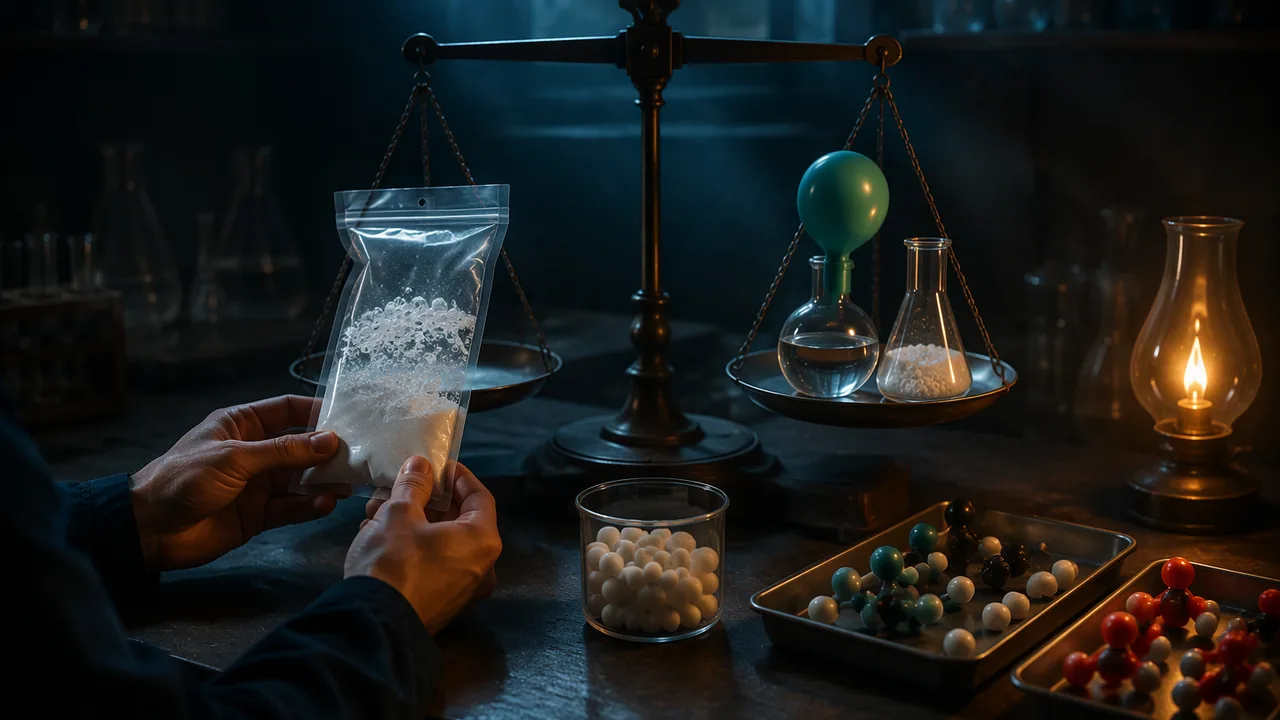
use the mole, molar masses and the mole ratios in a balanced equation to predict the mass of a product, and show that the calculation conserves mass.
Instruction
The counting problem. A balanced equation counts particles: 4 Fe atoms react with 3 O2 molecules. But you cannot count atoms on a balance; one atom of iron has a mass of about 9.3 × 10⁻²³ g. Chemists solve this the way a bank counts coins: by weighing a standard-sized group.
The mole. One mole is 6.022 × 10²³ particles (Avogadro’s number). The number is chosen so that one mole of an element has a mass in grams equal to its atomic mass in u. One mole of carbon atoms is 12.011 g; one mole of iron atoms is 55.845 g. That link, the molar mass, lets you convert between grams, which you can measure, and particles, which the equation counts.
Molar mass of a compound. Add the atomic masses of every atom in the formula. Water, H2O: 2(1.008) + 15.999 = 18.015 g/mol. Carbon dioxide: 12.011 + 2(15.999) = 44.009 g/mol. Iron(III) oxide, Fe2O3: 2(55.845) + 3(15.999) = 159.687 g/mol. So 18.0 g of water is almost exactly one mole, 6.02 × 10²³ molecules.
The three-step path. Every mass-to-mass prediction follows the same route: grams of A → moles of A → moles of B (mole ratio from the equation) → grams of B.
Worked example 1: the sealed bag. NaHCO3 + CH3COOH → NaCH3COO + H2O + CO2. Baking soda’s molar mass: 22.990 + 1.008 + 12.011 + 3(15.999) = 84.006 g/mol. Moles in 2.0 g: 2.0 ÷ 84.006 = 0.0238 mol. The ratio of CO2 to NaHCO3 is 1 : 1, so 0.0238 mol CO2. Mass: 0.0238 × 44.009 = 1.05 g. That is the maximum the open cup could lose, the figure you compared with in the lab.
Is there enough vinegar? 30 mL of 5% vinegar contains about 1.5 g of acetic acid (60.052 g/mol), or 0.025 mol, just more than the 0.0238 mol needed. The baking soda runs out first; it is the limiting reactant, and a little vinegar is left over. The reactant that runs out sets the amount of product. With only 20 mL of vinegar (about 0.017 mol of acid), the vinegar would be limiting instead, and some baking soda would be left undissolved in the bag.
Worked example 2: rust. How much rust forms from 1.00 kg (1,000 g) of iron? 4Fe + 3O2 → 2Fe2O3. Moles of Fe: 1,000 ÷ 55.845 = 17.91 mol. Ratio Fe2O3 : Fe = 2 : 4 = 1 : 2, so 8.953 mol Fe2O3. Mass: 8.953 × 159.687 = 1,430 g. The rust weighs 1.43 kg. Where did the extra 430 g come from? Oxygen used: 17.91 × 3/4 = 13.43 mol O2 × 32.00 g/mol = 430 g. Iron 1,000 g + oxygen 430 g = rust 1,430 g. The mathematics conserves mass exactly, which is what 9-12.PS1.B.3 asks you to show.
Why engineers care. Rust takes up more space than the iron it replaces, and it flakes. Where steel plates meet, rust can swell and pry them apart. That is one reason bridge crews attack every rust spot early, and why the Eads Bridge rehabilitation had to replace corroded struts and bracing rather than just paint over them.
📖 Read for this lesson
The reading opens over the lesson; close it to come back to exactly where you were. The checks below draw on it.
Formative check
Work through these before moving on. They are not graded — they tell you whether the standard below has landed yet.
Simulation & tools
Limiting reactants with sandwiches and molecules
Open the Molecules screen and choose “Make Water” (2H2 + O2 → 2H2O). (1) Set 4 H2 and 3 O2. Predict how many H2O form and what is left over, then check. (2) Set 6 H2 and 2 O2; predict, then check. (3) Name the limiting reactant in each case and explain how the coefficients let you predict it. (4) Count the atoms before and after in case 1 to show none were lost. No device? Draw the particles for both cases on paper and answer the same questions.
Open in a new tab ↗ · PhET Interactive Simulations, University of Colorado Boulder · CC BY 4.0
What is the molar mass of CaCO3 (Ca 40.078, C 12.011, O 15.999)?
In 2Mg + O2 → 2MgO, 0.50 mol of Mg produces mol of MgO and uses mol of O2.
If 1,000 g of iron rusts completely to 1,430 g of Fe2O3, 430 g of oxygen must have been taken from the surroundings.
How confident are you that you can use molar masses and mole ratios to predict product masses and show that mass is conserved?
Practice
Work these on paper or in your notebook, then open Check your answer. Aim for all of Fluency and Application; try at least one Challenge.
Printable version: this unit’s practice workbook (PDF)
Fluency
Build speed and accuracy with the core skill.
- What is the mass of 2.0 mol of CaCO3?
Check your answer
Answer: 200.2 gMultiply by the molar mass, 100.09 g/mol. - How many moles are in 10.0 g of H2SO4?
Check your answer
Answer: 0.102 molDivide by the molar mass, 98.07 g/mol. - How many molecules (or formula units) are in 2.5 mol of MgO? (Avogadro’s number = 6.022 × 10²³)
Check your answer
Answer: 15.055 × 10²³Multiply moles by Avogadro’s number. - Find the molar mass of CH4.
Check your answer
Answer: 16.04 g/molAdd the atomic masses of every atom in the formula (C 12.011, H 1.008). - For the balanced reaction 4Fe + 3O2 → 2Fe2O3, what mass of Fe2O3 forms from 50.0 g of Fe, assuming Fe is the limiting reactant?
Check your answer
Answer: 71.5 g of Fe2O3grams Fe → moles (0.895 mol) → mole ratio 2:4 → moles Fe2O3 (0.448 mol) → grams. - For the balanced reaction 4Fe + 3O2 → 2Fe2O3, what mass of Fe2O3 forms from 25.0 g of Fe, assuming Fe is the limiting reactant?
Check your answer
Answer: 35.7 g of Fe2O3grams Fe → moles (0.448 mol) → mole ratio 2:4 → moles Fe2O3 (0.224 mol) → grams.
Application
Use the skill in context. Show your reasoning.
- How much CO2 can 3.0 g of baking soda (NaHCO3, 84.006 g/mol) produce with excess vinegar? (CO2 44.009 g/mol)
Check your answer
Answer: 1.57 g3.0 / 84.006 = 0.0357 mol; ratio 1 : 1; 0.0357 × 44.009 = 1.57 g. - A 5.00 g steel wool pad (treat as pure iron) rusts completely to Fe2O3. Find the mass of rust and the mass of oxygen taken from the air.
Check your answer
Answer: 7.15 g of Fe2O3; 2.15 g of oxygen5.00 / 55.845 = 0.0895 mol Fe; ÷ 2 = 0.0448 mol Fe2O3; × 159.687 = 7.15 g. Oxygen = 7.15 − 5.00 = 2.15 g. - Propane burns: C3H8 + 5O2 → 3CO2 + 4H2O. For 88.2 g of propane (44.097 g/mol), find the masses of O2 used and of CO2 and H2O produced, and show that mass is conserved. (O2 31.998, CO2 44.009, H2O 18.015 g/mol)
Check your answer
Answer: O2 320.0 g; CO2 264.1 g; H2O 144.1 g. Reactants 88.2 + 320.0 = 408.2 g; products 264.1 + 144.1 = 408.2 g.88.2 / 44.097 = 2.000 mol. O2: 10.00 mol × 31.998. CO2: 6.000 mol × 44.009. H2O: 8.000 mol × 18.015.
Challenge
Stretch problems. Expect to think before you write.
- A group puts 2.0 g of baking soda (0.0238 mol) with only 10 mL of 5% vinegar (about 0.50 g of acetic acid, 60.052 g/mol) in a sealed bag. Which reactant is limiting, and what mass of CO2 forms?
Check your answer
Answer: Vinegar (acetic acid) is limiting; about 0.37 g of CO2.0.50 / 60.052 = 0.00833 mol acid, less than 0.0238 mol NaHCO3, and the ratio is 1 : 1. CO2: 0.00833 × 44.009 = 0.37 g.
Review
Keep earlier skills sharp.
- What is the mass of 5.0 cm3 of granite (density 2.75 g/cm3)?
Check your answer
Answer: 13.8 gMass = density × volume. - Explain why water boils at a much higher temperature than methane even though both are small molecules.
Check your answer
Answer: Water molecules form hydrogen bonds with each other; methane has only weak dispersion forces.
NIST Atomic Weights and Three More Worked Mole Problems
NIST Physical Measurement Laboratory, Atomic Weights and Isotopic Compositions (standard atomic weights; conventional values used where NIST gives an interval), retrieved 2026-11-05; SLS worked problems · Public domain (NIST data), with SLS worked examples
Why this reading. The lesson’s worked examples use molar masses without showing the atomic-weight table behind them. This reading gives that table for every element the course uses, plus three more fully worked three-step (grams → moles → moles → grams) problems, so you can check your own work on a new example before the performance task.
Standard atomic weights used in this course (NIST)
For elements whose atomic weight varies slightly in nature (H, Li, C, N, O, Mg, S, Cl), NIST gives a small interval; the table uses the conventional value inside that interval.
| Element | Symbol | Atomic weight (g/mol) | Element | Symbol | Atomic weight (g/mol) |
|---|---|---|---|---|---|
| Hydrogen | H | 1.008 | Sodium | Na | 22.990 |
| Carbon | C | 12.011 | Magnesium | Mg | 24.305 |
| Nitrogen | N | 14.007 | Aluminum | Al | 26.982 |
| Oxygen | O | 15.999 | Sulfur | S | 32.06 |
| Fluorine | F | 18.998 | Chlorine | Cl | 35.45 |
| Calcium | Ca | 40.078 | Iron | Fe | 55.845 |
| Zinc | Zn | 65.38 | Copper | Cu | 63.546 |
| Silver | Ag | 107.87 | Gold | Au | 196.97 |
| Lithium | Li | 6.94 | Potassium | K | 39.098 |
Worked example 1: making table salt from sodium and chlorine
2Na + Cl2 → 2NaCl. How much sodium chloride forms from 5.00 g of sodium? Moles of Na: 5.00 ÷ 22.990 = 0.2175 mol. Mole ratio NaCl : Na = 2 : 2 = 1 : 1, so 0.2175 mol NaCl. Molar mass of NaCl: 22.990 + 35.45 = 58.44 g/mol. Mass: 0.2175 × 58.44 = 12.71 g. Check by conservation: chlorine used = 0.2175 ÷ 2 = 0.1087 mol Cl2 × 70.90 g/mol = 7.71 g; 5.00 g Na + 7.71 g Cl2 = 12.71 g NaCl. Matches.
Worked example 2: burning magnesium (the Unit 1 reactivity metal)
2Mg + O2 → 2MgO. How much magnesium oxide forms from 3.00 g of magnesium ribbon? Moles of Mg: 3.00 ÷ 24.305 = 0.1234 mol. Ratio MgO : Mg = 1 : 1, so 0.1234 mol MgO. Molar mass of MgO: 24.305 + 15.999 = 40.304 g/mol. Mass: 0.1234 × 40.304 = 4.97 g. Oxygen taken from the air: 4.97 − 3.00 = 1.97 g, which should equal 0.1234 ÷ 2 × 32.00 = 1.97 g of O2. Matches.
Worked example 3: a second rust calculation, at a different scale
4Fe + 3O2 → 2Fe2O3. How much rust forms from a 500 g steel plate (treat it as pure iron)? Moles of Fe: 500 ÷ 55.845 = 8.954 mol. Ratio Fe2O3 : Fe = 2 : 4 = 1 : 2, so 4.477 mol Fe2O3. Molar mass of Fe2O3: 2(55.845) + 3(15.999) = 159.687 g/mol. Mass: 4.477 × 159.687 = 714.9 g. Oxygen used: 714.9 − 500 = 214.9 g, which should equal 8.954 × 3/4 × 32.00 = 214.9 g of O2. Matches, and it is exactly half the lesson’s 1.00 kg example (1,430 g of rust), because every quantity in the three-step path scales together.
A reminder on limiting reactants
Every example above assumed the second reactant (Cl2, O2) was plentiful, so the metal ran out first. Check that whenever real amounts of both reactants are given, the way the lesson checks that vinegar is in excess in the sealed bag: compute moles of each reactant, divide each by its coefficient in the balanced equation, and the smaller result identifies the limiting reactant.
Sources: NIST Physical Measurement Laboratory, Atomic Weights and Isotopic Compositions (standard atomic weights) (physics.nist.gov)