identify evidence of a chemical reaction, write and balance simple chemical equations by counting atoms, and explain the outcome of a reaction such as rusting from the outer electrons of the atoms involved.
Instruction
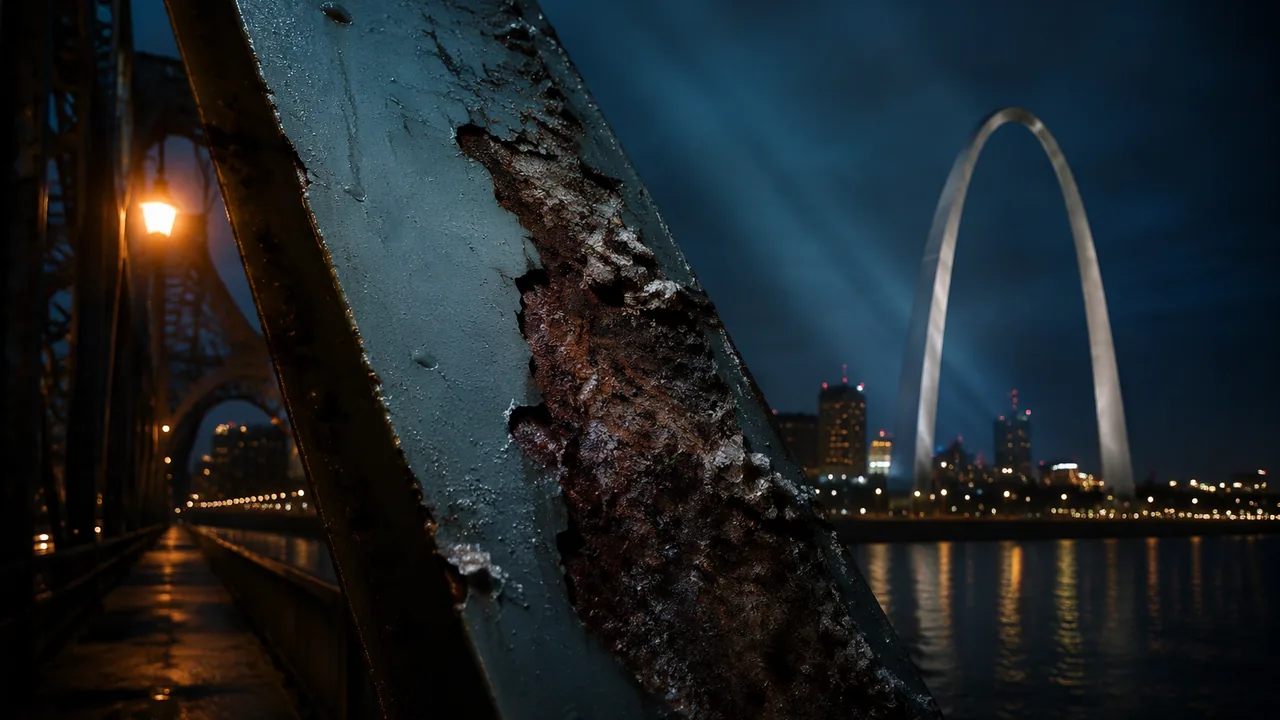
The phenomenon. The Eads Bridge crosses the Mississippi River at St. Louis, just north of the Gateway Arch. When it opened in 1874 it was the first major structure built with structural alloy steel. A century and a half of weather took its toll: from 2012 to 2016, Metro (the Bi-State Development Agency) spent $48 million to strip all the old paint and corrosion from the bridge, replace 1.2 million pounds of struts and bracing, and recoat the steel with a rust-inhibiting paint so the bridge can stay in service to at least 2091. Paint on a bridge is not decoration first; it is armor. Now look a few hundred meters south: the Gateway Arch’s outer skin is 886 tons of Type 304 stainless steel, unpainted since it was finished in 1965, and it is still silver. Missouri has no salty ocean fog, but it has salt of its own: MoDOT spreads about 123,000 tons of road salt in an average winter, and salty slush splashes onto bridge steel. What is rust, where does it come from, why does salt make it worse, and why does one kind of steel rust while the other does not? Those questions run through this unit.
Physical or chemical change? In a physical change, the substance stays the same substance: ice melting is still water. In a chemical change, atoms rearrange into new substances with new properties. Evidence of a chemical change includes a new color, a gas produced where no gas was before, a solid (precipitate) forming from two liquids, a temperature change or light, and properties that differ from the starting materials. Rust is reddish-brown and crumbly, where iron was gray, strong and magnetic. That is a new substance.
Explaining the outcome with electrons (9-12.PS1.A.2). Iron is a metal; it gives up outer electrons fairly easily. Oxygen is a nonmetal near the top right of the periodic table; it pulls strongly on electrons (electronegativity 3.44). When they meet, iron atoms lose electrons to become Fe3+ ions and oxygen atoms gain electrons to become O2− ions. Using the charge rule from Unit 1, two Fe3+ (+6) balance three O2− (−6), so the product is Fe2O3, iron(III) oxide. Real rust also holds water in its structure, but Fe2O3 is the core. Gold does not do this because its electrons are held far more tightly. Water and dissolved salt speed up rusting by letting ions move between the places where iron loses electrons and the places where oxygen gains them; that is why road salt, like sea spray, makes steel corrode faster. (The Arch’s stainless steel resists because its chromium forms a thin protective oxide film; you will compare strategies like that in Lesson 3.5.)
Writing equations. A chemical equation lists reactants on the left and products on the right: Fe + O2 → Fe2O3. As written, it breaks the rule you will test in the next lab: atoms are neither created nor destroyed. Count them. Left: 1 Fe, 2 O. Right: 2 Fe, 3 O. It is unbalanced.
Balancing by counting atoms. Change only the coefficients (the numbers in front); never change a formula, because that would change the substance. Worked example: magnesium burning, Mg + O2 → MgO. Oxygen: 2 on the left, 1 on the right, so write 2MgO. Now magnesium: 1 on the left, 2 on the right, so write 2Mg. Result: 2Mg + O2 → 2MgO. Check: 2 Mg and 2 O on each side.
Rust takes one more step. Fe + O2 → Fe2O3. Oxygen is 2 on the left and 3 on the right; the smallest number both divide into is 6, so write 3O2 and 2Fe2O3. That makes 4 Fe on the right, so write 4Fe. Result: 4Fe + 3O2 → 2Fe2O3. Check: Fe 4 = 4; O 6 = 6.
What the balanced equation means. Read it as a recipe in particles: 4 iron atoms react with 3 oxygen molecules to make 2 formula units of iron(III) oxide. Because the same atoms are on both sides, the total mass cannot change. That predicts something surprising: rusted iron should weigh more than the iron did, because it has picked up oxygen atoms from the air. You will test that logic with a reaction that produces a gas, where the mass seems to disappear.
📖 Read for this lesson
The reading opens over the lesson; close it to come back to exactly where you were. The checks below draw on it.
Formative check
Work through these before moving on. They are not graded — they tell you whether the standard below has landed yet.
A 10.0 g iron nail rusts completely in a sealed jar. The rust will weigh
Why does iron combine with oxygen to form Fe2O3?
Balance: H2 + O2 → H2O
Simulation & tools
Balance by counting atoms
Open the Introduction screen. (1) Balance “Make Ammonia” (N2 + H2 → NH3) and record the coefficients. (2) Balance “Separate Water” and record them. (3) On the Game screen, play Level 1 and record two equations you balanced. For each, write the atom count for every element on both sides. (4) Explain in one sentence why you may change coefficients but never subscripts. No device? Balance N2 + H2 → NH3, H2O → H2 + O2 and Al + O2 → Al2O3 on paper with atom counts.
Open in a new tab ↗ · PhET Interactive Simulations, University of Colorado Boulder · CC BY 4.0
How confident are you that you can identify chemical changes, balance equations, and explain a reaction’s product from outer electrons?
Practice
Work these on paper or in your notebook, then open Check your answer. Aim for all of Fluency and Application; try at least one Challenge.
Printable version: this unit’s practice workbook (PDF)
Fluency
Build speed and accuracy with the core skill.
- Balance: Al + O2 → Al2O3
Check your answer
Answer: 4Al + 3O2 → 2Al2O3O: 2 and 3 → 6 (3O2, 2Al2O3); then Al: 4. - Balance: Na + Cl2 → NaCl
Check your answer
Answer: 2Na + Cl2 → 2NaCl - Balance: CH4 + O2 → CO2 + H2O
Check your answer
Answer: CH4 + 2O2 → CO2 + 2H2OBalance C, then H (2H2O), then O: 2 + 2 = 4, so 2O2. - Balance: N2 + H2 → NH3
Check your answer
Answer: N2 + 3H2 → 2NH3 - Count the atoms of each element on both sides of 2H2O2 → 2H2O + O2. Is it balanced?
Check your answer
Answer: Left: 4 H, 4 O. Right: 4 H, 2 + 2 = 4 O. Balanced. - Which of these is evidence of a chemical change: ice melting, sugar dissolving, a nail rusting, a gas forming when vinegar meets baking soda, water boiling?
Check your answer
Answer: The nail rusting and the gas forming.The others change state or mix but make no new substance.
Application
Use the skill in context. Show your reasoning.
- Backyard grills burn propane: C3H8 + O2 → CO2 + H2O. Balance the equation and give the atom count for each side.
Check your answer
Answer: C3H8 + 5O2 → 3CO2 + 4H2O; each side has 3 C, 8 H and 10 O.C: 3CO2. H: 4H2O. O on the right: 6 + 4 = 10, so 5O2. - Use outer electrons to explain why sodium and chlorine form NaCl and why the equation needs 2Na for each Cl2.
Check your answer
Answer: Na loses its single valence electron (Na+); each Cl atom gains one (Cl−), so they combine 1 : 1. Chlorine exists as Cl2 molecules, which supply two Cl atoms, so two Na atoms are needed. - Explain why a steel guardrail on a Missouri highway overpass, splashed with salty slush every winter, rusts faster than an identical railing on a sheltered porch that never touches road salt.
Check your answer
Answer: Rusting needs oxygen and water, and dissolved salt ions let charge move between the areas where iron loses electrons and where oxygen gains them. Salty slush supplies both water and dissolved salt, so the reaction is faster.
Challenge
Stretch problems. Expect to think before you write.
- Rust often forms as iron(III) hydroxide. Balance: Fe + H2O + O2 → Fe(OH)3
Check your answer
Answer: 4Fe + 6H2O + 3O2 → 4Fe(OH)3Check: Fe 4 = 4; H 12 = 4 × 3; O 6 + 6 = 12 = 4 × 3.
Review
Keep earlier skills sharp.
- Convert 37 mL to L.
Check your answer
Answer: 0.0370 L - Electronegativities: O 3.44, H 2.20. Classify the O–H bond.
Check your answer
Answer: Polar covalent (difference 1.24) - Predict the formula of the compound of calcium and chlorine.
Check your answer
Answer: CaCl2Ca2+ needs two Cl−.
Two Steels in St. Louis: The Eads Bridge, the Gateway Arch and Missouri’s Road Salt
NPS Gateway Arch Fact Sheet and architecture page; Eads Bridge rehabilitation facts (Metro, as summarized in the Eads Bridge reference article); MoDOT Winter Operations fact sheet; KY3 News (2023); FHWA-HRT-11-060; American Galvanizers Association table of ISO 9223 categories; all retrieved 2026-11-05; SLS commentary and atom-count check · Public domain (U.S. federal and Missouri public-agency facts) and cited reference values, with SLS commentary
Why this reading. The lesson’s phenomenon is two kinds of steel standing side by side on the St. Louis riverfront: a bridge whose steel had to be stripped of rust and repainted, and an arch whose stainless skin has stayed silver. This reading puts real numbers behind both, and behind the salt Missouri spreads every winter, so your question board asks about real structures and a real measure of how much salt speeds corrosion.
The Eads Bridge: steel that needed rescuing
The Eads Bridge opened across the Mississippi at St. Louis in 1874. It was the first use of structural alloy steel in a major construction, and its longest arch spans 520 ft. Today it carries Metro’s MetroLink light-rail trains and a road deck. From 2012 to 2016, Metro (the Bi-State Development Agency) carried out the Eads Bridge Rehabilitation project to keep the bridge in service to at least 2091. The work included replacing 1.2 million pounds of struts, bracing and other support steel, removing all paint and corrosion from the superstructure, and repainting it with a rust-inhibiting coating. The total cost was $48 million.
That project is direct evidence for the lesson’s central claim: paint is armor, and the reaction underneath it never stops. Where the coating failed, Fe atoms kept losing electrons to oxygen, and some steel members had to be cut out and replaced rather than painted.
The Gateway Arch: steel that stays silver
The National Park Service’s fact sheet lists the Arch’s exterior skin as 886 tons (804 metric tons) of stainless-steel plate, 1/4 inch (6.3 mm) thick, Type 304 with a #3 finish. Beneath it is a 3/8 inch carbon-steel inner skin weighing 2,157 tons. The Arch was built between February 29, 1964 and October 28, 1965, and the stainless skin has never been painted. Stainless steel is not perfect, though: in 2015 an NPS-led corrosion investigation studied visible stains and deposits on the skin, noting that the Arch was built with no way to reach the outer steel for maintenance. Type 304 stainless contains about 18% chromium; the chromium forms a very thin, tightly attached oxide film that protects the iron beneath.
Missouri’s salt
Missouri has no salty sea fog, but its winter roads carry plenty of salt. MoDOT’s winter-operations fact sheet reports that the department treats more than 34,000 miles of roadway and uses about 123,000 tons of salt in an average winter (about 3.6 tons for every mile of road it maintains), plus brine, calcium and magnesium chloride and beet juice. A mild winter uses less: in the 2022–23 season MoDOT used 63,000 tons of salt, about 51% of the average. The Federal Highway Administration notes that cracks in bridge decks give deicing salts a path to the reinforcing steel, and that chloride near cracks can pass the threshold for corroding ordinary reinforcing steel within the first year. Nationally, FHWA puts the direct cost of corrosion to highway bridges at about $8.3 billion a year, with indirect costs to drivers (delays, lost time) about ten times that.
How much faster does salt make metal corrode?
Corrosion engineers rate outdoor environments with the ISO 9223 scale, based on how much metal a standard sample loses in its first year. The American Galvanizers Association publishes the scale with first-year corrosion rates for zinc (the galvanizing metal). Plain carbon steel corrodes much faster than zinc in every category, but the categories rank environments the same way for both metals.
| ISO 9223 category | Typical outdoor environment (summarized) | First-year zinc corrosion rate (µm/year) |
|---|---|---|
| C1, very low | Dry or cold zone, very low pollution and wetness (some deserts, polar regions) | < 0.1 |
| C2, low | Temperate rural area, minimal pollution, short time of wetness | 0.1 – 0.7 |
| C3, medium | Urban area with medium pollution or some effect of chlorides (salt) | 0.7 – 2.1 |
| C4, high | Industrial pollution or substantial chloride (salt) effect | 2.1 – 4.2 |
| C5, very high | Very high industrial pollution or significant chloride deposits | 4.2 – 8.4 |
| CX, extreme | Extreme pollution or extended chloride deposits, splash zone of salt water | 8.4 – 25 |
Notice what moves an environment up the scale: wetness, pollution and, above all, chlorides, the same chloride ions that road salt (sodium chloride) and calcium chloride put into the slush on a bridge. The top of category C4 (4.2 µm/year) is six times the top of category C2 (0.7 µm/year). That is the quantitative version of “salt makes rust worse.”
Checking the lesson’s prediction with these numbers
The lesson’s opening question asks about a 10.0 g iron nail rusting completely in a sealed jar. These rates describe thickness lost from a surface each year, not how fast a whole object converts, so use them to reason about rate, not completion: the same steel corrodes several times faster where salt reaches it than where it stays dry and clean. That is why a salted highway bridge needs more maintenance than a sheltered steel shed.
The chemistry behind the numbers
Every bit of metal lost is the reaction from the lesson: 4Fe + 3O2 → 2Fe2O3 (atom check: Fe 4 = 4, O 6 = 6), with iron losing electrons to become Fe3+ and oxygen gaining them to become O2−. Salt does not appear in the equation. Dissolved Na+, Ca2+ and Cl− ions make the thin water film on the metal conduct far better, so charge moves more easily between the places where iron gives up electrons and where oxygen accepts them.
Using this record
Cite the Eads Bridge rehabilitation ($48 million; 1.2 million pounds of steel replaced) as evidence that corrosion is continuous and costly. Cite the Arch’s 886 tons of unpainted Type 304 stainless as the contrasting case. Cite MoDOT’s 123,000 tons of salt and the ISO 9223 table when you argue that salt, not just age, explains a bridge’s maintenance need, and name the mechanism (dissolved ions speeding electron transfer) whenever you use these numbers as evidence.
Sources: Eads Bridge (opened 1874; 2012-2016 Metro rehabilitation, $48 million, 1.2 million pounds of steel replaced, paint and corrosion removed, service to at least 2091), summarizing Metro and press sources (en.wikipedia.org); National Park Service, Gateway Arch Fact Sheet (stainless-steel skin 886 tons, Type 304, #3 finish, 1/4 in plate) (nps.gov); National Park Service, Gateway Arch Architecture (construction February 29, 1964 – October 28, 1965; type/grade 304 stainless panels) (nps.gov); National Park Service, Investigating the Visible Stains on the Stainless Steel Skin of the Gateway Arch (2015 symposium; Arch built without access for maintenance of the skin) (nps.gov); Missouri Department of Transportation, MoDOT Winter Operations fact sheet (about 123,000 tons of salt in an average winter; more than 34,000 miles of roadway) (modot.org); KY3 News (Springfield, Mo.), ‘MoDOT workers prepare for winter weather season in the Ozarks’, Oct. 19, 2023 (63,000 tons of salt used in the 2022-23 season) (ky3.com); Federal Highway Administration, Multiple Corrosion-Protection Systems for Reinforced Concrete Bridge Components (FHWA-HRT-11-060), Chapter 1: $8.3 billion direct annual cost of bridge corrosion; deicing salts reaching reinforcing steel (fhwa.dot.gov); American Galvanizers Association, HDG Corrosion Rates for ISO Categories C1-C5/X (ISO 9223 first-year zinc corrosion rates; 100 micrometer typical minimum coating; Time-to-First-Maintenance city data) (galvanizeit.org)