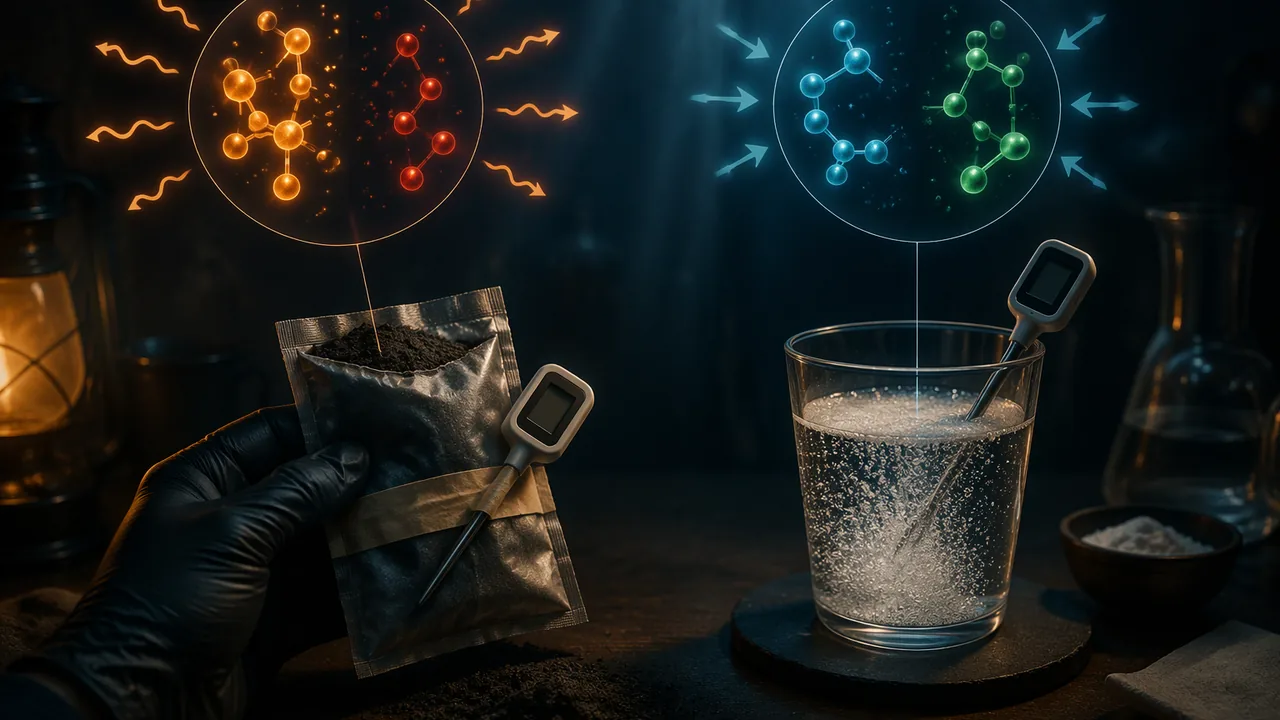
measure the temperature change of an exothermic and an endothermic reaction and use a bond-energy model to argue where the energy released or absorbed comes from.
Instruction
Rust that you can feel. A disposable hand warmer, the kind Missouri deer hunters and fans at a December football game stuff in their gloves, contains iron powder, salt, water held in a fiber and activated carbon. Open the packet and air gets in: the iron rusts, fast, and the packet heats up for hours. It is the same reaction that ate the Eads Bridge’s steel, sped up by fine powder and salt water. Meanwhile, baking soda and vinegar, from the last lab, get colder as they react. Today you measure both and argue where the energy goes.
Quick measurement at home. You need a kitchen or digital probe thermometer, white vinegar, baking soda and one air-activated hand warmer (sold at pharmacies and sporting-goods stores). Wear safety glasses, work with a parent or guardian nearby, taste nothing, and do not cut the hand warmer open. Put the thermometer in 30 mL (2 tablespoons) of vinegar in a cup and record the temperature; add 2.0 g of baking soda, stir, and record the lowest temperature. Typical runs show a drop of a few degrees. Then open the outer wrapper of a hand warmer, tape the thermometer tip to the packet and record the temperature every minute for 5 minutes; it typically rises well above body temperature. No thermometer or hand warmer? Use the four recorded runs in this lesson’s reading as your data. A reaction that releases energy to the surroundings is exothermic; one that absorbs energy from the surroundings is endothermic.
The bond-energy model. Every reaction breaks some bonds and forms others. Breaking a bond always takes energy, because you are pulling apart attracted particles. Forming a bond always releases energy. The bond energy is the energy needed to break one mole of a given bond (kJ/mol). The energy change of the reaction is
energy change = (energy to break reactant bonds) − (energy released forming product bonds)
A negative result means more energy is released than absorbed: exothermic. A positive result means endothermic.
Worked example: hydrogen burning. 2H2 + O2 → 2H2O. Approximate average bond energies from standard tables (values differ slightly between sources; these are from OpenStax Chemistry 2e, Table 7.2): H–H 436, O=O 498, O–H 464 kJ/mol. Broken: 2 H–H + 1 O=O = 2(436) + 498 = 1,370 kJ. Formed: each water has 2 O–H, so 4 O–H = 4(464) = 1,856 kJ. Change = 1,370 − 1,856 = −486 kJ. Exothermic, and close to the measured value of about −484 kJ for forming water vapor. The model works because the O–H bonds in the products are stronger, in total, than the bonds in the reactants.
Worked example: methane (natural gas) burning. CH4 + 2O2 → CO2 + 2H2O, with C–H 413 and C=O 799 (the value for the C=O bonds in CO2, from a LibreTexts bond-energy table). Broken: 4(413) + 2(498) = 2,648 kJ. Formed: 2(799) + 4(464) = 3,454 kJ. Change = −806 kJ, near the measured −802 kJ.
The misconception to argue against. Many people, and some textbooks for younger students, say “energy is stored in bonds and released when bonds break.” The model says the opposite: breaking bonds absorbs energy. Fuels release energy because the bonds in the products (CO2 and H2O) are stronger than the bonds in the fuel and oxygen. The energy is a property of the whole system’s change, not of one bond snapping.
Your argument. Explain the hand warmer and the cold baking-soda reaction with the model, using your temperature data as evidence. The iron-oxygen reaction releases about 824 kJ per mole of Fe2O3 formed (a measured value), so the Fe–O attractions in rust are much stronger than the bonds broken in iron metal and O2. RST.9-10.8 asks you to judge whether a text’s evidence supports its claim: evaluate the “energy stored in bonds” statement against the model and the data.
📖 Read for this lesson
The reading opens over the lesson; close it to come back to exactly where you were. The checks below draw on it.
Formative check
Work through these before moving on. They are not graded — they tell you whether the standard below has landed yet.
Which statement fits the bond-energy model?
For H2 + Cl2 → 2HCl with H–H 436, Cl–Cl 243 and H–Cl 432 kJ/mol, the energy change is kJ, so the reaction is .
The statement ‘fuels release energy when their bonds break’ is supported by the bond-energy model.
Using your temperature data and the bond-energy model, write a 5-7 sentence argument explaining why the hand warmer heats up while baking soda and vinegar cool down. Include a rebuttal of the ‘energy stored in bonds’ idea.
How confident are you that you can use bond energies to model and argue whether a reaction releases or absorbs energy?
Practice
Work these on paper or in your notebook, then open Check your answer. Aim for all of Fluency and Application; try at least one Challenge.
Printable version: this unit’s practice workbook (PDF)
Fluency
Build speed and accuracy with the core skill.
- A reaction mixture’s temperature falls from 21.5 °C to 17.8 °C. Is the reaction exothermic or endothermic? By how much did the temperature change?
Check your answer
Answer: Endothermic; it fell by 3.7 °C. - Does breaking a bond absorb or release energy? Does forming one absorb or release?
Check your answer
Answer: Breaking absorbs; forming releases. - Using H–H 436, O=O 498 and O–H 464 kJ/mol, find the energy to break the bonds in 2H2 + O2.
Check your answer
Answer: 1,370 kJ2(436) + 498 = 1,370. - Using O–H 464 kJ/mol, find the energy released forming the bonds in 2H2O.
Check your answer
Answer: 1,856 kJ4 O–H bonds: 4(464) = 1,856. - A reaction’s bond calculation gives +120 kJ. Will the surroundings warm or cool?
Check your answer
Answer: Cool; a positive value means energy is absorbed (endothermic).
Application
Use the skill in context. Show your reasoning.
- Estimate the energy change for N2 + 3H2 → 2NH3 using N≡N 946, H–H 436 and N–H 390 kJ/mol. Is it exothermic or endothermic?
Check your answer
Answer: −86 kJ; exothermicBroken: 946 + 3(436) = 2,254. Formed: 6(390) = 2,340. 2,254 − 2,340 = −86 kJ. - Splitting water, 2H2O → 2H2 + O2, is the reverse of burning hydrogen. Use the bond energies above to find its energy change and explain why electrolysis of water needs a steady energy supply.
Check your answer
Answer: +486 kJ; it is endothermic, because the O–H bonds broken (1,856 kJ) are stronger in total than the H–H and O=O bonds formed (1,370 kJ). The energy must be supplied, for example by electricity.1,856 − 1,370 = +486 kJ. - A hand warmer’s temperature rose from 20 °C to 52 °C in 5 minutes. Write a claim, evidence and reasoning explaining the rise with the bond-energy model.
Check your answer
Answer: Claim: iron rusting is exothermic. Evidence: temperature rose 32 °C. Reasoning: the Fe–O attractions formed in iron oxide release more energy than is absorbed breaking the metallic bonds in iron and the O=O bonds, so the net energy flows to the surroundings.52 − 20 = 32 °C.
Challenge
Stretch problems. Expect to think before you write.
- Burning hydrogen releases about 486 kJ per 4.032 g of H2 (2 mol), and burning methane about 806 kJ per 16.04 g of CH4 (1 mol), by the bond-energy estimate. Compare the energy released per gram and suggest one reason hydrogen is attractive as a vehicle fuel and one engineering difficulty.
Check your answer
Answer: Hydrogen about 121 kJ/g; methane about 50 kJ/g, so hydrogen releases about 2.4 times as much per gram. Attractive: high energy per gram and water as the only combustion product. Difficulty: hydrogen gas takes up a lot of space, so it must be stored under high pressure or very cold.486 / 4.032 = 120.5 kJ/g; 806 / 16.04 = 50.2 kJ/g; 120.5 / 50.2 = 2.4.
Review
Keep earlier skills sharp.
- Convert 25 m/s to km/h.
Check your answer
Answer: 90.00 km/h - Balance: 2Mg + O2 → ___MgO
Check your answer
Answer: 2
Bond Energies and Recorded Temperature Runs: Hand Warmer and Cold Reaction
Average bond energies from OpenStax Chemistry 2e Table 7.2 (CC BY 4.0), with C-H and C=O (in CO2) from a LibreTexts bond-energy table; enthalpies of formation from OpenStax Chemistry 2e Appendix G; all retrieved 2026-11-05. Temperature-vs-time data are SLS original recorded data (illustrative, four runs) · SLS original (prose and constructed teaching data, labeled illustrative); bond energies and enthalpies of formation are published reference values, cited by link
Why this reading. The lesson’s two worked examples use a handful of bond energies. This reading gives a fuller table, a third worked reaction to practice on, and four recorded temperature runs for the hand warmer and the cold reaction, so you have full data even if you have no thermometer or hand warmer at home.
Average bond energies (kJ/mol)
These are averages: the true energy to break a specific bond varies a little with what else is attached to the atoms, which is why different reference books list slightly different values. Use them for estimates, not for claims precise to better than about 10–20 kJ/mol. Values are from OpenStax Chemistry 2e Table 7.2, except C–H and C=O in CO2, which are from a LibreTexts table (OpenStax lists 415 for C–H and an average 741 for all C=O bonds).
| Bond | Average energy (kJ/mol) | Bond | Average energy (kJ/mol) |
|---|---|---|---|
| H–H | 436 | C–H | 413 |
| O=O | 498 | C=O (in CO2) | 799 |
| O–H | 464 | C–C | 345 |
| N≡N | 946 | C=C | 611 |
| N–H | 390 | C–Cl | 330 |
| Cl–Cl | 243 | C–O (single) | 350 |
| H–Cl | 432 | S–H | 340 |
| H–Br | 370 |
A third worked example, for practice: propane burning
C3H8 + 5O2 → 3CO2 + 4H2O. Propane has 8 C–H bonds and 2 C–C bonds. Broken: 8(413) + 2(345) + 5(498) = 3,304 + 690 + 2,490 = 6,484 kJ. Formed: 3 CO2 with 2 C=O each, so 6(799) = 4,794 kJ, plus 4 H2O with 2 O–H each, so 8(464) = 3,712 kJ; total formed = 8,506 kJ. Energy change = 6,484 − 8,506 = −2,022 kJ per mole of propane: strongly exothermic, which is why propane fuels grills and patio heaters.
Checking the model against measured values
OpenStax Appendix G lists measured standard enthalpies of formation: H2O(g) −241.82, CO2(g) −393.51, CH4(g) −74.6 and Fe2O3(s) −824.2 kJ/mol. From these, forming 2 mol of water vapor releases 2 × 241.82 = 483.6 kJ (the bond-energy estimate was 486 kJ), and burning 1 mol of methane releases 393.51 + 483.64 − 74.6 = 802.5 kJ (estimate 806 kJ). Rusting iron to 1 mol of Fe2O3 releases 824.2 kJ, the energy a hand warmer delivers slowly.
Recorded temperature runs
Four runs, each measuring 30 mL of vinegar at room temperature (21.5 °C), stirring in 2.0 g of baking soda and recording the lowest temperature reached; then taping a kitchen probe thermometer to an opened iron-powder hand warmer and recording the temperature once a minute for six minutes. These data are SLS original and illustrative.
| Run | Vinegar + baking soda: lowest temp (°C) | Temperature change | Hand warmer, min 1 | min 2 | min 3 | min 4 | min 5 | min 6 |
|---|---|---|---|---|---|---|---|---|
| 1 | 16.5 | −5.0 | 29 | 36 | 41 | 44 | 46 | 47 |
| 2 | 17.0 | −4.5 | 28 | 35 | 40 | 43 | 45 | 46 |
| 3 | 16.0 | −5.5 | 30 | 37 | 42 | 45 | 47 | 48 |
| 4 | 17.5 | −4.0 | 29 | 34 | 39 | 42 | 44 | 45 |
| Average | 16.75 | −4.75 | 29 | 35.5 | 40.5 | 43.5 | 45.5 | 46.5 |
Both reactions are clear: the vinegar-and-baking-soda cup cools by about 4–5 °C (an endothermic reaction absorbing energy from the surrounding liquid), while the hand warmer climbs steadily past body temperature (37 °C) and is still rising slowly at minute six, as the iron powder keeps rusting.
Using this record
Report your own numbers if you ran the measurements, or these averages if you used the data route. State the direction of each temperature change as your evidence, then use the bond-energy model, not the thermometer alone, to explain why: the model tells you whether more energy was needed to break bonds or released forming them.
Sources: OpenStax, Chemistry 2e, Section 7.5, Table 7.2 Bond Energies (kJ/mol) (CC BY 4.0) (openstax.org); LibreTexts Chemistry, 1.06 Bond Energies (University of Alberta Augustana, General Chemistry II): C-H 413 kJ/mol and C=O in CO2 799 kJ/mol (chem.libretexts.org); OpenStax, Chemistry 2e, Appendix G Standard Thermodynamic Properties for Selected Substances (Fe2O3(s) -824.2, H2O(g) -241.82, CO2(g) -393.51, CH4(g) -74.6 kJ/mol) (CC BY 4.0) (openstax.org)