explain how a designed material’s molecular structure produces its useful properties, support the explanation with lab and published evidence, and evaluate it against an alternative with prioritized criteria.
Instruction
The context. Missouri makes hard choices about materials every day. MoDOT spreads about 123,000 tons of salt in an average winter and also uses calcium chloride, magnesium chloride and beet juice, because plain salt works less well as the temperature falls. Farmers weigh soil additives that hold water through a dry summer. Fire crews choose between gels, foams and chemical retardants to protect homes. Bridge engineers pick coatings that survive years of road salt. Each choice depends on what a material does, and what it does depends on its structure at the scale of molecules.
Your job. Choose one designed material from the list: rock salt or another de-icer on Missouri highways, superabsorbent polymer for soil, PTFE nonstick coating, silicon in a solar cell, an aramid fiber, or a fire-retardant gel. You may propose another material if you can find at least two published sources about its structure and use. Write a brief that does three things.
1. Explain the structure (9-12.PS1.A.4). Draw and label one model of the material’s particle structure: an ionic lattice, a network, or a polymer chain with its side groups and any cross-links. Use the three-step chain from Lesson 2.4: structure, then force, then property and use. Name the specific bonds or intermolecular forces involved and say why they are strong or weak.
2. Support it with evidence (9-12.PS1.A.3). Use at least one result from your mystery-solids lab to support a claim about how particle forces show up in bulk properties, for example what the salt and sugar conductivity results tell you about ions. Add at least two published sources, such as OpenStax Chemistry 2e or a U.S. government agency page, and compare what they report (RST.9-10.2 asks you to trace a text’s explanation accurately). Do not state a figure you cannot source; label estimates as illustrative.
3. Evaluate against an alternative (9-12.ETS1.B.1). Name one alternative material for the same job, for example mulch or compost instead of a superabsorbent polymer. Choose at least three criteria (such as effectiveness, cost, safety, durability, or environmental impact) and rank them by priority, explaining your ranking. Build a criteria table that scores both materials and states the trade-offs honestly: what you give up to get what you rank highest. A good evaluation says what evidence would change the recommendation.
Quality bar. Strong briefs never say a material works “because of its chemicals”; they name the particle, the force and the property. They also keep claims within the evidence. A polymer may hold hundreds of times its mass in pure water, but in salty soil water the ions reduce how much it absorbs, and a good brief notices that kind of condition.
Stages. Plan, draft, review the draft against the checklist (yourself after a day’s break, or with a family member reading along), revise, and record a four-minute presentation that ends by answering one defense question about your evidence.
📖 Read for this lesson
The reading opens over the lesson; close it to come back to exactly where you were. The checks below draw on it.
Formative check
Work through these before moving on. They are not graded — they tell you whether the standard below has landed yet.
Which explanation of PTFE’s nonstick surface follows the structure-force-function chain?
When two materials each win on different criteria, ranking the criteria by priority is what lets you make a defensible recommendation.
Draft your plan: name your material and its alternative, write your structure-force-function chain in three sentences, and list your three criteria in priority order with one reason for the top one.
How confident are you that you can explain a designed material’s function from its structure and evaluate it against an alternative with prioritized criteria?
Unit 2 checkpoint
Do this before you start the task. It covers the whole unit and tells you what to review first.
Electronegativities: Li 0.98, F 3.98. The bond in LiF is
Which property is the best evidence that a dissolved substance is ionic?
Wax melts in hot water but salt does not. This shows that
Water boils at 100 °C and H2S at −60.3 °C. The main reason is
Attractions caused by momentary shifts in electron clouds are called forces, and they are stronger for molecules.
Water and carbon dioxide both contain polar bonds, but only water is a polar molecule.
Graphite conducts electricity because
Melting sugar breaks the covalent bonds inside sugar molecules.
Which structural feature makes a superabsorbent polymer hold water?
A trial with only water, used as a baseline for the conductivity test, is called a .
Two soil additives each win on different criteria. What makes a recommendation defensible?
Magnesium oxide melts at a much higher temperature than sodium chloride partly because its ions carry larger charges.
Submit: Structure and Function Materials Brief (900-1,200 words) + four-minute presentation
Task: Explain how one designed material’s molecular-level structure gives it the property that makes it useful, support the explanation with your mystery-solids lab data and at least two cited published sources, and evaluate the material against one alternative with a prioritized criteria table. Include one labeled structural diagram.
Submission workflow
- Stage 1 — Plan. Name your material and alternative, sketch the structural model, and list your structure-force-function chain, evidence and sources.
- Stage 2 — Checklist-reviewed draft. After a day’s break, check your draft against the checklist (or have a family member read it with the checklist in hand): every property claim names a particle and a force, and each criterion score has a reason. Submit the completed checklist and your revision plan.
- Stage 3 — Final brief. 900-1,200 words with the diagram, the criteria table and cited sources.
- Stage 4 — Presentation and defense. Record a four-minute presentation (video, or audio with slides). End by answering one of these defense questions: Which result from your mystery-solids lab supports your structure claim most strongly, and how could that result mislead you? Which criterion’s weight, if changed, would flip your recommendation? What new measurement would most change your conclusion?
How it is scored
| Criterion | What proficient looks like |
|---|---|
| Structure and function (9-12.PS1.A.4) | Explains the property from a correct particle-level model, naming the bonds or intermolecular forces involved. |
| Evidence from properties (9-12.PS1.A.3) | Uses lab data accurately to connect bulk properties to particle forces. |
| Evaluation and trade-offs (9-12.ETS1.B.1) | Ranks at least three criteria with reasons, scores both materials and states trade-offs honestly. |
| Sources (RST.9-10.2, SEP.8) | Summarizes at least two sources accurately and compares them. |
| Communication (SEP.8) | Clear structure and diagram; the presentation answers a question with evidence. |
Materials Brief Source File: Six Designed Materials, Their Alternatives and a Worked Criteria Table
DOE Solar Energy Technologies Office; USDA Forest Service water-enhancer QPL (Dec. 5, 2024); MoDOT Winter Operations fact sheet and FHWA-RD-95-202 anti-icing manual and USGS Mineral Commodity Summaries 2026 (Salt), retrieved Nov. 5, 2026; Zhang et al., Polymers 2019 (CC BY 4.0); bond energies computed from NIST WebBook data; criteria-table scores are SLS illustrative judgments; other sources retrieved Sept. 23, 2026 · Public domain (U.S. government works) and CC BY 4.0 (Zhang et al.), with SLS original commentary
Why this reading. The brief needs at least two published sources on your material, a comparison of what they report, and a criteria table against an alternative. This file hosts a sourced fact card for each material on the lesson’s list, one for the common alternatives, and a worked criteria table so the format is not a mystery. Facts are attributed line by line; anything unsourced is marked as a judgment for you to make.
Card 1: superabsorbent polymer for soil
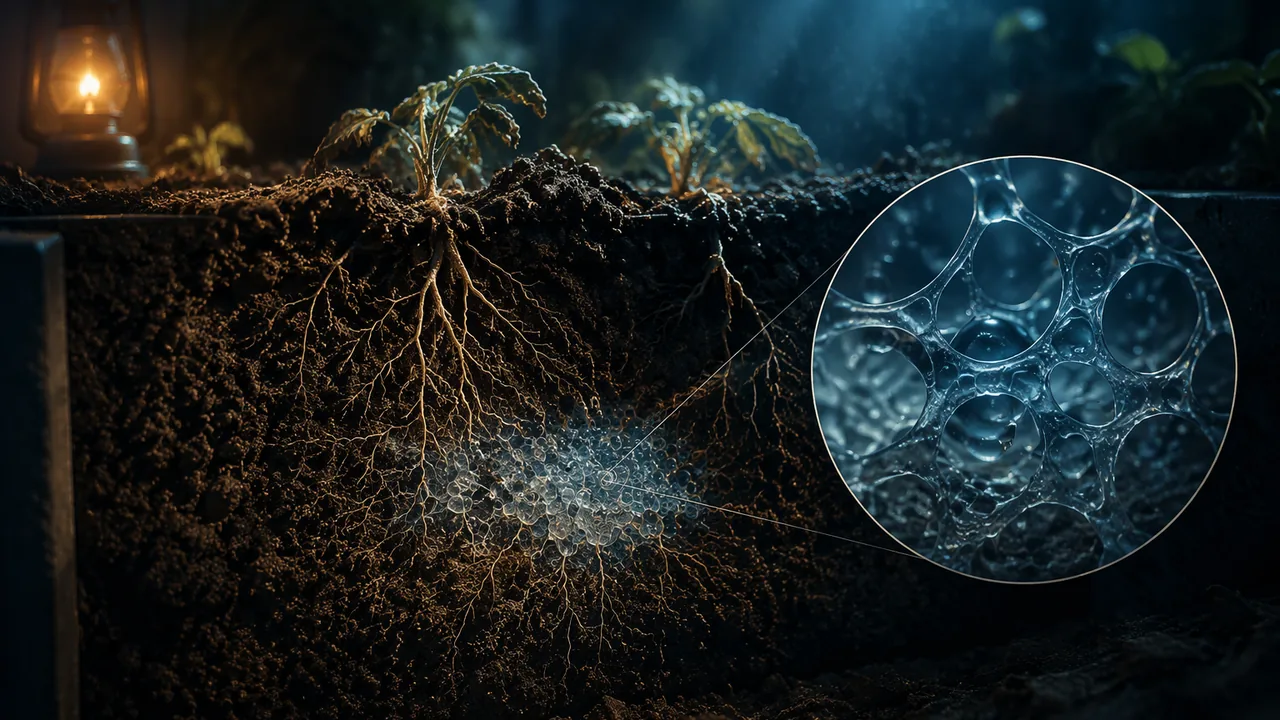
- Structure. Long polyacrylate chains carrying many ionic –COO− groups with Na+ counter-ions, lightly cross-linked into a network (Lesson 2.4).
- Measured performance. Zhang et al. (Polymers, 2019, open access): 738 g of deionized water per g of polymer, but 90 g/g in 0.9% NaCl solution. The authors attribute the drop to dissolved ions crowding the charged groups.
- What that means in a field. Irrigation and soil water carry dissolved salts, so field capacity sits far below the pure-water figure. A brief that quotes only the pure-water number is overstating.
- Alternative for the same job: compost or mulch, which hold water by capillary action in a porous mass rather than by ionic attraction. No hosted figure compares the two; if you claim one holds more, label it a judgment or an estimate.
Card 2: PTFE nonstick coating
- Structure. A carbon chain sheathed in fluorine atoms; C–F bond energy about 492 kJ/mol against 416 kJ/mol for C–H, both computed from NIST WebBook enthalpies (Lesson 2.4 reading).
- Force. Fluorine’s tightly held electrons (electronegativity 3.98) offer neighboring molecules very weak dispersion attraction, so little adheres.
- Alternative: a seasoned cast-iron or bare stainless-steel pan (metallic bonding, a surface oxide layer). Durability, cost and safety at high temperature are the criteria most briefs end up ranking; no hosted figures, so describe them as higher or lower.
Card 3: silicon in a solar cell
- Structure. A diamond-like covalent network of silicon atoms with trace added elements that let it conduct in a controlled way.
- Department of Energy figures. Monocrystalline silicon was 96% of global solar shipments in 2022; laboratory cells above 27% efficiency; industrial modules 20–22%; module life 25+ years with less than 1% output loss per year; silicon modules reached $1 per watt in 2012; silicon is the second most abundant element in the crust.
- Alternative: cadmium telluride thin-film modules, which DOE names as most of the remaining 4% of shipments. Criteria usually ranked: efficiency, lifetime, cost, and the toxicity and recycling of the materials.
Card 4: aramid fiber
- Structure. Rigid chains of ring-containing units linked by N–H and C=O groups; chains line up in parallel and hydrogen-bond to neighbors along their whole length (Lesson 2.4).
- Force. Covalent bonds along the chain carry the load; many hydrogen bonds between chains (at N–H groups, bond energy about 391 kJ/mol for the N–H bond itself) keep chains from sliding.
- Alternative: steel wire or plate for the same protective job. No hosted strength figures; if you cite a strength-to-weight ratio, find and cite a source, or describe it qualitatively.
Card 5: fire-retardant gel (water enhancer)
- What the Forest Service says. Water enhancers “alter the physical characteristics of water to increase effectiveness and adhesion to fuels. They are not retardants. They depend on the water they contain for their effectiveness.” Products on the December 2024 qualified list are mixed at 0.25% to 3.0% concentrate in water, and the list records for each product whether it may be applied from single-engine air tankers, helicopters or ground engines.
- Structure and force. A superabsorbent polymer network holding water; the gel clings to vertical and smooth surfaces where plain water runs off.
- Alternative: long-term fire retardant (the red material dropped from aircraft), which the Forest Service lists as a separate category that keeps working after its water evaporates; or plain water. Criteria: effectiveness after drying, cost, toxicity and corrosion (the Forest Service tests all three categories for corrosion and for aquatic and mammalian toxicity), and ease of application.
Card 6: salt as a road de-icer on Missouri highways
- Structure. The NaCl ionic lattice of Lesson 2.1; it works by dissolving into Na+ and Cl− ions that lower the temperature at which water can freeze.
- MoDOT figures (Winter Operations fact sheet). MoDOT uses 123,000 tons of salt in an average winter, can store over 250,000 tons, spends an average of $45 million a year on ice and snow, and covers more than 34,000 miles of roadway. It also uses calcium chloride, magnesium chloride, beet juice and abrasives, because these make treatment work at lower temperatures, and beet juice keeps salt from scattering and bouncing off the road.
- FHWA figures (anti-icing manual). Anti-icing brine should be as close to 23.3% sodium chloride as possible; at that strength it stays liquid down to about −21 °C (−6 °F). Calcium chloride’s lowest point is −51 °C (−60 °F) at 29.8%, and magnesium chloride’s is −33 °C (−28 °F) at 21.6%.
- USGS figures (Mineral Commodity Summaries 2026, Salt). Highway deicing took about 37% of the salt consumed in the United States in 2025; rock salt averaged about $54 per metric ton.
- Alternative: calcium chloride, beet-juice blends, or sand (traction only, no melting). Criteria usually ranked: melting effectiveness at low temperature, cost, corrosion of vehicles and bridges (Unit 3 will show why chloride ions speed rusting), and harm to roadside plants and streams. No hosted source gives a cost for calcium chloride; describe it as higher or lower, or find and cite a figure.
Comparing two sources (RST.9-10.2)
Pick two sources that report on the same property and state what each says before you judge. Example for the polymer: Zhang et al. report 738 g/g in pure water; the Lesson 2.4 lecture says a superabsorbent polymer “can hold many times its own mass of pure water.” The two agree in direction; the research article adds the salt-water figure the lecture only hints at, which changes what you can claim for a field. Example for silicon: DOE gives 27% for laboratory cells and 20–22% for shipped modules; a brief that says “silicon cells are 27% efficient” without saying which has traced its source inaccurately.
A worked criteria table (illustrative)
Scores are 1 (poor) to 5 (excellent) and are judgments, not measurements; the table shows the form. Priority weights must add to 1.
| Criterion (priority weight) | Superabsorbent polymer | Compost / mulch | Reason for the scores |
|---|---|---|---|
| Water held in salty soil water (0.4) | 3 | 3 | the polymer’s capacity falls about 88% in 0.9% salt (Zhang et al.); compost holds water by capillarity regardless of salt; no hosted head-to-head figure, so equal |
| Cost per acre (0.3) | 2 | 4 | judgment: a manufactured polymer against a bulk agricultural by-product |
| Soil health and residue (0.3) | 2 | 5 | compost adds organic matter; the polymer adds none and persists |
| Weighted total | 0.4(3)+0.3(2)+0.3(2) = 2.4 | 0.4(3)+0.3(4)+0.3(5) = 3.9 | the recommendation follows the weights; change the weights and say why, and the trade-off becomes visible |
State the trade-off in one sentence: choosing compost gives up the polymer’s very high pure-water capacity in exchange for lower cost and soil benefit. Then say what evidence would change the recommendation: a field trial measuring water held per dollar in the actual soil water, which none of the hosted sources provides.
Sources: U.S. Department of Energy, Solar Energy Technologies Office: Crystalline Silicon Photovoltaics Research (energy.gov); USDA Forest Service, Water Enhancers for Wildland Fire Management, Qualified Products List (December 5, 2024) (fs.usda.gov); Missouri Department of Transportation, MoDOT Winter Operations: Maintaining a Safe and Reliable Transportation System (fact sheet) (modot.org); FHWA-RD-95-202, Manual of Practice for an Effective Anti-Icing Program (Appendix B, Table 7 and eutectic table) (fhwa.dot.gov); USGS, Mineral Commodity Summaries 2026: Salt (February 2026) (pubs.usgs.gov); Zhang, Zhang, Chen, Wang, Cao and Wang, Preparation and Characterization of Superabsorbent Polymers Based on Sawdust, Polymers 2019 (CC BY 4.0) (pmc.ncbi.nlm.nih.gov); NIST Chemistry WebBook, SRD 69 (phase change and thermochemistry data by species) (webbook.nist.gov)