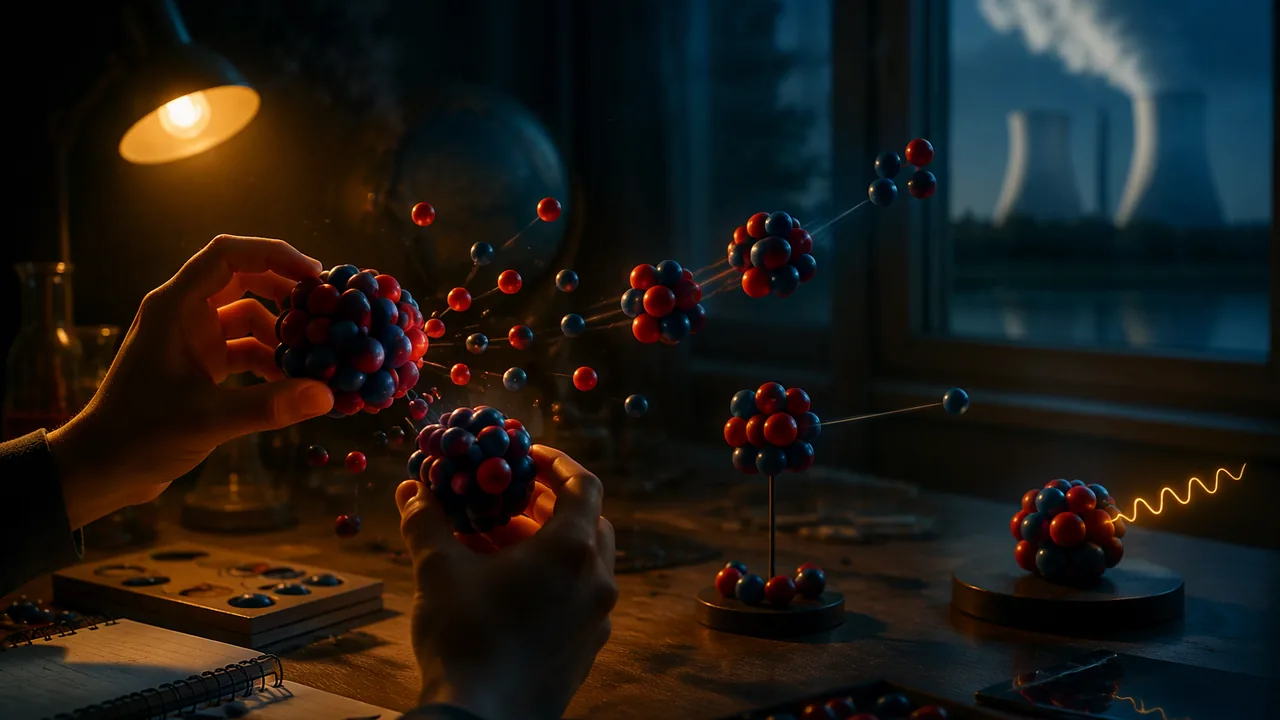
model alpha, beta and gamma decay, fission and fusion with balanced nuclear equations, use a hands-on model to explain half-life, and compare the energy of nuclear and chemical changes.
Instruction
A different kind of change. In Callaway County, about 25 miles northeast of Jefferson City, the Callaway Energy Center has generated electricity since December 1984. It is Missouri’s only nuclear power plant: one pressurized-water reactor with a summer capacity of about 1,190 megawatts, cooled by a 553-foot cooling tower that draws water from the Missouri River. In 2024 it produced about 10.5 million megawatt-hours, roughly 16% of all the electricity generated in Missouri (U.S. Energy Information Administration data). Its energy comes not from rearranging electrons, like every reaction so far, but from changing nuclei. That is why no chemical reaction could turn iron into gold (Unit 1), but nuclear processes do change one element into another.
What holds a nucleus together. Protons repel each other electrically. They are held in the nucleus by the strong nuclear force, which attracts protons and neutrons to each other but acts only over very short distances. Some combinations of protons and neutrons are unstable and change spontaneously, releasing radiation: this is radioactive decay.
Three kinds of decay. In a nuclear equation, mass numbers (top) and charges (bottom) must add up on both sides.
- Alpha decay emits a helium-4 nucleus (2 protons, 2 neutrons): uranium-238 → thorium-234 + helium-4. Check: 238 = 234 + 4; 92 = 90 + 2.
- Beta decay: a neutron changes into a proton and emits an electron: carbon-14 → nitrogen-14 + electron. Mass number stays 14; charge 6 = 7 + (−1).
- Gamma radiation is high-energy light emitted as a nucleus settles to a lower energy state; the element does not change.
Half-life. You cannot predict when one nucleus will decay, only the probability. For a large number of nuclei, a fixed fraction decays in each time interval, so the amount left halves every half-life. Iodine-131 has a half-life of about 8.0 days; after 24 days (3 half-lives) 1/8 remains. Carbon-14’s half-life is about 5,700 years; wood with 25% of the carbon-14 of living wood is about 2 × 5,700 = 11,400 years old. You will model this with coins at home: each shake, every coin that lands heads-up has “decayed” and is removed. Starting with 100 coins, you expect about 50, 25, 12 or 13, and so on: halving each shake, even though no one coin is predictable.
Fission. A slow neutron can split a uranium-235 nucleus: uranium-235 + neutron → barium-141 + krypton-92 + 3 neutrons. Check mass numbers: 235 + 1 = 141 + 92 + 3 = 236. Check protons: 92 = 56 + 36. The released neutrons can split more nuclei, a chain reaction; in a reactor, control rods absorb neutrons to keep it steady. Each fission releases about 200 MeV (3.2 × 10⁻¹¹ J), while a chemical reaction releases a few eV per molecule: tens of millions of times less. Complete fission of 1 kg of uranium-235 would release about 8 × 10¹³ J, roughly what burning 3,400 tonnes of coal releases (taking coal as about 24 MJ/kg). At Callaway, that energy heats water into steam that spins the turbine. The products are radioactive, which is why spent fuel must be stored safely for a very long time.
Fusion. Light nuclei can join into heavier ones. In the Sun’s core, hydrogen nuclei fuse, in several steps, into helium-4. Four hydrogen-1 atoms have a mass of 4.0313 u; one helium-4 atom has 4.0026 u. About 0.7% of the mass is converted to energy (E = mc2). On December 5, 2022, the National Ignition Facility at Lawrence Livermore National Laboratory became the first laboratory fusion experiment to release more energy than the laser energy delivered to its fuel: 3.15 megajoules out from 2.05 megajoules in. It was a scientific milestone, though a power plant is still far off.
📖 Read for this lesson
The reading opens over the lesson; close it to come back to exactly where you were. The checks below draw on it.
Lab: Coin Model of Radioactive Half-Life
Question. How does a random process applied to many ‘nuclei’ produce a predictable half-life?
Materials
- 100 coins of any kind, or 100 dried beans, pasta pieces or paper squares marked with a dot on one side
- A shoebox or plastic container with a lid
- Graph paper or a spreadsheet, data table
- A tray or baking sheet to spread the pieces on
- Shake the closed box gently; do not throw the pieces. Keep coins and beans away from young children and pets, and pick up any dropped pieces so no one slips.
Procedure
- Put all 100 pieces in the box with the marked side (or heads) down, close the lid and shake for 3 seconds. Each shake is one half-life interval.
- Spread the pieces on the tray. Remove every piece showing heads or the dot (‘decayed’) and record the number remaining.
- Return the remaining pieces to the box and repeat until fewer than 3 remain.
- Copy the six recorded runs from this lesson’s reading, add your run as a seventh, and calculate the average of all seven runs after each shake.
- Graph pieces remaining (y) against shake number (x) for your run and for the seven-run average, and draw the ideal halving curve on the same axes.
Data
| Shake number | 0 | 1 | 2 | 3 | 4 | 5 | 6 |
|---|---|---|---|---|---|---|---|
| Pieces remaining (your run) | 100 | ||||||
| Average of 7 runs (yours + 6 recorded) | 100 | ||||||
| Ideal (halving) | 100 | 50 | 25 | 12.5 | 6.25 | 3.1 | 1.6 |
Analysis
- Claim: does your model show a half-life? Evidence: compare your counts and the seven-run average with the ideal halving row. Reasoning: explain why the seven-run average matches better than one run.
- Could you predict which piece would ‘decay’ on the next shake? What does that tell you about real radioactive nuclei?
- State one way the coin model is like radioactive decay and one way it is not (for example, real nuclei change into a different element and emit radiation).
If you cannot do this lab in person: No coins or beans? Use the six recorded runs in this lesson’s reading as your data, and use the PhET Build a Nucleus simulation (Decay screen) to watch unstable nuclei decay.
Formative check
Work through these before moving on. They are not graded — they tell you whether the standard below has landed yet.
Simulation & tools
Build and decay a nucleus
Open the Decay screen. (1) Build a nucleus with 6 protons and 8 neutrons (carbon-14) and record whether the sim marks it stable. (2) Let it decay and record the decay type and the new element; write the nuclear equation with mass numbers and charges balanced. (3) Build a nucleus with 2 protons and 2 neutrons and record whether it is stable. (4) Explain in two sentences why the element changes in beta decay. No device? Write the nuclear equations for the beta decay of carbon-14 and the alpha decay of uranium-238 and check both sums.
Open in a new tab ↗ · PhET Interactive Simulations, University of Colorado Boulder · CC BY 4.0
In the fission uranium-235 + neutron → barium-141 + krypton-92 + neutrons, the mass numbers add to on each side.
Where does the energy released in fusion come from?
After two half-lives, a radioactive sample has fully decayed.
How confident are you that you can model decay, fission and fusion with balanced nuclear equations and explain half-life?
Practice
Work these on paper or in your notebook, then open Check your answer. Aim for all of Fluency and Application; try at least one Challenge.
Printable version: this unit’s practice workbook (PDF)
Fluency
Build speed and accuracy with the core skill.
- An isotope has a half-life of 50 days. How long until only 1/8 of the original sample remains?
Check your answer
Answer: 150.0 days (3 half-lives)1/8 = (1/2)3. - A sample starts with 80 g of an isotope whose half-life is 30 years. How much remains after 90.0 years?
Check your answer
Answer: 10.00 g90.0 years is 3 half-lives; halve 3 times. - A wood sample has 25% of the carbon-14 of living wood. Using a half-life of 5,730 years, estimate its age.
Check your answer
Answer: ≈ 11,460 yearst = 5730 × log2(100/percent remaining). - A sample starts with 640 g of an isotope whose half-life is 8 years. How much remains after 24.0 years?
Check your answer
Answer: 80.00 g24.0 years is 3 half-lives; halve 3 times. - Complete: uranium-238 → thorium-234 + ____
Check your answer
Answer: helium-4 (an alpha particle)238 − 234 = 4; 92 − 90 = 2, so helium. - Carbon-14 undergoes beta decay. What element and mass number does it become?
Check your answer
Answer: Nitrogen-14Mass number unchanged; atomic number rises from 6 to 7. - Does gamma emission change the element? Why or why not?
Check your answer
Answer: No; gamma rays are energy, so the numbers of protons and neutrons stay the same.
Application
Use the skill in context. Show your reasoning.
- Check that the fission uranium-235 + neutron → barium-141 + krypton-92 + 3 neutrons is balanced for mass number and for protons (U 92, Ba 56, Kr 36).
Check your answer
Answer: Mass numbers: 235 + 1 = 236 = 141 + 92 + 3. Protons: 92 = 56 + 36. Balanced. - A hospital receives 200 mg of cobalt-60 (half-life 5.27 years). How much remains after 15.81 years?
Check your answer
Answer: 25 mg15.81 / 5.27 = 3 half-lives; 200 ÷ 2 ÷ 2 ÷ 2 = 25 mg. - One fission releases about 200 MeV; a typical chemical reaction releases about 4 eV per molecule. About how many times more energy is released per event in fission? Use this to explain why a nuclear plant needs so little fuel compared with a coal plant.
Check your answer
Answer: About 50 million times (5 × 10⁷). Each nucleus that splits releases so much energy that a small mass of fuel supplies what would take enormous masses of coal.200,000,000 / 4 = 50,000,000.
Challenge
Stretch problems. Expect to think before you write.
- In the coin model, one run started with 100 coins and had 52, 27, 11, 6 and 2 left after five shakes. Compare with the ideal halving and explain why the average of 10 such runs gives results closer to the ideal.
Check your answer
Answer: Ideal: 50, 25, 12.5, 6.25, 3.1. The run is close but not exact because each coin is random. Averaging 1,000 coins across ten runs reduces random variation, just as a real sample of trillions of nuclei follows the half-life very precisely.Random scatter shrinks as the number of trials grows.
Review
Keep earlier skills sharp.
- What is the mass of 0.5 mol of H2O?
Check your answer
Answer: 9.0 gMultiply by the molar mass, 18.02 g/mol. - Raising the pressure on 2SO2 + O2 ⇌ 2SO3 (all gases) shifts the equilibrium which way?
Check your answer
Answer: Toward SO3, the side with fewer gas molecules
The Coin Model, Run Six Times, the Real Half-Lives Behind It, and Callaway in Numbers
SLS original coin-model runs (illustrative, six runs of 100 coins); IAEA LiveChart of Nuclides half-lives and masses; EIA Missouri nuclear and electricity profiles; Wikipedia, Callaway Nuclear Generating Station (thermal capacity, 2024 generation from EIA data); all retrieved 2026-11-05; SLS calculations · SLS original (constructed teaching data, labeled illustrative); public-domain U.S. government data; IAEA reference data; CC BY-SA 4.0 (Wikipedia facts, paraphrased)
Why this reading. The lab’s alternative route uses these six recorded runs, so a student without 100 coins can still graph an average against the ideal halving curve; a student who ran the lab adds their own run as a seventh. The reading also gives sourced half-lives for the lesson’s isotopes and the real numbers behind Missouri’s Callaway Energy Center.
Recorded coin-model runs (six runs of 100 coins each, illustrative)
| Shake | 0 | 1 | 2 | 3 | 4 | 5 | 6 |
|---|---|---|---|---|---|---|---|
| Run 1 | 100 | 53 | 28 | 16 | 7 | 4 | 2 |
| Run 2 | 100 | 49 | 23 | 11 | 6 | 3 | 1 |
| Run 3 | 100 | 47 | 26 | 14 | 8 | 3 | 2 |
| Run 4 | 100 | 52 | 24 | 13 | 5 | 2 | 1 |
| Run 5 | 100 | 48 | 27 | 12 | 6 | 4 | 2 |
| Run 6 | 100 | 51 | 25 | 15 | 7 | 3 | 1 |
| Average of six runs | 100 | 50.0 | 25.5 | 13.5 | 6.5 | 3.2 | 1.5 |
| Ideal (halving) | 100 | 50 | 25 | 12.5 | 6.25 | 3.1 | 1.6 |
The six-run average tracks the ideal halving curve closely at every shake, while single runs wander above and below it (Run 1 ran high at shake 1, Run 3 ran low). That is the point: 100 “nuclei” is too small a sample for a random, coin-by-coin process to look smooth, but 600 coins averaged together are already close to the ideal, and a real radioactive sample with 1020 or more nuclei follows the curve almost exactly.
Real half-lives (IAEA Nuclear Data Section)
| Isotope | Half-life | Decay mode | Where it appears |
|---|---|---|---|
| Iodine-131 | 8.0252 days | beta | Used to treat thyroid conditions; the lesson’s first half-life example |
| Cobalt-60 | 1,925.28 days (5.27 years) | beta | Used in radiation therapy and to sterilize medical supplies; a practice problem |
| Cesium-137 | 30.08 years | beta | A common fission product tracked in spent reactor fuel |
| Carbon-14 | 5,700 years | beta | Used to date material that was once alive; the lesson’s second example (older textbooks round it to 5,730) |
| Uranium-235 | 7.04 × 10⁸ years (704 million) | alpha (it splits when struck by a slow neutron) | The fissile isotope in the lesson’s fission equation |
| Uranium-238 | 4.468 × 10⁹ years (about 4.47 billion) | alpha | The lesson’s alpha-decay example; most of the uranium in reactor fuel |
The range runs from days to billions of years, all following the same halving pattern your coins modeled. The half-life belongs to the nucleus: heating, cooling or reacting an isotope chemically does not change it, because decay happens in the nucleus, not among the outer electrons that chemistry rearranges.
Checking the fusion number
IAEA atomic masses: hydrogen-1, 1.007825 u; helium-4, 4.002603 u. Four hydrogen-1 atoms: 4 × 1.007825 = 4.031300 u. Mass lost: 4.031300 − 4.002603 = 0.028697 u, which is 0.028697 ÷ 4.031300 ≈ 0.71% of the starting mass, the “about 0.7%” in the lesson.
Callaway in numbers
Missouri’s only nuclear plant, the Callaway Energy Center in Callaway County about 25 miles northeast of Jefferson City, began commercial operation on December 19, 1984. Its single pressurized-water reactor has a summer capacity of 1,190 megawatts of electricity and is cooled by a 553-foot natural-draft cooling tower that draws water from the Missouri River (EIA). In 2024 it generated 10,525,784 megawatt-hours, 15.7% of Missouri’s 66,875,710 megawatt-hours (EIA data).
How much uranium is that? (SLS estimate.) The reactor produces about 3,565 megawatts of heat to deliver about 1,190 megawatts of electricity, so about 1,190 ÷ 3,565 ≈ 33% of the heat becomes electricity. The 2024 output, 10,525,784 MWh × 3.6 × 109 J/MWh ≈ 3.8 × 10¹⁶ J of electricity, needed about 3.8 × 10¹⁶ ÷ 0.334 ≈ 1.1 × 10¹⁷ J of heat. Complete fission of 1 kg of uranium-235 releases about 8.2 × 10¹³ J, so the year’s heat equals the fission of about 1.1 × 10¹⁷ ÷ 8.2 × 10¹³ ≈ 1,400 kg of uranium-235 (in a real reactor some of the fissions are of plutonium formed in the fuel). Producing the same heat from coal at about 24 MJ/kg would take about 4.7 million metric tons of coal.
Using this record
Report your own counts if you ran the lab, plus the seven-run average, or the six-run average above if you used the alternative route. Compare with the ideal halving row using at least two shake numbers as evidence. When you discuss an isotope, cite its sourced half-life and its decay mode, and say what that mode does to the mass number and charge in its nuclear equation.
Sources: International Atomic Energy Agency, Nuclear Data Section, LiveChart of Nuclides data service (ground-state half-lives, decay modes and atomic masses for I-131, Cs-137, C-14, Co-60, U-235, U-238, H-1, He-4) (retrieved 2026-11-05) (nds.iaea.org); U.S. Energy Information Administration, Missouri Nuclear Profile (Callaway: location, 1,190 MW summer capacity, commercial operation 12/19/1984, cooling tower and Missouri River water) (retrieved 2026-11-05) (eia.gov); U.S. Energy Information Administration, Missouri Electricity Profile 2024 (state net generation 66,875,710 MWh) (retrieved 2026-11-05) (eia.gov); Wikipedia, Callaway Nuclear Generating Station (thermal capacity 3,565 MWth; monthly net generation table from EIA data, 2024 total 10,525,784 MWh) (retrieved 2026-11-05) (en.wikipedia.org)