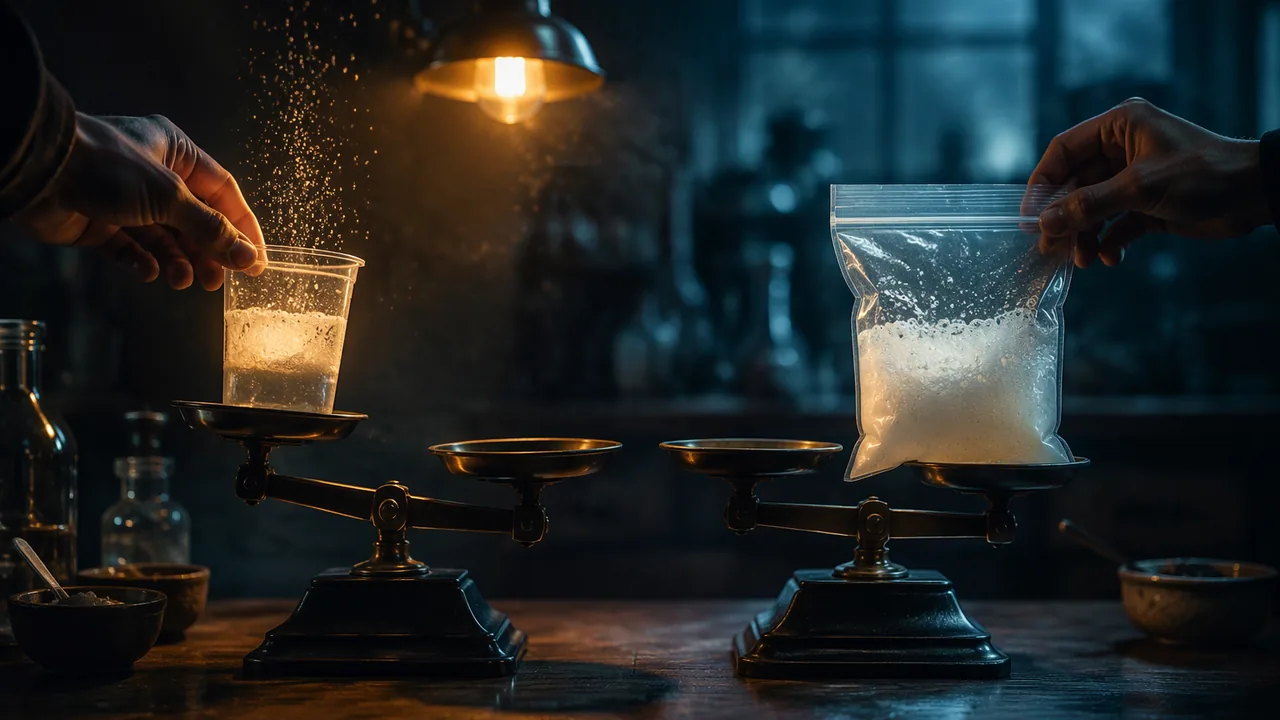
measure the mass of a reacting system in an open cup and in a sealed bag, and use the difference to support the claim that atoms, and therefore mass, are conserved in a chemical reaction.
Instruction
The investigation question. If atoms are conserved, mass should be conserved. But when you pour vinegar on baking soda, it fizzes, and the leftover liquid seems lighter. Has mass disappeared? Today you test the conservation claim with two setups: an open system, where matter can enter or leave, and a closed system, where it cannot.
The reaction. Baking soda is sodium hydrogen carbonate. Vinegar is about 5% acetic acid in water. They react:
NaHCO3 + CH3COOH → NaCH3COO + H2O + CO2
Count the atoms: left, 1 Na, 5 H, 3 C, 5 O; right, 1 Na, 3 + 2 = 5 H, 2 + 1 = 3 C, 2 + 1 + 2 = 5 O. Balanced as written. The fizz is carbon dioxide gas. Using molar masses (NaHCO3 84.01, CH3COOH 60.05, NaCH3COO 82.03, H2O 18.02, CO2 44.01 g/mol), the reactants total 144.06 g per mole of reaction and the products total 144.06 g: the equation itself predicts no change in mass.
What to expect. In the open cup, the carbon dioxide escapes into the room, so the scale reading drops. How much? In Lesson 3.4 you will learn to calculate that 2.0 g of baking soda can make at most about 1.05 g of CO2. So the open cup should lose about a gram. In the sealed bag, the gas is trapped, so the reading should stay the same, within the uncertainty of the scale.
A subtle source of error. As the gas fills the bag, the bag puffs up. An inflated bag pushes aside more air, and the air pushes up on it slightly (the same buoyancy that lifts a helium balloon). About 0.58 L of CO2 from 2.0 g of baking soda displaces about 0.7 g of air, so a very puffy bag can read a few tenths of a gram lighter even though no matter left. That is not a failure of conservation; it is a measurement effect you should name in your analysis. Using less baking soda, or a bag that is already loosely full, reduces it. Leaks are the other main error: press the sealed bag gently before reacting to check.
Reading a scale well. Use a digital kitchen scale that reads to 0.1 g (many kitchen scales and inexpensive pocket scales do). A 0.1 g scale has an uncertainty of about ±0.1 g, so two readings that differ by 0.1 g are effectively the same. Zero (tare) the scale with nothing on it, and never tare with the bag on it, because you need the total mass. Weigh everything, cup of vinegar and baking soda paper included, before mixing. If your scale reads only to the nearest gram, it cannot detect a 1 g change reliably: use the recorded data set in this lesson’s reading instead.
Many trials are stronger than one. Run each setup twice if you have enough materials, then combine your trials with the six recorded trials in this lesson’s reading and calculate the average mass change for each setup. If the open average is about −1 g and the closed average is about 0 g, the pattern supports conservation far more convincingly than any single result. 9-12.PS1.B.3 asks for a mathematical representation: you will support the claim both with the atom count and with the numbers.
Safety. Work with a parent or guardian nearby, at a kitchen table or counter. Wear safety glasses or goggles: vinegar stings the eyes. Use only baking soda and white vinegar; never mix either with bleach, ammonia or any other cleaner. Taste nothing. Keep the bag pointed away from faces while it fills, and open it slowly after the final reading.
📖 Read for this lesson
The reading opens over the lesson; close it to come back to exactly where you were. The checks below draw on it.
Lab: Conservation of Mass in Open and Closed Systems
Question. Does the total mass of reactants and products change when baking soda reacts with vinegar in an open cup and in a sealed bag?
Materials
- Baking soda (sodium hydrogen carbonate), 2.0 g per trial (a level 1/2 teaspoon is about 2-3 g, so weigh it) on a folded square of paper or a coffee filter
- White vinegar (5% acetic acid), 30 mL (2 tablespoons) per trial, in a small plastic cup (a medicine cup or 2 oz cup) that fits inside the bag
- Quart-size zip-top freezer bags; a drinking cup for the open trial
- Digital kitchen or pocket scale reading to 0.1 g; measuring spoons; a spoon
- Safety glasses or goggles, paper towels
- Do this lab with a parent or guardian nearby. Wear safety glasses or goggles throughout; vinegar stings if splashed in the eyes.
- Use only baking soda and white vinegar. Never mix them, or anything in this lab, with bleach, ammonia or other cleaners. Taste nothing.
- Point the sealed bag away from faces as it inflates, and open it slowly at the end.
- Wipe up spills at once. Spent solutions are sodium acetate and water and may go down the sink with running water.
Procedure
- Open trial: place the cup with 30 mL of vinegar and the paper holding 2.0 g of baking soda on the scale together. Record the total starting mass.
- Tip the baking soda into the vinegar, leaving the paper on the scale. When fizzing stops (about 2 minutes), record the final mass.
- Closed trial: put 2.0 g of baking soda in the corner of a zip-top bag. Stand the small cup with 30 mL of vinegar upright inside the bag, press out extra air and seal. Check for leaks by pressing gently.
- Record the mass of the whole sealed bag. Without opening it, tip the cup so the vinegar mixes with the baking soda. When fizzing stops, record the final mass.
- Calculate the mass change (final minus initial) for each trial. Repeat both trials once more if you have materials.
- Add your trials to the six recorded trials in this lesson’s reading and calculate the average change for open trials and for closed trials.
Data
| Trial | Initial mass (g) | Final mass (g) | Change (g) | Observations (fizzing, bag inflation, leaks) |
|---|---|---|---|---|
| Open cup | ||||
| Sealed bag | ||||
| Average, open (your trials + recorded set) | n = ___ | |||
| Average, closed (your trials + recorded set) | n = ___ | |||
Analysis
- Claim: is mass conserved in this reaction? Evidence: compare the average changes for open and closed trials (your trials combined with the recorded set). Reasoning: explain the difference using the atom count of the balanced equation and where the CO2 went.
- The theoretical maximum CO2 from 2.0 g of baking soda is about 1.05 g. Compare your open-cup loss with this number and suggest why it might be smaller (for example, some CO2 stays dissolved).
- Name two sources of error in the closed trial (leaks, buoyancy of the inflated bag, scale uncertainty) and say in which direction each would push the result.
- Use your results to predict whether a rusting nail in a sealed jar would gain, lose or keep the same total mass, and whether the nail itself would gain or lose mass.
If you cannot do this lab in person: No scale that reads to 0.1 g, or no materials? Use the six recorded trials in this lesson’s reading (open-cup and sealed-bag masses before and after) as your data, and model the atom count with the PhET Reactants, Products and Leftovers simulation (Molecules screen).
Formative check
Work through these before moving on. They are not graded — they tell you whether the standard below has landed yet.
What will happen to the scale reading of the sealed bag during the reaction?
An open cup started at 112.4 g and ended at 111.5 g. What mass left the cup, and as what?
The open-cup result disproves conservation of mass.
Write your claim-evidence-reasoning paragraph on conservation of mass. Use the averages for both setups (your trials plus the recorded set), the atom count for the equation, and one source of error with its direction.
How confident are you that you can use open and closed trials and an atom count to support the claim that mass is conserved?
Practice
Work these on paper or in your notebook, then open Check your answer. Aim for all of Fluency and Application; try at least one Challenge.
Printable version: this unit’s practice workbook (PDF)
Fluency
Build speed and accuracy with the core skill.
- A sealed bag reads 186.3 g before and 186.2 g after the reaction. The scale reads to ±0.1 g. Is mass conserved within the uncertainty?
Check your answer
Answer: Yes; the 0.1 g difference is within the scale’s uncertainty. - An open cup reads 98.7 g before and 97.8 g after. What is the mass change?
Check your answer
Answer: −0.9 g97.8 − 98.7 = −0.9. - Is a sealed zip-top bag an open or a closed system? Can energy pass through it?
Check your answer
Answer: Closed; yes, energy (heat) can pass through, but matter cannot. - Name the gas produced when baking soda reacts with vinegar.
Check your answer
Answer: Carbon dioxide, CO2 - Count the atoms on each side of NaHCO3 + CH3COOH → NaCH3COO + H2O + CO2.
Check your answer
Answer: Each side: 1 Na, 5 H, 3 C, 5 O
Application
Use the skill in context. Show your reasoning.
- Six trials’ open-cup changes (g) were −0.9, −0.8, −1.0, −0.7, −0.9, −0.8, and their sealed-bag changes were 0.0, −0.1, −0.2, 0.0, −0.1, 0.0 (illustrative data). Find both averages and state what they show.
Check your answer
Answer: Open −0.85 g; closed about −0.07 g. The open cup loses nearly a gram of escaping gas; the sealed bag’s change is within measurement error, supporting conservation of mass.Open: −5.1 / 6 = −0.85. Closed: −0.4 / 6 = −0.067. - The maximum CO2 from 2.0 g of baking soda is 1.05 g. An open cup lost 0.9 g. What percentage of the maximum escaped, and give one reason it is less than 100%.
Check your answer
Answer: About 86%. Some CO2 stays dissolved in the liquid (or some baking soda did not react).0.9 / 1.05 × 100 = 85.9%. - A student’s sealed bag lost 0.6 g and they heard a hiss while tipping it. What is the most likely error, and how would you redesign the trial?
Check your answer
Answer: A leak let CO2 escape. Double-seal or use a freezer bag, press to test for leaks before reacting, and use less baking soda so the bag is not stretched.
Challenge
Stretch problems. Expect to think before you write.
- 2.0 g of baking soda makes about 0.58 L of CO2, and air has a density of about 1.2 g/L. Estimate how much lighter a fully inflated bag could read because of buoyancy, and explain why this does not mean mass was lost.
Check your answer
Answer: About 0.7 g. The larger bag displaces more air, which pushes up on it; the matter inside is unchanged, so the scale reading, not the mass, changes.0.58 L × 1.2 g/L = 0.70 g.
Review
Keep earlier skills sharp.
- What is the mass of 20.0 cm3 of olive oil (density 0.92 g/cm3)?
Check your answer
Answer: 18.4 gMass = density × volume. - Why does salt water conduct electricity but sugar water does not?
Check your answer
Answer: Dissolved salt forms mobile ions; sugar dissolves as neutral molecules.
Open Cup, Sealed Bag: Six Recorded Trials of the Conservation-of-Mass Lab
SLS original recorded data set for the Lesson 3.2 procedure (illustrative, six trials, kitchen scale reading to 0.1 g); molar-mass check uses NIST standard atomic weights, retrieved 2026-11-05 · SLS original (constructed teaching data, labeled illustrative), with reference molar masses
Why this reading. The lab asks you to average many trials, and gives a no-scale route. This is the data set for both: six recorded trials of the open-cup and sealed-bag setups, so you can combine them with your own trials, or use them alone if your scale cannot read to 0.1 g. These data are SLS original and illustrative, constructed to match what the theoretical maximum (about 1.05 g of CO2 from 2.0 g of baking soda) predicts; they are not measurements by any agency.
The recorded trials
Six trials, each running one open-cup setup and one sealed-bag setup with 2.0 g of baking soda and 30 mL of white vinegar (5% acetic acid), on a digital scale reading to 0.1 g.
| Trial | Open: initial (g) | Open: final (g) | Open: change (g) | Sealed: initial (g) | Sealed: final (g) | Sealed: change (g) | Notes |
|---|---|---|---|---|---|---|---|
| 1 | 142.6 | 141.7 | −0.9 | 138.2 | 138.1 | −0.1 | bag moderately inflated |
| 2 | 140.1 | 139.0 | −1.1 | 139.5 | 139.4 | −0.1 | bag very full; likely buoyancy effect |
| 3 | 143.8 | 142.9 | −0.9 | 137.9 | 137.9 | 0.0 | bag loosely full, little buoyancy |
| 4 | 141.5 | 140.4 | −1.1 | 138.6 | 138.4 | −0.2 | small leak suspected at seal corner |
| 5 | 142.0 | 141.1 | −0.9 | 139.0 | 139.0 | 0.0 | no leak, bag loosely full |
| 6 | 140.9 | 139.9 | −1.0 | 138.3 | 138.2 | −0.1 | bag moderately inflated |
| Average | −0.98 | −0.08 | |||||
Read the pattern: every open trial lost close to a gram; every sealed trial lost at most two tenths of a gram, and two trials (3 and 5) read exactly zero change, within the scale’s uncertainty of about ±0.1 g. The two sealed trials with the largest (still small) losses were the ones with the fullest bag or a suspected leak, exactly the two sources of error the mini-lecture names.
Checking against the theoretical maximum
Using NaHCO3 (84.006 g/mol) and CO2 (44.009 g/mol): 2.0 ÷ 84.006 = 0.0238 mol, × 44.009 = 1.05 g of CO2 at most. The recorded open-cup average of 0.98 g lost is slightly below that maximum, which is expected: some CO2 stays dissolved in the liquid. A result close to, but not above, the theoretical maximum supports the mass-conservation claim; a result far above it would suggest a measurement mistake.
The buoyancy correction, sized
0.0238 mol of gas fills about 0.58 L at room conditions, and air has a density of about 1.2 g/L, so a fully inflated bag displaces about 0.58 × 1.2 = 0.70 g more air than a flat one. The air pushes up on the bag, so the scale reads slightly low even though no matter left, the same principle that makes a helium balloon float. That is why trials 1, 2, 4 and 6, with visibly inflated bags, show small negative changes while trials 3 and 5, whose bags stayed loosely full, read zero.
Using this record
Write your claim-evidence-reasoning paragraph with the averages (your trials plus these, or these alone: −0.98 g open, −0.08 g closed), the atom count from the balanced equation, and at least one named source of error with its direction: an inflated bag pushes the closed reading slightly negative (buoyancy), while a leaking seal pushes it more negative (real mass loss). Even the largest sealed-bag loss recorded (trial 4, −0.2 g) is far smaller than the 0.9–1.1 g lost by every open trial.
Sources: NIST Physical Measurement Laboratory, Atomic Weights and Isotopic Compositions (standard atomic weights) (physics.nist.gov)