describe a system at dynamic equilibrium and argue from evidence how changes in concentration, pressure and temperature shift it, applying the reasoning to making ammonia.
Instruction
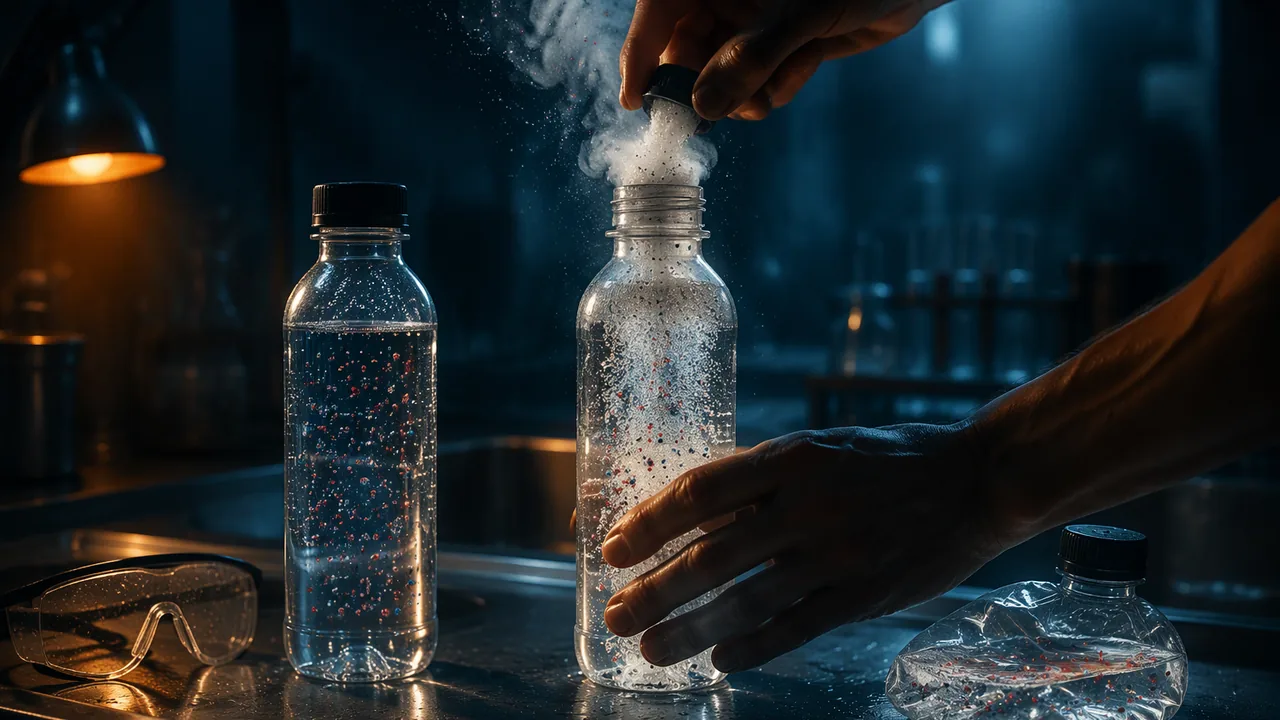
Quick observation at home. Take two sealed bottles of the same plain carbonated water (seltzer or club soda), one from the refrigerator and one that has sat at room temperature for a few hours. Wear safety glasses, hold each bottle over a sink, and open the cap slowly, pointing it away from your face and from other people; pour the water down the sink when you finish, and do not drink it as part of the lab. You should see three things. (1) The sealed bottles show almost no bubbles. (2) Opening the warm bottle releases a bigger hiss and more bubbling than the cold one. (3) If you pour out about half of an opened bottle, squeeze the air out and re-cap it, the fizzing slows and stops. What is happening in the bottle?
Dynamic equilibrium. In a sealed bottle, carbon dioxide moves both ways: CO2(gas) ⇌ CO2(dissolved). Molecules leave the liquid and others dissolve back, all the time. When the two rates are equal, the amounts stop changing. That state is dynamic equilibrium: not stopped, but balanced. Many reactions work the same way, running forward and backward at once.
Changing the conditions. If you disturb a system at equilibrium, it shifts in the direction that partly counteracts the change. This pattern is called Le Chatelier’s principle, and it is a prediction tool, not an explanation by itself; the explanation is always in rates of forward and reverse processes.
- Concentration. Opening the bottle lets CO2 gas escape, lowering its concentration above the liquid. Fewer gas molecules return to the liquid each second, but dissolved molecules keep leaving at the old rate, so there is a net flow out of solution: fizz. Re-capping lets gas build up again until the rates match.
- Pressure. For reactions between gases, raising the pressure favors the side with fewer gas molecules, because that reduces the pressure increase.
- Temperature. Raising the temperature favors the direction that absorbs energy. Dissolving CO2 releases energy, so warming the bottle shifts it toward gas: the warm bottle hisses more.
The big application: ammonia. Missouri farmers planted about 3.8 million acres of corn in 2025 (USDA National Agricultural Statistics Service), and corn needs a lot of nitrogen: in USDA’s most recent state survey of fertilizer use on corn (2018), 98% of Missouri corn acres received nitrogen fertilizer, at an average of 169 pounds of nitrogen per fertilized acre. The air is 78% nitrogen, but N2 has a triple bond so strong (about 946 kJ/mol) that plants cannot use it directly. Industrial fertilizer starts with the Haber-Bosch process:
N2(g) + 3H2(g) ⇌ 2NH3(g) energy change −92 kJ (exothermic)
That −92 kJ is the value your bond-energy model gave in Unit 3. Apply the reasoning: Pressure: 4 molecules of gas on the left, 2 on the right, so high pressure shifts toward ammonia. Temperature: the forward reaction releases energy, so a low temperature favors ammonia at equilibrium. Concentration: cooling the gas mixture so ammonia condenses to a liquid removes product, and the system keeps making more.
The trade-off that makes this an argument. Low temperature gives more ammonia at equilibrium, but, as you measured with antacid tablets, low temperature makes reactions slow. At a low temperature the plant would wait a very long time to get there. Real plants compromise: a moderately high temperature (about 400-500 °C, because the iron-based catalyst needs at least about 400 °C to work well) with that catalyst to speed both directions, high pressure (typically about 200 times atmospheric pressure, varying by plant), and continuous removal of ammonia. Even so, only about 15% of the gas becomes ammonia on each pass through the reactor, so the ammonia is condensed out and the unreacted gases are sent around again. A catalyst does not change how much ammonia is present at equilibrium; it only gets there faster. High pressure costs energy and demands strong, safe equipment. Every choice is a trade-off between yield, rate, cost and safety, the core of 9-12.PS1.B.2 and of engineering.
Arguing well. In today’s argument, each claim about a condition must name the direction of the shift, the evidence (the equation’s gas-molecule count or energy change, or your soda observations), and the rate consequence. RST.9-10.8 asks you to judge whether a claim is supported: “a catalyst increases the yield” is a common, unsupported claim you should be ready to rebut.
📖 Read for this lesson
The reading opens over the lesson; close it to come back to exactly where you were. The checks below draw on it.
Formative check
Work through these before moving on. They are not graded — they tell you whether the standard below has landed yet.
For N2 + 3H2 ⇌ 2NH3, raising the pressure
Adding a catalyst increases the amount of ammonia present at equilibrium.
Why don’t ammonia plants run at a low temperature, even though low temperature favors ammonia at equilibrium?
Write a 5-7 sentence argument recommending one change to an ammonia plant (temperature, pressure or product removal) that increases the amount of ammonia. Include the direction of the shift, the evidence from the equation, and the trade-off with rate, cost or safety.
How confident are you that you can argue how changes in concentration, pressure and temperature shift a system at equilibrium?
Practice
Work these on paper or in your notebook, then open Check your answer. Aim for all of Fluency and Application; try at least one Challenge.
Printable version: this unit’s practice workbook (PDF)
Fluency
Build speed and accuracy with the core skill.
- At dynamic equilibrium, have the forward and reverse reactions stopped?
Check your answer
Answer: No; they continue at equal rates, so the amounts stay constant. - Count the gas molecules on each side of N2 + 3H2 ⇌ 2NH3.
Check your answer
Answer: 4 on the left, 2 on the right - The forward reaction N2 + 3H2 → 2NH3 releases 92 kJ. Does raising the temperature favor ammonia or nitrogen and hydrogen at equilibrium?
Check your answer
Answer: Nitrogen and hydrogen (the energy-absorbing direction) - Why does a warm bottle of soda fizz more when opened than a cold one?
Check your answer
Answer: Dissolving CO2 releases energy, so warming shifts the equilibrium toward the gas; less CO2 stays dissolved. - Does a catalyst change the amount of product at equilibrium?
Check your answer
Answer: No; it only makes equilibrium arrive sooner.
Application
Use the skill in context. Show your reasoning.
- For 2SO2(g) + O2(g) ⇌ 2SO3(g), an exothermic reaction used to make sulfuric acid, predict the effect on the amount of SO3 of (a) raising pressure, (b) raising temperature, (c) removing SO3.
Check your answer
Answer: (a) More SO3: 3 gas molecules become 2. (b) Less SO3: heat favors the energy-absorbing reverse direction. (c) More SO3: the system shifts to replace the removed product. - A student writes: ‘Ammonia plants use a catalyst so that more ammonia is present at equilibrium.’ Evaluate the claim and rewrite it correctly.
Check your answer
Answer: Unsupported: a catalyst speeds forward and reverse reactions equally, so the equilibrium amount is unchanged. Correct: ‘Plants use a catalyst so that equilibrium is reached quickly at a moderate temperature.’ - Explain the temperature trade-off in ammonia synthesis using both equilibrium and rate reasoning.
Check your answer
Answer: Low temperature favors ammonia at equilibrium because the forward reaction is exothermic, but low temperature makes the reaction very slow (fewer collisions reach the activation energy). A moderate temperature with a catalyst gives a smaller equilibrium yield but much faster production.
Challenge
Stretch problems. Expect to think before you write.
- Cold drinks go flat more slowly than warm ones, and a re-capped half-empty bottle still loses some fizz each time it is opened. Use equilibrium to explain both observations.
Check your answer
Answer: Cold: dissolving is exothermic, so low temperature keeps more CO2 dissolved, and escape is also slower. Re-capping: each opening lets out the gas above the liquid, lowering its concentration; dissolved CO2 then leaves the liquid to rebuild the gas above it until equilibrium returns, so some is lost every time.
Review
Keep earlier skills sharp.
- For the balanced reaction CaCO3 → CaO + CO2, what mass of CO2 forms from 50.0 g of CaCO3, assuming CaCO3 is the limiting reactant?
Check your answer
Answer: 22.0 g of CO2grams CaCO3 → moles (0.500 mol) → mole ratio 1:1 → moles CO2 (0.500 mol) → grams. - Balance: N2 + H2 → NH3
Check your answer
Answer: N2 + 3H2 → 2NH3
Nitrogen for Missouri Corn: U.S. Ammonia Production and Real Plant Conditions
USGS Mineral Commodity Summaries 2026, Nitrogen; USDA NASS 2025 Missouri State Agriculture Overview; USDA ERS Fertilizer Use and Price Tables 9-10; Wikipedia, Haber process; all retrieved 2026-11-05; SLS commentary and estimate · Public domain (USGS, USDA) and CC BY-SA 4.0 (Wikipedia facts, paraphrased), with SLS commentary
Why this reading. The lesson gives the ammonia equilibrium equation and its energy change. This reading supplies the sourced numbers behind it: how much nitrogen Missouri corn uses, how much ammonia the country makes, and the conditions real plants run at, including how the equilibrium constant falls as the temperature rises.
Missouri corn and nitrogen
Missouri farmers planted 3,800,000 acres of corn in 2025 and harvested 3,640,000 acres for grain, averaging 185 bushels per acre for 673.4 million bushels (USDA NASS). In USDA’s most recent state-level survey of fertilizer use on corn (2018), 98% of Missouri corn acres received nitrogen fertilizer, at an average of 169 pounds of nitrogen per fertilized acre (USDA ERS, from NASS surveys).
An estimate (SLS, mixing years, so treat it as rough): 3,800,000 acres × 0.98 × 169 lb ≈ 629 million pounds of nitrogen, about 285,000 metric tons (1 metric ton = 2,204.6 lb). That is about 2% of the 14 million metric tons of nitrogen the United States made as ammonia in 2025.
How much ammonia the United States makes
According to the U.S. Geological Survey, ammonia was produced by 18 companies at 38 plants in 19 states in 2025, about 14,000 thousand metric tons measured as nitrogen. About 57% of production capacity was in Louisiana, Oklahoma and Texas, because of their large natural-gas reserves, the main feedstock. Plants that were producing ran at about 80% of rated capacity, and about 88% of U.S. ammonia production went to fertilizer. USGS links steady nitrogen demand to large corn plantings.
Real plant operating conditions
| Condition | Typical industrial value | Why, from the equilibrium reasoning |
|---|---|---|
| Temperature | about 400–500 °C; the iron catalyst needs at least about 400 °C to be efficient | Lower temperature favors ammonia at equilibrium (the forward reaction is exothermic), but the reaction must run fast enough to be economical |
| Pressure | about 200 bar (20 MPa), roughly 200 times atmospheric pressure, in most plants | High pressure shifts equilibrium toward the side with fewer gas molecules (2 NH3 vs. 1 N2 + 3 H2), at the cost of compression energy and stronger equipment |
| Catalyst | iron, promoted with small amounts of oxides such as K2O, CaO, SiO2 and Al2O3 | Speeds the forward and reverse reactions equally; equilibrium arrives sooner, but the equilibrium amounts do not change |
| Product removal | gases leaving the reactor are cooled under pressure so ammonia condenses and is drawn off as a liquid; unreacted N2 and H2 are recycled | Only about 15% of the gas becomes ammonia on each pass, so removing product and recycling the rest keeps the plant making more |
Temperature and the equilibrium constant
The equilibrium constant K for N2 + 3H2 ⇌ 2NH3 measures how far the equilibrium lies toward ammonia. Published values fall steeply with temperature:
| Temperature (°C) | 300 | 400 | 450 | 500 | 550 | 600 |
|---|---|---|---|---|---|---|
| K (× 10−5) | 434 | 16.4 | 4.51 | 1.45 | 0.538 | 0.225 |
From 400 to 500 °C, K falls by a factor of 16.4 ÷ 1.45 ≈ 11; from 300 to 500 °C, by 434 ÷ 1.45 ≈ 300. That is the exothermic-reaction rule from the lesson, in numbers: heating favors the energy-absorbing reverse direction. Plants accept the smaller K because at 300 °C the catalyzed reaction would be far too slow.
Feedstock and the emissions constraint
The hydrogen usually comes from natural gas reformed with steam, which releases carbon dioxide. Ammonia production is energy-intensive: by the estimates compiled on Wikipedia it uses about 1–2% of the world’s energy and accounts for about 3% of global carbon dioxide emissions. A strong evaluation names this constraint even though the ammonia equation itself does not show it.
Using this data
Cite the Missouri corn and USGS figures as evidence that ammonia synthesis is a large industry that Missouri farms depend on. Cite the operating-condition and K tables when you specify your recommended conditions in Lesson 4.3 and the Lesson 4.5 brief, and for each change state the direction of the shift, the evidence from the equation (gas-molecule count or energy change), and the trade-off in rate, cost or emissions.
Sources: U.S. Geological Survey, Mineral Commodity Summaries 2026, Nitrogen (Fixed)–Ammonia (retrieved 2026-11-05) (pubs.usgs.gov); USDA National Agricultural Statistics Service, 2025 State Agriculture Overview for Missouri (corn planted and harvested acres, yield, production) (retrieved 2026-11-05) (nass.usda.gov); USDA Economic Research Service, Fertilizer Use and Price, Tables 9 and 10 (percent of corn acreage receiving nitrogen and nitrogen rate per fertilized acre, by state, through 2018, from NASS Agricultural Chemical Use surveys) (retrieved 2026-11-05) (ers.usda.gov); Wikipedia, Haber process (typical operating conditions, catalyst, single-pass yield, equilibrium constant K at 300-600 °C, citing the chemical-engineering literature) (retrieved 2026-11-05) (en.wikipedia.org)