describe an atom in terms of protons, neutrons and electrons, use atomic number and mass number to find each, and ask testable questions about why elements behave differently.
Instruction
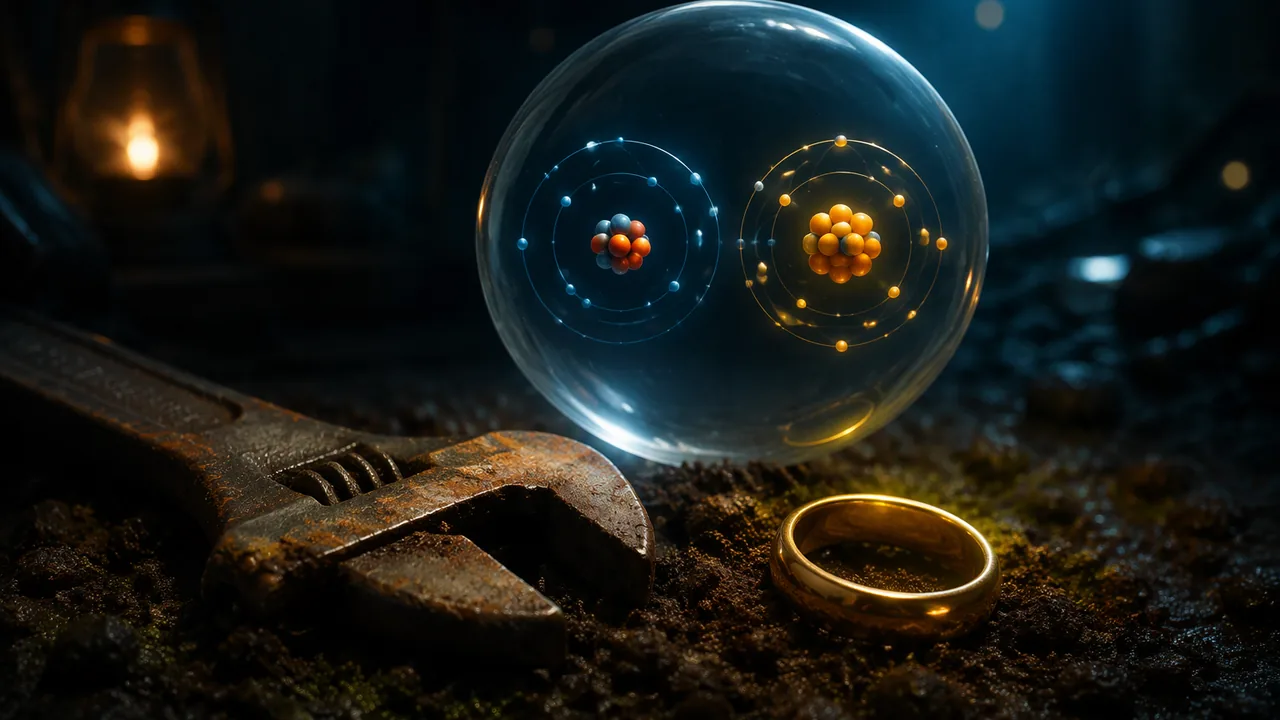
The phenomenon. In Iron County, Missouri, miners dug iron ore for well over a century. The Iron Mountain Mine produced ore from the 1830s until 1966, and the Pilot Knob surface hematite mine ran from 1835 into the 1920s (Missouri Geological Survey). That ore was not shiny metal. It was hematite (Fe2O3) and magnetite (Fe3O4): iron already joined to oxygen, and hematite turns rust red when it is powdered. Gold is different. The U.S. Geological Survey notes that gold commonly occurs in its native form, not combined with other elements, and gold objects made more than 5,000 years ago still shine. Leave an iron tool and a gold ring in the same damp Missouri field and the tool rusts back toward the same red iron oxide while the ring stays bright. Why does one element react with air and water while another does not? That question organizes this unit. To answer it we need a model of what an element is made of.
The nuclear atom. Every atom has a tiny, dense nucleus made of protons (charge +1) and neutrons (no charge), surrounded by much lighter electrons (charge −1). Protons and neutrons each have a mass of about 1 atomic mass unit (u); an electron has about 1/1,836 of that. So almost all of an atom’s mass is in the nucleus, but almost all of its volume is the space where its electrons are found. If the nucleus of a gold atom were the size of a marble, the atom would be the size of a football stadium.
Atomic number defines the element. The number of protons is the atomic number, Z. Every gold atom has 79 protons; an atom with 78 protons is platinum, not gold. In a neutral atom the number of electrons equals the number of protons, because the charges must balance. The mass number, A, counts protons plus neutrons. So neutrons = A − Z.
Worked example. Gold-197: Z = 79, so 79 protons and 79 electrons; neutrons = 197 − 79 = 118. Iron-56: Z = 26, so 26 protons and 26 electrons, and 56 − 26 = 30 neutrons. Notice that gold has about three times as many protons as iron. Size of the nucleus is not what makes gold unreactive, though; the explanation lies in how its electrons are arranged, which we develop over the next three lessons.
Isotopes. Atoms of one element can have different numbers of neutrons. Carbon-12 has 6 protons and 6 neutrons; carbon-14 has 6 protons and 8 neutrons. They are isotopes of carbon: same element, same chemistry, different mass. The atomic mass printed on the periodic table (12.011 for carbon) is an average over the isotopes found in nature, weighted by how common each is.
Ions. When an atom gains or loses electrons it becomes an ion. A sodium atom that loses one electron has 11 protons and 10 electrons, a net charge of +1 (Na+). A chlorine atom that gains one has 17 protons and 18 electrons, charge −1 (Cl−). Chemical reactions change electrons, never protons: that is why reactions cannot turn iron into gold.
Asking good questions. A scientific question can be tested with evidence. “Why is gold pretty?” cannot. “Does iron rust faster in salt water than in fresh water?” can. As you build the question board today, sort questions into ones you can investigate with an at-home lab, ones we can answer with data from NIST or OpenStax, and ones that need a model before they can be answered.
📖 Read for this lesson
The reading opens over the lesson; close it to come back to exactly where you were. The checks below draw on it.
Formative check
Work through these before moving on. They are not graded — they tell you whether the standard below has landed yet.
A gold ring and an iron tool were lost in the same damp Missouri field 50 years ago. Which statement best predicts what you would find today?
Iron-56 has protons, neutrons and electrons in a neutral atom.
Which change turns an atom into a different element?
Simulation & tools
Build an atom, an isotope and an ion
Open the Atom screen. (1) Build a neutral lithium-7 atom and record the protons, neutrons and electrons the sim needs. (2) Add one neutron: record what changes in the element name, the mass number and the charge. (3) Remove one electron: record the charge. (4) Answer: which particle count decides the element, which decides the isotope, and which decides the charge? No device? Complete the particle table for Li-7, Li-6 and Li+ on paper using Z = 3.
Open in a new tab ↗ · PhET Interactive Simulations, University of Colorado Boulder · CC BY 4.0
Write three questions about the iron-ore-and-gold phenomenon: one you could answer with an at-home lab, one you could answer with published data, and one that needs a model of the atom first. Explain your sorting in one sentence each.
How confident are you that you can describe an atom’s particles and use atomic number and mass number to find protons, neutrons and electrons?
Practice
Work these on paper or in your notebook, then open Check your answer. Aim for all of Fluency and Application; try at least one Challenge.
Printable version: this unit’s practice workbook (PDF)
Fluency
Build speed and accuracy with the core skill.
- How many protons, neutrons and electrons are in a neutral atom of carbon-14?
Check your answer
Answer: 6 protons, 8 neutrons, 6 electronsProtons = electrons = Z = 6; neutrons = A − Z = 14 − 6 = 8. - How many protons, neutrons and electrons are in a neutral atom of sodium-23?
Check your answer
Answer: 11 protons, 12 neutrons, 11 electronsProtons = electrons = Z = 11; neutrons = A − Z = 23 − 11 = 12. - How many protons, neutrons and electrons are in a neutral atom of gold-197?
Check your answer
Answer: 79 protons, 118 neutrons, 79 electronsProtons = electrons = Z = 79; neutrons = A − Z = 197 − 79 = 118. - How many protons, neutrons and electrons are in a neutral atom of uranium-235?
Check your answer
Answer: 92 protons, 143 neutrons, 92 electronsProtons = electrons = Z = 92; neutrons = A − Z = 235 − 92 = 143. - How many protons, neutrons and electrons are in a neutral atom of lithium-7?
Check your answer
Answer: 3 protons, 4 neutrons, 3 electronsProtons = electrons = Z = 3; neutrons = A − Z = 7 − 3 = 4. - An ion has 12 protons and 10 electrons. What is its charge, and what element is it?
Check your answer
Answer: +2; magnesium (Mg2+)Charge = protons − electrons = 12 − 10 = +2; Z = 12 is magnesium. - An ion has 16 protons and 18 electrons. Give its symbol and charge.
Check your answer
Answer: S2−Z = 16 is sulfur; 16 − 18 = −2.
Application
Use the skill in context. Show your reasoning.
- Carbon-12 and carbon-14 are both carbon. Explain what is the same and what is different about their atoms, and why they react the same way chemically.
Check your answer
Answer: Same: 6 protons and 6 electrons. Different: 6 vs 8 neutrons, mass numbers 12 vs 14. Chemistry depends on electrons, which are the same.Isotopes differ only in the nucleus’ neutron count; the electron arrangement that controls reactions is identical. - A student says iron could be turned into gold by a chemical reaction if we found the right one. Use atomic number to explain why no chemical reaction can do this.
Check your answer
Answer: Iron has 26 protons and gold 79; chemical reactions only move electrons, so they cannot change the number of protons.Element identity = proton number. Changing it is a nuclear process, not a chemical one. - A proton has mass about 1 u and an electron about 1/1,836 u. In a neutral gold-197 atom, estimate what fraction of the atom’s mass the electrons contribute.
Check your answer
Answer: About 0.022% (79 electrons ≈ 0.043 u out of about 197 u)79/1836 = 0.0430 u; divided by 197 u gives 0.000218, about 0.02%.
Challenge
Stretch problems. Expect to think before you write.
- An atom has mass number 40 and 22 neutrons. A second atom has mass number 40 and 20 neutrons. Identify both, and say whether they are isotopes of each other.
Check your answer
Answer: The first has Z = 18 (argon-40); the second has Z = 20 (calcium-40). They are not isotopes: different proton numbers mean different elements.Z = A − neutrons: 40 − 22 = 18, 40 − 20 = 20. Same mass number does not make atoms isotopes.
Review
Keep earlier skills sharp.
- Convert 25 mL to L.
Check your answer
Answer: 0.0250 L - Convert 100 kPa to atm.
Check your answer
Answer: 0.9869 atm - What volume does 20.0 g of water (density 1.0 g/cm3) occupy?
Check your answer
Answer: 20.0 cm3Volume = mass / density.
Iron Ore and Gold by the Numbers: NIST Atomic Data and Missouri’s Iron Mines
NIST Atomic Weights and Isotopic Compositions and NIST Atomic Spectra Database ionization energies (public domain); Missouri Geological Survey fact sheets Iron (PUB2895) and Magnetite (PUB2926); USGS, Prospecting for Gold in the United States; electrode potentials are reference values from standard compilations; all retrieved Nov. 5, 2026 · Public domain (U.S. government data) and Missouri state publications quoted briefly, with SLS commentary; electrode potentials are reference values
Why this reading. The lesson asks for a completed particle table for eight atoms and for questions you could answer with published data. Here are the published data: the atomic numbers, standard atomic weights and isotope masses that NIST maintains for every element, and the two measured numbers that separate gold from iron. Missouri’s iron ore, mined as iron already joined to oxygen, and the world’s native gold are the phenomenon; these tables are its evidence.
Eight atoms from the NIST tables
NIST (the National Institute of Standards and Technology) publishes the relative atomic mass of every known isotope and the fraction of each found in nature. The table below takes the most abundant isotope of eight elements. Two rows are worked; eight are yours. Rule: protons = Z; electrons = Z in a neutral atom; neutrons = A − Z.
| Atom | Z | Mass number A | Isotope mass (u, NIST) | Share in nature (NIST) | Protons | Neutrons | Electrons |
|---|---|---|---|---|---|---|---|
| Gold-197 | 79 | 197 | 196.96657 | 100% | 79 | 118 | 79 |
| Iron-56 | 26 | 56 | 55.93494 | 91.754% | 26 | 30 | 26 |
| Carbon-12 | 6 | 12 | 12.00000 | 98.93% | |||
| Oxygen-16 | 8 | 16 | 15.99491 | 99.757% | |||
| Sodium-23 | 11 | 23 | 22.98977 | 100% | |||
| Aluminum-27 | 13 | 27 | 26.98154 | 100% | |||
| Chlorine-35 | 17 | 35 | 34.96885 | 75.76% | |||
| Copper-63 | 29 | 63 | 62.92960 | 69.15% | |||
| Silver-107 | 47 | 107 | 106.90509 | 51.839% | |||
| Uranium-238 | 92 | 238 | 238.05079 | 99.2742% |
Notice that the isotope mass is close to, but never exactly, the mass number. Carbon-12 is exactly 12 because the unit is defined by it. Everything else is a measurement.
Iron has four isotopes; gold has one
The NIST composition table for iron and gold, in full. Every gold atom in nature is gold-197. Iron atoms in nature come in four masses, all with 26 protons.
| Isotope | Protons | Neutrons | Mass (u) | Share in nature |
|---|---|---|---|---|
| Fe-54 | 26 | 28 | 53.93961 | 5.845% |
| Fe-56 | 26 | 30 | 55.93494 | 91.754% |
| Fe-57 | 26 | 31 | 56.93539 | 2.119% |
| Fe-58 | 26 | 32 | 57.93327 | 0.282% |
| Au-197 | 79 | 118 | 196.96657 | 100% |
The standard atomic weight NIST lists for iron is 55.845; for gold, 196.966569. The iron figure is a weighted average over the four rows above (0.05845 × 53.93961 + 0.91754 × 55.93494 + 0.02119 × 56.93539 + 0.00282 × 57.93327 = 55.845). Lesson 1.4 makes this calculation the center of a workshop; here it is enough to see where the number on the periodic table comes from.
The two measurements that separate gold from iron
The lesson says the difference between the two metals lies in how their electrons are arranged. Two published measurements make that claim testable.
| Quantity | Iron | Gold | Source |
|---|---|---|---|
| First ionization energy (energy to remove one electron from a gas-phase atom) | 7.9024 eV | 9.22553 eV | NIST Handbook of Basic Atomic Spectroscopic Data |
| Standard electrode potential of the metal ion (a measure of how readily the metal in water gives up electrons; more negative = more readily) | Fe2+/Fe: −0.44 V | Au3+/Au: +1.52 V | Reference values, standard compilations (not NIST) |
Read them together. It takes about 17% more energy to pull an electron off a gold atom than off an iron atom, and in water the difference is far larger: iron sits well below hydrogen on the electrode-potential scale, gold sits far above it. Oxygen in wet air readily takes electrons from iron and forms Fe2+ and Fe3+ ions; it cannot take them from gold. That is the whole phenomenon in two rows, and Lessons 1.3 and 1.4 build the model that explains why the numbers come out this way.
The phenomenon, as the Missouri Geological Survey states it
The Missouri Geological Survey’s fact sheets on iron and magnetite give the iron half of the story. Missouri’s iron ores are iron oxide minerals, “composed of the elements iron and oxygen.” The two most important are hematite, Fe2O3, which is red when powdered, and magnetite, Fe3O4, which is magnetic and makes a black powder.
| Mine (county) | Ore | Years worked (Missouri Geological Survey) |
|---|---|---|
| Iron Mountain (St. Francois) | magnetite and hematite | recorded in a land grant in 1797; mined from the 1830s until 1966 |
| Pilot Knob surface mine (Iron) | hematite | 1835 into the 1920s |
| Pilot Knob underground mine (Iron) | magnetite | 1967 to 1980 |
| Pea Ridge (Washington) | magnetite | 1964 to 2001, Missouri’s last operating iron mine |
The Survey puts Missouri’s total iron production at nearly 62 million long tons. Every ton of it was dug out of the ground as an oxide, not as metal; turning it into iron meant pulling the oxygen back off in a furnace.
Check the formulas with NIST atomic weights (Fe 55.845, O 15.999). Hematite: 2 × 55.845 + 3 × 15.999 = 159.687 g/mol, of which iron is 111.690 ÷ 159.687 = 69.9%. Magnetite: 3 × 55.845 + 4 × 15.999 = 231.531 g/mol, of which iron is 167.535 ÷ 231.531 = 72.4%. The Survey calls magnetite “the richest of the iron oxide ore minerals,” and the arithmetic agrees.
The gold half comes from the U.S. Geological Survey: gold was among the first metals people mined because it “commonly occurs in its native form,” not combined with other elements, and gold objects made more than 5,000 years ago have been found still intact. Rust on an iron tool is mostly iron oxide, the same family of compounds as the ore. Iron left in wet air goes back toward the compound it was mined as; gold has no such compound to go back to.
How big is an atom’s mass, in grams?
One atomic mass unit is 1.66054 × 10⁻²⁴ g. So one iron atom (55.845 u) has a mass of 55.845 × 1.66054 × 10−24 = 9.27 × 10⁻²³ g, and one gold atom 3.27 × 10⁻²² g. A one-gram gold flake holds about 3 × 10²¹ atoms. Unit 3 introduces the mole to make counting at that scale practical.
Sorting your questions
The open task asks you to write three questions and sort them. Use the tables to decide the second kind: a question is answerable with published data if NIST or a comparable agency has already measured the quantity. “Does gold have isotopes?” is answered above (no natural ones besides Au-197). “Does an iron nail rust faster in salt water?” is a lab question. “Why does gold hold its electrons more tightly than iron?” needs a model of the atom first; the table gives you the fact, not the reason.
Sources: NIST, Atomic Weights and Isotopic Compositions with Relative Atomic Masses (Physical Measurement Laboratory) (physics.nist.gov); NIST Atomic Spectra Database (ver. 5.12), Ionization Energies Data: Li, Na, Mg, K, Fe, Co, Ni, Cu, Zn, Rb, Cs, Au, Pb (physics.nist.gov); Missouri Geological Survey, Iron (fact sheet PUB2895, 2020) (dnr.mo.gov); Missouri Geological Survey, Magnetite (fact sheet PUB2926, 2020) (dnr.mo.gov); U.S. Geological Survey, Prospecting for Gold in the United States (General Interest Publication) (pubs.usgs.gov); Standard electrode potential (data page), values as tabulated from standard reference compilations (en.wikipedia.org)