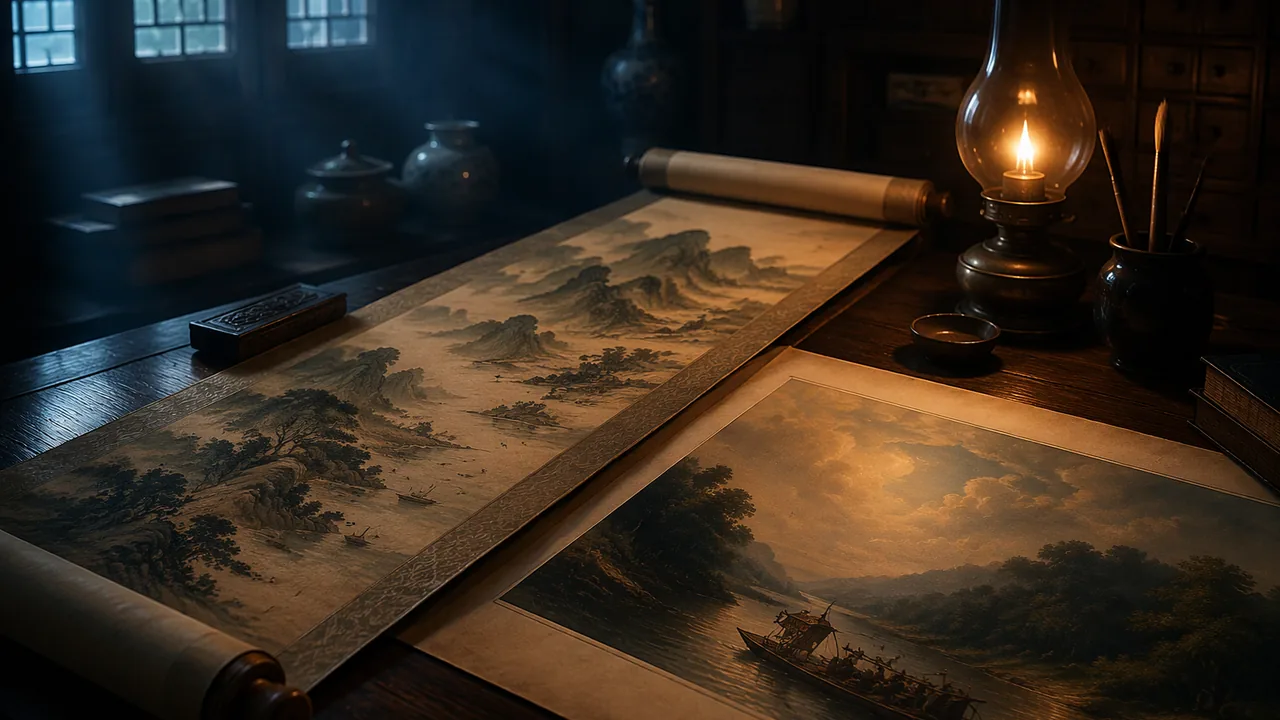
compare the purposes landscape painting has served in several cultures, and connect those purposes to the style and composition of specific works.
Instruction
A landscape is never just a view. Artists choose which land to paint, from where, for whom and why, and those choices carry ideas about nature, power, belief and belonging. The approved record asks students to identify similarities and differences in the purposes of art in selected cultures, and to investigate named landscape painters’ styles and rules of composition. This lesson does both.
Landscape as a world to wander. In China, landscape painting (shanshui, “mountains and water”) was a major tradition centuries before it was in Europe. Guo Xi’s handscroll Old Trees, Level Distance (c. 1080, The Metropolitan Museum of Art) is unrolled a section at a time, so the viewer travels through the landscape rather than seeing it all at once. Writings on painting attributed to Guo Xi describe three kinds of distance, high, deep and level; this scroll’s title names the level view. Five centuries later Dong Qichang’s River and Mountains on a Clear Autumn Day (c. 1624-27, Cleveland Museum of Art) sets an abstract landscape diagonally across the picture, which the museum describes as recalling earlier masters while expressing his own style. For these scholar-painters, landscape was a way to express a mind and to join a conversation with the past.
Landscape as time. The screens Landscape of the Four Seasons (late 1400s, Cleveland Museum of Art) by Yi Sumun, whom the museum describes as a Korean painter believed to have moved to Japan in 1424, show the passage of the seasons when read from right to left. A landscape can hold a year.
Landscape as travel and everyday life. Utagawa Hiroshige’s woodblock print Mishima: Morning Mist (c. 1833/34, Art Institute of Chicago) comes from a series on the stations of the Tōkaidō road, sold to a wide public. Travelers and weather matter as much as the land.
Landscape as mood and music. The Rajput painting Maru Ragini (1650-80, Cleveland Museum of Art) belongs to a ragamala, a series of paintings of musical modes. A warrior stands with his camel at a green stream against an intensely yellow ground. The landscape is a mood, not a map.
Landscape as ideal, nation and sublime. Claude Lorrain’s View of Delphi with a Procession (1673, Art Institute of Chicago) imagines an ancient, idealized world, as Claude’s classical landscapes typically do. John Constable painted the Suffolk countryside he grew up in, as in Stoke-by-Nayland (1836, Art Institute of Chicago). J. M. W. Turner’s Fishing Boats with Hucksters Bargaining for Fish (1837-38) is a sea piece of boats, weather and working people.
Landscape as perception and feeling. Claude Monet painted many canvases of the same stacks of wheat in different light and seasons in 1890-91, including Stacks of Wheat (End of Summer) and Stacks of Wheat (Sunset, Snow Effect) (Art Institute of Chicago). Vincent van Gogh’s The Poet’s Garden (1888) is built from visible, directional strokes. Winslow Homer’s The Herring Net (1885) makes the sea a place of work.
Landscape and story. Robert S. Duncanson, based in Cincinnati, was, in the Cleveland Museum’s words, the first African American artist to achieve recognition both nationally and abroad. His Vale of Kashmir (1867) was inspired by Thomas Moore’s poem Lalla-Rookh, yet the human figures stay subordinate to the landscape.
Landscape as argument: Missouri’s rivers. George Caleb Bingham (1811-1879), who spent much of his childhood in Franklin, Missouri, and was mostly self-taught, painted the people who worked the Missouri and Mississippi rivers. In Raftsmen Playing Cards (1847, Saint Louis Art Museum, 50:1934) six raftsmen play cards on a simple raft in the haze of early morning. The Saint Louis Art Museum points out what a first glance misses: a sandbar at the left and a snag, a fallen tree, breaking the water at the right, dangers that could wreck rafts and steamboats. Bingham was also a politician, and the museum reads the painting as an argument: his clean, collegial river workers present Missouri as trustworthy, and the snag makes the case for clearing the rivers with federal funds. His earlier Fur Traders Descending the Missouri (1845, The Metropolitan Museum of Art, 33.61) is set on the same river. Here a landscape is a calm view and a political claim at once.
Landscape as a record of harm. A contemporary Missouri example works the other way. Emmet Gowin’s aerial photograph The Abandoned and Condemned Village of Times Beach, Missouri (1989, Saint Louis Art Museum, 26:2021) shows a town on the Meramec River in early morning light, a tidy street grid that looks peaceful. The museum explains that the town was declared uninhabitable in 1982 after a contractor sprayed its roads with the toxic chemical dioxin, and was fully evacuated by 1985. The photograph is under copyright; we study it by description. Ask what it means to make a beautiful picture of a damaged place.
📖 Read for this lesson
The reading opens over the lesson; close it to come back to exactly where you were. The checks below draw on it.
Formative check
Work through these before moving on. They are not graded — they tell you whether the standard below has landed yet.
How does the handscroll format change the experience of Guo Xi’s landscape compared with a framed European painting?
Guo Xi (c. 1080)
Tap to revealLandscape to wander through; high, deep and level distance.
Yi Sumun (late 1400s)
Tap to revealFour seasons read right to left across screens.
Hiroshige
Tap to revealTravel and weather on the Tōkaidō road; prints for a wide public.
Maru Ragini
Tap to revealLandscape as the mood of a musical mode.
Monet, Stacks of Wheat
Tap to revealOne motif in many lights: landscape as perception.
Duncanson
Tap to revealStory subordinate to grand landscape; first African American artist recognized nationally and abroad.
Bingham, Raftsmen Playing Cards (1847)
Tap to revealMissouri river workers at ease, with a snag and sandbar: landscape as an argument for clearing the rivers.
Choose two landscapes from different cultures. What purpose does each serve, and how does its composition or style serve that purpose? Describe your own response to one of them.
How confident are you that you can compare the purposes of landscape in several cultures and connect purpose to composition and style?
Practice
Work these on paper or in your notebook, then open Check your answer. Aim for all of Fluency and Application; try at least one Challenge.
Printable version: this unit’s practice workbook (PDF)
Fluency
Build speed and accuracy with the core skill.
- Define shanshui, handscroll and ragamala.
Check your answer
Answer: Shanshui: “mountains and water,” the Chinese term for landscape painting. Handscroll: a long horizontal painting unrolled a section at a time from right to left. Ragamala: a series of Indian paintings, each representing a musical mode (raga or ragini).Glossary terms from the lesson. - Name the three kinds of distance described in writings attributed to Guo Xi. Which one does the title Old Trees, Level Distance name?
Check your answer
Answer: High, deep and level. The title names the level view.In Lesson 2.3: looking up at a peak, deep into a valley, level across to far hills. - Match each work to the purpose of landscape the lesson gives it: (a) Yi Sumun, Landscape of the Four Seasons; (b) Hiroshige, Mishima: Morning Mist; (c) Maru Ragini; (d) Claude Lorrain, View of Delphi with a Procession.
Check your answer
Answer: (a) landscape as time (seasons read right to left); (b) travel and everyday life (stations of the Tōkaidō road, sold to a wide public); (c) mood and music (a musical mode); (d) an ideal, imagined ancient world.A landscape is never just a view: each purpose shapes the choices.
Application
Use the skill in context. Show your reasoning.
- How does the handscroll format change how a viewer experiences Guo Xi’s landscape compared with a framed painting? Connect the format to the scholar-painters’ purpose.
Check your answer
Answer: The viewer unrolls it section by section and travels through the landscape over time rather than seeing it all at once. That suits a landscape meant as a world to wander and, for scholar-painters, a way to express a mind and join a conversation with the past.A strong answer links format (sequence, time) to purpose. - The Saint Louis Art Museum reads Bingham’s Raftsmen Playing Cards (1847) as an argument. Identify the two details a first glance misses and explain the argument.
Check your answer
Answer: A sandbar at the left and a snag (a fallen tree) breaking the water at the right, dangers that could wreck rafts and steamboats. Bingham, also a politician, shows clean, collegial river workers to present Missouri as trustworthy, while the snag makes the case for clearing the rivers with federal funds.The painting is a calm view and a political claim at once. - Emmet Gowin’s aerial photograph of Times Beach, Missouri (1989) shows a tidy, peaceful-looking street grid. What does the museum say happened there, and what question does the lesson ask about the image?
Check your answer
Answer: The town on the Meramec River was declared uninhabitable in 1982 after a contractor sprayed its roads with the toxic chemical dioxin, and it was fully evacuated by 1985. The lesson asks what it means to make a beautiful picture of a damaged place.Here landscape works as a record of harm, the reverse of an ideal view. - Compare the purposes of Constable’s Stoke-by-Nayland and Monet’s Stacks of Wheat series, using the lesson’s descriptions.
Check your answer
Answer: Constable painted the Suffolk countryside he grew up in, landscape as a place of belonging. Monet painted many canvases of the same stacks of wheat in different light and seasons (1890-91), landscape as perception: each canvas tests a different condition of light.Any comparison that names a distinct purpose for each, with evidence from the lesson, is acceptable.
Challenge
Stretch problems. Expect to think before you write.
- Duncanson’s Vale of Kashmir (1867) was inspired by Thomas Moore’s poem Lalla-Rookh, yet its figures stay subordinate to the landscape. Using the A-semester idea of dominance and subordination, explain what that choice says about the painting’s purpose.
Check your answer
Answer: The landscape dominates and the human story is deliberately subordinated, so the painting is about the grandeur of the place more than the narrative; the poem gives a starting point, and the land carries the mood.A strong answer applies dominance and subordination to subject matter, not only to value and edge.
Review
Keep earlier skills sharp.
- Review (Lesson 1.1): Peto’s Books on a Table and Monet’s Stacks of Wheat both deal with time. How differently does each show it?
Check your answer
Answer: Peto uses outdated objects (a quill pen and candle by 1900) and turning pages as signs of passing time; Monet paints the same motif in many lights and seasons, so time appears as changing light across a series.One uses symbolic objects in shallow space; the other a series of perceptions of one place.
Fifteen Landscapes from Many Traditions: Museum Records, Descriptions and a Comparison Grid
Museum open-access records, retrieved Sept. 26, 2026: Met 1981.276; Cleveland 1959.46, 1976.92, 2018.168, 2014.12; Art Institute of Chicago 1932.170, 1941.1020, 1922.4453, 1922.4472, 1985.1103, 1922.431, 1933.433, 1937.1039; Saint Louis Art Museum 50:1934 and Art as Advocate educator resource, Met Open Access API 33.61, retrieved Nov. 10, 2026 · Public domain (the artworks other than the Gowin photograph, which is described only; museum records under CC0), with SLS original descriptions and comparison grid. Cleveland catalog text is CC0; Saint Louis Art Museum text is summarized.
Why this reading. Your task is to compare the purposes of landscapes from different cultures and tie each purpose to composition and style. That needs the works in front of you. Below, each of the lesson’s landscapes has its museum record and a description of what is in it, where the horizon sits and how the space is built, so your comparison can be made from this page. Museum links in the lesson are a convenience only. Records checked against museum open-access data on Sept. 26, 2026. Horizon positions are measured on the museums’ photographs and are approximate.
A. Landscape to wander through and to join a conversation (China)
Guo Xi, Old Trees, Level Distance, ca. 1080, Northern Song dynasty. Handscroll, ink and color on silk. Painting 35.6 × 104.4 cm; with its mountings the scroll is 37.5 cm high and 853.8 cm (about 28 feet) long. The Metropolitan Museum of Art, 1981.276, public domain. What you see in the opening section: a low, misty scene in gray-brown ink. Three gnarled bare trees with twisting branches stand at center right, and a small roofed pavilion rises among them. Low banks sweep across the foreground, a few large rocks sit at lower right, and at left two tiny figures stand on a plank bridge beside a little boat; faint hills fade into mist behind. There is no bright color and no hard edge in the distance. A scroll this long can only be seen a section at a time, so the viewer moves through it.
Dong Qichang, River and Mountains on a Clear Autumn Day, c. 1624–27, Ming dynasty. Handscroll, ink on Korean paper; painting only 38 × 136.8 cm. Cleveland Museum of Art, 1959.46, CC0. What you see: pale paper with a landscape in dry gray ink. Rounded, stacked masses of rock rise across the upper left and center, tipped with small pines; a broad band of empty, unpainted paper below them reads as river; a line of tall, slim trees runs diagonally down toward the right foreground. The museum says Dong “places an abstract landscape composition diagonally across the picture plane, configured to recall earlier masters and simultaneously express his own personal style.” Cleveland translates his inscription: “Huang Gongwang’s Autumn Day, looks like this. I truly regret the master has not seen my work.” Notice the boast: the painter is answering an earlier master.
B. Landscape as the passage of time (Korea and Japan)
Yi Sumun, Landscape of the Four Seasons, late 1400s. Pair of six-panel screens, ink and slight color on paper; overall 92.7 × 348.7 cm. Cleveland Museum of Art, 1976.92, CC0. Cleveland says Yi Sumun is believed to have been a Korean painter who moved to Japan in 1424, and that the screens, viewed from right to left, show the passage of the four seasons. What you see: two screens, each six panels wide, with a large lake or river winding through both. Steep cliffs and pine-covered rocks stand at the left of the lower screen; misty mountains recede behind a bridge at the right of the upper one; small figures, boats and pavilions are scattered along the water. Everything is in shades of ink with faint color.
C. Landscape as travel and everyday life (Japan)
Utagawa Hiroshige, Mishima: Morning Mist, from the series Fifty-three Stations of the Tokaido Road, c. 1833/34. Color woodblock print, 24.3 × 37.5 cm. Art Institute of Chicago, 1932.170, public domain. What you see: a deep blue band across the very top that fades to white below it. In the foreground, travelers stand in a pale gray-beige mist: porters in blue and round straw hats carry a passenger in a sedan chair, and behind them a rider in a blue jacket sits on a horse loaded with green bundles. To the right stand two dark pine trees, in front of a gray torii gate and stone lanterns that fade into mist. At left more figures are only gray silhouettes. Foreground figures are the darkest, most detailed and most saturated; everything else is flat gray and pale. There is no horizon line.
D. Landscape as mood and music (India)
Maru Ragini, from a Ragamala (Garland of Melodies), 1650–80, Northwestern India, Rajasthan. Gum tempera, ink and gold on paper; painting 26 × 17.6 cm. Cleveland Museum of Art, 2018.168, CC0. What you see: an orange border decorated with blue flowers frames a tall picture. A young warrior in a white robe with a spear stands beside a camel on an intensely yellow ground; two dark green, feathery trees with big leaves rise on either side against a gray sky at the top; a green band of grass and small flowers runs across the bottom. The ground is flat color with no cast shadow. Cleveland notes that the musical mode is based on folk melodies of Rajasthan, where local stories feature a hero with a camel mount.
E. Landscape as ideal, place, and weather (Europe)
Claude Lorrain, View of Delphi with a Procession, 1673. Oil on canvas, 101.6 × 127 cm. Art Institute of Chicago, 1941.1020. What you see: a dark, wooded rock mountain fills the left half; a small round temple crowns its summit and old towers and walls cling to its foot. A tall dark tree at the right frames the view; between them the sea and pale blue mountains recede to a horizon about 59 percent of the way down. A stone bridge runs in from the left; a procession of figures with a garlanded ox crosses the lower middle. The foreground is dark, the middle ground golden, the far distance pale blue.
John Constable, Stoke-by-Nayland, 1836. Oil on canvas, 126 × 169 cm. Art Institute of Chicago, 1922.4453. What you see: a huge sky of thickly brushed white and blue clouds fills the upper 45 percent. A church tower and cottages stand small at the left horizon. A dark mass of large trees rises right of center and frames the scene. In the foreground a horse and cart stand at lower right, and a figure sits near a fence at left; a curving track leads from the foreground to the village.
J. M. W. Turner, Fishing Boats with Hucksters Bargaining for Fish, 1837–38. Oil on canvas, 174.5 × 224.9 cm. Art Institute of Chicago, 1922.4472. What you see: a large boat at left with a pale, tilted sail and a crowd of people aboard rides a swelling gray-green sea; a dark storm mass fills the upper left and light breaks across the upper right; small boats and a buoy lie to the right; the horizon sits low at about 70 percent down.
F. Landscape as perception and feeling
Claude Monet, Stacks of Wheat (End of Summer), 1890–91. Oil on canvas, 60 × 100.5 cm. Art Institute of Chicago, 1985.1103. Two haystacks (a large one at right, a small one at left) glow orange-pink against blue-purple low hills; the sky is pale yellow and lilac; the horizon is about 30 percent down; long blue and pink shadows lie across the grass. Stacks of Wheat (Sunset, Snow Effect), 1890–91, oil on canvas, 65.3 × 100.4 cm, Art Institute of Chicago, 1922.431: two stacks stand in snow under an orange sunset sky, with blue shadows on the snow and the horizon about a quarter of the way down. Same subject, two pictures: the colors of everything change with the light.
Vincent van Gogh, The Poet’s Garden, 1888. Oil on canvas, 73 × 92.1 cm. Art Institute of Chicago, 1933.433. Every area is built from separate, directional strokes: horizontal in the yellow-green sky, curved dabs in the round bushes and trees, tall vertical strokes in the green lawn. A pale blue roof peeks out at the left edge; a weeping tree with a red trunk stands at right. The horizon is hidden by trees.
Winslow Homer, The Herring Net, 1885. Oil on canvas, 76.5 × 122.9 cm. Art Institute of Chicago, 1937.1039. Two fishermen in a small dory haul a net heavy with silvery blue herring over the side; the sea is choppy green-gray, the sky a hazy brown-gray, and the horizon about halfway up the picture; small sailing vessels are faint on the horizon; a red-orange buoy floats at lower center.
G. Landscape and story
Robert S. Duncanson, Vale of Kashmir, 1867. Oil on canvas; unframed 73 × 132.4 cm. Cleveland Museum of Art, 2014.12, CC0. What you see: a wide view across a lake to pale blue mountains at the center; dark tropical trees and palms frame the left and right; a tiny boat and a group of figures near a fountain and monumental steps on the right; light hazy sky. Cleveland says Duncanson, who was based in Cincinnati, was “the first African American artist to achieve recognition both nationally and abroad,” and that the painting was inspired by an episode in Thomas Moore’s poem Lalla-Rookh (1817); despite its storytelling details, “the human elements remain subordinate to the overwhelming splendor of the natural landscape.”
H. Landscape as argument and as record (Missouri)
George Caleb Bingham, Raftsmen Playing Cards, 1847. Oil on canvas, 28 1/16 × 38 1/16 in. (71.3 × 96.7 cm). Saint Louis Art Museum, Bequest of Ezra H. Linley, by exchange, 50:1934. What the museum describes: six raftsmen enjoy a quiet game of cards aboard a simple raft in the haze of early morning. A sandbar lies to the left, and a snag, a fallen tree, breaks the river’s surface to the right; both could wreck rafts and steamboats. The museum says Bingham, primarily self-taught, spent much of his childhood in Franklin, Missouri, and as an artist and politician used paintings to lobby for commerce and investment in his home state; the painting was shown first in St. Louis and then in New York in 1847. Throughout the 1840s Bingham and other Whig politicians urged federal funding to clear the Mississippi and Missouri rivers, and the museum reads the snag as part of that argument.
George Caleb Bingham, Fur Traders Descending the Missouri, 1845. Oil on canvas, 29 × 36 1/2 in. (73.7 × 92.7 cm). The Metropolitan Museum of Art, Morris K. Jesup Fund, 1933, 33.61, public domain. The Met records Bingham as born in Augusta County, Virginia, in 1811, and as dying in Kansas City, Missouri, in 1879. Open the record and describe it yourself with the grid below: where is the horizon, what fills the foreground, and how does the river lead the eye?
Emmet Gowin, The Abandoned and Condemned Village of Times Beach, Missouri, 1989. Photograph, Saint Louis Art Museum, 26:2021. Under copyright; studied by description only. What the museum describes: an aerial view in early morning light, looking east, from a series recording places where people have radically altered landscapes. The tidy street grid looks peaceful and shows no sign of the chemicals. Times Beach, about 17 miles southwest of St. Louis on the Meramec River, was declared uninhabitable in 1982 after a contractor sprayed its roads with dioxin to control dust; it became an EPA Superfund site and was fully evacuated by 1985.
Comparison grid for your sketchbook
| Question | Worked row: Guo Xi | Worked row: Monet |
|---|---|---|
| Where is the viewer? | Moving along the scroll, a section at a time | Standing in front of a field at a fixed time of day |
| Purpose | To wander mentally through a misty landscape | To record how light changes color |
| Composition | Low banks, three trees as the center, faded hills | Two stacks, horizon 30 percent down, long shadows |
| Style and color | Ink on silk, gray-brown, soft edges | Short strokes of unblended color |
| Evidence | Met 1981.276; scroll length 853.8 cm | AIC 1985.1103 and 1922.431 |
Choose four works from different sections A–H, fill one column each, and add a sentence connecting each work’s purpose to its composition or style.
Sources: The Metropolitan Museum of Art, Open Access, Guo Xi, Old Trees, Level Distance (1981.276) (metmuseum.org); Cleveland Museum of Art Open Access: 1959.46, 1976.92, 2018.168, 2014.12 (clevelandart.org); Art Institute of Chicago open-access API (records cited above) (artic.edu); Saint Louis Art Museum, George Caleb Bingham, Raftsmen Playing Cards (50:1934) (slam.org); The Metropolitan Museum of Art, Open Access API, George Caleb Bingham, Fur Traders Descending the Missouri (33.61) (metmuseum.org); Saint Louis Art Museum, Art Along the Rivers educator resource: Art as Advocate (Bingham; Gowin and Fentress, Times Beach) (slam.org)