present a documented portfolio and sustained investigation, exhibit my work in a curated home or online exhibition, and defend my development as an artist in a recorded defense.
Instruction
This is the capstone of the year. The approved course record expects every advanced art student to exhibit at the end of the year and to take part in critique; in this course the exhibition is one you curate at home or online, the critique is your own against published criteria, and the defense is recorded. This task brings the exhibition, the portfolio and the defense together.
The portfolio. At least twelve works from the year, photographed and documented as in Lesson 4.2, in a physical portfolio and a digital version. Six to eight works form the sustained investigation, presented in a sequence you choose, with six to ten process pages from your log (experiments, failures, revisions). The remaining works show breadth: different media, two- and three-dimensional work, and different approaches. Include the rework from Lesson 4.3 with its rationale.
The statement. Your final 300-500-word artist statement, revised after a day away and a reading aloud in front of the work, and, if possible, after one reading by a parent or other adult.
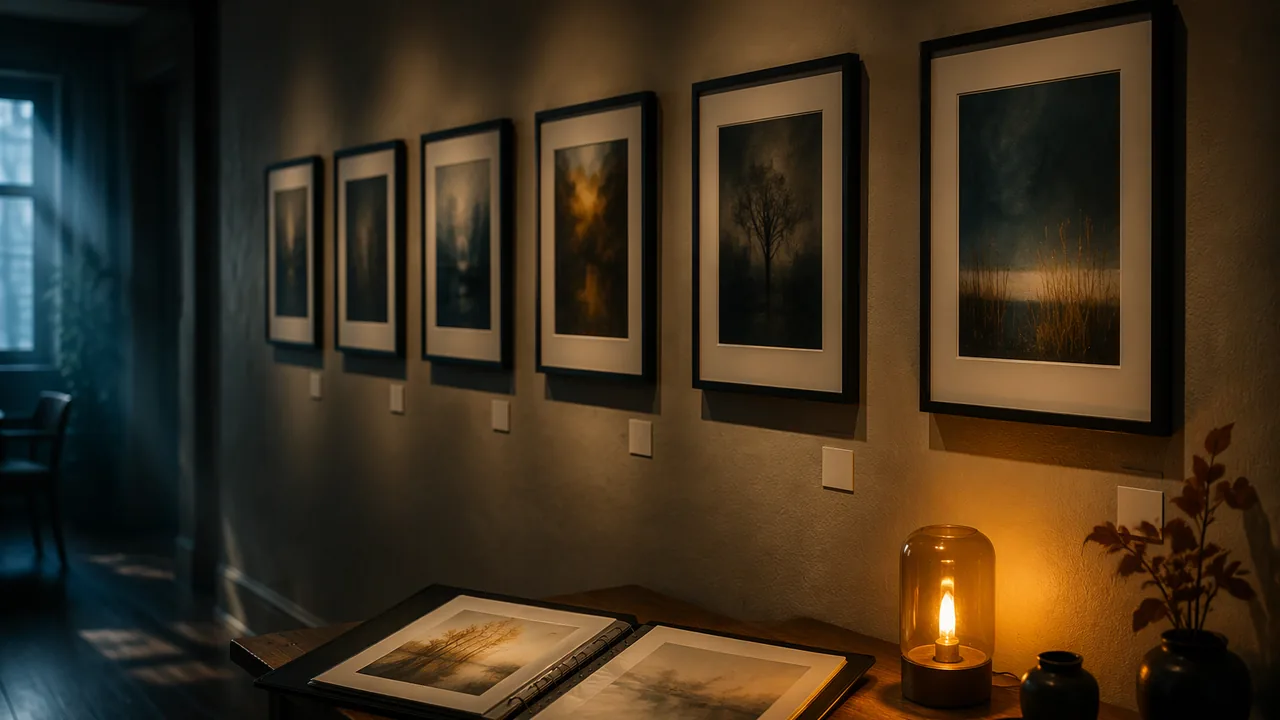
The exhibition. Install your show according to your curatorial plan: hang work level and at the planned height with removable hooks or tape a parent approves, set out three-dimensional work on a stable surface, place labels and wall text, and check lighting and the path through the room. Standard VA:Pr5A.II asks you to apply methods appropriate to the place. After installation, walk the show as a visitor and fix one thing. Finish the catalog or online version with the same order, labels and alt text. Show it to at least two visitors: family members, invited guests, or, online with a parent’s permission, two people who respond in writing. Record the two conversations or responses in your log.
The defense. A recorded five-minute presentation in front of your work or your catalog, followed by recorded or written answers to the panel questions published in the brief. A family member or other adult may watch and ask the questions. Cover:
- Your investigation’s question, and how it changed from the midyear proposal.
- Two works that mark turning points, and what you learned from each.
- One work you reworked, and why.
- One artist or tradition from the year that shaped your approach.
- What you would investigate next.
Expect questions such as: Which work are you least satisfied with, and why is it here? What would you cut if you could show only eight works? How does your statement’s claim show in this piece? Answer at least three of the published questions.
Scoring. The rubric follows the record’s criteria (originality and inventiveness, design and composition, technique and workmanship, development of ideas) and adds the investigation, the presentation and the defense.
After the show. Take the show down carefully and store the works as your preservation plan says. Keep the digital version, the catalog and your log; they are the start of your next portfolio, whether for college, a job, or your own continuing work.
📖 Read for this lesson
The reading opens over the lesson; close it to come back to exactly where you were. The checks below draw on it.
Formative check
Work through these before moving on. They are not graded — they tell you whether the standard below has landed yet.
One of the published panel questions asks, “If you could show only eight works, what would you cut?” What does a strong answer do?
Name the two works that mark turning points in your investigation and what each taught you. What would you investigate next?
How confident are you that you can present my portfolio and investigation, exhibit my work and defend my development in a recorded defense?
Unit 4 checkpoint
Do this before you start the task. It covers the whole unit and tells you what to review first.
Which role researches when, where, why and by whom works were made, and revises attributions?
Daumier’s title Nadar Elevating Photography to the Heights of Art puns on a real balloon ascent and on whether photography could rank as art.
Which Missouri institution was founded in 2001 by the curator and collector Emily Rauh Pulitzer?
A philosopher who asks what art and beauty are and how judgments of taste can be justified is an .
A 9 x 12 inch drawing goes in a 14 x 17 inch mat with an 8.5 x 11.5 inch opening. What is each side border?
Digitally removing a smudge that is on the real artwork is honest correction.
The trapezoid shape produced when a camera is not parallel to a flat artwork is called distortion.
The juror and the investigation reviewer rank the same drawing differently. Why?
A rework that does not solve the problem has no value in the portfolio.
Which is the strongest opening for an artist statement?
Using a 57-inch center line, where is the top edge of a 24-inch-tall work?
Submit: Sustained investigation portfolio, artist statement, installed exhibition and portfolio defense
Task: Present a documented portfolio of at least twelve works (six to eight forming your sustained investigation, with process pages), a 300-500-word artist statement, your curated home or online exhibition with its catalog, and a recorded five-minute portfolio defense with answers to the panel questions.
Submission workflow
- Stage 1 — Plan. Portfolio selection with reasons, investigation sequence, statement draft, and curatorial plan, checked against the Stage 1 checklist in the brief.
- Stage 2 — Self-critiqued draft. Statement reread after a day away (and, if possible, read by a parent or other adult); a recorded practice defense scored against the rubric; one work reworked with its rationale.
- Stage 3 — Final portfolio and exhibition. Documented portfolio (physical and digital), final statement, and the installed home showing or finished online exhibit with labels, wall text and a catalog.
- Stage 4 — Defense. Recorded five-minute portfolio defense with recorded or written answers to at least three panel questions, and notes on two visitor conversations or responses.
How it is scored
| Criterion | What proficient looks like |
|---|---|
| Sustained investigation (VA:Cr2A.III) | A clear question pursued through six to eight works that build on each other, with evidence of experiment, risk and revision. |
| Technique, design and breadth (VA:Cr1B.III) | Skilled handling across several media, strong composition, and a range of 2D and 3D approaches. |
| Reflection and reworking (VA:Cr3A.III) | A reasoned rework with evidence; development over the year explained. |
| Selection, statement and exhibition (VA:Pr4A.III) | Selection and sequence justified; statement specific and supported by the work; installation or online exhibit carefully presented and accessible. |
| Defense (VA:Re7A.III) | Explains the investigation’s development and turning points; answers questions with evidence from the work. |
Portfolio Task 8 Brief: Criteria, a Timed Five-Minute Defense, Strong and Weak Answers, a Process Page and Installation Checklist
SLS original brief and constructed exemplar; the student and works are invented for this course. Access-route minimum from the U.S. Access Board ADA guide, viewed Sept. 26, 2026 · SLS original
Why this reading. This is the full brief for the capstone, Portfolio Task 8: the assignment, four-level criteria, a complete five-minute defense script with timing, the published panel questions with strong and weak answers, a process-page example, the installation checklist, a self-score sheet and the visitor-conversation log. Everything is an SLS original; the student and works are invented for this course. The sample portfolio and statement they refer to are in the readings for Lessons 4.3 and 4.4.
The assignment
Submit and present: (1) a portfolio of at least 12 documented works, physical and digital, with 6 to 8 forming the sustained investigation in a sequence you choose, 6 to 10 process pages from your log, at least one three-dimensional work, and the rework from Lesson 4.3 with its rationale; (2) your final 300–500-word artist statement, revised after a day away and a reading aloud in front of the work (and, if possible, one reading by a parent or other adult); (3) your curated exhibition: a home showing or an online exhibit (shared only with a parent’s permission), with labels, wall text and a catalog; (4) a recorded five-minute defense, followed by recorded or written answers to at least three of the published panel questions below; (5) notes on two conversations with visitors or two written responses.
Stage 1 checklist
Portfolio list (at least 12, with 6–8 investigation works marked); investigation sequence; statement draft; curatorial plan with selection, wall plan or slide sequence, and preservation list.
Criteria, four levels
| Criterion | 4 Exceeds | 3 Meets | 2 Approaching | 1 Beginning |
|---|---|---|---|---|
| Sustained investigation | Clear question; 6 to 8 works that each build on the last; evidence of experiment, risk and revision on process pages | Clear question; 6 works that connect | Works are on one theme but do not build | Unconnected works |
| Technique, design and breadth | Skilled work in several media; strong composition; 2D and 3D | Skilled in two media; some 3D | One medium mostly | Uneven throughout |
| Reflection and reworking | The rework has a stated problem, evidence, change and result; development explained across the year | Rework explained | Rework described without evidence | No rework |
| Selection, statement, exhibition | Selection and sequence justified against criteria; statement’s claims are visible in the work; installation or online exhibit level, labeled, accessible, with alt text | Justified selection; statement clear | Statement generic | Work not installed or labeled |
| Defense | Explains turning points with evidence from specific works; answers questions with evidence and names what is unfinished | Explains development; answers most questions | Describes rather than explains | Does not answer the questions about the work |
A five-minute defense, timed (SLS original; constructed)
The words shown are the core of each segment: about 290 words, roughly two minutes of speech. The remaining time is spent pointing at the works and letting the camera, and any viewer, look.
0:00 to 0:45, the question. “My investigation asks how a neighborhood remembers what its buildings forget. In September my proposal was to draw one corner store in many lights. It has changed: I now ask what remains when the building is gone.”
0:45 to 2:15, two turning points. “The first is Layered Storefront, number 3. I transferred a photograph under tissue and expected a clear image. Instead the face in the window almost vanished. That failed, and it taught me that loss of information was my subject. Number 4 is the revision: I made the loss deliberate. The second is What Stays, no. 2, the collage with the woven map. Before it, my photographs were the most important part of every piece. In it, I made the map the center and moved the photographs to the edge.”
2:15 to 3:15, the rework. “In all three of my reviews, the eye went first to the transferred photograph in the upper left of number 6, not to the map. I glazed the photograph to lower its contrast and put a darker paper under the map. After that, my mother and my uncle looked first at the map. It only partly worked, so I would crop the photograph next.”
3:15 to 4:00, a source. “Monet’s Stacks of Wheat paintings at the Art Institute of Chicago, especially Sunset, Snow Effect, showed me that repeating one subject in changing light is a way of thinking. My store is my haystack.”
4:00 to 5:00, next. “Next I would investigate what people say about the place when the building is gone. That needs sound or writing, not only images, and I do not yet know how to make that. I would start with a listening project, three interviews and one map.”
The published panel questions, with strong and weak answers
Answer at least three on your recording or in writing. A family member or other adult may read them to you.
| Question | Strong answer | Weak answer |
|---|---|---|
| Which work are you least satisfied with, and why is it here? | “Number 2, the sign study. It is a study, and on a wall it looks unfinished. I kept it as a process page paired with number 1 to show what the drawing taught me, and I would not hang it alone.” | “They are all fine.” |
| What would you cut if you could show only eight? | Names works (cut 5, 8, 9, 10, 11 and 14) and states the criterion: “the ones that do not answer my question,” and what the smaller selection emphasizes: the layered transfers and the map. | “I would cut the newest ones.” |
| How does your statement’s claim show in this piece? | Points at the fading face and reads the sentence: “the pieces that lost information are the ones people stopped to look at.” | “It is about memory.” |
A process page (SLS original)
Date, title, what I tried, what happened, what I learned, what next. Example: “Oct. 12. Layered Storefront (photo under three sheets of tissue). Tried: transfer at full strength. Happened: face lost, sign readable. Learned: tissue hides faces first, text last. Next: try two sheets with the face on the top sheet.” Six to ten pages like this show experiments and failures, not only successes.
Installation checklist
- Each work level, center at 57 inches, 6 inches between works in a row; hung with hooks or tape a parent approves.
- Every work labeled: artist, title, year, medium, dimensions (height × width), one sentence; wall text in place.
- The path through the rooms at least 36 inches wide (the U.S. Access Board’s minimum for an accessible route); labels type at least 24 points; alt text for every image in the catalog or online exhibit.
- Three-dimensional works on stable tables, out of the path; lamps checked so there is no glare on glass or glossy work and no hot lamp near paper.
- After installation, walk the show as a visitor and fix one thing; write it in your log.
Self-score sheet
A day after recording, watch your defense once with the rubric. For each of the five criteria write a score from 1 to 4 and one line of evidence naming a work by number. Total 20 possible. Write one question you answered well and one you would answer differently now, and how. If a parent or other adult watched, they may score it too; keep both sheets.
Visitor conversation log
Record two conversations (at a home showing) or two written responses (online, with a parent’s permission): what the visitor looked at first, what they said the work was about (in their words), one question they asked, and what you would change because of it.
Sources: U.S. Access Board, Guide to the ADA Accessibility Standards, Chapter 4: Accessible Routes (access-board.gov); Art Institute of Chicago, Monet, Stacks of Wheat (Sunset, Snow Effect) (1922.431) (artic.edu)