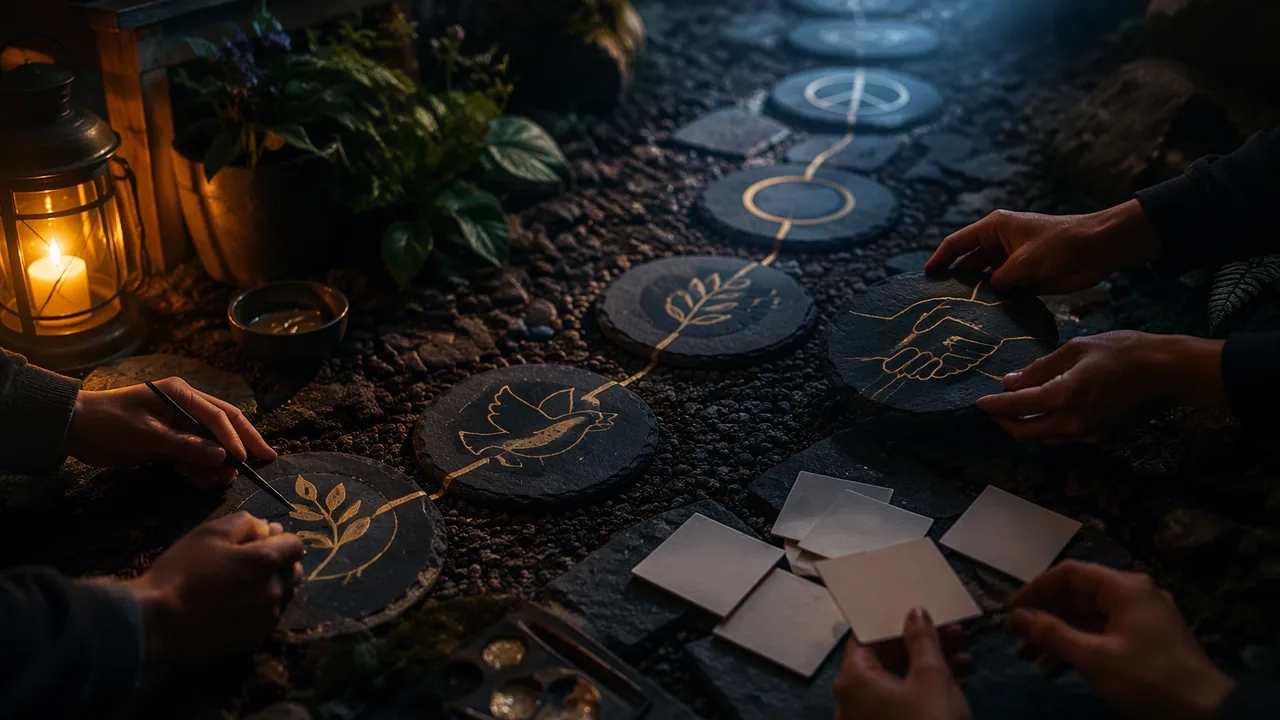
research and design symbols of peace, love and harmony from a cultural tradition, paint them durably on a stone, and plan an installation that transforms a place at home or a site an adult approves.
Instruction
The record’s Stepping Stones to Peace project asks students to share their cultural heritage and identity and “visually build a lasting communication of peace.” In the original project each student paints symbols of peace, love and harmony on a slate stepping stone, and the stones are joined by a line representing the unity of cultures. In this course you make your own stone, design its unity line to a published standard so that it could join any other student’s stone in a path, and plan an installation for a real place.
Choosing a tradition. You may draw on your family’s culture of origin, a community you belong to (a faith, a neighborhood, a language), or a tradition you have studied. You never have to disclose family history you would rather keep private; a stone about a chosen or shared tradition, or about your own values, meets the task fully.
Researching symbols. Symbols of peace and harmony vary. Some are words: salaam in Arabic and shalom in Hebrew both mean peace and are used as greetings. Some are written characters: the Chinese character 和 (hé) carries meanings of harmony and peace. Some are images: an olive branch, a dove, clasped hands, a shared meal, a circle. Many communities have their own. Research at least three from reliable sources: family members or community elders if you choose, museum object pages, library books or cultural organizations. Record the source of each symbol and what it means in its own tradition.
Respect. Some symbols are sacred or belong to specific communities and are not open for anyone to use. Standard VA:Cr2B.III asks you to balance freedom and responsibility in the use of images. If you are not part of a tradition, choose symbols its members share publicly, and check their meaning. Avoid sacred designs of Indigenous nations and religious communities unless you belong to them.
Design. Your stone combines two or three symbols with something of your own identity: a color, a pattern, an initial, a plant. Design for the stone’s shape and for viewing from above while walking. Keep forms bold, because fine detail will not read on a textured surface at a distance. Paint the unity line to the standard in the lab sheet (1 inch wide, 6 inches up from the bottom edge, entering the left edge and leaving the right), so your stone would connect with anyone else’s built to the same rule.
The stone. Use only a stone your family owns or buys: a slate tile or a smooth concrete paver from a garden or hardware store, usually a few dollars. Never take stones from parks, streams, conservation areas or anyone else’s property. A low-cost alternative is a ceramic floor tile or a square of heavy cardboard sealed with acrylic varnish for an indoor display.
Painting on stone. Clean the stone with water and a stiff brush and let it dry completely. If the surface is porous, an adult applies a thin coat of water-based exterior primer outdoors. Transfer the design with chalk or graphite. Paint with exterior acrylic or patio paint in thin layers, letting each dry. Outline with an outdoor paint marker if you want crisp lines.
Sealing. Outdoors, paint wears quickly under feet and sun. Seal the finished stone with two coats of a clear, water-based exterior sealer, brushed on outdoors, with gloves, with an adult present, following the label. Never use spray sealers indoors. Sealed stones last longer, but expect to touch them up over time.
The installation. Standard VA:Cr2C.I asks for a proposal for an installation that transforms the perception and experience of a place. Missouri has a well-known example of art changing how people experience a landscape: Laumeier Sculpture Park in St. Louis County, which, by its own account, opened on July 7, 1976, after the artist Ernest Trova gave 40 artworks to the county, and is one of the first and largest dedicated sculpture parks in the country. Visitors there meet sculpture along trails, so the art changes the walk. Your proposal does the same on a small scale. Choose a real place: a garden path, a porch step, an entry, or, indoors, a shelf or a stretch of floor. If family members want to paint stones too, the shared unity line joins them into a short path; if not, your single stone marks a threshold. Write the proposal to the person responsible for the place (a parent, or a site owner an adult contacts for you): where, why, how people will encounter the stone, and how it will be maintained.
📖 Read for this lesson
The reading opens over the lesson; close it to come back to exactly where you were. The checks below draw on it.
Studio: Stepping Stones to Peace
Question. How can symbols of peace and harmony from a tradition, painted on a stone, be designed to read clearly underfoot, carry a unity line that could join other stones, and change how people experience a real place?
Materials
- One slate tile or smooth concrete paver, about 8-12 inches across, that your family owns or buys (never taken from a park, stream or private property); low-cost alternative: a ceramic tile or heavy cardboard square
- Stiff brush and water for cleaning; water-based exterior primer if the surface is porous
- Exterior acrylic or patio paint (or ordinary acrylic for an indoor piece), brushes of several sizes, an outdoor paint marker if available
- Chalk or graphite for transfer; sketchbook and design templates cut to the stone’s shape; a ruler
- Clear water-based exterior sealer, brushed on outdoors with an adult present (acrylic varnish for an indoor piece); gloves
- Pavers and slate are heavy: lift with bent knees and a straight back, carry one at a time, and work on a low, stable surface or the ground; wear closed-toe shoes.
- Slate edges can be sharp: check the edges and tape them, or ask an adult to sand them, before handling.
- Apply primer and sealer only outdoors, with gloves and an adult present, following the label; never spray sealer indoors.
- Wash hands after painting and before eating; rinse brushes into a bucket and pour the rinse water where the paint label directs, not into a storm drain.
Procedure
- Research three symbols of peace, love or harmony from your chosen tradition; record each source and meaning.
- Draft three designs on templates cut to your stone’s shape, combining two or three symbols with an element of your identity; mark the standard unity line (1 in. wide, 6 in. up) entering the left edge and leaving the right.
- Clean the stone, let it dry completely, and, if it is porous, have it primed outdoors.
- Transfer your chosen design with chalk and paint it in thin layers, letting each dry; add the unity line at the standard color, width and height.
- Photograph the finished stone from standing height; seal it outdoors with two coats of clear water-based sealer with an adult present.
- Lay the stone (and any family members’ stones) in your chosen place, photograph the installation, and write the installation proposal for that place.
Data
| Symbol | Tradition | Meaning in its tradition | Source |
|---|---|---|---|
Analysis
- From six feet away and standing over it, does your stone communicate peace or harmony? Ask a family member what they read in it before you explain, or look at your photo after a day away and write what a stranger would see.
- How did you decide which symbols were appropriate for you to use, and what source confirmed their meaning?
- How does the installation change the place where it is laid? What would you change about its position or the unity line?
If you cannot do this studio in person: If a stone or paver is not available, paint the design on a ceramic tile or a square of heavy cardboard with acrylic and seal it with acrylic varnish (brushed, not sprayed), or produce the design digitally at stone size in Krita or Inkscape and print it for an indoor floor or wall installation.
Formative check
Work through these before moving on. They are not graded — they tell you whether the standard below has landed yet.
A student wants to paint a sacred design from an Indigenous nation they do not belong to. What is the best guidance?
Exterior sealer can be sprayed or brushed in a closed room at home as long as the windows are shut to keep dust out.
Write two sentences for your installation proposal: where your stone should go (at home or at a site an adult approves), and how it will change people’s experience of that place.
How confident are you that you can design and paint a symbolic stone responsibly and plan an installation that transforms a place?
Practice
Work these on paper or in your notebook, then open Check your answer. Aim for all of Fluency and Application; try at least one Challenge.
Printable version: this unit’s practice workbook (PDF)
Fluency
Build speed and accuracy with the core skill.
- Name three words or characters for peace or harmony from the lesson and their languages.
Check your answer
Answer: Salaam (Arabic) and shalom (Hebrew), both meaning peace and used as greetings; the Chinese character 和 (hé), meaning harmony and peace.Images such as an olive branch, a dove, clasped hands, a shared meal or a circle also serve. - Define installation, primer and sealer.
Check your answer
Answer: Installation: an artwork arranged in a specific space so viewers experience the space differently. Primer: a first coat that helps paint grip a surface. Sealer: a clear protective coat that shields paint from wear and weather.Glossary terms from the lab. - State the course’s unity-line standard.
Check your answer
Answer: A line 1 inch wide, 6 inches up from the bottom edge, entering the left edge and leaving the right, so any stone built to the rule connects with any other.On a 12-inch stone, 6 inches is the middle.
Application
Use the skill in context. Show your reasoning.
- Using the lab sheet’s formula, how long is a path of n 12-inch stones with 1-inch joints? Compute it for 4 stones and for 6 stones.
Check your answer
Answer: Length = 12n + (n – 1) inches. 4 stones: 51 inches (4.25 ft). 6 stones: 77 inches (about 6.4 ft).4: 12 x 4 + 3 = 48 + 3 = 51; 51 / 12 = 4.25 ft. 6: 12 x 6 + 5 = 72 + 5 = 77; 77 / 12 = 6.4 ft. - A person 5.5 feet tall stands about 3 feet from a stone on the ground. How far are their eyes from the stone, and how wide should the smallest strokes be by the course guide of at least 1 inch per 10 feet?
Check your answer
Answer: About 6.3 feet; the smallest detail should be about 0.63 inch, so use strokes at least 3/4 inch wide.√(5.5² + 3²) = √(30.25 + 9) = √39.25 = 6.26, about 6.3 ft. 6.3 / 10 x 1 in. = 0.63 in. Bold forms read on a textured surface; fine detail does not. - A student who is not part of a particular Indigenous nation wants to paint one of its sacred designs. What does the lesson advise, and which standard applies?
Check your answer
Answer: Avoid sacred designs of Indigenous nations and religious communities unless you belong to them; choose symbols a tradition’s members share publicly, or ones from traditions you belong to, and check their meaning with a reliable source. Standard VA:Cr2B.III: balancing freedom and responsibility in the use of images.Some symbols belong to specific communities and are not open for anyone to use. - List the safety and environment rules for the stone: getting it, lifting it, priming and sealing it, and cleaning up.
Check your answer
Answer: Use only a stone your family owns or buys, never one from a park, stream, conservation area or other property. Lift with bent knees and a straight back, one at a time, in closed-toe shoes; tape or sand sharp slate edges. Prime and seal outdoors, with gloves and an adult present, following the label; never spray sealer indoors. Wash hands; rinse brushes into a bucket and pour the rinse water where the label directs, not into a storm drain.Standard VA:Cr2B.I: how materials affect health and the environment.
Challenge
Stretch problems. Expect to think before you write.
- Laumeier Sculpture Park opened on July 7, 1976, after Ernest Trova gave 40 artworks to St. Louis County. Explain how it changes the experience of a landscape, and write a two-sentence installation proposal of your own that does the same on a small scale.
Check your answer
Answer: Visitors meet sculpture along trails, so the art changes the walk. Model proposal: “I propose laying my stone at the porch step, where everyone entering the house steps over it. Its unity line points toward the door, so coming home begins with a line that could continue, and I will touch up the paint each spring.”A strong proposal names the place, how people will encounter the stone, and how it will be maintained, addressed to the person responsible for the place.
Review
Keep earlier skills sharp.
- Review (Lesson 3.1): which of the four strategies does a stepping stone of peace symbols mainly use, and why does that strategy suit a small object seen from above?
Check your answer
Answer: Symbolic: its forms stand for ideas (peace, love, harmony) a community can read. Symbols compress meaning into a bold form that can be read quickly underfoot, without needing a story or a written explanation.Like the Akan weights, symbols compress meaning into a form.
Stepping Stones Lab Sheet: A Research Page, Design and Unity-Line Geometry, a Home Paint Plan and a Proposal Model
SLS original lab reference sheet; all dimensions and values set or computed by SLS; Laumeier Sculpture Park facts from its Our Story page, retrieved November 10, 2026 · SLS original
Why this reading. The lab asks you to research three symbols, design for a stone seen from above while walking, paint a unity line to a shared standard, and write an installation proposal for a real place. This sheet gives the research page format with a worked row, the measurements for the design and the unity line, the paint plan, and a model proposal. The example is constructed by SLS; it is not a claim about any one community.
1. Research page: format and a worked row
| Symbol | Tradition | Meaning in its tradition | Source (you must name yours and the date you read it) |
|---|---|---|---|
| The word salaam (Arabic) | Arabic-speaking communities | Peace; also used as a greeting | Worked row: from Lesson 3.2; replace with a dictionary or a community member, dated |
| The word shalom (Hebrew) | Jewish communities | Peace; also used as a greeting | Same |
| The character 和 (hé) | Chinese-speaking communities | Harmony, peace | Same |
Rule for your own row: a symbol only counts if you can name where its meaning came from. If you cannot find a source, choose a different symbol. Avoid sacred designs of Indigenous nations and religious communities unless you belong to them.
2. Design: sizes for a stone seen while walking
Use a 12-in. square stone. A person 5.5 ft tall stands about 3 ft from a stone on the ground, so the distance to it is √(5.5² + 3²) = 6.3 ft. The course guide (SLS, not a standard): the smallest detail should be at least 1 in. of size for every 10 ft, so about 0.63 in.; use strokes at least 3/4 in. wide. Keep two or three symbols on the stone, not five. Test it: draw the design at full size in marker and look at it standing up.
3. The unity line: geometry
The course standard is a line 1 in. wide at 6 in. up from the bottom edge (the middle of a 12-in. stone), entering the left edge and leaving the right edge. Choose a color that contrasts with your stone; if family members paint stones to join yours, agree on one color. Because every stone built to the standard has the line at the same height and width, any two connect when laid side by side. Mark it on your stone first: draw two lines 5.5 in. and 6.5 in. up from the bottom, from edge to edge, and keep every symbol at least 1/2 in. clear of them. The joints between stones are 1 in. wide, so the line breaks for 1 in. at each joint (or is painted onto the gap fill).
How long is a path? For n stones of 12 in. with 1-in. joints, the length is 12n + (n − 1) inches. For 1 stone: 12 in. For 4 stones (yours and three family members’): 12 × 4 + 3 = 51 in., or 4.25 ft. For 6 stones: 12 × 6 + 5 = 77 in., or about 6.4 ft.
4. Paint plan
- Use only a stone your family owns or buys (a slate tile or concrete paver from a garden or hardware store); never take one from a park, stream or private property.
- Clean and dry the stone completely (overnight if it was wet).
- Primer, only if the surface is porous: one thin coat of water-based exterior primer, brushed on outdoors with gloves and an adult present; dry as the label directs.
- Transfer the design with chalk or graphite.
- Paint in thin layers, two to three coats for full coverage, waiting until the surface is dry to the touch (about 15–30 minutes for thin acrylic) between coats.
- Photograph. Seal with two coats of clear water-based exterior sealer, brushed on outdoors with gloves and an adult present, following the label for drying time between coats and before anyone walks on it. Never spray sealer indoors.
5. A model installation proposal (SLS original; constructed)
“To: my parents. I propose setting my stone into the gravel at the start of the path from our driveway to the back door, where everyone who comes home steps over it. The unity line, one inch wide and six inches above the bottom edge, points along the path toward the door, so the walk home begins with a line that could continue. My sister wants to paint a second stone; with hers the path would be 12 × 2 + 1 = 25 inches long, and the line would cross both. The idea comes from Laumeier Sculpture Park in St. Louis County, which opened in 1976 and where sculpture placed along trails changes the walk. I will check the stone each spring, touch up the paint, and reseal it outdoors with an adult.”
Proposal checklist: where; why there; how people meet the stone (walking over it, seeing it from a window, finding it on a shelf); the arithmetic for any path; how it will be maintained; who must approve it.
Sources: Laumeier Sculpture Park, Our Story (laumeiersculpturepark.org)