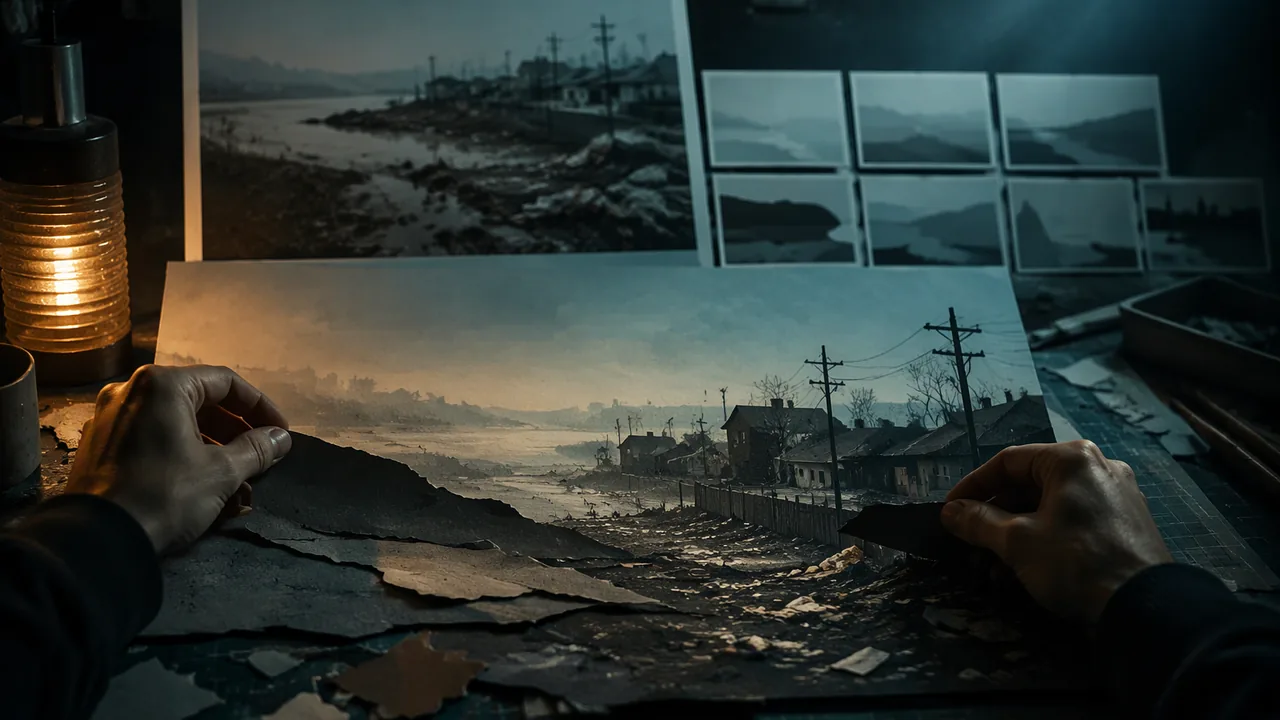
examine my paper landscape in progress against traditional and contemporary criteria, plan and make revisions, compare my approach with a landscape tradition, and review my sustained investigation at its second checkpoint.
Instruction
This task completes the landscape and marks the second checkpoint of your sustained investigation.
What you submit for the unit. The finished paper landscape; your source photographs and thumbnails; a revision note; and a 250-350-word comparison of your approach with one landscape tradition from Lesson 2.1. The comparison should name the purpose your landscape serves (a record of a place, a mood, a memory, a claim about a neighborhood, a view of work or travel) and compare it with the purpose and composition of a specific work.
The self-critique: two sets of criteria. Put the work away for a day. Then examine it twice, once with criteria from a traditional context and once with criteria from a contemporary one, and plan revisions from what each shows. A family member or another adult may look too; write down what they say.
- Traditional criteria. Use the conventions from Lesson 2.3 and the record’s question. Where do the paper strokes add to the visual unity, and where do they detract? Do values and temperatures step from near to far, as atmospheric perspective requires? Is the dominant area clear? If you followed an East Asian convention instead, does your empty or misty area read as space rather than as a gap?
- Contemporary criteria. Many artists today, like Emmet Gowin in his photograph of Times Beach (Lesson 2.1), ask a landscape to be honest about the place, including what people have done to it, rather than ideal. Ask: does your picture show the place as it is, power lines, litter, flood marks and all, or did you tidy it? Is that choice deliberate, and does it serve your purpose?
Write a revision plan with at least two changes, each tied to one of the criteria. Typical revisions: glazing distracting pieces, adding darker, warmer foreground pieces, simplifying a crowded area, strengthening the lightest light at the focal point, or restoring a true detail of the place you had left out. Make the changes, then note in your revision note which criterion each one answered.
Investigation checkpoint 2. Bring four works or substantial studies from your sustained investigation, including any from Unit 1 (your landscape may count if it addresses your question), with your log. In a written self-conference, lay the works side by side and answer the questions on the conference sheet in writing. Standard VA:Pr4A.II asks you to analyze, select and critique personal work for a portfolio. Ask: Which work is the strongest answer to your question so far? Which is weakest, and would you rework it or replace it? What is still untested? Update your plan for the last two or more works.
Care. Let the landscape dry flat. Seal it with a final thin coat of matte medium if the surface is uneven. Store it flat, with a sheet of clean paper over the surface.
Presenting. Record a short artist talk (about three minutes) showing the landscape and reading or summarizing your comparison. You may also show it to your family, or add it to an online portfolio only with a parent’s permission.
Looking ahead. Unit 3 turns from the land to art with a social message. Think about whether your investigation question has a public dimension, something you would want other people to notice or care about.
📖 Read for this lesson
The reading opens over the lesson; close it to come back to exactly where you were. The checks below draw on it.
Formative check
Work through these before moving on. They are not graded — they tell you whether the standard below has landed yet.
At your written self-conference, one of your four works clearly does not answer your question. What is the most useful decision?
Missouri standard: VA:Cr3A.I
Examine your landscape in progress twice: once with a traditional criterion (a convention from Lesson 2.3, such as atmospheric perspective or the use of empty space) and once with a contemporary one (does it show the place honestly, including what people have done to it?). What does each reveal, and which two revisions will you make? Then name the studied work your comparison will use and its purpose.
How confident are you that you can complete a paper landscape, compare it with a tradition, and critique my investigation at its second checkpoint?
Unit 2 checkpoint
Do this before you start the task. It covers the whole unit and tells you what to review first.
How is a handscroll viewed?
What does the Saint Louis Art Museum say the snag in Raftsmen Playing Cards argues for?
Duncanson was, in the Cleveland Museum’s words, the first African American artist to achieve recognition both nationally and abroad.
Distant objects look lighter, cooler and less detailed because of perspective.
On a twelve-part color wheel, how many degrees apart are two complements?
A base wash is laid after the paper pieces, to seal them.
Who turned “impression” into a label for Monet and his colleagues?
In Chinese landscape painting, empty areas of silk or paper read as mist, water or sky.
A shared practice within a tradition, which can be followed or broken, is a .
On a 14 x 11 inch picture with the horizon one-third down from the top, how much area is sky?
Which piece is right for foreground grass?
Submit: Paper-painted landscape, comparison and investigation checkpoint 2
Task: Paint a landscape you have photographed in person with torn and cut paper over an acrylic wash, revise it after a self-critique against traditional and contemporary criteria, compare your approach with a studied tradition, and review four investigation works in a written self-conference.
Submission workflow
- Stage 1 — Plan. Source photographs, three thumbnails, the chosen composition with its conventions labeled, and a wash color decision, checked against the assignment list in the brief.
- Stage 2 — Critiqued work in progress. Landscape at two-thirds complete, self-critiqued after a day away against one traditional and one contemporary set of criteria (an adult viewer optional); revision plan written.
- Stage 3 — Revised final. Finished landscape with revision note, the 250-350-word comparison, and four investigation works with the log.
- Stage 4 — Defense. A recorded artist talk and the written investigation self-conference.
How it is scored
| Criterion | What proficient looks like |
|---|---|
| Composition and depth (VA:Cr1B.III) | Clear planes, a dominant area, and values and temperatures that step from near to far. |
| Paper as brushstroke (VA:Cr2A.III) | Pieces chosen and shaped for hue, value, texture and direction; paper reads as painting. |
| Unity and revision (VA:Cr3A.III) | Distracting pieces resolved; specific changes, each planned from a traditional or a contemporary criterion, explained. |
| Craftsmanship (VA:Cr2A.II) | Secure, flat adhesion; clean surface; wash integrated. |
| Comparison with a tradition (VA:Cn11A.II) | Purpose and composition compared accurately with a specific studied work. |
Portfolio Task 6 Brief: Criteria, an Exemplar Comparison, Revision Note and Critique Sheets
SLS original brief and constructed exemplars; Hiroshige record checked against the Art Institute of Chicago open-access API, retrieved Sept. 26, 2026; Gowin photograph and Times Beach facts from the Saint Louis Art Museum Art as Advocate educator resource, retrieved Nov. 10, 2026 · SLS original
Why this reading. This is the full brief for Portfolio Task 6: the assignment, four-level criteria, an exemplar comparison with commentary, a revision note, and the two sheets you will use in your self-critique and at the investigation self-conference. Everything is an SLS original; the exemplar was written for this course and is not by a real student. The tradition work it uses is Utagawa Hiroshige, Mishima: Morning Mist (c. 1833/34, color woodblock print, 24.3 × 37.5 cm, Art Institute of Chicago, accession 1932.170, retrieved Sept. 26, 2026), described in the reading “Fifteen Landscapes from Many Traditions.” Numbers for the build are in the technique sheet for Lesson 2.4.
The assignment
Submit (1) a paper-painted landscape, at least 11 × 14 in., of a place you photographed yourself; (2) at least ten source photographs and three thumbnails with conventions labeled; (3) a revision note naming the traditional or contemporary criterion each change answered; (4) a 250–350-word comparison of your approach with one landscape from Lesson 2.1, naming your landscape’s purpose and comparing it with that work’s purpose and composition; (5) four works or studies from your sustained investigation with your log and a revised plan.
Criteria, four levels
| Criterion | 4 Exceeds | 3 Meets | 2 Approaching | 1 Beginning |
|---|---|---|---|---|
| Composition and depth | Three clear planes; a dominant area unmistakable at first glance; values step from near to far and the horizon is deliberate | Planes and dominant area clear; values mostly step | Depth partly clear; competing focal points | Flat; no dominant area |
| Paper as brushstroke | Pieces cut and torn for the stroke they stand for; direction follows form; torn and cut edges chosen on purpose | Most pieces shaped for form | Pieces mostly rectangles | Pieces laid randomly |
| Unity and revision | Distracting pieces glazed or replaced; two or more explained changes | One or two distracting pieces remain; two changes explained | One change | No visible revision |
| Craftsmanship | Every piece flat and secure; no gaps of bare board except by choice; clean edges | Mostly flat; a few lifting edges | Bubbles, glue shine, bare gaps | Pieces coming off |
| Comparison | States the purpose of both works; compares composition with specific, checkable details and an accession number | Compares purpose and composition accurately | General statements | No specific work used |
Exemplar comparison (SLS original, about 290 words; constructed)
“My landscape is the main street of my Missouri river town at dusk, made to show that the place I walk past every day is worth looking at. Its purpose is a record of a place with a claim behind it: that a neighborhood full of shop signs and power lines can be beautiful.
Utagawa Hiroshige’s Mishima: Morning Mist (c. 1833/34, Art Institute of Chicago, 1932.170) has a similar purpose. It is one print in a series about the stations of the Tokaido road, made for a wide public, and the travelers matter as much as the land. Hiroshige and I both put people in front of a place instead of leaving it empty. Our compositions are different, though. Hiroshige has no horizon line: mist fills the middle, and he gets depth from tone alone, with the darkest, most detailed shapes (the porters and the rider) in front and each farther shape a lighter gray. I chose a horizon two thirds of the way down (7.33 inches of an 11-inch board) and broke it with two dark bare oak trees. Depth in my picture comes from value steps: sky pieces at about 15 to 30 percent darkness, street strips at 70 to 85 percent.
The biggest difference is the focus. Hiroshige leads the eye to a group of figures. I made a single lit shop window, 1.5 by 1 inch at the lower-right thirds crossing, the lightest and warmest spot. When I came back to it after a day, the red flecks of car lights competed with it, so I cut them from eight to four. Looking at Hiroshige made me see that I had also used mist, in the pale lavender sky pieces, but I had not let it soften the far buildings. My next version would.”
Why this is strong. It states its own purpose first and the studied work’s purpose second; it compares a specific composition device (horizon) and a specific depth device (value steps versus tone); it gives numbers the reader can check; and it names a revision and a next step. Weak versions say “both are nice landscapes with different styles.”
Exemplar revision note (SLS original)
“Self-critique, traditional criteria (question 1): my eye went first to a magazine piece with printed letters in the sky. Cause: text has the highest contrast in the upper half. Change: I brushed a thin glaze of gray-violet acrylic over it, about 25 percent, until the letters no longer read. Result: with the covering-sheet test, my eye, and my father’s when I asked him, now goes to the window first. Contemporary criteria (question 5): I had left out the power lines that cross the street, so the place looked tidier than it is; I added two thin dark cut lines across the sky, which also lead to the window. Still to fix: the foreground strips are too even; I will tear a few shorter pieces.”
Self-critique sheet: traditional and contemporary criteria (fill in after a day away; an adult viewer may add answers)
Part A, traditional criteria (conventions from Lesson 2.3).
- Cover the picture with a sheet of paper and slide it down. What do you look at first? Is it the dominant area you planned?
- Squint: do the values step from light (far) to dark (near)? Name one plane that is out of order.
- Which pieces add to unity? Which detract? Give a location (for example, upper left sky).
- Which paper pieces look like brushstrokes? Which look like scraps?
Part B, contemporary criteria. Many artists today, such as Emmet Gowin in his aerial photograph of Times Beach, Missouri (1989, Saint Louis Art Museum), picture places honestly, including what people have done to them.
- Does the picture show the place as it is, or did you tidy it (power lines, signs, litter, flood marks)? Was that choice deliberate?
- Does the choice serve the purpose you named for the landscape?
Part C, revision plan.
- Two changes, each tied to one numbered question above.
- After making them: which criterion did each change answer, and what still needs work?
Investigation checkpoint 2: self-conference sheet
Lay out four works or studies (including any from Unit 1) and the log side by side. Write: (a) which work is the strongest answer to my question so far, and why; (b) which is weakest and whether I will rework or replace it; (c) what is still untested; (d) the plan for my last two or more works. The next day, reread your answers as a reviewer would, then rewrite the plan in three to five sentences.