compare composition conventions across landscape traditions, and explain how changes in context have changed the interpretation and value of landscape works.
Instruction
The record asks students to study the rules of composition as they relate to each landscape artist’s work, and to compare how the meaning of a work has been affected over time by changes in interpretation and context. This lab does both, because “rules” of composition turn out to be conventions that differ across traditions and change over time.
European conventions. Many European landscapes use a few recurring devices. A foreground, middle ground and background give three planes of depth. Framing elements (trees or buildings at the sides) close the picture like stage wings. A horizon line placed near the upper or lower third rather than the middle gives either the sky or the land priority. Leading lines (a road, river or fence) draw the eye into depth. Atmospheric perspective makes distance. Test these on Claude Lorrain’s View of Delphi with a Procession and Constable’s Stoke-by-Nayland: which devices do you find?
East Asian conventions. Chinese landscape painting uses shifting viewpoints rather than one fixed eye. Guo Xi’s three distances (looking up at a peak, looking deep into a valley, looking level across to far hills) can appear in one scroll. Empty areas of silk or paper are not blank; they read as mist, water or sky and let the composition breathe. Dong Qichang’s River and Mountains on a Clear Autumn Day places its landscape on a diagonal. Hiroshige’s Mishima: Morning Mist uses softened, layered tones to suggest mist and distance. Neither system is “correct”; each serves its purposes.
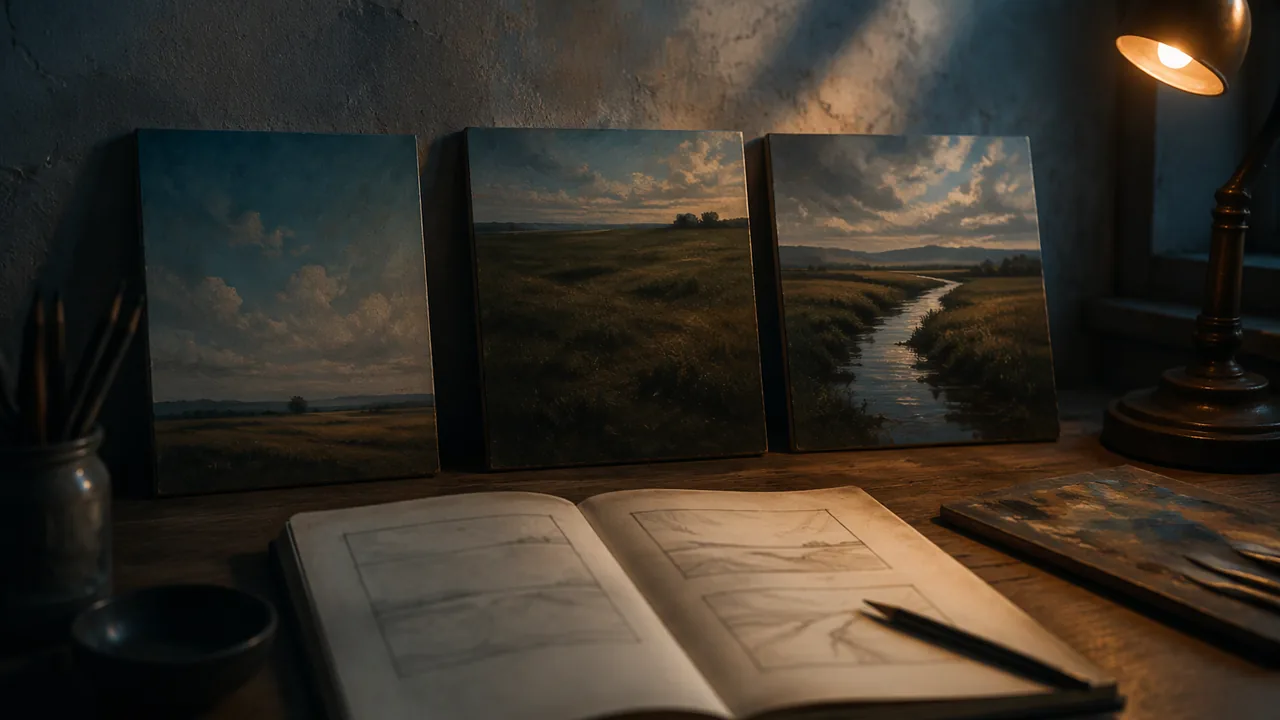
Diagramming. For each of three landscapes, make a thumbnail that shows only the horizon, the main masses, the leading lines and the dominant area. Label the devices. Compare: which conventions are shared, and which are specific to one tradition?
Reputations that changed. In 1874 a group of painters including Monet exhibited independently in Paris. A critic, Louis Leroy, mocked them in a satirical review, borrowing the word “impression” from the title of a Monet painting, and “Impressionists” stuck. Work that some critics saw as unfinished sketches came within decades to be seen as a new way of painting light and perception, and Monet’s series such as the Stacks of Wheat are now among the most admired paintings in American museums. The paintings did not change; the context of interpretation did, as viewers learned to value loose handling, everyday subjects and the direct recording of light.
Robert S. Duncanson’s reputation changed in another way. Recognized in his lifetime in the United States and abroad, he was overlooked for decades after his death; scholarship and exhibitions since the later twentieth century have restored his place, and the Cleveland Museum acquired his Vale of Kashmir in 2014 (the year is in its accession number). Ask: whose landscapes were included in the histories, and why?
George Caleb Bingham shows a third kind of change. Records at the Nelson-Atkins Museum of Art in Kansas City cite a 1966 Kansas City Star headline announcing that the art world had “discovered” Bingham, more than eighty years after his death. The reading of his paintings has changed too: the Saint Louis Art Museum now presents Raftsmen Playing Cards not only as a peaceful river scene but as advocacy, pointing to the snag and sandbar that argued for federal river cleanup in the 1840s. Diagram it: where are the horizon, the raft and the snag, and does the snag break or obey the European conventions above?
Written seminar. Work through these questions in writing, or talk them over with a family member or another adult and note what they say: Are the European “rules of composition” universal, or one tradition’s conventions? Which criteria would you use to judge a Chinese handscroll, and are they the same you would use for Constable? Standard VA:Re9A.III asks you to construct evaluations from differing sets of criteria. End by writing a judgment of one landscape using two different sets of criteria.
📖 Read for this lesson
The reading opens over the lesson; close it to come back to exactly where you were. The checks below draw on it.
Formative check
Work through these before moving on. They are not graded — they tell you whether the standard below has landed yet.
How did the name “Impressionists” come about?
In Chinese landscape painting, unpainted areas of silk or paper are mistakes that the painter did not have time to fill.
Write a judgment of one landscape using two different sets of criteria (for example, European composition conventions and the purposes of a scholar-painter). Where do the verdicts agree and differ?
How confident are you that you can compare composition conventions across traditions and explain how a work’s reputation changed with its context?
Practice
Work these on paper or in your notebook, then open Check your answer. Aim for all of Fluency and Application; try at least one Challenge.
Printable version: this unit’s practice workbook (PDF)
Fluency
Build speed and accuracy with the core skill.
- Name five European landscape composition devices from the lesson.
Check your answer
Answer: Foreground, middle ground and background; framing elements; horizon line near the upper or lower third; leading lines; atmospheric perspective.These are conventions of one tradition, not universal rules. - Name two East Asian landscape conventions the lesson describes.
Check your answer
Answer: Shifting viewpoints instead of one fixed eye (Guo Xi’s three distances can appear in one scroll); empty areas of silk or paper that read as mist, water or sky. (Also: Dong Qichang’s diagonal placement; Hiroshige’s softened layered tones for mist.)Neither system is “correct”; each serves its purposes. - Define convention and explain why the lesson puts “rules” of composition in quotation marks.
Check your answer
Answer: A convention is a shared practice within a tradition, which can be followed or broken. The “rules” turn out to be conventions that differ across traditions and change over time, not universal laws.This prepares the seminar question: are European rules universal?
Application
Use the skill in context. Show your reasoning.
- How did the name “Impressionists” come about, and how did the value of the paintings change afterward?
Check your answer
Answer: In 1874 the critic Louis Leroy mocked the independent exhibition of Monet and others in a satirical review, borrowing “impression” from a Monet title, and the name stuck. Work some critics saw as unfinished sketches came to be seen as a new way of painting light and perception; Monet’s Stacks of Wheat are now among the most admired paintings in American museums.The paintings did not change; the context of interpretation did. - Duncanson’s reputation and Bingham’s both changed after their deaths. Compare the two changes using the lesson’s evidence.
Check your answer
Answer: Duncanson: recognized in his lifetime nationally and abroad, then overlooked for decades; scholarship and exhibitions since the later twentieth century restored him, and Cleveland acquired Vale of Kashmir in 2014. Bingham: a 1966 Kansas City Star headline said the art world had “discovered” him, more than eighty years after his death; and his Raftsmen Playing Cards is now read as advocacy as well as a peaceful scene.Duncanson’s change is about inclusion in the histories; Bingham’s is rediscovery plus a new reading. - Bingham died in 1879. The Kansas City Star “discovered” him in 1966. How many years later was that? Does it fit the lesson’s claim of “more than eighty years”?
Check your answer
Answer: 87 years; yes, more than eighty.1966 – 1879 = 87. - Write a judgment of Hiroshige’s Mishima: Morning Mist using two different sets of criteria: European composition conventions and the print’s own purpose.
Check your answer
Answer: Model: “By European conventions, the print lacks a clear horizon and deep atmospheric recession, because mist replaces the far distance. By the purposes of a print about travel on the Tōkaidō road sold to a wide public, it succeeds: softened, layered tones make the weather and the travelers the subject. The verdicts differ because only the second set fits what the print was made to do.”Standard Re9.HSIII: evaluations from differing sets of criteria; a strong answer notes where they agree or differ and why.
Review
Keep earlier skills sharp.
- Review (Lesson 1.3): the reputations of Harnett, Peto, the Impressionists and Duncanson all changed. Name one cause of change that the Harnett-Peto case had which the Impressionist case did not.
Check your answer
Answer: New evidence about who made the works: Frankenstein’s research re-attributed many “Harnetts” to Peto. The Impressionists’ change came from viewers learning to value loose handling, everyday subjects and the direct recording of light, not from re-attribution.Both are changes in the context of interpretation, with different causes.
Composition Devices, Two Traditions and Three Changed Reputations: Layouts, Records and a Worked Two-Criteria Judgment
Museum open-access records retrieved Sept. 26, 2026 (AIC 1941.1020, 1922.4453, 1932.170, 1985.1103; Cleveland 1959.46, 2014.12; Met 1981.276); Leroy, Le Charivari, 25 Apr. 1874 (English translation, Wikisource, public domain); Saint Louis Art Museum 50:1934 and Art as Advocate educator resource; Nelson-Atkins Museum of Art 66-12 published references; retrieved Nov. 10, 2026 · Public domain (Leroy 1874 and its public-domain English translation; the artworks; museum records under CC0), with SLS original layouts and worked example. Art Institute description text quoted briefly under CC BY 4.0.
Why this reading. The written seminar asks you to diagram composition devices in three landscapes, compare traditions, and explain how a reputation changed. You need the pictures’ layouts, the record of who said what, and a documented history to argue from. The works are described more fully, with museum records, in the reading “Fifteen Landscapes from Many Traditions.” Records retrieved Sept. 26, 2026; positions are approximate fractions of the picture’s width (x) and height (y) measured on the museums’ photographs, with 0,0 at the top left.
Composition devices found in five works (answer key for your diagrams)
| Device | Claude, View of Delphi with a Procession (1673; Art Institute of Chicago 1941.1020) | Constable, Stoke-by-Nayland (1836; AIC 1922.4453) | Hiroshige, Mishima: Morning Mist (c. 1833/34; AIC 1932.170) |
|---|---|---|---|
| Horizon | y = 0.59 (sea, far right) | About y = 0.45 to 0.50, at the church tower’s base; sky fills the top 45 percent | None: mist replaces the horizon; a deep blue band across the top, y = 0 to 0.08 |
| Foreground / middle / background | Dark foreground grass; golden middle with figures; pale blue distant sea and mountains | Foreground lane and cart; middle village and trees; background sky | Dark figures; gray-blue pines and gate; pale gray silhouettes |
| Framing elements | Dark mountain at left (x 0 to 0.55); tall dark tree at right (x 0.65 to 1.0) | Dark tree mass right of center (x 0.35 to 0.85, y 0.05 to 0.75) | Two dark pines at right (x 0.70 to 0.90) |
| Leading line | A stone bridge from the left (x 0 to 0.25, y 0.68 to 0.85) and the track under the procession | A curving track from lower left to the village; the museum calls the right-hand lane “shady, tunnel-like” | The diagonal poles and the two gray stone lanterns lead the eye toward the gate |
| Dominant area | The procession of light-robed figures (x 0.55 to 0.98, y 0.68 to 0.85) and the bright sky and sea | The brilliant sky and the sunlit village at left | The group of porters, sedan chair and rider (x 0.28 to 0.68, y 0.30 to 0.95): the darkest and most detailed shapes |
| Atmospheric perspective | Yes: mountains and sea go pale blue | Partly: the village is small and pale, the sky bright | Yes, made by tone: each farther shape is a lighter gray |
What the Art Institute says (CC BY 4.0). On Constable: he “divided the canvas between a brilliant, airy vista toward the hamlet on the left and a shady, tunnel-like country lane leading off to the right,” and the painting was “meant as a full-scale sketch for a work that he never realized.” Constable wrote of it in a letter, “What say you to a summer morning?” On Claude: the painting was commissioned by Cardinal Carlo Camillo Massimi, and shows ruins “restored to their original glory as Claude imagined.”
East Asian devices, defined
Three distances (attributed to Guo Xi): high distance looks up at a peak from below; deep distance looks from the front of a scene back into a valley; level distance looks across water or flat land to far hills. Guo Xi’s Old Trees, Level Distance (ca. 1080; The Metropolitan Museum of Art, 1981.276) is 853.8 cm long, so the viewer meets these views one after another as the scroll is unrolled. In the opening section, low banks and faint hills across mist are a level view. Empty paper in Dong Qichang’s River and Mountains on a Clear Autumn Day (c. 1624–27; Cleveland Museum of Art, 1959.46) is not a mistake: below the stacked rock masses a broad unpainted band reads as river, and a line of trees runs diagonally toward the lower right. Cleveland: Dong “places an abstract landscape composition diagonally across the picture plane.”
Reputations that changed: three documented cases and a pattern
1. “Impressionists,” 1874. Louis Leroy’s review of the first independent exhibition appeared in the newspaper Le Charivari on 25 April 1874, written as a comic dialogue between two visitors. Of Monet’s Impression, Sunrise one says: “Wallpaper in its embryonic state is more finished than that seascape.” (English translation, public domain, Wikisource.) The name Leroy used as a joke was later adopted by the artists. Seventeen years later, the Art Institute records, in May 1891 Monet hung fifteen of the Stacks of Wheat canvases together in the Galerie Durand-Ruel in Paris, “an unprecedented critical and financial success.” Today the Art Institute says it has “the largest group of Monet’s Stacks of Wheat in the world.” The paintings did not change between 1874 and 1891; the vocabulary for looking at them did.
2. Duncanson’s Vale of Kashmir. Signed “Duncanson. / 1867. / Cinti O” (Cincinnati, Ohio). Cleveland Museum of Art, 2014.12 (CC0). The provenance and exhibition record document its path: owned by Andrew Nicholas Jergens (1881–1967) of Cincinnati, passed by inheritance to Elizabeth Marie Jergens; consigned to Spanierman Gallery, New York, by 1980 and bought that year by Richard and Jane Manoogian; shown in Robert S. Duncanson: A Centennial Exhibition at the Cincinnati Art Museum in 1972, in American Paintings from the Manoogian Collection at the National Gallery of Art, the de Young, The Metropolitan Museum of Art and the Detroit Institute of Arts in 1989–90, and in Lifting the Veil: Robert S. Duncanson and the Emergence of the African American Artist in 1995–96; lent to the Detroit Institute of Arts in 2007–09; and purchased by Cleveland in 2014. Cleveland’s text: Duncanson was “the first African American artist to achieve recognition both nationally and abroad.” What the record cannot tell you is why some histories left him out. That question is for your written seminar: whose landscapes were included, and who decided?
3. Bingham, the river painter re-read. The Nelson-Atkins Museum of Art’s record for Bingham’s Mountain Landscape (66-12) lists among its published references a Kansas City Star article of 11 June 1966 by Lew Larkin titled “Art World Has ‘Discovered’ Bingham and Many of His Works Await the Finding.” A painter who died in Kansas City in 1879 needed rediscovering 87 years later. The reading of his work has shifted as well. The Saint Louis Art Museum now presents Raftsmen Playing Cards (1847, 50:1934) as advocacy: a sandbar at the left and a snag at the right are dangers that argued, in the 1840s, for clearing the Mississippi and Missouri rivers with federal funds. For your diagram: mark the raft and its figures, the horizon, the sandbar and the snag, and ask whether the snag is a framing element, a leading line, or a deliberate break in the calm.
4. A pattern. In each case the object stayed the same while the audience and its criteria changed: a joke word became a movement name; a private house picture became a museum’s headline acquisition; a regional painter was “discovered” and his calm river scene read as a political argument.
Judge one landscape by two sets of criteria: a worked example (SLS original)
Take Constable’s Stoke-by-Nayland. Set A, European composition conventions: it has a framing tree mass, a track leading in and a bright, airy sky; but its foreground and middle ground are more tangled than Claude’s clear planes and its surface is rough, so on finish it scores lower than Claude. Set B, the artist’s own stated purpose, a specific morning after rain: the dew-flecked highlights, puddles and drooping tree match the time and weather Constable names, and the roughness suits a sketch, so on this set it scores high. The verdicts disagree on finish and agree on atmosphere. A strong write-up states which set it prefers and why. A weak one says only “it is good.”
Written seminar sheet (answer in writing; you may talk it over with a family member or another adult and note what they say)
- Write two conventions from Europe and two from East Asia. For each, name the work that shows it.
- Draw three thumbnails using the positions above (horizon, main masses, leading lines, dominant area). Label every device.
- Write a two-set judgment of one landscape, as in the example.
Sources: Art Institute of Chicago open-access API: 1941.1020, 1922.4453, 1932.170, 1985.1103, 1922.431 (artic.edu); Cleveland Museum of Art Open Access: Dong Qichang (1959.46) and Duncanson, Vale of Kashmir (2014.12, with provenance and exhibition history) (clevelandart.org); The Metropolitan Museum of Art, Open Access: Guo Xi, Old Trees, Level Distance (1981.276) (metmuseum.org); Louis Leroy, The Exhibition of the Impressionists (Le Charivari, 25 April 1874), English translation, Wikisource (en.wikisource.org); Saint Louis Art Museum, George Caleb Bingham, Raftsmen Playing Cards (50:1934) (slam.org); Saint Louis Art Museum, Art Along the Rivers educator resource: Art as Advocate (Bingham; Gowin and Fentress, Times Beach) (slam.org); Nelson-Atkins Museum of Art, George Caleb Bingham, Mountain Landscape (66-12), published references (art.nelson-atkins.org)