identify the shared strategies of trompe l’oeil painting across periods and explain why artists and audiences valued illusion.
Instruction
Trompe l’oeil is French for “deceive the eye.” It names paintings designed, for a moment, to be mistaken for real objects. The approved record surveys the form from the Renaissance through Photorealism. This lesson begins even earlier, with a story, and then studies the strategies illusionists share.
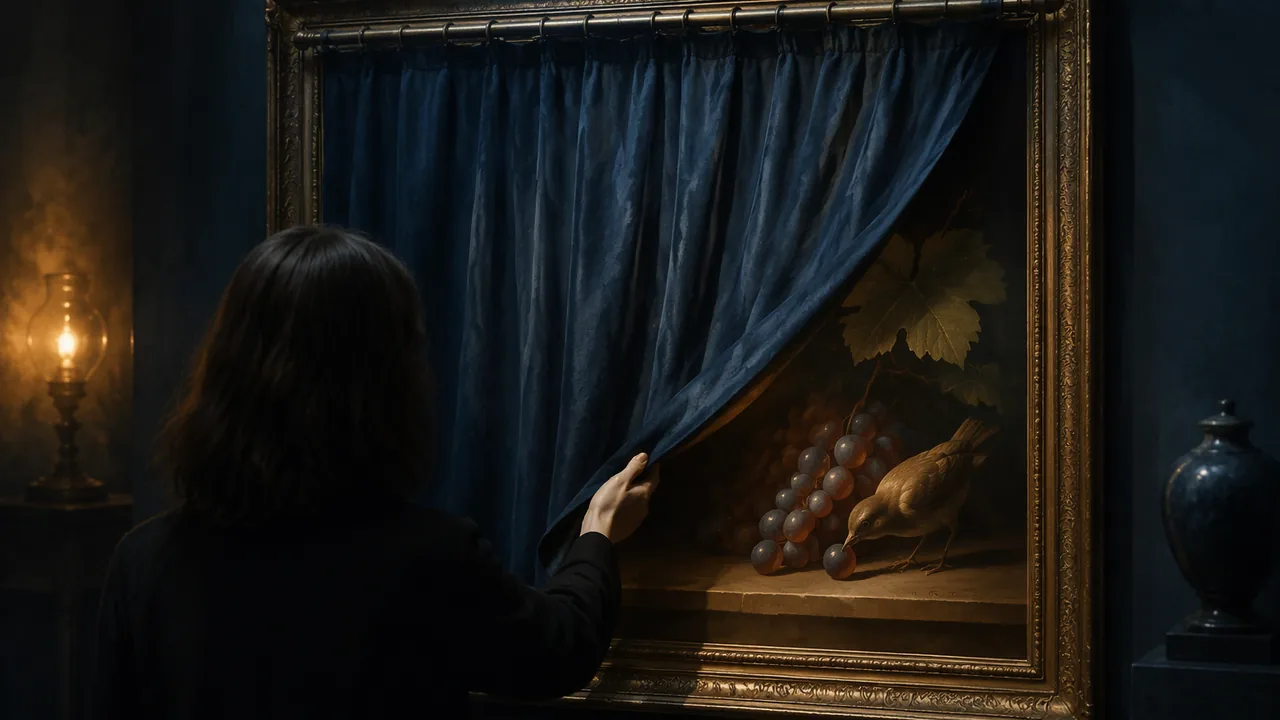
The story of the curtain. The Roman writer Pliny the Elder, in Book 35 of his Natural History (first century CE), tells of a contest between two Greek painters. Zeuxis painted grapes so convincingly that birds flew down to peck at them. His rival Parrhasius then showed a painting covered, apparently, by a curtain. Zeuxis asked for the curtain to be drawn aside, and discovered it was painted. Pliny reports that Zeuxis conceded: he had deceived birds, but Parrhasius had deceived an artist. Whether the contest happened we cannot know, but the story became a touchstone for later painters.
A painted curtain in 1658. Look at Trompe-l’Oeil Still Life with a Flower Garland and a Curtain (1658, Art Institute of Chicago) by Adriaen van der Spelt, who painted the flowers, and Frans van Mieris, who painted the curtain. A blue curtain on a rod appears to hang in front of the painting, partly drawn back to reveal the flowers. Dutch collectors of the period sometimes protected paintings with real curtains, so the painted one plays a joke on the viewer and, it seems, on Pliny’s story.
American trompe l’oeil. In the late nineteenth century William Michael Harnett (1848-1892), born in Ireland and raised in Philadelphia, became famous for still lifes that fool the eye. Compare Memento Mori, “To This Favor” (1879, Cleveland Museum of Art), Still Life—Violin and Music (1888, The Metropolitan Museum of Art) and Just Dessert (1891, Art Institute of Chicago). John Frederick Peto (1854-1907), also from Philadelphia, painted worn, everyday objects in works such as Lights of Other Days (1906, Art Institute of Chicago).
In Missouri collections. You can see both painters in Missouri. Harnett’s With the “Staats Zeitung” (1890, Saint Louis Art Museum, 26:1945) sets a pipe, a newspaper and a tankard on a plain wooden tabletop; the museum notes how light from the left catches the metal bands of the pipe, the deckle edge of the newspaper and the joints of the tankard, and that Harnett usually painted worn objects whose value was sentimental. Peto’s Books on a Table (about 1900, Nelson-Atkins Museum of Art, Kansas City, 90-11) piles books in a precarious arrangement with a quill pen and a candle, technologies already outdated by 1900; the museum reads the turning pages as a sign of passing time.
Five strategies. As you look, find these:
- Shallow space. Illusion is most convincing when objects sit close to the picture surface, against a wall, a door or a tabletop edge, so the eye has no deep space to measure.
- Life size. Objects painted at their real size are easier to mistake for real.
- Cast shadows. A crisp shadow falling from an object onto the surface behind it is the strongest single cue that the object stands in front of that surface.
- Flat or nearly flat objects. Letters, cards, paper money, pinned notes and hanging objects are easier to fake than deep three-dimensional ones, because they barely change as you move.
- Surface detail. Wood grain, peeling paper, a nail head, a torn corner: small, specific textures convince the eye up close.
Photorealism. From the late 1960s, painters in the United States such as Richard Estes and Audrey Flack made paintings from photographs with photographic precision: shop windows, reflections, city streets and still lifes. Their work is under copyright, so we discuss it by description. Photorealism differs from trompe l’oeil: it does not usually try to make you mistake the painting for the object. It makes you notice how a camera sees, with its reflections, even focus and cropping, and it raises the question this unit will argue about: is precise imitation enough?
Your project. The record’s project, and yours, is a trompe l’oeil work in colored pencil from your own photograph. As you look, collect ideas for a shallow arrangement of flat objects that mean something to you.
📖 Read for this lesson
The reading opens over the lesson; close it to come back to exactly where you were. The checks below draw on it.
Formative check
Work through these before moving on. They are not graded — they tell you whether the standard below has landed yet.
Why do trompe l’oeil painters favor letters, cards and objects hanging against a flat door?
In the 1658 painting at the Art Institute of Chicago, the curtain and the flowers were painted by two different artists.
Zeuxis and Parrhasius
Tap to revealPliny’s story: painted grapes deceive birds; a painted curtain deceives a painter.
Van der Spelt and van Mieris (1658)
Tap to revealA painted curtain appears to hang in front of a flower painting.
Harnett and Peto
Tap to revealPhiladelphia painters of illusionistic still life in the late 1800s and early 1900s.
Photorealism
Tap to revealFrom the late 1960s: paintings that reproduce the look of photographs.
Missouri collections
Tap to revealHarnett, With the “Staats Zeitung” (1890, Saint Louis Art Museum); Peto, Books on a Table (about 1900, Nelson-Atkins).
How confident are you that you can name the shared strategies of trompe l’oeil and explain why audiences valued illusion?
Practice
Work these on paper or in your notebook, then open Check your answer. Aim for all of Fluency and Application; try at least one Challenge.
Printable version: this unit’s practice workbook (PDF)
Fluency
Build speed and accuracy with the core skill.
- What does trompe l’oeil mean, and what is a trompe l’oeil painting designed to do?
Check your answer
Answer: French for “deceive the eye.” It is designed, for a moment, to be mistaken for real objects.The objects seem to sit on or in front of the picture plane. - Retell Pliny’s story of Zeuxis and Parrhasius in two sentences and explain why Zeuxis conceded.
Check your answer
Answer: Zeuxis painted grapes so convincingly that birds flew down to peck at them; Parrhasius then showed a painting apparently covered by a curtain, and when Zeuxis asked for the curtain to be drawn aside, he found it was painted. Zeuxis conceded because he had deceived birds, but Parrhasius had deceived an artist.Pliny tells it in Book 35 of his Natural History (first century CE); whether it happened we cannot know. - List the five strategies of trompe l’oeil from the lesson.
Check your answer
Answer: Shallow space; life size; cast shadows; flat or nearly flat objects; surface detail.The cast shadow is the strongest single cue that an object stands in front of a surface.
Application
Use the skill in context. Show your reasoning.
- The 1658 Trompe-l’Oeil Still Life with a Flower Garland and a Curtain was painted by two artists. Who painted what, and what joke does the painted curtain play?
Check your answer
Answer: Adriaen van der Spelt painted the flowers; Frans van Mieris painted the curtain. Dutch collectors sometimes protected paintings with real curtains, so the painted blue curtain fools the viewer into thinking it is one, and seems to answer Pliny’s story of Parrhasius.The curtain appears to hang on a rod in front of the painting, partly drawn back. - Why are letters, cards and pinned notes easier to fake in paint than a deep three-dimensional object such as a vase?
Check your answer
Answer: Flat or nearly flat objects barely change as you move, and in shallow space the eye has no deep space to measure, so there are few depth cues to test the illusion. A deep object shifts as the viewer moves and gives itself away.This is why many trompe l’oeil paintings show objects against a wall, a door or a tabletop edge. - How does Photorealism differ from trompe l’oeil, according to the lesson?
Check your answer
Answer: Trompe l’oeil tries to make you mistake the painting for the object; Photorealism (from the late 1960s, painters such as Richard Estes and Audrey Flack) does not usually try to fool you, but makes you notice how a camera sees, with its reflections, even focus and cropping.Both raise the unit’s question: is precise imitation enough? - Compare the two Missouri works: Harnett’s With the “Staats Zeitung” (Saint Louis Art Museum) and Peto’s Books on a Table (Nelson-Atkins). What does each museum point out?
Check your answer
Answer: Saint Louis: light from the left catches the metal bands of the pipe, the deckle edge of the newspaper and the joints of the tankard, and Harnett usually painted worn objects whose value was sentimental. Nelson-Atkins: Peto piles books precariously with a quill pen and candle, technologies already outdated by 1900, and the turning pages read as a sign of passing time.A strong answer gives at least one point from each museum and notes the shared theme of worn, everyday objects.
Review
Keep earlier skills sharp.
- Review from Studio Art A: in Unit 1’s value lab you learned the six zones of light. Which zone does trompe l’oeil depend on most to place an object in front of a surface, and why?
Check your answer
Answer: The cast shadow. A crisp shadow from an object onto the surface behind it is the strongest single cue that the object stands in front of that surface.In the A-semester lab the cast shadow was darkest where it touches the object; the same rule makes a pinned note look lifted.
Five Trompe l’Oeil Paintings and Pliny’s Story: Records, Descriptions and the Evidence for Five Strategies
Pliny, Natural History 35.36 (Bostock and Riley, 1855; Perseus Digital Library); museum open-access records retrieved Sept. 26, 2026 · Public domain (Pliny translation of 1855; the artworks; museum records under CC0), with SLS original descriptions. The Art Institute description is quoted briefly under CC BY 4.0.
Why this reading. Your chart asks for five trompe l’oeil strategies, each with an example. You cannot look at a painting through a text lesson, so the museum record and a description of each work are printed here, along with Pliny’s own words. A museum link, where the lesson gives one, is only a convenience; everything you need to find the strategies is below. Records checked against each museum’s open-access data on Sept. 26, 2026.
Pliny’s story, in the 1855 translation
In Book 35, chapter 36 of the Natural History, Pliny writes that Parrhasius “entered into a pictorial contest with Zeuxis, who represented some grapes, painted so naturally that the birds flew towards the spot where the picture was exhibited. Parrhasius, on the other hand, exhibited a curtain, drawn with such singular truthfulness, that Zeuxis, elated with the judgment which had been passed upon his work by the birds, haughtily demanded that the curtain should be drawn aside to let the picture be seen. Upon finding his mistake, with a great degree of ingenuous candour he admitted that he had been surpassed, for that whereas he himself had only deceived the birds, Parrhasius had deceived him, an artist.” Pliny adds a second story: Zeuxis painted a child carrying grapes, birds again came to peck at them, and Zeuxis said he had painted the grapes better than the child, “for if I had fully succeeded in the last, the birds would have been in fear of it.” (Bostock and Riley translation.) Notice the two tests of success: an audience of birds, and an audience of a rival painter.
Five works: records
| Work | Museum record |
|---|---|
| Adriaen van der Spelt (flowers) and Frans van Mieris (curtain), Trompe-l’Oeil Still Life with a Flower Garland and a Curtain | 1658; oil on panel; 46.5 × 63.9 cm (about 18 × 25 in.); Art Institute of Chicago, accession 1949.585 |
| William Michael Harnett, Still Life—Violin and Music | 1888; oil on canvas; 40 × 30 in. (101.6 × 76.2 cm); The Metropolitan Museum of Art, accession 63.85 |
| Harnett, Memento Mori, “To This Favour” | 1879; unframed 61.3 × 81.5 cm (24 1/8 × 32 1/16 in.); Cleveland Museum of Art, accession 1965.235 (the museum spells it “Favour”) |
| Harnett, Just Dessert | 1891; oil on canvas; 56.6 × 68 cm (22 1/4 × 26 3/4 in.); Art Institute of Chicago, accession 1942.50 |
| John Frederick Peto, Lights of Other Days | 1906; oil on canvas; 77.5 × 115 cm (30 1/2 × 45 1/4 in.); Art Institute of Chicago, accession 1956.125 |
What you would see
Van der Spelt and van Mieris (1658). The ground is near black. A thin gold rod runs across the very top of the panel, edge to edge. From it, on the right third of the picture, hangs a pale blue satin curtain from small blue tabs, in vertical folds with bright, sharp highlights and a cream-colored hem at the bottom. The curtain is drawn to the right, uncovering a garland of flowers that arcs from the upper left down through the center: a large pink rose, a white rose, an orange poppy, a striped red-and-white tulip, small blue flowers, and a small butterfly resting near the curtain’s edge. The Art Institute counts about twenty kinds of flower and says the curtain refers to the story of Parrhasius. The curtain overlaps the flowers, so it seems to hang in front of the picture surface.
Harnett, Violin and Music (1888). The whole picture is one flat wooden door of vertical pale boards, seen straight on. Two rusty iron strap hinges run horizontally, one near the top and one near the bottom. A violin hangs by its neck from a nail at the center, in front of a sheet of music whose corners curl. At left a bow hangs down beside it; at upper right hangs a horseshoe; at right, a small padlock and a narrow wooden slat; at lower right a small flute lies at an angle, and a small white card is tucked in near the hinge. Every object throws a short shadow to the right, so the light comes from the left. On the museum’s photograph the violin’s body takes up about 35 percent of the picture’s height, which is about 14 inches of a 40-inch painting. A standard full-size violin body is about 14 inches (35.5 cm) long, so the painter drew it at very nearly life size.
Harnett, Memento Mori (1879). A dim stone wall with an arched niche fills the background. On a table covered with an olive-green cloth stand, at center right, a human skull resting on a large leather-bound book with a red label on its spine, and a brass candlestick with an extinguished candle. At left an hourglass and an open book with its pages fanning. In front, hanging over the table’s edge, is a tattered brown-spotted book cover with a few lines of handwriting on it (Cleveland says the quotation is inscribed on the inside cover of a tattered book). Cleveland’s catalog says the extinguished candle, spent hourglass and skull symbolize death and that the inscription comes from Hamlet’s graveyard scene. The handwriting appears to be a version of the line printed in the play: “Now get you to my lady’s chamber, and tell her, let her paint an inch thick, to this favour she must come.” (Shakespeare, Hamlet 5.1, public domain.) This picture is deep: it recedes into a shadowed niche.
Harnett, Just Dessert (1891). A white marble slab runs across the lower third; below it, the front of a dark reddish-brown table. From left to right on the slab: a tall lidded pewter flagon, half a coconut, a turquoise-green ginger jar netted with cane and holding a pale spoon, a small wooden box stenciled “SMYRNA,” a bunch of pale green grapes that hangs over the front edge of the marble, a leaning bottle with a cork sealed in orange wax, a leafy branch, and at right a copper pitcher with a riveted handle. One loose grape rests on the marble at far right. The background is dark green-black. The Art Institute notes small crumbs of cork on the grapes and smashed fig seeds, which show that the dessert has been eaten.
Peto, Lights of Other Days (1906). A wide picture. A wooden shelf runs horizontally about three-fifths of the way down, held by two curved brackets under it. Along it: a lantern with a wire guard and red bars, brass and dark candlesticks holding candles burned nearly to stubs, an oil lamp, a tin lantern with its door open, torn books, and small tubes and cups that project past the shelf’s front edge; one brass lamp hangs upside down below the shelf. Edges are soft and the darks are dark green-brown. The Art Institute says the soft-edged style suggests the artist’s hand, unlike the “heightened illusionism” of Harnett.
Where to find the five strategies
- Shallow space: the door in the Violin (the whole picture is a wall); the shelf in Peto; the rod and curtain in 1658. Contrast: Memento Mori is deep.
- Life size: the violin, measured above. The 1658 panel is only about 25 inches wide, so its curtain is a small curtain.
- Cast shadows: the short shadows to the right of each object on the Violin door; the pitcher’s shadow on the marble in Just Dessert.
- Flat or nearly flat objects: the sheet of music and the small card on the door; the handwritten cover leaf hanging over the table’s edge in Memento Mori.
- Surface detail: rust on the hinges, the stenciled “SMYRNA,” the fanned book pages, cork crumbs on the grapes.
One more device belongs in your chart. Grapes and a curtain, the two objects in Pliny’s contest, both appear here: a curtain in 1658, grapes hanging over the edge of the marble in 1891. Objects that overhang an edge, like those grapes and Peto’s tubes, seem to reach into the viewer’s space.
Photorealism, by description
Photorealist paintings from the late 1960s onward are still under copyright, so no image is reproduced. They are made from photographs, so they inherit what a lens does: even focus across the whole picture, bright reflections in glass and chrome, and cropping like a snapshot. They usually do not try to make you reach out and touch. They ask you to look at a photograph as an object.
Sources: Pliny the Elder, The Natural History, Book 35, chapter 36 (trans. John Bostock and H. T. Riley, 1855), Perseus Digital Library (perseus.tufts.edu); Art Institute of Chicago, accessions 1949.585, 1942.50 and 1956.125 (open-access API) (artic.edu); The Metropolitan Museum of Art, Open Access, accession 63.85 (metmuseum.org); Cleveland Museum of Art Open Access, accession 1965.235 (clevelandart.org); Shakespeare, Hamlet (Project Gutenberg) (gutenberg.org)