formulate and support a position on the aesthetic value of illusionistic art, explain how interpretations of trompe l’oeil have changed, and revise or defend my position after weighing opposing views.
Instruction
The record asks students to formulate and support a position about the aesthetic value of a specific work and then change or defend that position after considering the views of others, and to compare how the meaning of a work has changed over time because of changes in interpretation and context. Trompe l’oeil is an ideal case, because its reputation has swung sharply.
The case against. A long tradition in European art theory placed imitation of appearances below invention and ideas. On this view, a painting that merely fools the eye is a clever trick, admired for the labor it took, like a sideshow. The objects in American trompe l’oeil are ordinary (pipes, mugs, newspapers, money), and the paintings seem to have no subject beyond their own skill.
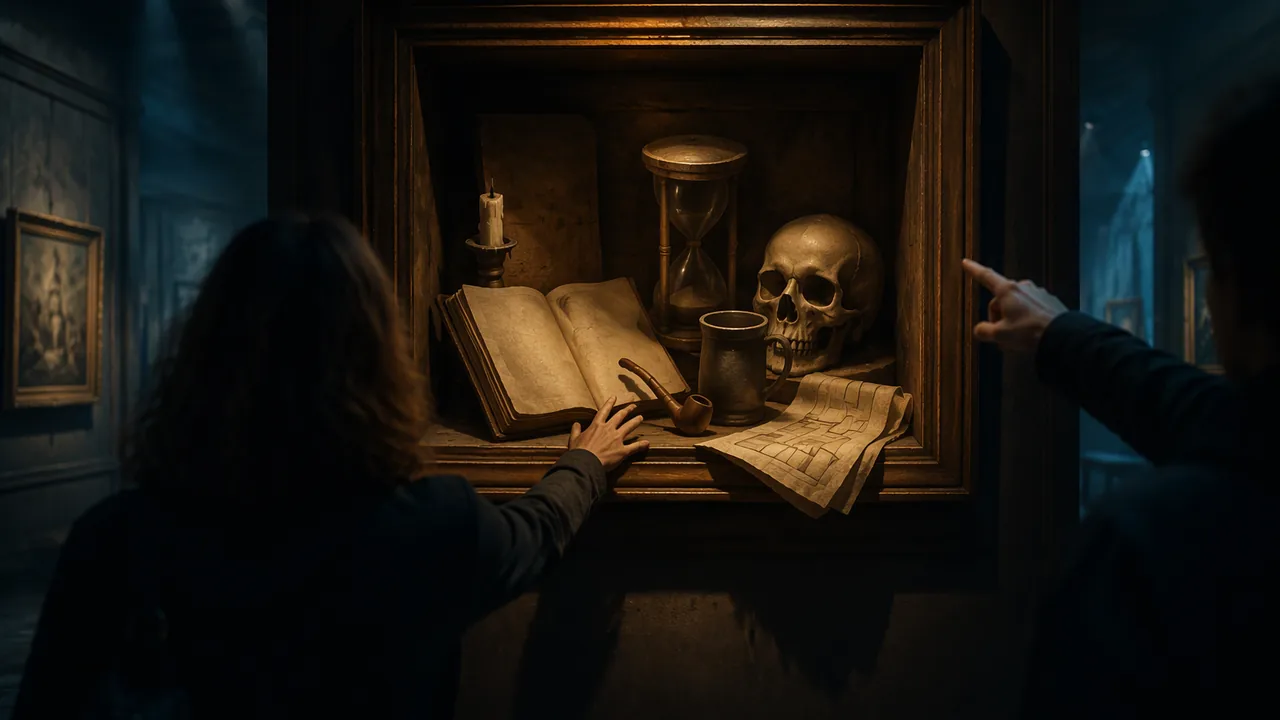
The case for. Others argue that trompe l’oeil is about seeing itself. It makes viewers aware of how they judge what is real, which is a serious subject. The objects are not random: Peto’s worn, battered things and Harnett’s Memento Mori, “To This Favor” carry themes of time, memory and death that go back to Dutch still life. In the Harnett, the museum notes, an extinguished candle, a spent hourglass and a skull stand for death, and a tattered book is inscribed with a line from the graveyard scene of Shakespeare’s Hamlet; the museum suggests the quotation’s mention of paint also jokes about the painting’s own artifice. And the paintings’ play with the picture surface anticipates questions modern art later asked openly.
A reputation that changed. In their lifetimes Harnett’s paintings drew crowds and sold to businessmen and saloons, while some critics dismissed illusionism. After his death his work fell out of fashion. In the mid-twentieth century, interest revived, and the art historian Alfred Frankenstein investigated the paintings attributed to Harnett. His research, published in After the Hunt (1953), showed that many paintings sold as Harnetts were in fact by Peto, some carrying forged Harnett signatures. Peto, who had worked in relative obscurity, emerged as a distinct and admired artist. The same paintings had been valued, then ignored, then re-read and re-attributed. Their meaning changed because the context of interpretation changed: new attention to American art, a new interest in how pictures refer to their own surfaces, and new evidence about who made them.
Photographs and responsibility. Your trompe l’oeil project works from your own photograph. Photorealists and trompe l’oeil painters raise a responsibility question that standard VA:Cr2B.III names: balancing freedom and responsibility in the use of images. Working from another person’s photograph without permission, or painting a convincing fake of a real document such as money or an ID, is not acceptable. (Harnett’s paintings of paper money reportedly drew the attention of the U.S. Secret Service; whatever the details of that story, paint no currency.)
The dialogue protocol. First write a position of 3-5 sentences: is illusion enough to make a painting good? Support it with one specific work. Then hold a structured dialogue on paper with the voices in this lesson’s reading (Pliny, the museums, the critics) or with a recorded critic’s talk: before you answer each voice, restate its point in your own words. If you like, run the dialogue out loud with a family member or another adult and note what they say. In the last round, write the strongest case for the position you find less convincing. Afterward, revise your position or defend it, naming the strongest argument you met against it and your answer. Changing your mind for a reason is a strength.
Criteria again. Standard VA:Re9A.III asks you to construct evaluations based on differing sets of criteria. Try judging the same painting by imitational, formal and expressive criteria, and notice where the verdicts diverge.
📖 Read for this lesson
The reading opens over the lesson; close it to come back to exactly where you were. The checks below draw on it.
Formative check
Work through these before moving on. They are not graded — they tell you whether the standard below has landed yet.
What did Alfred Frankenstein’s research, published in 1953, show?
A convincing trompe l’oeil painting of current paper money is an acceptable choice for this project.
Write your final position on whether illusion is enough, name the strongest opposing argument you met, and answer it (or explain why it changed your mind).
How confident are you that you can form, defend and revise a position on the value of illusion, and explain how trompe l’oeil’s reputation changed?
Practice
Work these on paper or in your notebook, then open Check your answer. Aim for all of Fluency and Application; try at least one Challenge.
Printable version: this unit’s practice workbook (PDF)
Fluency
Build speed and accuracy with the core skill.
- Summarize the case against illusion as the lesson presents it.
Check your answer
Answer: A long tradition in European art theory ranked imitation of appearances below invention and ideas; a painting that merely fools the eye is a clever trick admired for its labor, like a sideshow, and American trompe l’oeil objects (pipes, mugs, newspapers, money) seem to have no subject beyond the painter’s skill.This is the view your position must answer if you disagree with it. - Define attribution, forgery and memento mori.
Check your answer
Answer: Attribution: identifying who made a work from evidence such as style, signatures and records. Forgery: a work falsely presented as by another maker, such as a painting with a false signature. Memento mori: Latin for “remember you must die”; an image or object reminding viewers of mortality.Glossary terms from the lesson. - What did Alfred Frankenstein show in After the Hunt (1953)?
Check your answer
Answer: That many paintings sold as Harnetts were in fact by Peto, some carrying forged Harnett signatures. Peto emerged as a distinct and admired artist.The same paintings were valued, then ignored, then re-read and re-attributed.
Application
Use the skill in context. Show your reasoning.
- In Harnett’s Memento Mori, “To This Favor”, which objects stand for death, and what text appears? How does this support the case for illusion?
Check your answer
Answer: An extinguished candle, a spent hourglass and a skull stand for death; a tattered book is inscribed with a line from the graveyard scene of Shakespeare’s Hamlet, whose mention of paint the museum suggests also jokes about the painting’s artifice. It shows the objects carry themes of time, memory and death from Dutch still life, so the painting is about more than skill.The case for also says trompe l’oeil is about seeing itself and anticipates modern art’s questions about the picture surface. - Name three changes in the context of interpretation that changed the meaning of Harnett’s and Peto’s paintings in the mid-twentieth century.
Check your answer
Answer: New attention to American art; a new interest in how pictures refer to their own surfaces; new evidence about who made them (Frankenstein’s re-attributions).In their lifetimes Harnett drew crowds and sold to businessmen and saloons; after his death he fell out of fashion. - Write a 3-5 sentence position on whether illusion is enough to make a painting good, supported by one specific work, as the dialogue protocol begins.
Check your answer
Answer: Model: “Illusion alone is not enough, but in the best trompe l’oeil it is not alone. Peto’s Books on a Table fools the eye with its precarious pile, yet the outdated quill and candle and the turning pages make it about passing time. The illusion draws me close; the objects give me something to think about once I am there. So illusion is a means, and the painting is good when the means serves an idea.”A strong position takes a clear side, cites a specific work and gives a reason the opposing side would have to answer. - Explain why painting a convincing fake of current paper money or an ID is not acceptable in this project, using standard Cr2.2.HSIII.
Check your answer
Answer: The standard asks you to balance freedom and responsibility in the use of images; a realistic fake of a real document could be misused and is not acceptable, just as working from another person’s photograph without permission is not. (Harnett’s money paintings reportedly drew the Secret Service’s attention.)Use objects and images you have the right to use.
Challenge
Stretch problems. Expect to think before you write.
- Judge Harnett’s Memento Mori, “To This Favor” (1879) by imitational, formal and expressive criteria, using only what the lesson tells you. Where do the verdicts diverge?
Check your answer
Answer: Model: by imitational criteria it scores high, since its candle, hourglass, skull and tattered book are painted to fool the eye. By expressive criteria a critic in the “case against” tradition might call it a trick, while the “case for” reads the objects as a meditation on death and time, with a Hamlet line that jokes about the painting’s own artifice. Formal criteria ask how the objects are organized in shallow space against the picture surface. The verdicts diverge most on the expressive question: trick or meditation?Standard Re9.HSIII asks for evaluations from differing sets of criteria and for noticing where they diverge.
Review
Keep earlier skills sharp.
- Review (Lesson 1.1): why might Frankenstein’s re-attribution have been hard to make by eye alone, given what Harnett and Peto had in common?
Check your answer
Answer: Both were Philadelphia painters of illusionistic still life in the late 1800s and early 1900s, painting worn, everyday objects, so style alone could be confused, and some Petos carried forged Harnett signatures. Attribution needed evidence such as records, not just style.Attribution rests on style, signatures and records together.
Is Illusion Enough? What Was Said, the Criteria to Argue By, and a Worked Position
Pliny, Natural History 35.36 (Bostock and Riley, 1855); Art Institute of Chicago open-access records 1942.50 and 1956.125 and Cleveland Museum of Art 1965.235, retrieved Sept. 26, 2026; adapted for independent study Nov. 10, 2026 · Public domain (Pliny translation; museum records under CC0), with SLS original worksheets, worked example and constructed exemplar. Art Institute description quoted briefly under CC BY 4.0.
Why this reading. The lesson asks you to state a position, use one specific work as evidence, meet an opposing view, and revise or defend. Here are the published judgments to argue with, the criteria to argue by, a worked example, and note sheets for a written dialogue with those voices. The two works used most are described in the reading “Five Trompe l’Oeil Paintings and Pliny’s Story” (Harnett, Just Dessert, 1891, Art Institute of Chicago 1942.50; Peto, Lights of Other Days, 1906, 1956.125; retrieved Sept. 26, 2026).
What was actually said, by whom
| Speaker | Claim | What it implies about “is illusion enough?” |
|---|---|---|
| Zeuxis, in Pliny’s Natural History 35.36 (public domain, Bostock and Riley) | After birds pecked at grapes in his painting of a child carrying grapes, he said he had painted the grapes better than the child, “for if I had fully succeeded in the last, the birds would have been in fear of it.” | Deception is a real test of skill, but it tests only one thing. A painter who is fooling birds has not yet made a convincing person. |
| Pliny, same chapter | Zeuxis conceded that he had deceived birds and Parrhasius had deceived “him, an artist.” | Deceiving a trained viewer counts for more than deceiving an animal. Skill is judged by experts. |
| Art Institute of Chicago, on Harnett’s Just Dessert (CC BY 4.0) | Cork crumbs on the grapes and smashed fig seeds show the dessert has been eaten, “as well as highlighting Harnett’s skillful renderings in trompe l’oeil.” | The illusion carries a small story (a meal just finished) but the museum also credits it as skill on display. |
| Art Institute of Chicago, on Peto’s Lights of Other Days (CC BY 4.0) | The objects are “replete with nostalgia”; they “allude to older ways of life and fading memories.” Peto’s “soft-edged style is suggestive of the artist’s hand rather than the heightened illusionism” of Harnett. | A painter can weaken the illusion on purpose and gain expression. On this view the feeling is the point, not the trick. |
| Cleveland Museum of Art, on Harnett’s Memento Mori (CC0) | The word “paint” in the Hamlet quotation “wittily evokes the artifice of Harnett’s picture.” | The illusion is also about illusion: a painting joking about being a painting. |
A reputation that changed, with what is known
Alfred Frankenstein’s book After the Hunt: William Harnett and Other American Still Life Painters, 1870–1900 (1953) cataloged Harnett’s work and drew a distinction between Harnett and Peto. Art-historical accounts report that many pictures then labeled Harnett were found to be Peto’s, some carrying forged Harnett signatures. The Art Institute’s publication record for Just Dessert lists that book. The Art Institute also notes that Peto had stopped exhibiting at professional venues by 1890 and worked instead for local patrons near his New Jersey home. Put together, one reputation was built on being sold as the other’s work. A work’s value changed when its maker was corrected. That is the case for “context changes value”; you decide what it shows about illusion.
Three sets of criteria
| Set | Question to ask of the painting | Evidence you can point to |
|---|---|---|
| Imitational | How closely does it match the look of the real thing, and from how far? | Cast shadows, life-size scale, surface texture (rust, cork crumbs, wood grain), edges sharp or soft. |
| Formal | Are the shapes, values and spaces well organized, apart from what they represent? | Horizontal shelf or slab against verticals; the brightest object and the darkest space; whether the eye travels or stops. |
| Expressive | What does it make you think or feel, and does it mean something beyond the object? | Signs of use and time, symbols such as skull and hourglass, a quotation, a joke about paint. |
Worked example (SLS original; a constructed exemplar, not a quotation from anyone)
Take Harnett’s Just Dessert and Peto’s Lights of Other Days. Imitational: Harnett scores higher, since the marble edge, the copper’s reflections and the hanging grapes are drawn crisply, while Peto’s edges are soft. Formal: both are built on a strong horizontal (the marble edge and the shelf) crossed by verticals (flagon, candlesticks), and both use a dark ground to make objects stand forward, so the verdicts are close; Peto’s crowded rhythm of upright candles across the shelf is the more varied. Expressive: Peto’s burned-down candles and hanging lamp carry the museum’s “fading memories,” while Harnett’s crumbs suggest a moment just past. On imitation alone, Harnett wins; on expression, Peto is at least equal. So the answer to “is illusion enough?” depends on which criteria you accept, and a position that names its criteria is stronger than one that does not.
Position sheet
Stem. “Illusion [is / is not] enough to make a painting good, because in [work, artist, date, museum, accession number] the [specific feature] shows ___. The strongest opposing point is ___, but ___.” Keep to 3–5 sentences.
Constructed exemplar (SLS original). “Illusion is not enough. Zeuxis himself, in Pliny’s account, judged that fooling birds proved only that he had painted grapes well and the child badly. Harnett’s Memento Mori at the Cleveland Museum (1965.235) is not a shallow trick, since it is a deep, dim scene where the candle, hourglass and skull turn skill into a warning about time. The strongest argument against me is that Parrhasius’s curtain fooled an artist, and that is more than a trick. But being fooled is over in a second; the painting that keeps me looking after I know it is paint is the one that made the illusion serve a meaning.”
Dialogue note sheet. Work through each voice in the table above (and any recorded critic you watch, or an adult you talk the question over with). Make four columns: The voice’s point, restated in my words | Work they used | Criteria set they used (imitational, formal, expressive) | Does it change my position? Why?. In the last round you write for the position you find less convincing, so write its best sentence first.
Photographs and responsibility
Working from photographs raises the question of whose image it is. The rule for this project: use objects and pictures you own or made, get permission for anyone’s photograph, and do not paint convincing copies of paper money or official documents.
Sources: Pliny the Elder, The Natural History, Book 35, chapter 36 (Bostock and Riley), Perseus Digital Library (perseus.tufts.edu); Art Institute of Chicago, Just Dessert (1942.50) and Lights of Other Days (1956.125) (artic.edu); Cleveland Museum of Art, Memento Mori, “To This Favour” (1965.235) (clevelandart.org)