evaluate my portfolio using differing sets of criteria, select the works that best represent my investigation and range, and articulate the rationale for reworking one piece.
Instruction
A portfolio is an argument about who you are as an artist. This lab puts your year’s work in front of reviewers who use different criteria, as real portfolios meet different audiences: a college art program, a scholarship panel, an employer, an exhibition juror. The record asks students to articulate the process and rationale for refining and reworking their own art, and to review their work to select pieces for a portfolio review.
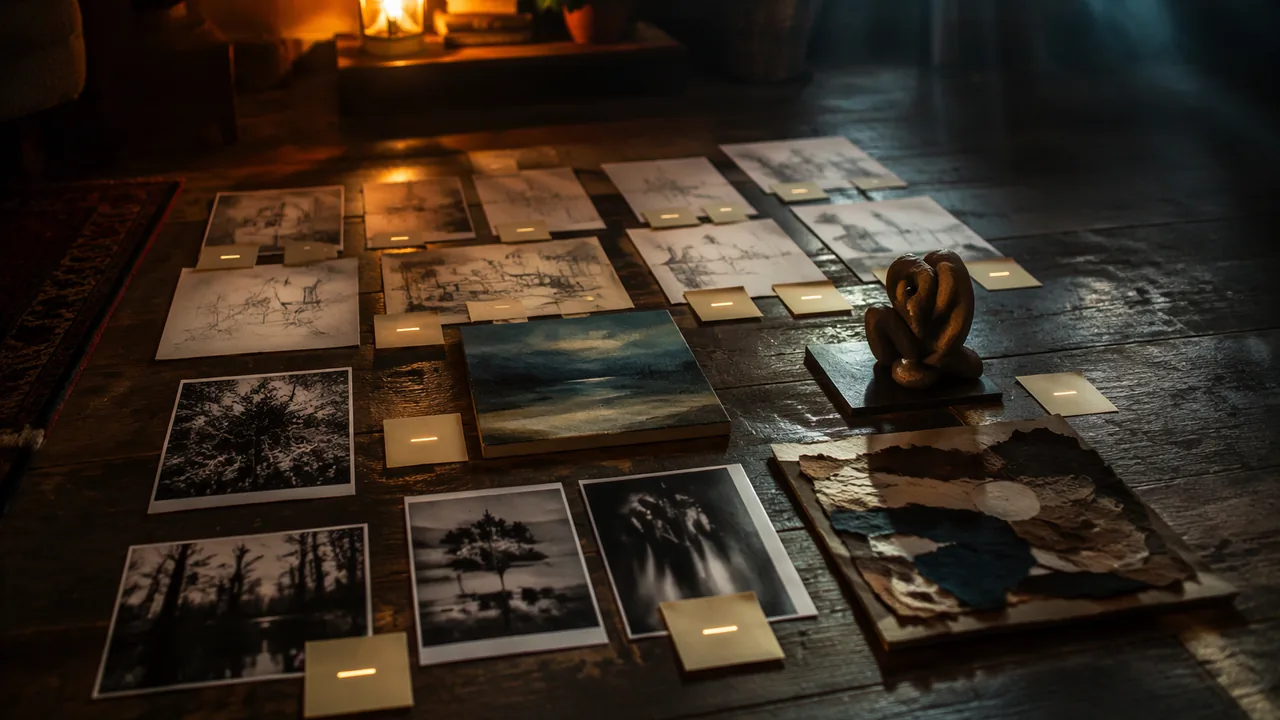
Lay it all out. Put every work from the year on a table, a clean floor or a wall at home, in chronological order, with your investigation log. Photograph the whole layout. Look at the whole before judging parts. What do you see that you did not see one work at a time? Where did your work change most?
Three reviewers, three sets of criteria. You review your own portfolio three times, in three different reviewer roles, on three different days, so each review starts with fresh eyes. If a family member or another adult is willing, give them one role and its criteria sheet from this lesson’s reading; their review counts as one of the three:
- The college reviewer looks for range of media and approaches, strong observational skill, evidence of thinking and process, and a sustained investigation that goes somewhere.
- The exhibition juror looks for works that are finished, strong on their own, and that would work together on a wall.
- The investigation reviewer looks only at the sustained investigation: is the question clear, does each work push it further, is there evidence of experiment, risk and revision?
In each role, write: the three strongest works by their criteria and why; one work that does not meet their criteria and why; and one question for the artist. Standard VA:Re9A.III asks you to construct evaluations based on differing sets of criteria. You will notice that your three reviews disagree. A small, very finished drawing may be the juror’s favorite and the investigation reviewer’s least important piece.
Selecting. Using the reviews, choose your portfolio: at least twelve works, with six to eight from the investigation and the rest showing breadth, including at least one three-dimensional work. You do not have to accept every reviewer’s judgment, but you must be able to explain your choices against their criteria.
Reworking. Choose one work to rework before the final portfolio. Reworking is not starting over and not tidying up. It is a considered response to a problem you and your reviewers identified. Write a rationale of 150-250 words: what the problem is, what evidence (reviewers’ comments, your own looking) shows it, what you will change, and what you expect the change to do. After reworking, add two sentences on whether it worked. If the answer is no, that is still evidence of process.
A worked rationale. “In my collage from Unit 3, in all three reviews the eye went first at the transferred photograph in the upper left, not the woven map at the center, which is the main idea. The transfer is the highest-contrast area in the piece. I will glaze it with thin white acrylic to lower its contrast, and add a darker paper under the woven section so that it becomes the strongest contrast. I expect viewers to look first at the map. (After: My mother and my uncle now look at the map first; in my own photo of it two days later the photo still catches my eye first, but it no longer dominates.)”
Responses that develop. Standard VA:Re7A.III asks how responses to art develop over time. Write one sentence on a work you judged differently in September than you do now, and why.
📖 Read for this lesson
The reading opens over the lesson; close it to come back to exactly where you were. The checks below draw on it.
Formative check
Work through these before moving on. They are not graded — they tell you whether the standard below has landed yet.
The exhibition juror ranks your small finished drawing highest; the investigation reviewer ranks it lowest. What explains this?
A reworking that does not solve the problem has no value in a portfolio.
Name one work you judged differently in September than you do now, and explain what changed in your understanding.
How confident are you that you can evaluate my portfolio with different criteria, select works and justify reworking one?
Practice
Work these on paper or in your notebook, then open Check your answer. Aim for all of Fluency and Application; try at least one Challenge.
Printable version: this unit’s practice workbook (PDF)
Fluency
Build speed and accuracy with the core skill.
- Name the three reviewer roles and what each looks for.
Check your answer
Answer: College reviewer: range of media and approaches, strong observational skill, evidence of thinking and process, and a sustained investigation that goes somewhere. Exhibition juror: works that are finished, strong on their own, and that would work together on a wall. Investigation reviewer: only the investigation (a clear question, each work pushing it further, evidence of experiment, risk and revision).Each review is done on a different day with fresh eyes. - What are the selection rules for the final portfolio?
Check your answer
Answer: At least twelve works, six to eight from the investigation and the rest showing breadth, including at least one three-dimensional work.You must be able to explain your choices against the reviewers’ criteria. - Define rework and say what reworking is not.
Check your answer
Answer: To change a finished or nearly finished work in response to an identified problem. It is not starting over and not tidying up.It is a considered response to a problem you and your reviewers identified.
Application
Use the skill in context. Show your reasoning.
- The exhibition juror ranks your small finished drawing highest and the investigation reviewer ranks it lowest. Explain the disagreement using Re9.HSIII.
Check your answer
Answer: They apply different sets of criteria: the juror values finish and presence on a wall, while the investigation reviewer values contribution to the investigation’s question. Differing criteria produce differing evaluations; your job is to understand and explain them.Neither reviewer is wrong. - List the four parts of a rework rationale, and identify each in the lesson’s worked collage example.
Check your answer
Answer: Problem: the eye went first to the transferred photograph in the upper left, not the woven map, the main idea. Evidence: all three reviews; the transfer is the highest-contrast area. Change: glaze the transfer with thin white acrylic and add darker paper under the woven section. Expected effect: viewers look first at the map. (Plus two sentences afterward on whether it worked.)150-250 words; a rework that does not fully work is still evidence of process. - In the worked example, after reworking, two family members looked at the map first, but the artist’s own photo two days later still caught her eye first at the transferred photo. Did the rework succeed? Write the two-sentence after-note.
Check your answer
Answer: Model: “Partly. Two viewers now look at the map first, and the photo no longer dominates, though in my own photo it still catches my eye first, so I would lower its contrast a step further.”An honest after-note reports mixed evidence and states the next decision. - Write the review notes the lesson asks for in one role (choose the college reviewer) for an imagined portfolio: three strongest works and why, one that does not meet the criteria and why, and one question.
Check your answer
Answer: Model: strongest: the observed value drawing (observational skill), the faceted abstraction series (thinking and process), the found-object sculpture (range of media). Weakest: a second collage that repeats the first (adds no range). Question: “How did the investigation’s question change between the first and sixth works?”Any answer that applies the college reviewer’s stated criteria to each choice is acceptable.
Review
Keep earlier skills sharp.
- Review (Lesson 3.4): the worked rework fixes a collage whose eye goes to the wrong place first by changing contrast. How is that like fixing the date in the Macbeth poster?
Check your answer
Answer: Both fix a reading order. In the poster, the date was promoted from level three to level two (enlarged and moved beside the title) so viewers found it; in the collage, contrast is lowered on the transfer and raised under the map, so the main idea becomes dominant. Each change was tested again with viewers.Dominance and subordination, and visual hierarchy, both set where the eye goes first.
Portfolio Review Kit: A Sample Portfolio, Three Scored Criteria Sets, Three Disagreeing Reviews, a Selection and a Rework Rationale
SLS original teaching materials; the portfolio, artist and reviewers are invented for this course · SLS original
Why this reading. In this lab you review your own portfolio three times, as three different reviewers on three different days (a family member or other adult may take one role), and you then select and rework. To practice before you review your own, and to see what a useful review looks like, this reading supplies a complete sample portfolio, the three reviewers’ criteria as scored sheets, three finished sample reviews that disagree, a selection built from them, and a rework rationale. Everything is an SLS original: the portfolio, artist and reviewers are invented for this course and none is a real student.
Sample portfolio: 14 works (SLS original; constructed)
Investigation question: How does a neighborhood remember what its buildings forget? (I = part of the investigation; 3D = three-dimensional.)
| # | Title | Medium and size | Investigation | State |
|---|---|---|---|---|
| 1 | Corner Store, 8 a.m. | Graphite, 9 × 12 in. | I | Finished; tightly rendered |
| 2 | Store Sign Study | Pencil and ink, 6 × 9 in. | I | Study |
| 3 | Layered Storefront | Photo transfer under tissue, 12 × 16 in. | I | Finished; a risky experiment |
| 4 | Layered Storefront 2 | Photo transfer under tissue, 12 × 16 in. | I | Finished; revised from #3 |
| 5 | What Stays, no. 1 | Collage, 14 × 11 in. | I | Finished |
| 6 | What Stays, no. 2 | Collage and woven map, 14 × 11 in. | I | Finished; the strongest idea |
| 7 | Block Model | Cardboard and paper, 6 × 8 × 8 in. (h × w × d) (3D) | I | Finished |
| 8 | Trompe l’oeil corkboard | Colored pencil, 12 × 16 in. | Not I | Finished; Unit 1 |
| 9 | Paper landscape: the freeway | Torn paper on board, 11 × 14 in. | Not I | Finished; Unit 2 |
| 10 | Peace stone | Acrylic on slate, 12 × 12 in. (3D) | Not I | Finished; Lesson 3.2 |
| 11 | Poster: Macbeth campaign | Digital print, 11 × 17 in. | Not I | Finished |
| 12 | Self-portrait in mirror | Charcoal, 18 × 24 in. | Not I | Finished; Semester A |
| 13 | Still life, three bottles | Oil pastel, 12 × 16 in. | Not I | Finished |
| 14 | Clay bowl | Air-dry clay, painted, 6 in. diameter (3D) | Not I | Finished |
Three reviewers, three scored criteria sets
| Reviewer | Criteria (score each 1 to 4) | Write |
|---|---|---|
| College reviewer | Range of media and approaches; observational skill; evidence of thinking and process; a sustained investigation that goes somewhere | The three strongest works and why; one that does not meet these criteria; one question for the artist |
| Exhibition juror | Each work finished and strong alone; works that would hang well together; craftsmanship and presentation | As above |
| Investigation reviewer | Question clear; each work pushes it further; evidence of experiment, risk and revision | As above; only the investigation works count |
Three finished sample reviews (SLS original; they disagree on purpose)
College reviewer. Scores: range 4, observation 3, process 4, investigation 3 (total 14 of 16). Strongest: #6 (the map ties the question to a form), #3 and #4 together (a risk and then a real revision), #12 (skilled observation). Does not meet: #13, one of several pieces with no link to the rest of the year. Question: why did the transferred photograph disappear in #4?
Exhibition juror. Scores: finish 4, wall strength 3, cohesion 2, presentation 3 (12 of 16). Strongest: #1 (finished and quiet), #12, #9. Does not meet: #2, a study that reads as unfinished on a wall. Question: which five would hang as one group?
Investigation reviewer. Scores: question 4, pushes further 3, experiment and revision 4, risk 3 (14 of 16). Strongest: #3, #4, #6. Does not meet: #1, which is skilled but repeats what #2 already learned and takes the question no further. Question: what does #7 show that the drawings could not?
Where they disagree. #1 is the juror’s first choice and the investigation reviewer’s weakest, because they apply different criteria: finish and wall presence versus contribution to the question. #12 is picked by two of three as strong observation even though it is not part of the investigation.
The selection built from the reviews (worked)
Requirements: at least 12 works; 6 to 8 from the investigation; at least one three-dimensional work; the rework included. Selected (13): investigation, seven works (#2 kept as a process page, #3, #4, #5, #6, #7 and #1); breadth, six works (#8, #9, #10, #12, #14 and #11). Cut: #13, the still life, for lack of connection. Why #1 stays despite the investigation reviewer: it is the best finished drawing and shows the skill the investigation depends on, and it will be shown with #2 as a pair labeled “study and result.” Three-dimensional works: #7, #10 and #14.
The rework rationale, worked (150 to 250 words; SLS original)
“Work: #6, What Stays, no. 2. Problem: all three reviewers looked first at the transferred photograph in the upper left, not at the woven map at the center, which is the main idea. Evidence: the transfer is the highest-contrast area (white against near black); all three reviews name it first; my own squint photo shows it as the darkest and lightest spot. Change: glaze the photograph with thin white acrylic to lower its contrast, and add a darker paper under the woven map so the map becomes the strongest contrast. Expected result: viewers look first at the map. After: two of three viewers (my mother, my uncle, and my own photo of it two days later) now go to the map first; in the third the photograph still comes first, but it no longer dominates. This worked partly; I will try cropping the photograph next.”
Your review sheet, blank
- Your reviewer role: college / juror / investigation, and the date (one role per day).
- Score each of the four criteria from 1 to 4 and write one line of evidence for each score, naming a work by number.
- Three strongest works, with reasons tied to the criteria.
- One work that does not meet the criteria, and why.
- One question for the artist.
One sentence on a changed response: name a work you judged differently in September than now and say what changed.