complete my sustained investigation, write a full artist statement, and select and curate a home or online exhibition of my work that shapes how viewers understand it and preserves the works and their record.
Instruction
This workshop has three strands that run in parallel: finishing the investigation, writing the statement, and curating your year-end exhibition. Plan your sessions so each gets time.
Finishing the investigation. Use your self-conference plan from Unit 3. The last work or works should be the investigation’s strongest answer to its question so far, not a repeat of earlier ones. If you are unsure what to make, look at the last two works and ask: what did they almost do that the next one could do fully?
The artist statement (300-500 words). Your midyear statement was short. This one explains a body of work. A useful structure:
- What. One or two sentences on what your work is about: the investigation’s question and its subject. Start with the work, not your childhood.
- How. Your materials and processes, and why they suit the question. Be specific: “I layer transferred photographs under tissue so that faces appear and disappear” says more than “I use mixed media.”
- Why and where from. What led you to the question, and one or two artists, traditions or sources that shaped your approach.
- What changed. How the investigation developed, and one thing you discovered through making that you did not expect.
- For the viewer. What you hope a viewer notices or considers.
Write in the first person and present tense. Cut every sentence that could be about anyone’s art (“Art has always been my passion”). Read it aloud in front of your work: every claim should be visible in the work. Share personal material only as far as you choose.
Curating. Standard VA:Pr6A.III asks you to curate a collection to affect viewers’ understanding of social, cultural or political experiences, and VA:Pr4A.III asks you to justify choices in selecting and presenting work for a specific exhibition. You are the curator of your own show. Choose its form: a home showing on one or two walls and a table for family and invited guests; a catalog as a PDF or slide deck; or an online exhibit shared only with a parent’s permission. Many students do a home showing and a catalog of the same works. Plan:
- A theme or thread that connects the works: place, memory, material, identity, the environment. A good theme lets each work stay itself while revealing connections.
- A selection. Curating starts with analysis: from your full portfolio, choose the works that serve this show’s theme and audience, usually eight to twelve, and write one line on why each is in and why any strong work is left out.
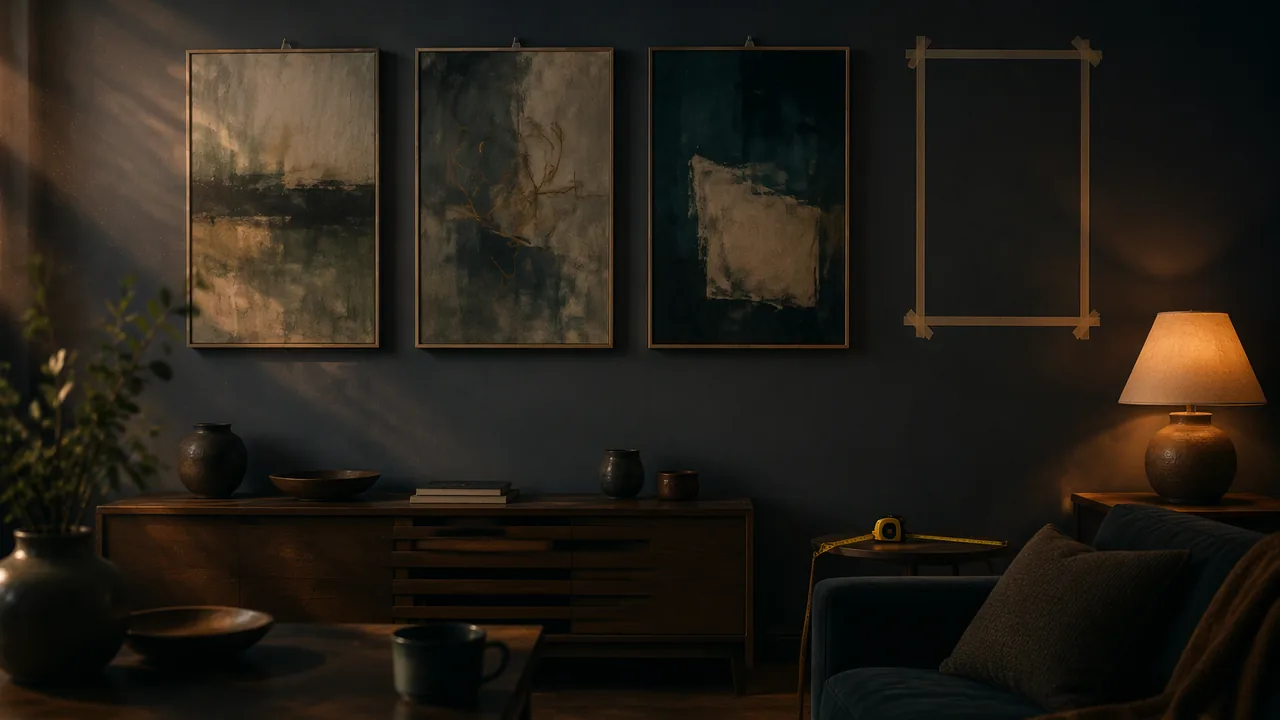
- A wall plan or slide sequence, to scale or in order, showing where each work goes. Consider what a viewer meets first, the path or order they follow, groupings, spacing, hanging height, and space for three-dimensional work and your stone.
- Wall text: a title and a 100-150-word introduction for visitors (the first page of a catalog).
- Labels for every work, with title, date, medium, dimensions and one sentence.
- A curatorial rationale of 250-350 words: why these works, why this order, and what you want visitors to understand.
- Preservation. A show ends, but the works and their record should last. List where each work, shown or not, will be stored and how (flat and interleaved, boxed, away from sun and damp, as in Lesson 4.2), and keep the catalog and the image files backed up in two places as the exhibition’s permanent record. The Saint Louis Art Museum, for the same reason, keeps an archival summary online for each past exhibition, such as its 2014-15 Nick Cave show.
- Access: labels in a readable size at a readable height, a clear path through the room, alt text (a one- or two-sentence description) for every image in a catalog or online exhibit, and captions on any video.
A worked example. One student’s investigation dealt with a grandmother’s kitchen, a disappearing corner store, the walk to the bus stop and the Missouri River at the edge of town. She titled her show “What Stays” and hung it so visitors met the walk first, a row of small drawings in the hallway leading into the living room, then the river and the store as a pair on one wall, and ended at the kitchen collage, placed alone on the dining-room wall for emphasis. Her catalog followed the same order. Her rationale explained that the order moves from moving through a town to the places that hold people still. Two works she liked, a still life and a self-portrait, stayed in the portfolio but out of the show because they did not belong to the thread; her preservation list recorded where they and the shown works are stored.
Deadline. By the end of the workshop, the statement is in second draft, the curatorial plan is complete, and all investigation works are finished and documented.
📖 Read for this lesson
The reading opens over the lesson; close it to come back to exactly where you were. The checks below draw on it.
Formative check
Work through these before moving on. They are not graded — they tell you whether the standard below has landed yet.
Which opening sentence of an artist statement is strongest?
Missouri standard: VA:Pr4A.I
When you curate your year-end exhibition, the best choice is always to include every finished work from the year, because works left out of a show are lost.
Write the “What changed” section of your statement: how did your investigation develop, and what did you discover through making that you did not expect?
How confident are you that you can finish my investigation, draft a full statement and select, curate and preserve my own exhibition?
Practice
Work these on paper or in your notebook, then open Check your answer. Aim for all of Fluency and Application; try at least one Challenge.
Printable version: this unit’s practice workbook (PDF)
Fluency
Build speed and accuracy with the core skill.
- List the five parts of the artist statement structure.
Check your answer
Answer: What; how; why and where from; what changed; for the viewer.300-500 words, first person, present tense; start with the work, not your childhood. - Define curatorial rationale, wall text, wall plan and catalog.
Check your answer
Answer: Curatorial rationale: a written explanation of why works were selected and arranged as they are. Wall text: an introductory panel that frames an exhibition or section. Wall plan: a scaled drawing of where works will hang or sit. Catalog: a printed or digital publication of the exhibition, with images, labels and texts, that stays as its record.Glossary terms from the workshop. - Name four access features the workshop requires for the exhibition or catalog.
Check your answer
Answer: Labels in a readable size at a readable height; a clear path through the room; alt text (a one- or two-sentence description) for every image in a catalog or online exhibit; captions on any video.Access is part of the curatorial plan.
Application
Use the skill in context. Show your reasoning.
- Rewrite this weak statement sentence so it is specific and visible in the work: “I use mixed media and art has always been my passion.”
Check your answer
Answer: Model: “I layer transferred photographs under tissue so that faces appear and disappear.” (Cut the passion sentence: it could be about anyone’s art.)Every claim should be visible in the work when you read it aloud in front of it. - Use the technique sheet’s hanging rule: the center of each work at 57 inches, 6 inches between works in a row. Five drawings, each 12 inches tall and 9 inches wide, hang centered in a 144-inch hallway. How long is the row, where does it start, and how high are the top edges?
Check your answer
Answer: Row 69 inches; starts 37.5 inches from the left end; top edges at 63 inches.Row = 5 x 9 + 4 x 6 = 45 + 24 = 69. Start = (144 – 69) / 2 = 37.5. Top = 57 + 12 / 2 = 63. - A single 14 x 11 inch collage (14 tall, 11 wide) hangs alone, centered, on a 96-inch wall. Where does its left edge go, and how high is its top edge?
Check your answer
Answer: Left edge 42.5 inches from the end of the wall; top edge at 64 inches.(96 – 11) / 2 = 42.5. 57 + 14 / 2 = 57 + 7 = 64. - In the worked show “What Stays,” explain the curatorial order and why two strong works were left out. Which standards does this decision address?
Check your answer
Answer: Visitors meet the walk first (small drawings in the hallway), then the river and store as a pair, and end at the kitchen collage alone for emphasis; the order moves from moving through a town to the places that hold people still. The still life and self-portrait stayed in the portfolio but out of the show because they did not belong to the thread, and the preservation list records where they are stored. This addresses Pr4.HSIII (justifying selection and presentation for a specific exhibition) and Pr6.HSIII (curating to affect viewers’ understanding).Works left out are not lost: they stay in the portfolio, stored and backed up.
Review
Keep earlier skills sharp.
- Review (Lesson 4.2): what must the preservation plan for your exhibition include, using what you learned about storing and documenting work?
Check your answer
Answer: Where each work, shown or not, will be stored and how (flat and interleaved, boxed, away from sun and damp), and the catalog and image files backed up in two places as the exhibition’s permanent record.The Saint Louis Art Museum keeps an archival summary online for each past exhibition for the same reason.
The Artist Statement and the Curated Exhibition: A Complete Worked Set with Wall Text, Labels, Wall-Plan Arithmetic, a Preservation List and a Rationale
SLS original teaching materials; the artist, works and show are invented for this course. Accessible-route minimum from the U.S. Access Board ADA guide, viewed Sept. 26, 2026; works cited checked against Cleveland Museum of Art and Art Institute of Chicago open-access records · SLS original (constructed teaching materials), with a public-domain U.S. government figure (Access Board).
Why this reading. The workshop asks you to write a 300–500-word artist statement and to curate your own exhibition, at home or online, with a selection, wall text, labels, a wall plan or slide sequence, a preservation list and a rationale. To do that you need to see each one done well. This is a complete set for one invented student curating her own show, with the numbers behind the plan, all SLS originals constructed for this course; the artist, works and show are invented. The access minimum for routes comes from the U.S. Access Board’s ADA guide (viewed Sept. 26, 2026).
1. An artist statement, annotated (SLS original, about 330 words)
What. “My work asks how a neighborhood remembers what its buildings forget. I follow one corner store on my walk to the bus stop, from the morning it opened to the week it closed.
How. I make drawings, then transfer photographs onto paper and layer tissue over them so faces and signs surface and fade. In the collages I weave a paper map through torn storefront photographs. I chose tissue because it hides and reveals at the same time, which is how memory works for me.
Why and where from. The question started when the store’s sign came down and nobody I asked could remember its color. Two sources shaped the work. Posada’s broadsides (Cleveland Museum of Art, 2000.97) showed me that a cheap image with text can carry the news of a place to people who pass it every day. Monet’s Stacks of Wheat series (Art Institute of Chicago, 1985.1103 and 1922.431) showed me that one subject can be painted many times as its light changes; my store is the same subject in many lights.
What changed. I began with tightly rendered drawings, like the first two. They were skilled, but they told me what the store looked like, not what it meant. After the layered transfers I stopped drawing the building whole. An unexpected result: the pieces that lost information, where a face dims under tissue, were the ones people stopped to look at. In the last works, the map is at the center, and the photographs are at its edge.
For the viewer. I hope that someone walking past a block they know well asks what is written on it that they never read.”
What to notice. The first sentence names the question, not the artist’s childhood. Every process claim (tissue, weaving) is something a viewer can see in the work. Two studied works are named with what was learned from each. The “What changed” part reports a surprise. Nothing in it could be about anyone’s art.
2. Wall text for the show (SLS original, 117 words)
“What Stays. Every work here asks what remains after a place changes: a grandmother’s kitchen, a corner store that closed, the walk to the bus stop, and the Missouri River at the edge of town. You will meet the walk first, in a row of small drawings in the hallway that leads you in. The river and the store hang side by side in the living room, so that you can compare a place that is being watched with one that is fading. The kitchen collage hangs alone in the dining room, where it is quiet. Each work is made from materials I gathered myself: photographs, paper, tissue and pencil. Look for what has been left out.”
3. Labels (template and one filled in)
Format: Artist. Title, year. Medium. Dimensions (height × width, in inches). One sentence. Example: “Maya R. What Stays, no. 2, 2027. Collage and woven paper map. 14 × 11 in. The map at the center is the only piece with no photograph on it.” Print labels in type of at least 24 points, dark on light, and tape them (with tape a parent approves) with their center at 57 in. from the floor beside the work. In a catalog, the label goes under the image, followed by the alt text.
4. The selection (worked)
From a portfolio of 14 works, Maya selects 8 for the show: the five walk drawings, the river, the store and the kitchen collage. Left out: the trompe l’oeil corkboard, the still life and the self-portrait, because they are strong but do not belong to the thread of places that change; the peace stone stays on the front path, where it was installed, and is shown in the catalog as a photograph.
5. The wall plan, in numbers (SLS original)
Hanging rule for this show: the center of each work at 57 inches from the floor, and 6 inches between works in a row. For a work of height h, the top edge is at 57 + h ÷ 2 inches. For a wall of length W and a row of length R, centered, the row starts (W − R) ÷ 2 from the left end.
| Works | Sizes | Wall | Calculation |
|---|---|---|---|
| Walk series, 5 drawings | 12 × 9 in. each (12 tall, 9 wide) | Hallway, 144 in. (12 ft) | Row = 5 × 9 + 4 × 6 = 69 in.; start at (144 − 69) ÷ 2 = 37.5 in.; top edge at 57 + 6 = 63 in. |
| River and store, a pair | 24 × 30 in. and 18 × 24 in. | Living room, 120 in. (10 ft) | Pair = 30 + 12 + 24 = 66 in. with a 12-in. gap; start at (120 − 66) ÷ 2 = 27 in.; tops at 57 + 12 = 69 in. and 57 + 9 = 66 in. |
| Kitchen collage, alone | 14 × 11 in. | Dining room, 96 in. (8 ft) | Start at (96 − 11) ÷ 2 = 42.5 in.; top edge at 57 + 7 = 64 in. |
Path. Visitors come in the front door, walk the hallway past the walk series, turn into the living room to stand before the pair, and end in the dining room at the kitchen collage. Keep the path at least 36 inches wide, the minimum continuous clear width the U.S. Access Board’s ADA guidance gives for an accessible route; move a chair or a table if needed. Any three-dimensional work you show goes on a stable table, never on the floor in the path.
The catalog or online version. One slide or page per work in the same order: the wall text first, then each image with its label and alt text, then the rationale. Alt text example: “A collage of torn storefront photographs around a woven paper map; the map in the center is the lightest area.” Share it outside the family only with a parent’s permission.
6. Preservation list (worked)
| Work | After the show |
|---|---|
| Walk series and store drawing | Flat in a portfolio, glassine between sheets, under the bed away from sun and damp |
| River painting | Upright, face to the wall with cardboard in front, in a closet |
| Collages (shown and not) | Flat, never face to face, in a box lined with clean paper |
| Block model | In a box with soft paper around it, on a shelf; never lifted by a projecting part |
| All images and the catalog | Full-resolution files and the catalog PDF in two places (cloud drive and USB), named as in Lesson 4.2 |
7. Curatorial rationale (SLS original, about 250 words)
“I chose eight works from my portfolio that treat a place as something remembered, not just seen: the walk, the river, the corner store and the kitchen. The order moves from moving through a town to the places that hold people still. Visitors meet the walk series first, five small drawings that lead them along the hallway and set a walking pace. I placed the river and the store side by side on one living-room wall so that a viewer standing before them sees two places changing at different speeds: the river, which is watched, and the store, which is gone. The kitchen collage hangs alone in the dining room, with more than three feet of empty wall on each side, because it is the only work about a place that is still intact, and I want it to be the last thing seen. I left out three strong works, the corkboard, the still life and the self-portrait, because they would pull the show away from its question; they stay in my portfolio. The block model, the investigation’s one three-dimensional work, stays in the catalog as three photographs rather than in the rooms, because it is too fragile for a busy hallway. I kept every work at one center height so that no work reads as more important than another. Labels are at 57 inches beside each work, and a catalog with the same images, labels and alt text is available for people who cannot visit. My intention is that visitors leave asking what stays in the places they pass every day.”
8. Checklist
- Statement: 300–500 words; five parts; nothing that could be about anyone’s art.
- Show: theme; selection with a reason for each work in and each strong work out; wall plan with the arithmetic shown, or slide sequence; wall text 100–150 words; a label for every work; rationale 250–350 words; preservation list; access notes (label size, path width, alt text, captions); a parent’s permission for anything shared online.
Sources: U.S. Access Board, Guide to the ADA Accessibility Standards, Chapter 4: Accessible Routes (access-board.gov); Cleveland Museum of Art, Posada, The Skeleton of the Buses (2000.97) (clevelandart.org); Art Institute of Chicago, Monet, Stacks of Wheat (1985.1103 and 1922.431) (artic.edu)