take and defend a position on whom Apess’s argument is addressed to and what it asks of them, using at least two quoted passages, and respond directly to a classmate’s reasoning rather than restating my own.
Instruction
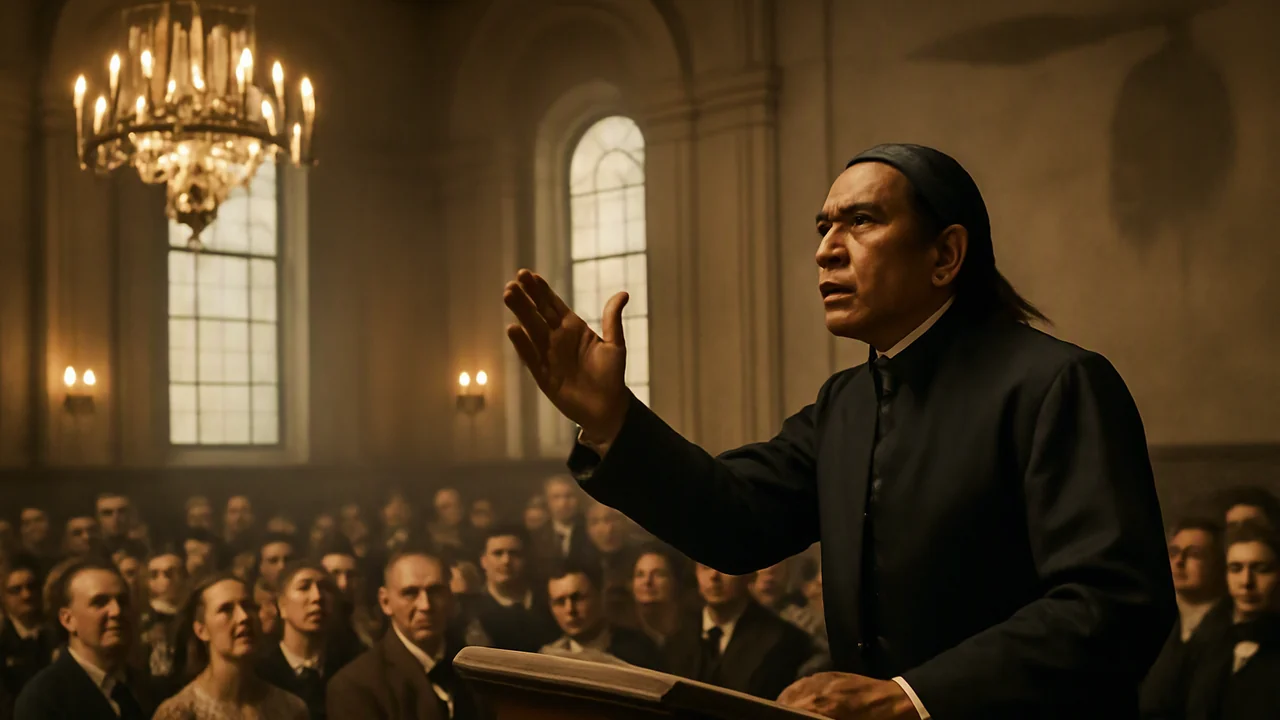
William Apess was Pequot, born in 1798 in Massachusetts, indentured as a child, and later a Methodist minister. In January 1836 he stood up in the Odeon in Boston and delivered a eulogy for Metacom — the Wampanoag leader the English called King Philip — who had led the war of 1675-76 against the New England colonies and whose severed head had been displayed on a pike in Plymouth for two decades.
He delivered it to a Boston audience. He delivered it twice, by demand. And the argument he made is the subject of this seminar.
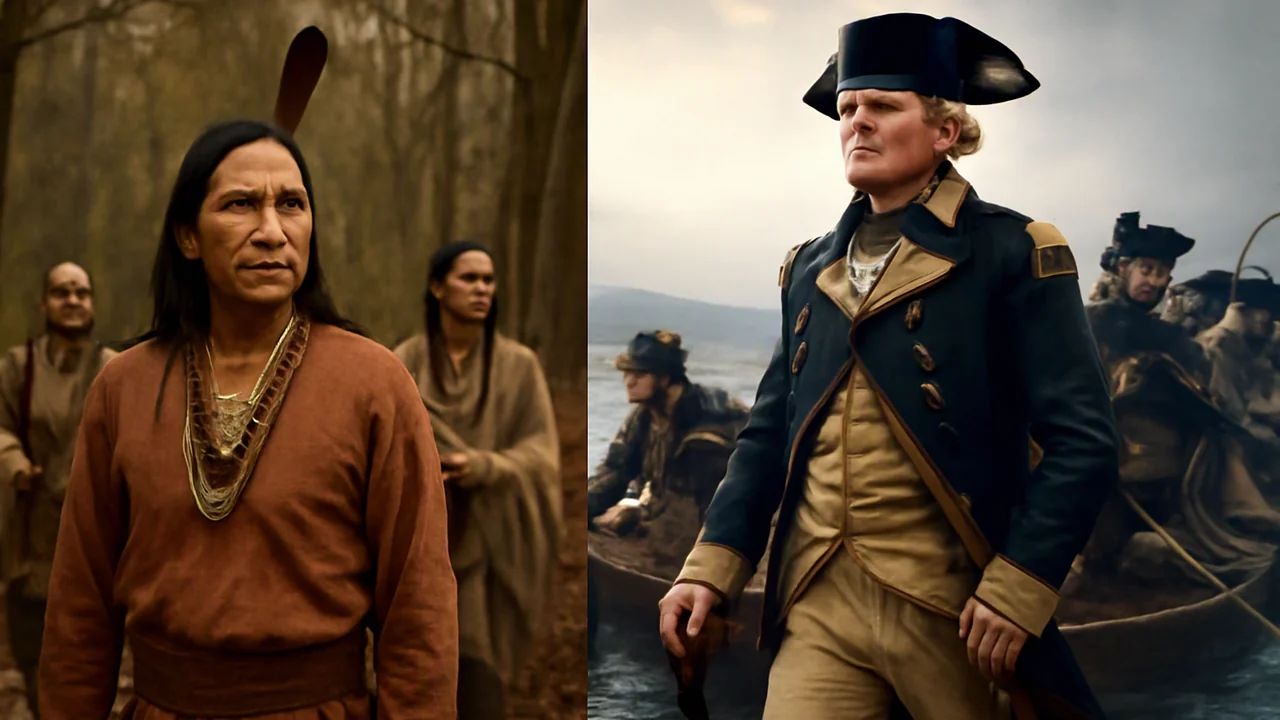
What Apess does. He calls Metacom “the greatest man that was ever in America,” and then builds the comparison out systematically: he sets Metacom beside George Washington and argues the Wampanoag leader was the greater patriot, defending his homeland against invaders with fewer resources and no allies. He recounts the war’s atrocities with dates and places. He quotes the colonists’ own histories back at them.
The structural move to watch is the same one you will meet in every unit of this course. He does not attack his audience’s values. He grants them completely and then applies them consistently. If courage in defense of one’s country is a virtue — and this audience had spent sixty years saying so about 1776 — then it is a virtue in 1675 too, and the arithmetic runs the other way.
Three years earlier, in “An Indian’s Looking-Glass for the White Man,” he had done the same thing with Christianity: he takes his readers’ own scripture, notes that Christ was not a white man, and asks by what principle they read color into a faith that does not contain it.
The question for the seminar. Whom is this argument for?
One reading: it is for the Boston audience — an attempt to change the minds of people with power, using the only leverage available, their own stated commitments. On this reading Apess is a strategist and the eulogy is a piece of political work.
Another reading: an audience that applauds a speech and changes nothing has not been persuaded of anything, and Apess knew it. On this reading the eulogy is for the record and for Native listeners and readers — a refusal to let Metacom be remembered only as the colonists remembered him, spoken in the city where his head was displayed.
Both are supportable. The text will not settle it, and the disagreement is the lesson.
How this runs. Record a ninety-second claim. Then reply to two classmates. A reply is not “I agree” plus a restatement. It does one of three things and you must name which: press (ask what their reading does with a passage that cuts against it), extend (take their claim somewhere they did not and say why the text allows it), or qualify (accept it under a condition, and state the condition).
A typed transcript is an equal-credit alternative to the recording.
One ground rule. Apess was one Pequot writer in one decade. He does not speak for the Wampanoag, whose leader he is eulogising, and he does not speak for you. Attend to what this writer argued in this room.
Reading: Eulogy on King Philip and the Looking-Glass: the passages the seminar argues from
William Apess (Pequot), Eulogy on King Philip (Boston, 1836) and “An Indian’s Looking-Glass for the White Man” (1833) | Text: https://archive.org/download/eulogyonkingphil00apes/eulogyonkingphil00apes_djvu.txt; https://archive.org/download/eulogyonking00apesrich/eulogyonking00apesrich_djvu.txt; https://archive.org/download/eulogyonkingphil00apes_0/eulogyonkingphil00apes_0_djvu.txt; https://archive.org/download/experiencesoffiv00apes/experiencesoffiv00apes_djvu.txt · SLS original; quoted passages are public domain (Apess, 1833 and 1836)
Cite by passage number. At least one passage you quote must be one that makes your own position harder to hold.
The seminar asks whom Apess’s Eulogy on King Philip is for. Below are the passages to argue from, numbered E1 to E6 for the Eulogy and L1 to L3 for “An Indian’s Looking-Glass for the White Man,” so you can cite them in your ninety-second claim. William Apess is Pequot. The man he eulogizes, Metacom, was Wampanoag. The listeners were in Boston. Cite the passage number and quote exactly.
From the Eulogy on King Philip (delivered at the Odeon, Boston, 1836)
E1 (the title-page motto)
Who shall stand in after years in this famous temple, and declare that Indians are not men ! if men, then heirs to the same inheritance.
E2 (the opening)
Justice and humanity for the remaining few prompt me to vindicate the character of him who yet lives in their hearts, and, if possible, melt the prejudice that exists in the hearts of those who are in the possession of his soil, and only by the right of conquest — is the aim of him who proudly tells you, the blood of a denominated savage runs in his veins.
E3
Oh, Christians, can you answer for those beings that have been destroyed by your hostilities, and beings too that lies endeared to God as yourselves? his Son being their Saviour as well as yours, and alike to all men?
E4
We may look upon this move of Philip’s to be equal, if not superior to that of Washington crossing the Delaware. For while Washington was assisted by all the knowledge that art and science could give, together with all the instruments of defence, and edged tools to prepare rafts, and the like helps for safety across the river, Philip was naked as to any of these things, possessing only what nature, his mother had bestowed upon him; and yet makes his escape with equal praise.
E5
Yes, in vain have I looked for the Christian to take me by the hand and bid me welcome to his cabin, as my fathers did them, before we were born; and if they did, it was only to satisfy curiosity, and not to look upon me as a man and a Christian. And so all of my people have been treated, whether Christians or not.
E6 (near the close)
I say then, a different course must be pursued, and different laws must be enacted, and all men must operate under one general law. And while you ask yourselves, what do they, the Indians, want? you have only to look at the unjust laws made for them, and say they want what I want, in order to make men of them, good and wholesome citizens. And this plan ought to be pursued by all missionaries, or not pursued at all. That is not only to make Christians of us, but men; which plan as yet has never been pursued. And when it is, I will then throw my might upon the side of missions, and do what I can to favor it. But this work must begin here first, in New England.
From “An Indian’s Looking-Glass for the White Man” (1833)
L1
Now let me ask you, white man, if it is a disgrace for to eat, drink and sleep with the image of God, or sit, or [page break] walk and talk with them? Or have you the folly to think that the white man, being one in fifteen or sixteen, are the only beloved images of God?
L2
But, reader, I acknowledge that this is a confused world, and I am not seeking for office; but merely placing before you the black inconsistency that you place before me — which is ten times blacker than any skin that you will find in the Universe.
L3
Did you ever hear or read of Christ teaching his disciples that they ought to despise one because his skin was different from theirs? Jesus Christ being a Jew, and those of his Apostles certainly were not whites, — and did not he who completed the plan of salvation complete it for the whites as well as for the Jews, and others?
Where Apess names who he is speaking to
The text does not settle the question, but Apess tells you in his own words who he is addressing at several points. Collect these before you argue.
I appeal to the lovers of liberty.
…
And ye fathers, I will appeal to you that are white.
…
If we cannot read, we can see and feel
Apess, Eulogy, three different addresses: the “lovers of liberty,” the “fathers” who are white, and “we” who cannot read.
Two readings can be built from these, and this seminar tests both. They are SLS framings for discussion, not the positions of any scholar. Reading 1, the Boston audience: the argument is aimed at the people in the room, using their own values (liberty, Washington, Christian love) as leverage; the evidence is E1, E2, E3, E6 (“here first, in New England”). Reading 2, the record and the community: the speech is also for readers who were never in the room, and for people whom the room did not include; the evidence is E5 (“in vain have I looked”) and the printed pamphlet itself. A strong claim uses at least one passage that makes the position harder to hold.
Protocol
- Record a ninety-second claim, or write it as a transcript. Both earn equal credit.
- Reply to two classmates. Each reply names its move: press (ask what their reading does with a passage that cuts against it), extend (take the claim where they did not and say why the text allows it), or qualify (accept it under a stated condition).
- Quote from the passage numbers above. Speak about what this writer argued in this room, and do not speak for the Wampanoag, the Pequot or any other nation.
Question stems
- Press: “Your reading of E3 needs the Boston audience to be persuadable. What do you do with E5?”
- Extend: “If Apess is also writing for people outside the room, then the printed pamphlet matters. What does L2 add?”
- Qualify: “I agree that E6 is aimed at policy makers, but only if the phrase ‘here first, in New England’ is about location and not about audience.”
- Evidence: “Which word in that passage decides it for you?”
A model claim (SLS original, about 90 seconds)
“I think the Eulogy is aimed at the Boston audience but not expecting them to change. In E3 Apess asks a question, ‘can you answer for those beings that have been destroyed by your hostilities,’ which is a question a witness is asked, and a witness has to answer. That is pressure on the room. But E5 works against me: he says he has looked ‘in vain’ for a Christian to take him by the hand, which sounds like a man who has stopped waiting. So my claim is that Apess writes for two audiences at once, the room he has to face and the record he is making, and I hold that the first is the means and the second is the aim. My question for a classmate: if the aim is the record, why does he end E6 with a demand aimed at New England?”
Source
William Apess, Eulogy on King Philip, as pronounced at the Odeon, in Federal Street, Boston (Boston: published by the author, 1836; Internet Archive copy “eulogyonking00apesrich”), and “An Indian’s Looking-Glass for the White Man” in The Experiences of Five Christian Indians of the Pequod Tribe (Boston, 1833; Internet Archive copy “experiencesoffiv00apes”), retrieved 2026-09-26. Page-number digits, the space before punctuation and a few line-break splits and misprints in the scanned pages were corrected; every word is Apess’s. Because editions of the Eulogy differ in pagination, cite by passage number (Apess, Eulogy, E3).
Formative check
Work through these before moving on. They are not graded — they tell you, and your teacher, whether the standard below has landed yet.
Apess sets Metacom beside George Washington and argues Metacom was the greater patriot. Why is that comparison structurally effective for a Boston audience in 1836?
Apess’s argument can be treated as the Native view of King Philip’s War.
Draft the ninety-second claim you will record. State in one sentence whom you think the Eulogy is for; quote two passages, including one that makes your position harder to hold; and close with a question you genuinely want a classmate to answer. Paste the draft here before you record.
How confident are you that you can respond to a classmate by pressing, extending or qualifying their claim rather than restating my own?