use parallel structure correctly in my own sentences, identify antithesis and anaphora in a speech, and explain what the grammar does that the content alone would not.
Instruction
Parallel structure means items doing the same grammatical job take the same grammatical form. It is a rule of correctness and, in speech, a source of power — which is why the CCSS treats it as a language standard and why the texts in this unit are full of it.
Correctness first.
- Faulty: Winnemucca records names, dates, and that rations were withheld.
- Parallel: Winnemucca records names, dates, and withheld rations.
Two nouns and a clause cannot share a list. The same rule governs paired constructions — not only… but also…, either… or… — which must join equivalent forms on each side.
Now the power. Parallelism makes a sentence predictable in form, which lowers the effort of following the content and makes any break in the pattern land like a change of key.
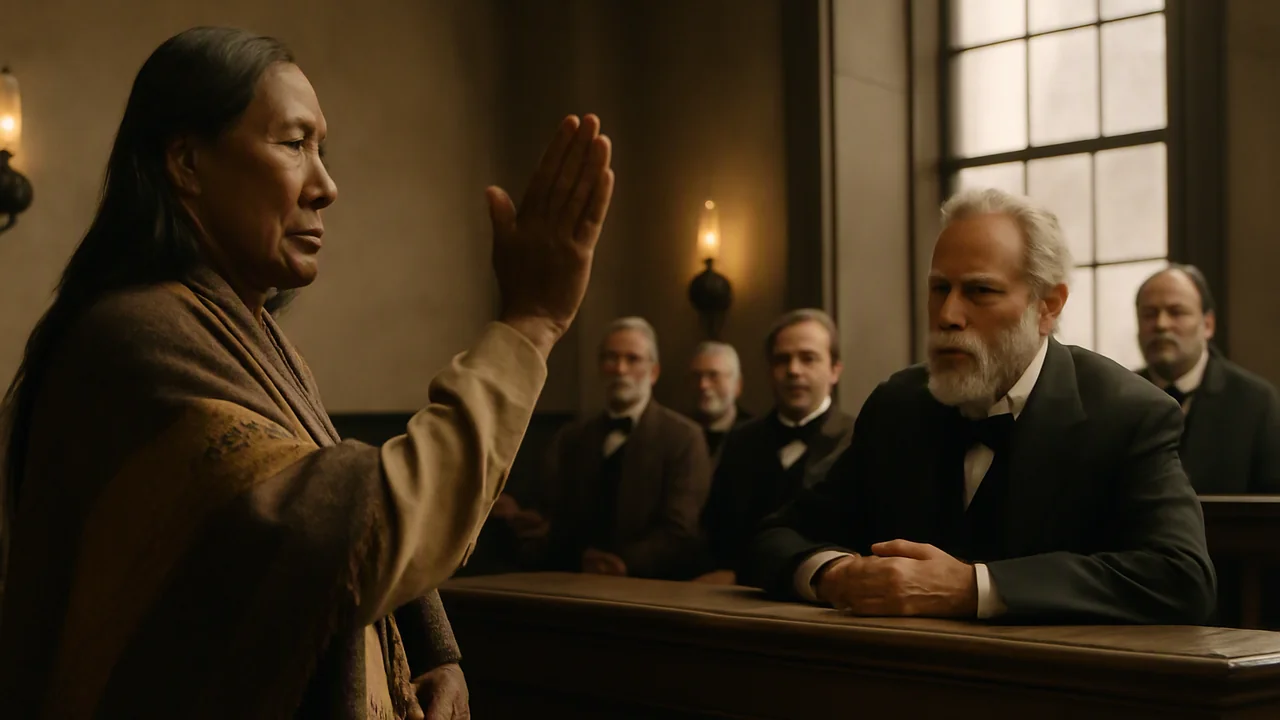
Antithesis sets opposed ideas in parallel form so the grammar performs the contrast. Standing Bear, in the passage you will read in the next lesson, holds up his hand and says: “That hand is not the color of yours, but if I prick it, the blood will flow, and I shall feel pain. The blood is of the same color as yours. God made me, and I am a man.”
Look at what the structure does. Not the color of yours — a concession, granted first. But if I prick it… the blood will flow… I shall feel pain — three parallel consequences. The blood is of the same color as yours — the contrast completed, in the same grammatical frame as the concession. The argument is carried by the symmetry: he grants the visible difference in order to make the invisible sameness undeniable.
Rewrite it unbalanced — although our skin color differs, we are physiologically the same and I am human — and the claim survives while the force does not. And notice something else: the balanced version can be spoken to a judge in a courtroom in 1879. The unbalanced version is a sentence from a textbook.
Anaphora is parallelism plus repetition at the head of successive clauses. Winnemucca: “You have taken our land; you have driven us from place to place…” Each repetition costs the audience nothing to process, so attention moves to the new material inside the frame, and the returning phrase accumulates weight.
Tricolon is the three-part parallel series — the smallest number that establishes a pattern and completes it in one breath.
The analytical move this lesson trains, and it connects to RI.9-10.5: do not stop at naming the device. Standing Bear uses antithesis to emphasize his point could be written by someone who had not read it. Ask instead: what does the structure let the speaker do that a plain statement could not? Here, it lets him concede the thing his listeners can see and use the concession as the ground for the claim they cannot dispute.
Reading: Mentor sentences for parallel structure, antithesis and anaphora, with a worked key

Standing Bear (Ponca), speech of 1879 (Tibbles, in The New York Times, 27 May 1906); William Apess (Pequot), Eulogy on King Philip (1836) and Indian Nullification (1835); Sarah Winnemucca Hopkins, Life Among the Piutes (1883); Thomas H. Tibbles, The Ponca Chiefs (1879); Elias Boudinot, An Address to the Whites (1826) | Text: https://en.wikisource.org/wiki/The_New_York_Times/1906/5/27/One_Case_Where_Carl_Schurz_Was_Not_on_the_Side_of_Human_Liberty; https://archive.org/download/eulogyonking00apesrich/eulogyonking00apesrich_djvu.txt; https://archive.org/download/lifeamongpiutes00manngoog/lifeamongpiutes00manngoog_djvu.txt; https://archive.org/download/poncchiefsanindi00tibbrich/poncchiefsanindi00tibbrich_djvu.txt; Project Gutenberg 12486; https://archive.org/download/addressto00boud/addressto00boud_djvu.txt · SLS original; quoted passages are public domain (Standing Bear via Tibbles, 1879 and 1906; Apess, 1835 and 1836; Winnemucca Hopkins, 1883; Boudinot, 1826)
Read each mentor aloud first. Then do exercise (a) to (c) before you read the worked key.
The lab teaches one structure, parallelism, in three strengths: correct parallel form in a series, antithesis, and anaphora. The mentors below are sentences by Native speakers and writers who used them in print (Standing Bear, Apess, Winnemucca, the Marshpee tribe, Boudinot). Read each aloud before you read the note under it. The exercise sentences (a) to (c) are in the lesson; the worked key follows the mentors.
Mentor sentences
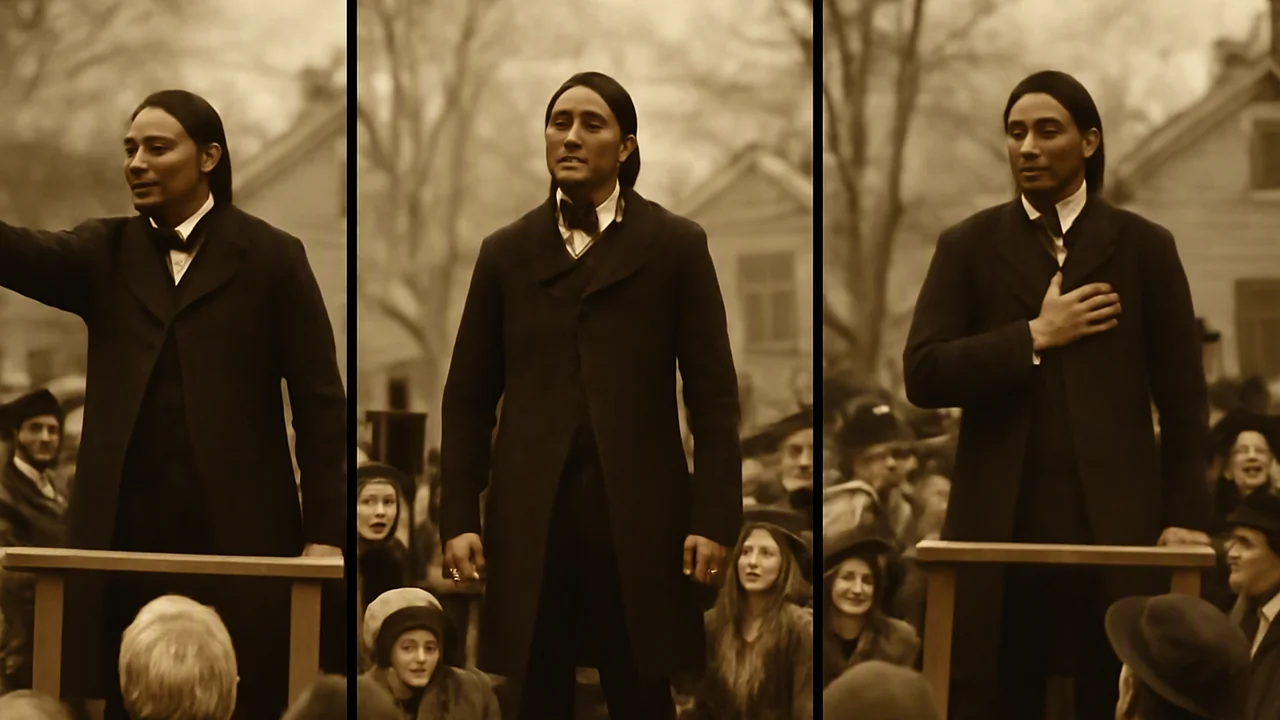 M1: Standing Bear (Ponca), to Judge Elmer Dundy in Omaha, 1879, as Thomas H. Tibbles reported it (The New York Times, 27 May 1906)
That hand is not the color of yours, but if I prick it, the blood will flow and I shall feel pain. The blood is of the same color as yours. God made me, and I am a man.
Antithesis with the concession first. He grants the visible difference, and the next two sentences put the shared fact in the same frame.
M2: William Apess (Pequot), Eulogy on King Philip (Boston, 1836)
Look at the disgraceful laws, disfranchising us as citizens. Look at the treaties made by Congress, all broken. Look at the deep-rooted plans laid, when a territory becomes a State, that after so many years, the laws shall be extended over the Indians that live within their boundaries.
Anaphora: three sentences begin Look at the. The first two are short and the third runs long, so the pile-up is built into the sentence lengths.
M3: Sarah Winnemucca Hopkins (Northern Paiute), Life Among the Piutes (1883), chapter 1: the old women answering a prophecy about the coming of white people
We shall [no] longer be a happy people, as we now are; we shall no longer go here and there as of old; we shall no longer build our big fires as a signal to our friends, for we shall always be afraid of being seen by those bad people.
A tricolon with anaphora and negation. Each clause has the shape we shall no longer plus a verb phrase, and each names something lost. (The bracket marks a scan misprint in the source text, “po”.)
M4: Standing Bear (Ponca), refusing the order to leave the Niobrara, as reported in Thomas H. Tibbles, The Ponca Chiefs (Boston, 1879)
We have harmed no man. We have kept our treaty. We have learned to work.
Three short parallel sentences, each We have plus a past participle. The frame carries the claim, and it takes only nine words.
M5: The Marshpee tribe, resolutions adopted 21 May 1833, as printed in William Apess, Indian Nullification (1835)
Resolved, That we will rule our own tribe and make choice of whom we please for our preacher. Resolved, That we will have our own meeting house, and place in the pulpit whom we please to preach to us. Resolved, That we will publish this to the world;
Parallel clauses in a legal frame: Resolved, That we will plus a different verb phrase each time. Parallelism is what lets a list of promises read as one act.
M6: William Apess (Pequot), Indian Nullification of the Unconstitutional Laws of Massachusetts (1835)
Let them put our white neighbors in Barnstable County under the guardianship of a Board of Overseers, and give them no privileges other than have been allowed to the poor, despised Indians. Let them inflict upon the said whites a preacher whom they neither love nor respect, and do not wish to hear. Let them, in short, be treated just as the Marshpee tribe have been, I think there will soon be a declension of morals and population.
Anaphora as a thought experiment. Let them comes three times, and each time the white neighbors take the Marshpee’s place. The structure is the argument.
M7: Elias Boudinot (Cherokee), An Address to the Whites (Philadelphia, 1826)
Need I spend one moment in arguments, in favour of such an institution; need I speak one word of the utility, of the necessity, of an institution of learning; need I do more than simply to ask the patronage of benevolent hearts, to obtain that patronage.
Parallel rhetorical questions that shrink: one moment, one word, more than simply to ask. The reader is walked to the conclusion that no argument is needed.
Worked key for the exercise (SLS original)
Test. List the items, then ask what each one has to be. In (a) the items are all predicates that need a past-tense verb. In (b) they are all passive verbs. In (c) they are all things Standing Bear asked for, and each needs the same form after it.
| Faulty sentence | Repair | Why it is faulty, and what the repair does |
|---|---|---|
| (a) Winnemucca lectured, wrote a book, and that she sold it at the lectures. | Winnemucca lectured, wrote a book, and sold it at the lectures. | A that-clause cannot share a list with two bare verbs. The repair makes three past-tense verbs, so the reader can see three things she did in order. |
| (b) The petition was signed, delivered, and Congress passed a bill. | The petition was signed, delivered, and answered by a bill. | Two passive verbs and then a full clause with a new subject break the pattern. Three passives keep the petition as the subject all the way through. |
| (c) Standing Bear asked for the right to bury his son, to return to his homeland, and that he be recognized as a person. | Standing Bear asked for the right to bury his son, to return to his homeland, and to be recognized as a person. | Two infinitives and a that-clause do not match. Three infinitives make three requests of the same kind, and the last one is the largest. |
Anaphora rewrite of (a), with what it adds. Winnemucca lectured in the East; Winnemucca wrote a book; Winnemucca sold it at every lecture. The repeated subject puts her, and not the events, at the head of each clause. It adds an accumulating effort: three acts by the same actor, and the reader hears the effort repeat.
A device analysis that says what the structure does (SLS original)
Weak: Apess uses anaphora to emphasize his point. That sentence could be written about a speech nobody has read. Strong: In “Look at the disgraceful laws… Look at the treaties… Look at the deep-rooted plans,” Apess (M2) repeats the same command three times and lengthens each item, so that a Boston audience is told to inspect, one after another, the very documents its own government wrote. The repetition turns his listeners into the ones who must look. The strong version names the words, says what the structure does in this text, and names the audience.
Checklist for your own repairs
- List the items in the series.
- Say each one aloud after the same lead-in words.
- Rewrite the one that sounds wrong until it matches the others.
- Ask whether a repeated opening (anaphora) would help, and say what it adds.
Sources
M1: The New York Times, 27 May 1906, quoting Thomas H. Tibbles, on Wikisource. Tibbles reported the speech after it was interpreted, so it is a report and not a transcript. M2 and M7: Internet Archive copies of the 1836 and 1826 printings, retrieved 2026-09-26. M3: Internet Archive copy of the 1883 edition. M4: Internet Archive copy of the 1879 edition. M5 and M6: Project Gutenberg ebook 12486. Worked key, notes and device analysis SLS original.
Formative check
Work through these before moving on. They are not graded — they tell you, and your teacher, whether the standard below has landed yet.
Which sentence uses parallel structure correctly?
“That hand is not the color of yours, but if I prick it, the blood will flow, and I shall feel pain.” What does the balanced construction accomplish that a plain statement could not?
Writing “Winnemucca uses anaphora to emphasize her point” is adequate analysis of the repeated “You have” construction.
Repair these for parallel structure, then rewrite one using anaphora and say what the repetition adds: (a) Winnemucca lectured, wrote a book, and that she sold it at the lectures. (b) The petition was signed, delivered, and Congress passed a bill. (c) Standing Bear asked for the right to bury his son, to return to his homeland, and that he be recognized as a person.
How confident are you that you can hear a broken parallel in my own writing and repair it without being told which item is wrong?