delineate Winnemucca’s argument into claim, evidence and link, and explain why naming individuals and dates makes the book harder to answer than a general account would be.
Instruction
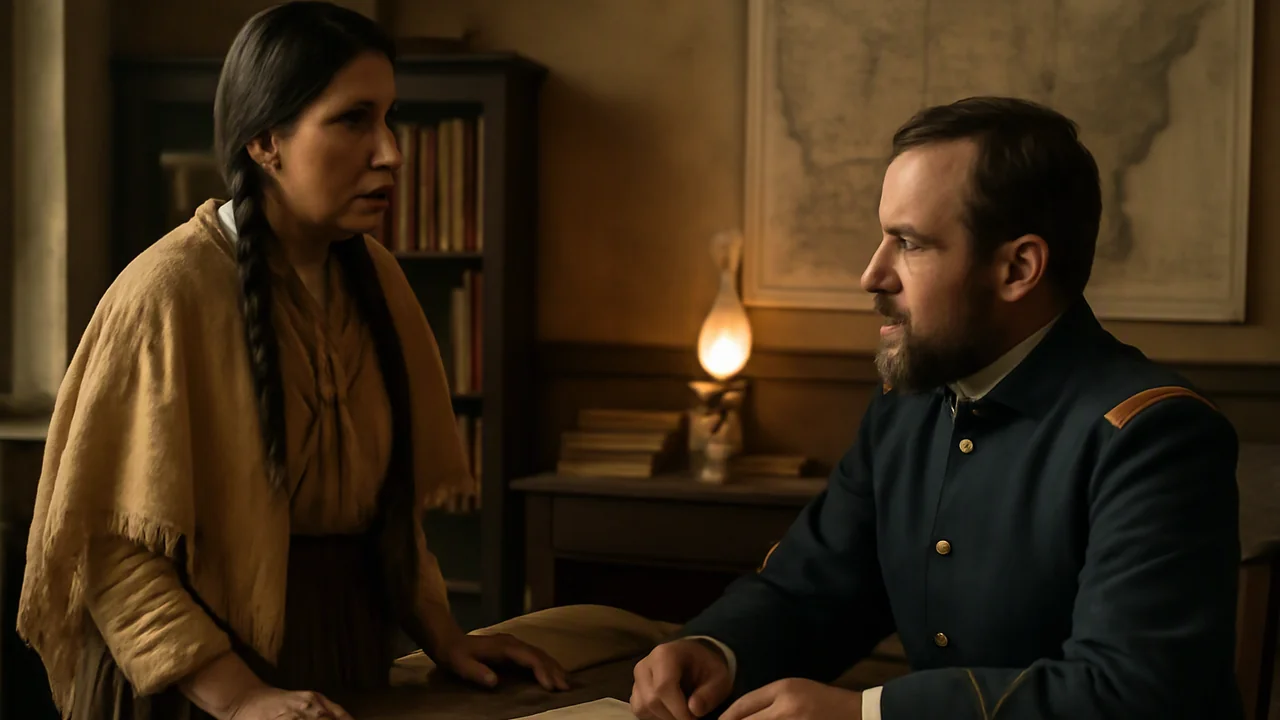
Every act of persuasion sits inside a rhetorical situation: a speaker, an audience, a purpose, and an occasion. Aristotle named three ways a speaker moves an audience — ethos, the appeal from constructed credibility; pathos, the appeal to values and feeling; logos, the appeal from evidence and reasoning.
Hold all three, because the writer in this lesson had a problem with the first that no amount of skill could fully solve, and built her solution out of the third.
The situation. Sarah Winnemucca Hopkins was Northern Paiute, born around 1844 in what is now Nevada. She worked as an interpreter and scout for the US Army, and she watched federal agents divert supplies intended for her people, watched her family moved by force in winter, and spent years petitioning for the right of the Northern Paiute to return to the Malheur reservation. In 1879 she began lecturing in the East — by one count more than three hundred lectures — and in 1883 published Life Among the Piutes, which she sold at those lectures to fund a petition to Congress.
The petition succeeded on paper. A bill passed. It was not carried out.
Her ethos problem. She was Paiute, a woman, and lecturing to eastern audiences about the conduct of federal officials. Opponents attacked her character directly and in print, which was the standard method of answering a Native witness. Any argument resting on trust me was going to lose.
Her solution, and the reason this text anchors the unit. She wrote a book that functions as testimony under cross-examination. It names agents. It gives dates. It says where she was standing and who else was present. It quotes what was said. It describes the movement of specific supplies and specific numbers of people.
Consider what that costs and what it buys. It costs her: an account this specific can be checked, and anything wrong in it can be used to discredit the whole. It buys her: an account this specific must be answered in its particulars, and a general denial no longer works.
That is a logos strategy adopted precisely because ethos was unavailable, and it is the same structural move you saw Occom make in Unit 1 and will see Standing Bear make in Lesson 3.3.
Why this is the right text for RI.9-10.8. That standard asks you to evaluate reasoning and evidence and to identify fallacious reasoning. Most serious arguments contain no fallacy, and students who learn only fallacy names have nothing to do with a text like this. The real work is three questions: is the evidence relevant to the claim actually made, is it sufficient, and is the source in a position to know. Winnemucca’s method is an extended answer to the third — she was there, she was the interpreter, she heard it.
Before you read. The book describes the forced winter removal of her people, and family separation. Your instructor will have set the classroom practice. Write about what the text does; naming a technique is both the stronger analysis and the more serious treatment of what is being described. An alternative pathway is available on request and carries no penalty.
Reading: Life Among the Piutes: the witness, the named agent and the removal
Sarah Winnemucca Hopkins (Northern Paiute), Life Among the Piutes: Their Wrongs and Claims (Boston, 1883) | Text: https://archive.org/download/lifeamongpiutes00manngoog/lifeamongpiutes00manngoog_djvu.txt · SLS original; quoted passages are public domain (Winnemucca Hopkins, 1883)
Cite by passage number. The book names the agent Reinhard; keep that spelling when you quote it.
Sarah Winnemucca Hopkins (Northern Paiute) published Life Among the Piutes: Their Wrongs and Claims in Boston in 1883, edited by Mary Mann, and sold it at her lectures to raise money for a petition to Congress. The passages below are numbered W1 to W7 so you can cite them. They show three things the lesson asks you to see: where she stands as a witness (W1, W6, W7), the specific, named events she reports (W2, W3, W4), and how she addresses her readers (W5). Two of the passages describe a winter removal and hungry children. Read for what the writing does; an alternative route through the lesson is always open to you and carries no penalty.
The book opens
W1: the first paragraph, on when and who
I was born somewhere near 1844, but am not sure of the precise time. I was a very small child when the first white people came into our country. They came like a lion, yes, like a roaring lion, and have continued so ever since, and I have never forgotten their first coming.
Life Among the Piutes (1883), chapter 1
A named agent, a named place, a recorded exchange
W2: Winnemucca to Agent Reinhard, at the Malheur Agency, on a Sunday
I went to him and said, “Mr. Reinhard, some of my people have come here to [make] a home with us. They were never here before. They say they have nothing to eat. This is why I came to speak to you. Excuse me for coming on Sunday to tell of my people’s wants.” He told me to say to them that he was not going to issue any more rations to them. I said, “Very well, I will tell them.”
Life Among the Piutes, chapter 6
W3: what Paiute men told her the agent had stopped issuing
Our agent, Reinhard, has been very unkind to us since you left us. He has not given us anything to eat; he is not issuing rations to us as our father Parrish used to do, and our poor children are [crying] to us for food, and we are powerless to help our little ones.
Life Among the Piutes, chapter 7
The Yakima removal
W4a: the commanding officer at Camp Harney tells her the order
Sarah, an order is issued that your people are to be taken to Yakima Reservation, across the Columbia River.” I said, “All of my people?” “No, not your father’s, but all that are here.” I asked, “What for?” He said he did not know.
Life Among the Piutes, chapter 8
W4b: her answer, and the timing
It was just a little before Christmas. My people were only given one week to get ready in. I said, “What! In this cold winter and in all this snow, and my people have so many little children? Why, they will all die. Oh, what can the President be thinking about? Oh, tell me, what is he? Is he man or beast? Yes, he must be a beast; if he has no feeling for my people, surely he ought to have some for the soldiers.” “I have never seen a president in my life and I want to know whether he is made of wood or rock, for I cannot for once think that he can be a human being. No human being would do such a thing as that, — send people across a fearful mountain in midwinter.”
Life Among the Piutes, chapter 8
Her address to her readers
W5
Since the war of [1860] there have been one hundred and three (103) of my people murdered, and our reservations taken from us; and yet we, who are called blood-seeking savages, are keeping our promises to the government. Oh, my dear good Christian people, how long are you going to stand by and see us [suffer] at your hands?
Life Among the Piutes, chapter 5
Officers who vouch for her, printed in the book’s appendix
W6: Brevet Colonel George B. Sanford, 1st Cavalry, Camp on Fayette River, 5 September 1878
During the late campaign against the Bannock Indians Sarah Winnemucca has been with the various commands in the field, and has to my knowledge rendered very valuable service. She is entirely trustworthy and reliable. In my opinion she is deserving of great credit for her conduct during the campaign.
W7: Captain Thomas M. Gregor, 1st Cavalry, Camp Harney, Oregon, 28 October 1878
She has been constantly in the field, enduring hardships that strong men succumbed under. Her [efforts] in the beginning of the campaign in getting her father and a large portion of the hostile Indians deserve great praise. She is now employed as interpreter at this post, and fulfils her duties to the satisfaction of all parties.
A worked delineation (SLS original)
- Claim, the sentence someone could deny: the hunger and removal of the Paiute at Malheur were produced by the conduct of named federal agents, and not by circumstance.
- Evidence, in the order she offers it: her own position as interpreter and witness (W1, and the officers in W6 and W7 who vouch for it); a specific exchange with a named agent, Reinhard, in which he says he will issue no more rations (W2); the report of Paiute men that he has “not given us anything to eat” (W3); the date and the officer’s order to move her people (W4a, W4b); the direct address to her readers (W5).
- The link, what must be true for the evidence to support the claim: if a named agent had authority over the rations, and stopped issuing them, then the hunger was a decision and not a shortage. If a military officer gave the order and the season was “a little before Christmas,” then the winter march was a choice made with knowledge of the season.
- The three tests. Relevant: yes, because the evidence names who acted and what he did. Sufficient: partly; one exchange (W2) is testimony from one witness, and the reader would want the men in W3 or an officer to confirm it. In a position to know: strongly, because she was there as interpreter, and W6 and W7 say two officers relied on her.
What her argument does not need to prove, and why that is a strength. It does not need to prove that all federal officials were cruel, or that any white person was. It only needs to show that particular agents made particular decisions. A narrow claim is easier to defend and harder to dismiss: a reader who wants to reject it must reject Reinhard’s recorded words, not a general impression.
Sources
Sarah Winnemucca Hopkins, Life Among the Piutes: Their Wrongs and Claims, ed. Mary Mann (Boston: Cupples, Upham, 1883), Internet Archive copy “lifeamongpiutes00manngoog,” retrieved 2026-09-26. In the scanned text, the spacing inside quotation marks and before punctuation was closed up, a few scan misprints (marked here in square brackets) (the year “1860,” the words “make,” “crying,” “efforts,” “suffer”) were corrected, and the chapter’s first word was set in lower case; every other word is Winnemucca’s or the officers’. The book spells the agent “Reinhard”; historical sources spell his name Rinehart. Chapter numbers are those of the 1883 contents page. Framing and worked delineation SLS original.
The agreements and the record here
Winnemucca’s book is one nation’s record of a specific removal, with named agents and dates. Every nation has its own record of its agreements with the United States — treaties, executive orders, statutes, court cases — and its own account of how they were kept.
This slot is your own nation’s agreements with the United States — treaties, executive orders, statutes, court cases — and the account of how they were kept. Hold two things apart for the whole of this work. The texts are federal public documents and anyone may read them; the community’s account of what those agreements did here is the nation’s own, and it is not yours to collect. Your school may bring that account to you. Meanwhile, take one of the three routes below; all three earn full credit, and each one ends in a treaty text or a federal record you can cite by name.
Your route — choose one. All three earn full credit.
- Route A — The treaty itself (Kappler, and the Tribal Treaties Database) — Charles J. Kappler’s Indian Affairs: Laws and Treaties is the standard compilation: seven volumes of treaties, statutes and executive orders, out of copyright, digitized by the Oklahoma State University Library at dc.library.okstate.edu/digital/collection/kapplers. Volume II holds the treaties. OSU also runs the free Tribal Treaties Database at treaties.okstate.edu, built with the U.S. Department of Agriculture and the Department of the Interior, where you can browse by nation, by document type and by provision. Find an agreement involving your own nation, read it end to end, and log the date, the parties as the document names them, what each side promised, and what the United States reserved to itself. Not every nation’s relationship with the United States rests on a treaty: many rest on an executive order, an act of Congress or a later agreement, which Kappler’s other volumes carry. If that is your nation, take that instrument instead and name it accurately — the difference is itself part of the history. Quote no more than two sentences, and give the volume and page.
- Route B — The record of the agreement, and its gaps — Open archives.gov/research/native-americans and read the Treaties section, then search the National Archives Catalog (catalog.archives.gov) for your nation’s name together with a term from the record itself — “agency”, “annuity”, “council proceedings”, “ratified treaty”. Records of the Bureau of Indian Affairs are Record Group 75. Open one document and write 200 words on what the file shows about how an agreement was carried out rather than how it was written: who was paid, who was moved, who wrote the report, and who never appears in it at all.
- Route C — What the nation says about it now — An agreement signed in the 1800s is operating law today, and nations litigate, negotiate and legislate under their treaties this year. From the nation’s own website, read its natural resources, legal, sovereignty or newsroom pages, present tense, and write 200 words on what the nation itself currently says about the agreement that covers its land: what it holds the United States to, what it is asking for, what it treats as settled. Use the nation’s own name for the agreement. If a matter is in litigation the nation may say very little in public, and if the nation says nothing at all, that is your finding — record it, and do not fill the gap from news coverage or from a court’s summary of the nation’s position.
For the school — how this slot gets filled
Who holds this: The tribal historic preservation office, the tribe’s legal or natural resources department, a tribal archive, or the nearest tribal college.
- Treaty texts are federal public documents and are freely available; the community’s account of what happened is not a public document and is not yours to take.
- Ask the tribal historic preservation office or legal department what may be used in a classroom and, separately, what may appear in a course other schools can see.
- Where an account is offered by a specific person, agree attribution and agree that they may revise or withdraw it later. An elder’s account is not a citation you own.
- Be ready for the answer to be that the treaty may be taught and the community account may not. That is a complete answer, and the lesson still works.
Formative check
Work through these before moving on. They are not graded — they tell you, and your teacher, whether the standard below has landed yet.
Winnemucca names federal agents, dates and numbers throughout. Before reading on — what does that specificity buy, and what does it cost?
Winnemucca records asking agent Rinehart directly why rations were not issued, and records his reply. Why is that exchange stronger evidence than a statement that rations were withheld?
Evaluating an argument means finding the fallacy in it.
The appeal from a speaker’s constructed credibility is ; whether a source is in a position to know the specific thing being claimed is its .
Delineate Winnemucca’s argument in four steps: (1) the claim — the sentence someone could deny; (2) the evidence, in the order she offers it; (3) the link — what has to be true for that evidence to support that claim, written as a full proposition; (4) the three tests, with your judgment on each. Then answer in one sentence: what does her argument not need to prove, and why is that a strength?
How confident are you that you can name the link between a piece of evidence and the claim it is offered for, and say whether it holds?