distinguish what Posey inherited from the dialect-letter tradition from what he did with it, and frame a research question that both a literary text and a federal report can answer.
Instruction
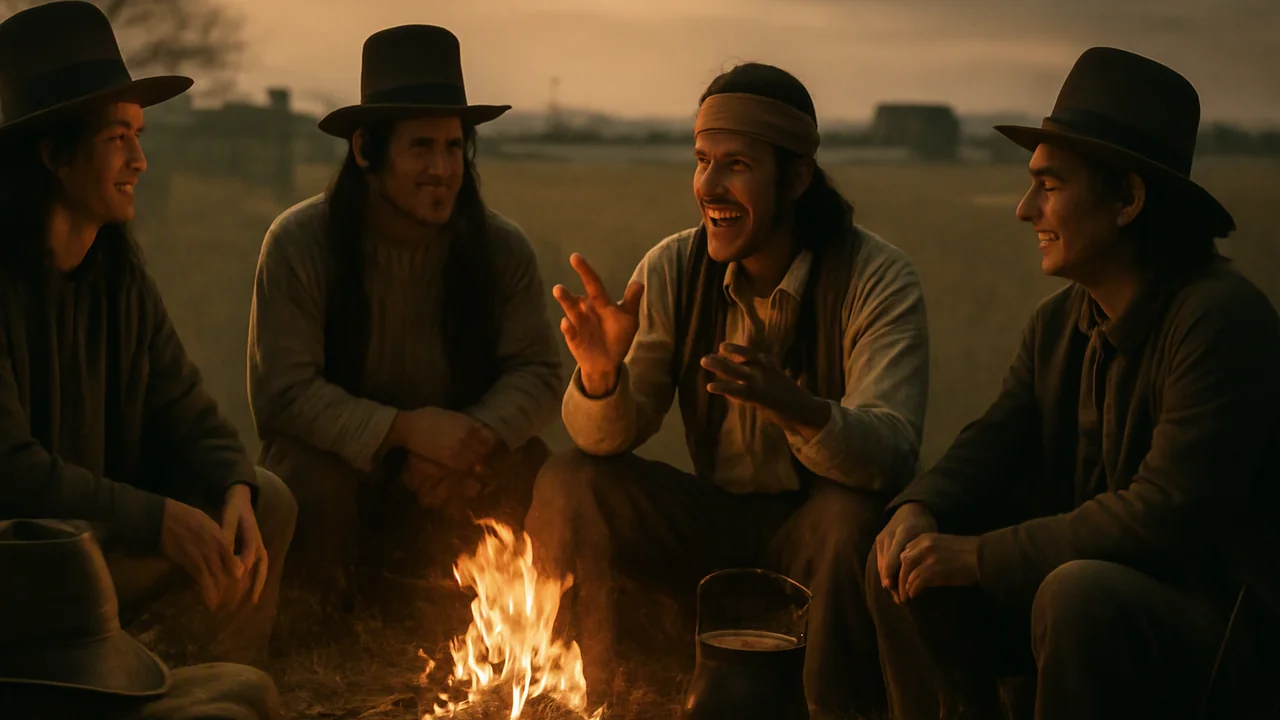
Alexander Posey was Muscogee (Creek), born in 1873 in Indian Territory. He was a poet, a newspaper editor, and for a time an official of the Creek Nation. Between 1902 and 1908 he published a series of letters in Oklahoma newspapers signed Fus Fixico — a fictional Creek correspondent who reports the conversations of a handful of friends sitting around a fire, talking about what the federal government is doing to them.
They are funny. They were popular. They were reprinted widely, and they are among the sharpest political writing of the period.
What Posey inherited. The dialect letter was a standing American newspaper form — a rustic correspondent, phonetic spelling, apparent naivety, and political satire underneath. White humorists had used it for decades, and a great deal of it was contemptuous of the people whose speech it imitated.
What Posey did with it. Three changes, and each is worth naming precisely because each converts the form’s weapon.
First, the speakers are the ones with the judgment. In the inherited form the dialect speaker is the joke. In Posey’s letters Fus Fixico and his friends are consistently correct about what is happening to them, and the officials they discuss — thinly renamed, entirely recognizable — are the ones who look absurd.
Second, the Creek English is accurate. Posey was a first-language Creek speaker writing the English of Creek speakers he knew. The inherited form used spelling to mark a speaker as ignorant; Posey’s marks a speaker as bilingual, which is the opposite claim.
Third, the target is policy. The letters run through allotment, the Dawes Commission’s enrollment process, the dissolution of the Creek national government, and the manoeuvring toward Oklahoma statehood — the exact policy period the Meriam Report would audit twenty years later.
Why this matters for research, not just for reading. RL.9-10.9 is a standard about the difference between a convention and a choice. Students routinely credit an author for what a genre supplied or blame them for what it required. Separating the two lets you ask a real question about Posey — and then the same question about a government report.
The complication you should not skip. Posey worked for the Dawes Commission as an enrollment clerk. He satirised allotment and he also administered part of it. That is not a gotcha; it is the ordinary condition of people inside a system they are also arguing with, and the second Essential Understanding — that there is no single position, and no generic Native person — is precisely what it illustrates.
Framing the question. The semester’s essential question is: when a policy is described by the government that made it and by the people it was made about, what can each account see that the other cannot? A workable research question is narrow, arguable, and answerable from both kinds of text. “What was allotment?” fails. “What can Posey’s satire register about enrollment that a statistical audit cannot, and what can the audit establish that satire cannot?” passes.
Reading: Fus Fixico letters, a dialect-letter model and three Meriam Report findings, with worked chart and questions
Alexander Posey (Muscogee Creek), Fus Fixico letters, reprinted in the Vinita Daily Chieftain, 16 June and 9 November 1903; Petroleum V. Nasby (David Ross Locke), letter of 20 September 1866 (PG #18465); Lewis Meriam and staff, The Problem of Indian Administration (1928) | Text: PG #18465 (the Gutenberg ebook); Chronicling America / Library of Congress (loc.gov; OCR text via tile.loc.gov), Vinita Daily Chieftain (LCCN sn83025020), 16 June 1903, p. 2; Chronicling America / Library of Congress (loc.gov; OCR text via tile.loc.gov), Vinita Daily Chieftain (LCCN sn83025020), 9 November 1903, p. 1; archive.org/download/ldpd_11418459_000/ldpd_11418459_000_djvu.txt [not machine-checkable: includes text only on non-scriptable hosts; checked by hand] · SLS original; quoted passages are public domain (Posey, 1903; Locke, 1866; Meriam et al., 1928)
Read the letter aloud, then read the Report. Ask what each one can establish that the other cannot.
The lesson asks you to separate what Alexander Posey (Muscogee Creek) inherited from a standing newspaper form from what he did with it, and to frame a research question that a literary text and a federal report can both answer. This reading gives you a sample of the inherited form, two Fus Fixico letters from 1903, three findings of the 1928 Meriam Report, a worked inheritance chart, and worked questions. Posey’s letters were printed in Oklahoma newspapers; the copies here are from the digitized pages of the Vinita Daily Chieftain, which reprinted them, and the scanned text has errors. Square brackets mark words repaired from the scan or supplied where it dropped a mark. Cite by label.
The inherited form: a dialect letter from 1866
 N1: Petroleum V. Nasby (David Ross Locke), a letter from “Confedrit X Roads,” 20 September 1866
I wuz sent for to come to Washington, from my comfortable quarters at the Post Offis, to attend the convenshun uv sich soldiers and sailors uv the United States ez bleeve in a Union uv 36 States, and who hev sworn allejinse to a flag with 36 stars onto it, at Cleveland. My esteemed and life-long friend and co-laborer, Rev. Henry Ward Beecher, wuz to hev bin the chaplin uv the convenshun, but he failed us, and it wuz decided in a Cabinet meetin that I shood take his place. I didn’t see the necessity uv hevin a chaplin at every little convenshun uv our party, and so stated; but Seward remarked, with a groan, that ef ever there wuz a party, since parties wuz invented, wich needed prayin for, ours wuz that party.
The Wit and Humor of America, vol. 2 (Project Gutenberg 18465)
Two Fus Fixico letters by Alexander Posey, 1903
F1: on statehood, 1903
Well, so all the wire-stretchers for single statehood was leaped on the fence but one politician up to Wagoner who was sign his name See A. Castle[.] He was called a big convention [over] to Shawnee if he could get up a crowd. He was the only one that was still on deck and don’t want to give up the ship and swim out alive.
Hotgun he say, “well maybee so it was take lots of grit to do that but it don’t take no philosophy hardly.”
Fus Fixico, in the Indian Journal, as reprinted in the Vinita Daily Chieftain, 16 June 1903
F2: on See A. Castle
Then Hotgun he say, “Well [so] I think See A. Castle- was better changed his name to Bee A. Fence.”
Same letter
F3: the lawyers and the convention
Well, so,” Hotgun he say, “there was a fine opportunity for some lawyer to pay his board bill and saw off his practice in the police court.” And Tookpafka Micco he say, “Well, so you was had to sight me.” Then Hotgun he say, “Well, so I think they was a good chance for some lawyer that didn’t had anything but bright prospects and the Arkansaw [Digest] to start something ‘sides pow-wows to make resolutions and delegates to congress, ’cause the people was burned out on old chestnuts like that and they appetite was craved for green things.”
Fus Fixico, “last letter,” as printed in the Vinita Daily Chieftain, 9 November 1903
F4: the pie counter
And Tookpafka Micco he say, “Well, so I think Clarence Dug Last at the Muskogee Phoenix was tried to ring in the changes for him down in South Town, when the coming senators and congressman and county judges and sheriffs and justices of the peace and school trustees and state house janitors and dog pelters was asked the Great White Father in Washington for a handout from [the pie] counter.”
Same letter
Three findings of the Meriam Report, 1928
R1: the general condition (chapter 1, page 3)
An overwhelming majority of the Indians are poor, even extremely poor, and they are not adjusted to the economic and social system of the dominant white civilization.
Lewis Meriam and staff, The Problem of Indian Administration (Baltimore: Johns Hopkins Press for the Institute for Government Research, 1928)
R2: allotment (chapter 1, page 41)
The policy of individual allotment should be followed with extreme conservatism. Not accompanied by adequate instruction in the use of property, it has largely failed in the accomplishment of what was expected of it. It has resulted in much loss of land and an enormous increase in the details of administration without a compensating advance in the economic ability of the Indians.
Same report
R3: boarding schools (chapter 1, page 11)
The survey staff finds itself obliged to say frankly and unequivocally that the provisions for the care of the Indian children in boarding schools are grossly inadequate.
Same report
The page numbers are counted from the running heads of the 1928 printing, which sit on even pages only. R2 is on page 41 and the sentence after the quoted passage runs onto page 42. Cite as (Meriam 41).
Worked inheritance chart (SLS original)
| Feature | What the inherited form supplied (N1) | What Posey did with it (F1 to F4) |
|---|---|---|
| A speaker who reports talk | A “Postmaster” who reports what other men said to him, in his own voice. | A chorus of friends around a fire, Hotgun and Tookpafka Micco, who answer each other in short turns. |
| Spelling that marks the speaker | Sound-spelling, such as “wuz,” “sich ez,” “uv,” which marks the speaker as ignorant. | Almost no sound-spelling; the marking is done by grammar (“was had to sight me,” “he was had bad luck”), the same in every voice. |
| Names that mock | Place names such as “Confedrit X Roads.” | Puns on officials, “See A. Castle,” “Clarence Dug Last,” pinned on the men who hold the offices. |
| Who is the joke | The speaker, who is a fool and does not know it. | The office-seekers, whom the friends see clearly; Hotgun’s “Bee A. Fence” is the punch line. |
| Subject | Party politics of 1866. | Statehood, the convention lawyers, and the crowd waiting at the “pie counter” (F4) for jobs from “the Great White Father in Washington.” |
The question the chart supports. The form was the same and the direction of the joke was reversed, and the moment the joke lands is when the friends look at the people who gain from a policy.
Worked research question and its three tests (SLS original)
| Step | Answer |
|---|---|
| Question | What can Posey’s letters about statehood show about who gained from the change in Indian Territory that the Meriam Report’s finding on allotment cannot, and what can the Report establish that the letters cannot? |
| 1. A passage in Posey that answers it | F4: the list of offices, “senators and congressman and county judges and sheriffs” and the rest, all “asked the Great White Father in Washington for a handout.” |
| 2. A passage in the Meriam Report that answers it | R2: allotment “resulted in much loss of land and an enormous increase in the details of administration.” |
| 3. The disagreement, in one sentence | The letters show who was lining up for the new offices that statehood created; the Report shows what allotment did to the land, and neither account shows the other’s half. |
A question that fails: What was allotment? It has one answer and needs no second account. A question that passes names a claim, can be answered from both kinds of text, and lets the two accounts disagree.
Sources
Nasby: Project Gutenberg ebook 18465, letter dated 20 September 1866. Posey: Chronicling America, Library of Congress, Vinita Daily Chieftain (LCCN sn83025020), 16 June 1903, page 2, and 9 November 1903, page 1, text from the digitized OCR, retrieved 2026-09-26. The Meriam Report: Institute for Government Research, The Problem of Indian Administration (Baltimore, 1928), Internet Archive copies ldpd_11418459_000 and problemofindiana0000broo. Chart, questions and framing SLS original.
What happened here in this policy period
Posey wrote about allotment as it ran through the Creek Nation, and the Meriam Report audited the policy nationally. What that period did in this place — which lands, which families, which school — is held here, not in either of those documents.
This slot is what the allotment and assimilation period did in this place: which lands, which families, which school. Some of that record sits in a tribal archive and some of it is held by people rather than by paper, and both are evidence — the third Essential Understanding says so. What is held by people is the community’s to share or not, and your school may bring it to you; it is never something you go and collect. For your paper, take one of the three routes below. All three earn full credit, all three run on national public-domain sources, and all three end with a document you can cite.
Your route — choose one. All three earn full credit.
- Route A — The national audit (the Meriam Report, 1928) — The Problem of Indian Administration — the Meriam Report — was a survey of federal Indian policy submitted to the Secretary of the Interior on 21 February 1928, and it is the document that made the failure of allotment official. The National Indian Law Library posts it chapter by chapter, free, at narf.org/nill/resources/meriam.html. Read the General Summary of Findings in Part I and one of the Part II chapters — Health, Education, or Economic Conditions. Then write 250 words on the survey’s method: who the surveyors talked to, what they counted, what they treated as a problem and what they treated as normal. Where the report describes conditions in a region or at an agency near you, say so and give the chapter and page.
- Route B — The paper trail of the land and the school — Open archives.gov/research/native-americans and read the Allotment Records, School Records and Census Records sections, which explain what each series contains and how it is arranged. Then search the National Archives Catalog (catalog.archives.gov) for the name of the agency, reservation or school, and open one digitized item. Write 250 words on what one allotment schedule, census roll or school file records about a person — and on what the form never asked. These records exist because the federal government was counting, allotting and schooling people; say that plainly when you cite them.
- Route C — The end of the period, nation by nation — The allotment era closed with the Indian Reorganization Act of 1934, and each nation voted on it separately. Open Ten Years of Tribal Government Under I.R.A. (Theodore H. Haas, United States Indian Service, January 1947), free at thorpe.law.ou.edu/IRA/IRAbook/index.html, and find Table A: the tribes, bands and communities that voted to accept or reject the Act, the date of each election, and the votes cast. Take your own nation if it appears, and two others in different states. Write 250 words comparing the three votes, and close on the limit of the evidence: a vote tally tells you the decision and the margin, and tells you nothing about what people said to each other before they made it.
For the school — how this slot gets filled
Who holds this: A tribal historian or historic preservation office, a tribal college, a tribal realty or land office, or community members whose families lived it.
- Approach the tribal historic preservation office or cultural department first, and ask them who the right person is rather than deciding yourself.
- For an oral account, agree in advance how it may be recorded, who keeps the recording, whether it may be quoted, and whether the person may withdraw it later. These are four separate permissions.
- Do not ask a student to supply their own family’s account as coursework. A student may volunteer; being assigned to produce family history is a different thing and it is not appropriate.
- Agree citation with the person or office: how they wish to be named, or whether they wish to be named at all.
Formative check
Work through these before moving on. They are not graded — they tell you, and your teacher, whether the standard below has landed yet.
The dialect letter was a standing American form, often contemptuous of the speakers it imitated. Before reading on — what does Posey change about it?
Why does Posey keep the phonetic spelling rather than writing his speakers in standard English?
Because Posey worked as an enrollment clerk for the Dawes Commission, his satire of allotment is hypocritical and cannot be taken seriously.
Build the inheritance chart: what the dialect-letter form supplied, and what Posey did with each feature. Then draft your research question and test it: (1) name a passage in Posey that answers it; (2) name a passage in the Meriam Report that answers it; (3) state in one sentence what the two accounts disagree about, or what one can see that the other cannot. If you cannot complete step 3, revise the question.
How confident are you that you can separate what a genre supplied from what an author chose to do with it?