4.07 Competing Retrofits and Prototype Version 1
set prioritized criteria and constraints for a downtown earthquake retrofit, compare competing solutions with a weighted decision matrix, and build and run a first prototype.
- I can generate a list of at least three realistic criteria and two constraints, such as cost, safety, reliability, and aesthetics, that define what makes a solution acceptable for a complex real-world problem.
- I can assign priorities to each criterion and constraint so I can logically and systematically evaluate different solution proposals.
- I can analyze and describe the strengths and weaknesses of each solution based on my criteria and constraints, including social, cultural, and environmental impacts, and explain possible barriers to putting each solution into action.
- I can select logical and realistic inputs when using a computer simulation.
- I can use the simulation to test the effects of different solutions, tradeoffs, or decisions.
Phase 4: Build
Warm-Up ~5 min
Do Now. The council’s engineer says, “The strongest retrofit is the wrong one if the shops can’t open.” Explain what she means in two sentences.
A two-story model has walls upstairs and only corner posts on its open ground floor. When shaken, where will it fail first?
Instruction ~10 min
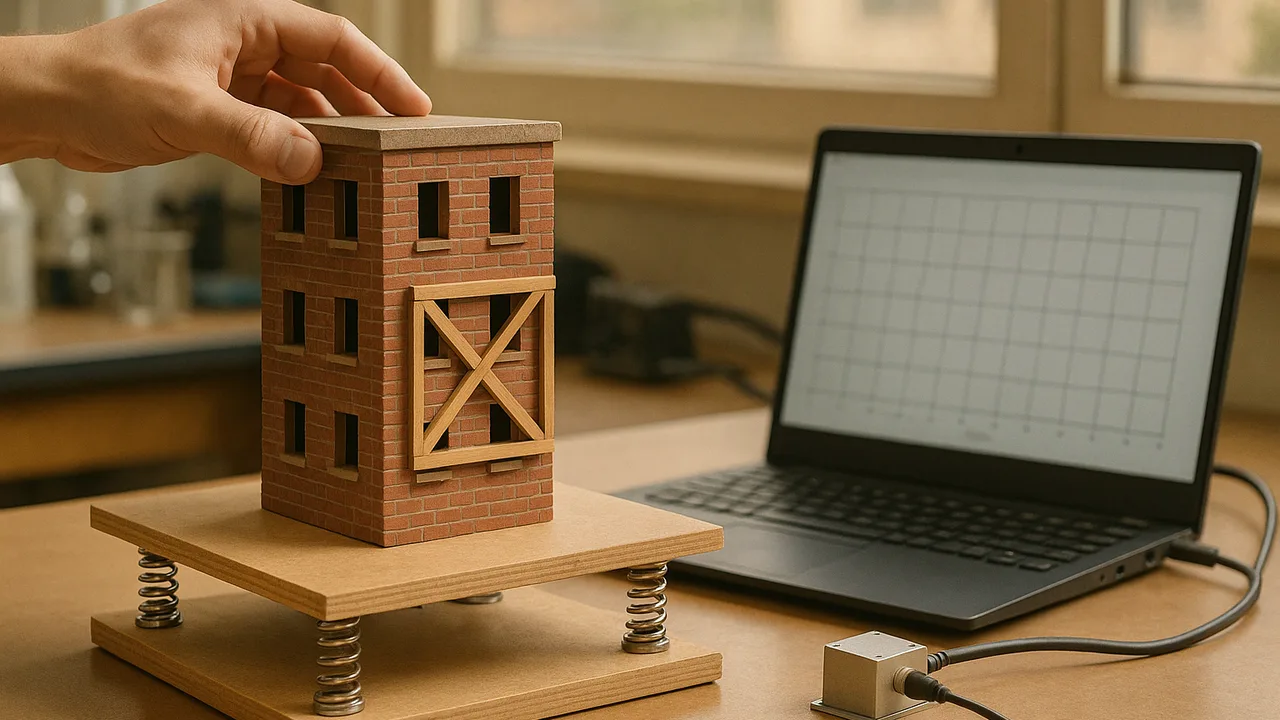
The design problem. Most teams chose a hazard in 4.02; today the whole class prototypes one shared challenge so we can compare results, then each team carries the method back to its own hazard. The town’s old downtown has two-story apartment buildings over open garages and shops. We will model one and retrofit it.
Criteria and constraints, prioritized. C1 (most important): in the standard shake test, the top shifts no more than 10 mm and nothing collapses. C2: the retrofit still passes with a 200 g load upstairs. C3: it can be built in one period. Constraints: K1 cost no more than 12 material points (each straw 1 point, each 10 cm of tape 1 point, each card panel 3 points); K2 the two front openings stay at least 6 cm wide and clear so shops and cars can use them; K3 no change to the upstairs units, so tenants can stay.
Three competing solutions.
- X-bracing in the garage openings. Stiff and cheap, but it blocks the openings.
- A stiff corner frame. Card triangles (gussets) at every ground-floor joint make the corners rigid while leaving openings clear, like a steel moment frame.
- Rear and side shear walls. Card panels glued or taped to the back and sides of the ground floor stiffen it while the front stays open.
Worked example 1: a weighted decision matrix.
| Criterion (weight) | X-bracing in the garage openings | Stiff corner frame (gusseted joints) | Rear and side shear walls |
|---|---|---|---|
| C1 Top shift in the shake test (5) | 5 | 3 | 4 |
| K2 Garage and shop openings stay usable (4) | 1 | 5 | 4 |
| K1 Cost in material points (3) | 4 | 3 | 3 |
| C3 Time and disruption for tenants (2) | 4 | 3 | 3 |
| Weighted total | 49 | 50 | 55 |
Scores are one class’s sample judgments on a 1–5 scale.
Shear walls: 5×4 + 4×4 + 3×3 + 2×3 = 20 + 16 + 9 + 6 = 55. X-bracing scores best on stiffness but fails K2 badly, which pulls it down. A solution that breaks a constraint should not win just because it scores well on one criterion.
Worked example 2: the shake test as a simulation. The shake table is our physical simulation. Its inputs are the shake distance (10 cm each way), the rhythm (one cycle per second), the duration (10 s) and the load; its output is the top’s shift. Keep every input the same for every design, then change one: the retrofit. Choose realistic inputs: shaking much harder than the standard test tells you little about the design earthquake.
Build V1. Base model: a two-story straw frame, about 15 cm per story, with cross-braced walls upstairs and only four corner posts on the ground floor. Test it unretrofitted first, then add your team’s chosen retrofit and test again.
| Model | Cost (points) | Front openings clear? (cm) | Top shift, trial 1 (mm) | Trial 2 | With 200 g, trial 1 | Trial 2 | Meets C1, C2, K1, K2? |
|---|---|---|---|---|---|---|---|
| Base, no retrofit | |||||||
| V1 retrofit |
Guided Exercises ~15 min
Plan, score and build in your team.
Independent Practice ~10 min
Build and test V1.
Score the three retrofits in your own decision matrix with your team's weights, total them, and explain in three sentences why you chose your V1 and what barrier could stop it being built in a real downtown (cost, tenants, permits, looks).
Run the base model and V1 twice each, with and without the load. Record results and say which criteria and constraints V1 meets.
Closure ~5 min
Version 1 is standing, or not. Next lesson: critique, retest and version 2.
How confident are you that you can I can set prioritized criteria and constraints and compare solutions in a weighted decision matrix.
Exit ticket: did V1 meet C1? Give your average top shift and one change you would try next.
Teacher notes
Materials (per team): about 40 straws, 2 m masking tape, two index-card panels, scissors, the 4.05 shake table, a 200 g weight, ruler, goggles. Prepare one base model in advance as a demonstration.
Setup: teams that chose wildfire, runoff or resources in 4.02 still build the retrofit today; in 4.09 they apply the same matrix method to their own hazard.
Listen for: teams that ignore K2; matrices filled in after the choice was made; changing the shake between tests.
Support / stretch: provide a pre-built base model. Stretch: design a base-isolation version (the model on marbles inside a ring) and argue whether it is realistic for an old building.