2.07 Competing Surfaces and Prototype Tile Version 1
set criteria and constraints for a cooler schoolyard surface, compare competing designs with a weighted decision matrix, and plan and build a model tile that uses energy-budget science.
- I can include ways to measure or indicate the effects of water’s properties—such as heat capacity, flow, polarity, and density—on Earth’s materials or surface processes in my investigation plan.
- I can state whether I will conduct my investigation individually or as part of a group.
Phase 4: Build
Warm-Up ~5 min
Do Now. Look at your 2.06 brainstorm. Which idea uses the least water? Which cools the most? Are they the same idea?
Under the lamp for 15 minutes, which model tile will warm LEAST?
Instruction ~10 min
Our client. The school facilities department of Inland City. Its schoolyards are mostly dark blacktop, and in late spring and early fall the play areas get too hot for recess some afternoons. The department has asked our class to explain why the city is so much hotter than the coast in summer, and to design a cooler schoolyard surface it can test before rebuilding a yard.
Class criteria and constraints (set in 2.07, used through 2.09). Each team’s model schoolyard tile (10 cm × 10 cm) sits 25 cm under the class heat lamp for 15 minutes, beside a bare black “blacktop” tile. (C1) Its surface temperature rise is at most 60% of the blacktop tile’s rise. (C2) It stays safe to walk on: firm, with no standing water. (C3) 10 minutes after the lamp is off, it is no warmer than the blacktop tile. Constraints: (K1) no more than 50 mL of water per test, because water is scarce; (K2) no more than 10 sample budget points of materials; (K3) the design must work all year, not just in summer.
Four competing designs. A, Cool Coat: a light, reflective coating on the blacktop (raises albedo). B, Shade Sail: a fabric sail above the surface (cuts energy in). C, Damp Pavers: porous pavers over a water-holding layer that is watered once in the morning (stores energy and loses it by evaporation). D, Hybrid: a light coating on porous pavers.
| Criterion (weight) | A Cool Coat | B Shade Sail | C Damp Pavers | D Hybrid |
|---|---|---|---|---|
| Cools the surface (C1) (3) | ||||
| Safe to walk on (C2) (3) | ||||
| Cool after sunset (C3) (2) | ||||
| Water use (K1) (2) | ||||
| Cost (K2) (2) | ||||
| Works all year (K3) (1) | ||||
| Weighted total |
Worked example 1: predicting with the energy budget. Mei predicted: “Cool Coat reflects light, so less energy comes in. Damp Pavers absorb light but spend energy evaporating water and have water’s high specific heat, so they warm slowly. But they need water, and after sunset a wet tile may stay warmer longer because it stored more energy.” That last thought is why C3 matters.
Worked example 2: a fair test plan. Malik’s team listed: independent variable, the tile design; dependent variable, surface temperature every minute for 15 minutes on and 10 minutes off; controlled variables, tile size, lamp distance (25 cm), lamp, start temperature, thermometer contact; the bare black tile runs alongside every test as the control. They decided to work as a team, one person timing, one reading each thermometer, one recording.
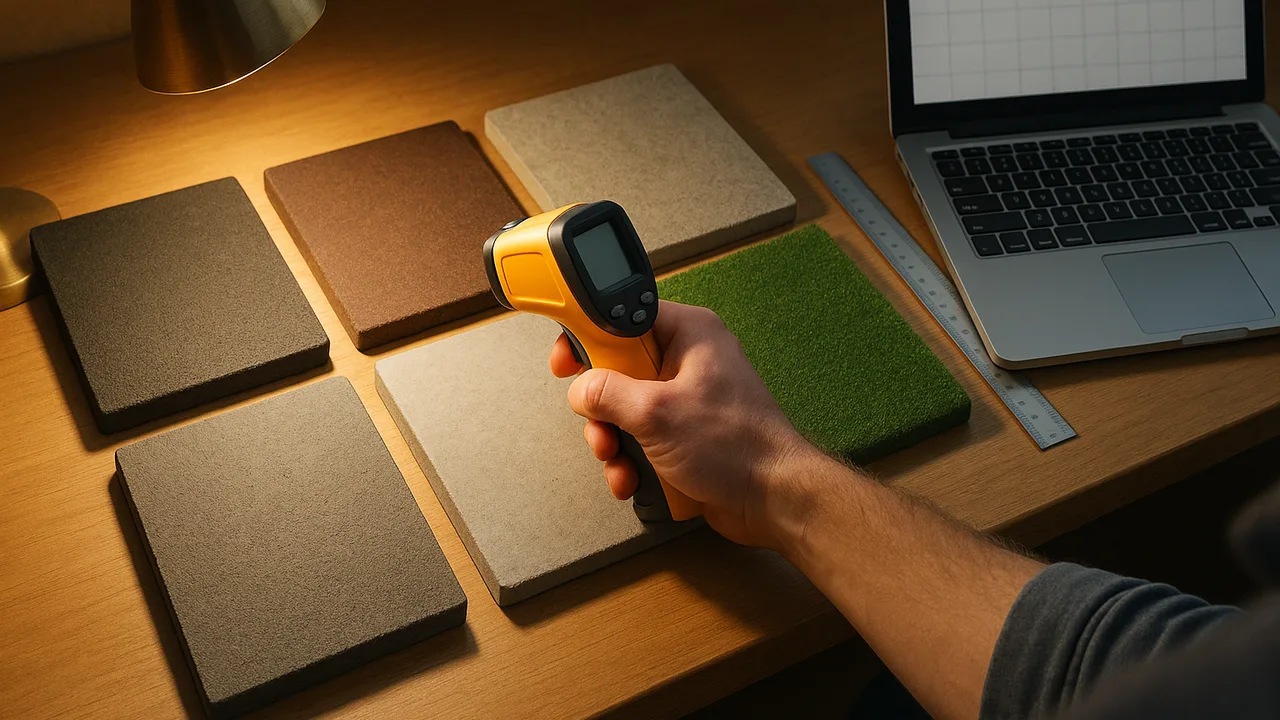
Build version 1. Base: a 10 cm × 10 cm square of dark foam board or tile. Sample budget list: white paint or paper 2 points; a fabric shade on craft-stick posts 3; a sponge or porous layer 2; sand 1; up to 50 mL water free; foil 2.
| Tile | Start (°C) | After 15 min lamp (°C) | Rise (°C) | Rise as % of blacktop | 10 min after lamp off (°C) | Water used (mL) |
|---|---|---|---|---|---|---|
| Blacktop control | 100% | 0 | ||||
| Our V1 |
Guided Exercises ~15 min
Score, plan, then build.
Independent Practice ~10 min
Score the matrix and build V1.
Complete the decision matrix with your own scores and weighted totals. Name the leading design and its weakest row.
Sketch your V1 tile with labels, list its budget points and water use, and predict its rise as a percentage of the blacktop's, with a reason from the energy budget.
Closure ~5 min
V1 is built and the test plan is set. Next lesson: critique, test, and version 2.
How confident are you that you can I can plan a fair test that measures how water and surface properties change heating.
Exit ticket: which criterion do you expect your V1 to struggle with most, and why?
Teacher notes
Materials (class): two or three desk lamps with 60 W-equivalent bulbs at a fixed 25 cm height, 10 cm squares of dark foam board or dark tile, white paint or paper, fabric scraps, craft sticks, sponges, sand, foil, digital thermometers or an infrared thermometer, measuring cylinders, goggles.
Setup: lamps vary; keep each team on one lamp all week and always run the black control beside its tile.
Listen for: designs that flood the tile (fails C2 and K1); matrices scored to match a favorite.
Support / stretch: offer two pre-planned designs to choose from. Stretch: predict each design’s C3 result before testing and explain the prediction with specific heat.