1.07 Competing Plans and a Recharge-Pond Prototype
compare competing basin strategies with a weighted decision matrix and model runs, and design and build version 1 of a recharge-pond bed that lets water soak in fast while trapping silt.
- I can describe realistic relationships between simulation variables to show how factors like costs and technology affect natural resource management, human sustainability, and biodiversity.
- I can include user-controlled variables in my simulation to show how changing factors like technology can affect biodiversity and other components.
- I can include ways to measure or indicate the effects of water’s properties—such as heat capacity, flow, polarity, and density—on Earth’s materials or surface processes in my investigation plan.
Phase 4: Build
Warm-Up ~5 min
Do Now. From your 1.06 brainstorm, pick the two strategies you think the district would argue about most. Write one sentence on what each side would say.
Muddy flood water is spread on a recharge pond with a bare sand floor. What happens over several weeks?
Instruction ~10 min
Our client. The board of a farm valley’s groundwater management district. The valley is hot and dry in summer, its crops depend on wells, and its groundwater basin has been overdrawn for years. Some domestic wells have gone dry and the ground near the canal is sinking. The board has asked our class for an evidence-based water plan it can take to the public.
Three competing plans. Engineers never test only one idea. Our three concepts: Plan A, Cut Pumping: a 20% pumping allocation for every well, with meters. Plan B, Recharge Ponds: capture 150,000 acre-feet of flood water in each wet year and let it soak in. Plan C, Combined: a 20% cut plus 100,000 acre-feet of managed recharge in wet years.
Class criteria and constraints (set in 1.07, used through 1.09). Basin plan, tested in the model basin with the wet-dry sequence: (C1) storage at the end of year 20 is at least the starting 2,000,000 acre-feet; (C2) the creek flows every year (storage above 1,200,000); constraint (K1) pumping is cut by no more than 20%, to protect farm jobs; constraint (K2) managed recharge is at most 150,000 acre-feet in a wet year, the capacity of the district’s possible recharge ponds. Recharge-pond bed prototype: (C3) 250 mL of muddy water soaks through in 60 seconds or less; (C4) the water that comes out scores 3 or better on the 5-point clarity card; (K3) materials cost no more than 10 sample budget points; (K4) the top layer lifts out for cleaning.
Worked example 1: run the plans (sample basin). With the wet-dry sequence (two wet years at 700,000, three dry years at 200,000, repeating), average recharge is (2 × 700,000 + 3 × 200,000) / 5 = 400,000. Plan A: pumping 440,000, average change −40,000 a year, so storage ends year 20 at 1,200,000 and the creek fails in year 20. Plan B: managed recharge adds 2 × 150,000 / 5 = 60,000 a year on average against a 150,000 overdraft, so storage falls about 90,000 a year to 200,000. Plan C: each five-year cycle gains 2 × (700,000 + 100,000 − 440,000) = 720,000 in wet years and loses 3 × (440,000 − 200,000) = 720,000 in dry years, so storage ends year 20 back at 2,000,000 and never falls below it. Only Plan C meets C1 and C2 inside the constraints.
| Criterion (weight) | Plan A Cut | Plan B Ponds | Plan C Combined |
|---|---|---|---|
| Storage stable by year 20 (3) | |||
| Creek flows every year (3) | |||
| Protects farm jobs (2) | |||
| Cost to build and run (2) | |||
| Fair to household wells (2) | |||
| Weighted total |
Score each plan 1–3 per row, multiply by the weight and add. Model numbers are from the sample basin.
Worked example 2: a weighted score. Malik scored Plan C 3 on storage (×3 = 9), 3 on the creek (9), 2 on farm jobs (4), 1 on cost (2) and 3 on household wells (6): total 30. Plan A scored 24 and Plan B 19. The matrix favors Plan C, but its weak row, cost, is the one the board will ask about.
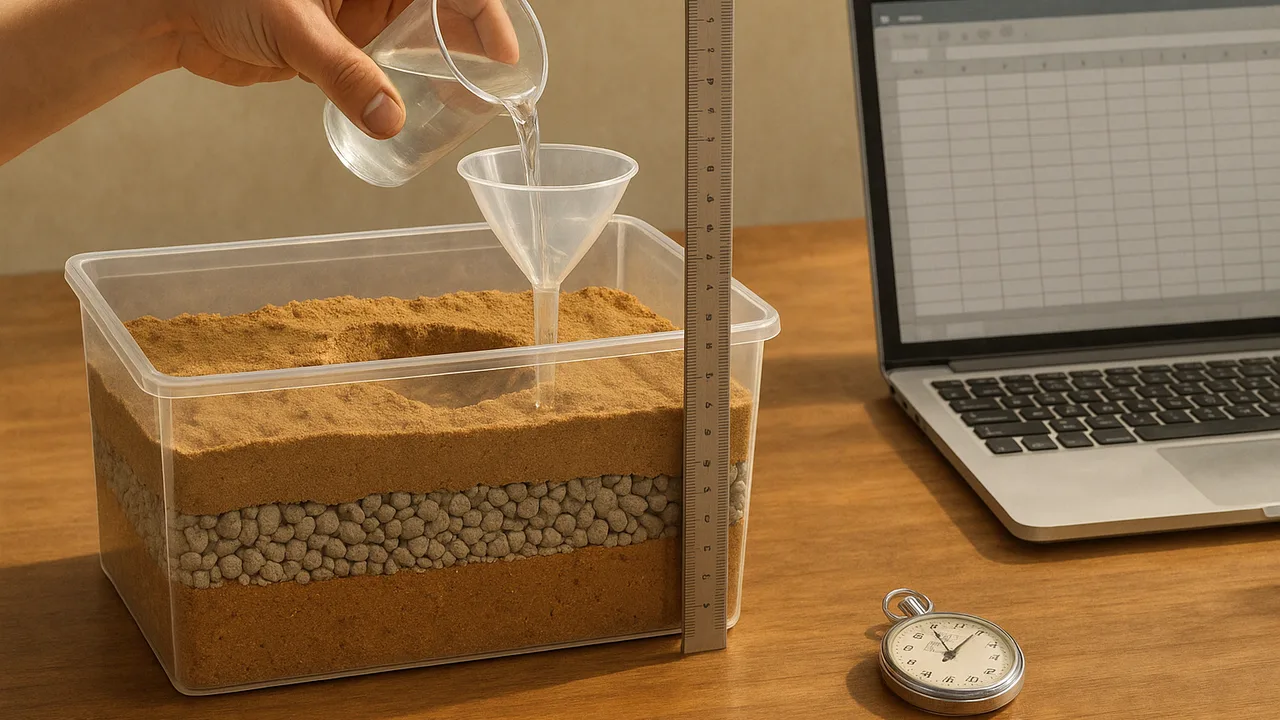
The prototype: a recharge-pond bed. Plan C needs ponds that soak water in fast without clogging. Each team designs a layered bed in a cut plastic bottle with holes in the cap end: choose from gravel, coarse sand, fine sand, a cloth or coffee filter and cotton. Decide whether you will test as a team or each build a variant, sketch the layers with their thickness, and write the measurements that will show C3 and C4. Then build version 1 and run one test: pour 250 mL of muddy water (2 spoonfuls of soil stirred into 250 mL), time it, and score the outflow’s clarity.
| Bed version | Layers (top to bottom, cm) | Budget points | Soak time (s) | Clarity (1–5) | Meets C3? C4? |
|---|---|---|---|---|---|
| V1 trial 1 | |||||
| V1 trial 2 |
Sample price list: 1 cup gravel 2 points; 1 cup coarse sand 2; 1 cup fine sand 1; 1 filter 2; 3 cotton balls 1.
Guided Exercises ~15 min
Score the plans, then plan your prototype test.
Independent Practice ~10 min
Complete the team decision matrix and build version 1.
Fill in the decision matrix with your own scores, show the weighted totals, and write two sentences naming the winning plan and its weakest row.
Add a “percent pumping cut” cell and a “wet-year recharge” cell to your 1.05 model so a user can change them. Find the smallest recharge that, with a 20% cut, meets C1.
Closure ~5 min
Plan C leads on paper and version 1 of the bed is built. Next lesson: critique, test and improve.
How confident are you that you can I can compare solutions with a weighted matrix and a simulation, and plan a test that measures how water moves through Earth materials.
Exit ticket: what did version 1 of your bed score on C3 and C4, and what one change will you try first?
Teacher notes
Materials (per team): a 2 L bottle cut in half by an adult, with small holes in the cap; cups of gravel, coarse sand and fine sand; coffee filters; cotton balls; a 250 mL measure; garden soil for muddy water; a stopwatch; a laminated 5-point clarity card (1 = opaque brown, 5 = clear); tray; goggles.
Answer check: with a 20% cut, 100,000 acre-feet of wet-year recharge is the smallest amount that meets C1. All model numbers are sample data.
Listen for: teams that score the matrix to match a favorite; beds stuffed with filters that pass C4 but fail C3.
Support / stretch: provide a pre-built spreadsheet with the two input cells. Stretch: add a cost per acre-foot of recharge and a farm-income loss per acre-foot of cut pumping, and find the cheapest plan that meets C1 and C2.