2.06 One Energy Budget, Two Climates, One Hot Schoolyard
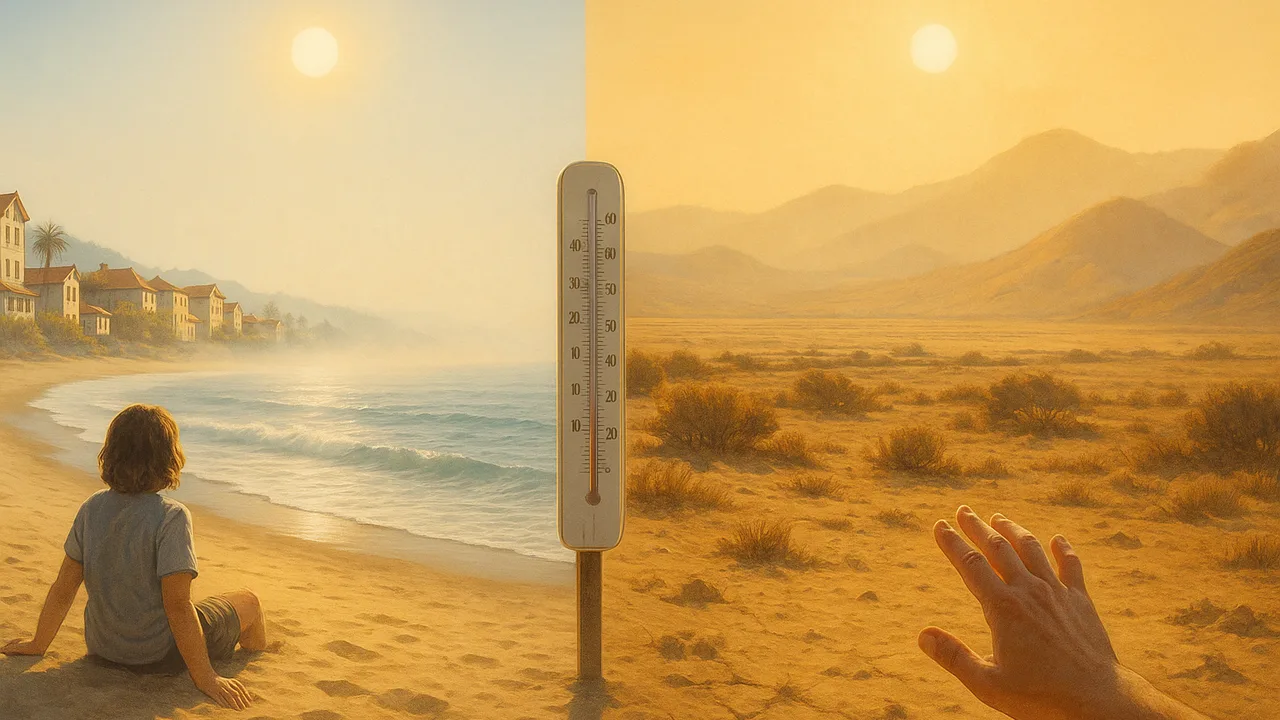
revise an energy-budget model that explains both the coastal-inland contrast and a hot schoolyard, write a CER that uses the properties of water, and brainstorm cooler schoolyard designs.
- I can organize the factors in a climate model into groups based on whether they affect energy input, energy output, or energy storage and redistribution in Earth’s systems.
- I can describe how the properties of water are connected to their effects on Earth materials and surface processes.
- I can judge whether my data can be used to infer how water affects processes in the natural world.
Phase 3: Make Sense
Warm-Up ~5 min
Do Now. List every way water has shown up in this unit’s energy story so far. Aim for at least four.
Which property of water does the MOST to keep Coastal Town's summers mild?
Instruction ~10 min
Pulling it together. We have four pieces: sun angle (2.01), water’s specific heat (2.03), climate drivers (2.04) and the planet’s energy balance (2.05). Today each team revises one model that explains Coastal Town, Inland City and a hot schoolyard with the same four categories: energy in, energy out, energy stored, energy moved.
| Category | Planet | Coastal Town vs Inland City | Schoolyard |
|---|---|---|---|
| Energy in | |||
| Energy out | |||
| Energy stored | |||
| Energy moved |
Water’s properties, in one place. High specific heat: water stores energy with little temperature change, so oceans and wet ground warm slowly. Evaporation: turning liquid water to vapor takes about 2,260 J per gram at its boiling point, and somewhat more at everyday temperatures, so wet surfaces lose energy as they dry; this is why sweating cools you. Polarity: water’s hydrogen bonds cause both of these. Transparency and mixing: sunlight reaches meters down, and currents spread the energy.
Worked example 1: a CER with sentence starters. Claim: “Coastal Town’s summers are cool because its air is chilled by cold ocean water before it arrives.” Evidence: “The sample normals show Coastal Town’s July high is 27 °F cooler than Inland City’s, although their January highs differ by only 2 °F; in our lab, 200 g of water warmed much less than 200 g of sand under the same lamp.” Reasoning: “Upwelling brings cold water to the surface in summer, and water’s high specific heat keeps it cold; air crossing it cools and forms the marine layer, which the heating valley then pulls inland.”
Worked example 2: can our lab data be trusted for the real world? Priya’s sand-to-water ratio was 3.6, not 5. She judged the data good enough to infer the direction and rough size of the effect, but not the exact ocean behavior, because a cup cannot mix, evaporate or let light penetrate the way the ocean does.
Ideate. Now flip from explaining to designing. Using the four categories, brainstorm at least six ways to cool the schoolyard surface: reduce energy in (shade sails, trees), raise energy out by reflection (light coatings), store energy without heating up (water-holding pavers), move energy away by evaporation (planted beds, permeable surfaces that stay damp). Each idea must name its category and one cost, especially in water.
Guided Exercises ~15 min
Fill the model table, then work the cards.
Independent Practice ~10 min
Write and brainstorm.
CER: why is Inland City's July so much hotter than Coastal Town's? Use the sample normals, your lab data and the energy model, and include at least one property of water.
Ideate: list at least six schoolyard cooling ideas. For each, name its energy category and its water cost (none, low or high).
Closure ~5 min
The model explains the climate contrast and the hot blacktop. Next phase we prototype a cooler surface.
Exit ticket: which idea do you think will cool the most for the least water, and what measurement would prove it?
Teacher notes
Materials: each team’s 2.01 sketch, the four-category model table on chart paper, the 2.03 lab data.
Fact note: the 2,260 J/g latent heat is at 100 °C; at everyday temperatures it is a little higher (about 2,440 J/g near 25 °C).
Listen for: water only as “cold stuff” rather than an energy store; ideas that ignore water scarcity from Unit 1.
Support / stretch: category cards for sorting ideas. Stretch: estimate the energy carried away when 50 mL of water evaporates from a tile.