4.03 Engineering Runoff: Testing Permeable Surfaces
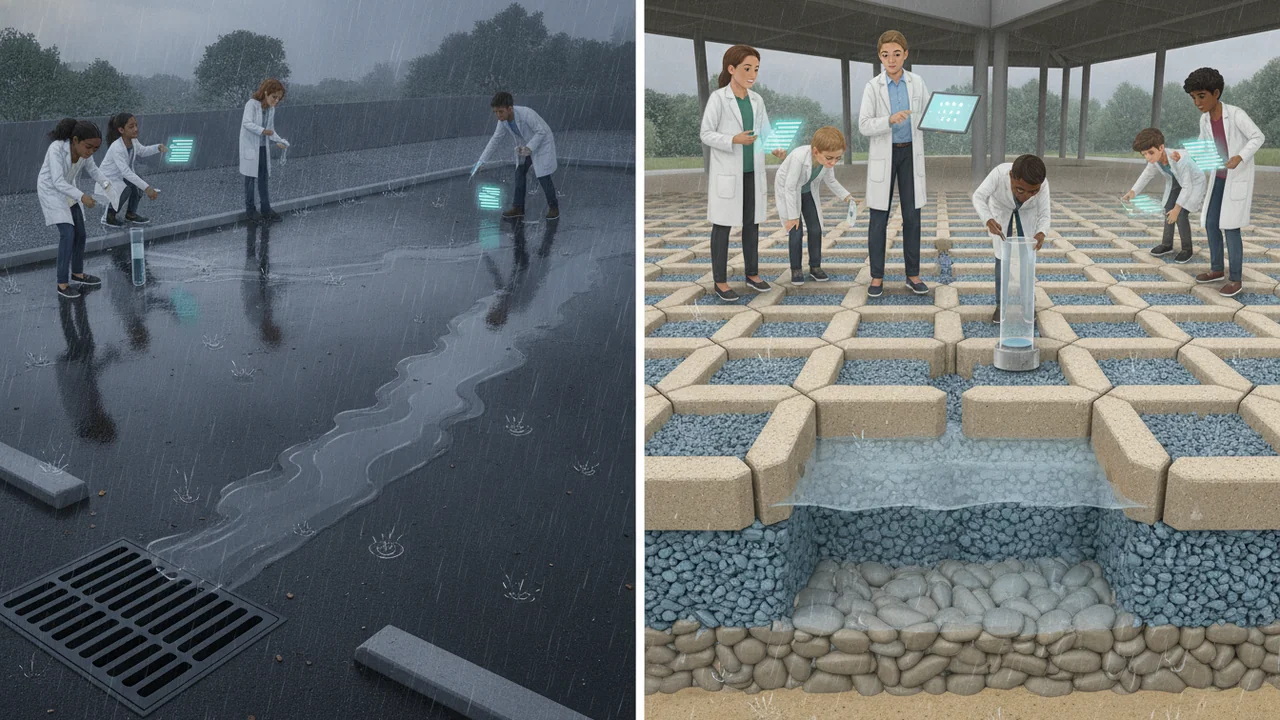
design, test and refine a model surface that reduces stormwater runoff and the pollution it carries, and evaluate it against criteria and constraints.
- I can explain how a specific human activity affects a natural system and describe the scientific reasoning behind a technological solution designed to reduce those impacts.
- I can describe how a technological solution works, including whether it stabilizes or destabilizes the natural system, and propose possible refinements to improve its effectiveness.
- I can identify real-world examples of scientists and engineers developing technologies to address environmental degradation and explain how these solutions are refined.
- I can describe and quantify the criteria and constraints for a technological solution to an environmental problem.
- I can analyze the tradeoffs involved in a solution, using research to explain why certain priorities or compromises are necessary.
- I can explain how a proposed refinement to a technological solution could increase benefits or decrease costs and risks for people and the environment.
Phase 2: Investigate
Warm-Up ~5 min
Do Now. After the first big rain of autumn, the creek through our client’s town turns brown and smells of oil. Write where you think the oil and mud came from, and how they got into the creek.
One centimeter of rain falls on a 1-hectare asphalt parking lot. About how much water runs off?
Instruction ~10 min
A human impact we can see. Rain that falls on roofs, streets and parking lots cannot soak in, so it runs off, picking up oil, metals from brake pads, fertilizer, pet waste and litter. In many cities, storm drains are a separate system that carries that runoff straight to creeks, rivers and the coast without treatment. Some older cities instead have combined sewers that send stormwater to a treatment plant, but in heavy rain they can overflow untreated sewage into rivers. Either way, beach and river health warnings after rain are common. Natural ground would have absorbed much of that water and filtered it.
Runoff coefficient. Engineers describe a surface by its runoff coefficient C: the fraction of rain that runs off. A roof or asphalt lot has C of about 0.9; a lawn or forest much less. The volume of runoff is V = C × area × rain depth.
Worked example. One centimeter of rain falls on a 1-hectare (10,000 m2) parking lot with C = 0.9: V = 0.9 × 10,000 × 0.01 = 90 m3, or 90,000 liters. If the lot were rebuilt with permeable pavement and planted strips so that C fell to about 0.2 (an illustrative value), runoff would be 20 m3. The other 70 m3 would soak in, recharging groundwater (Unit 1) and leaving much of its pollution in the soil, where microbes can break some of it down.
Solutions to test. Engineers and cities use several green infrastructure designs:
- Permeable pavement: concrete, asphalt or pavers with gaps, over a bed of gravel that stores water while it soaks in.
- Rain gardens and bioswales: shallow planted basins that collect runoff from roofs and streets.
- Cisterns: tanks that capture roof water for later use in dry months.
The engineering design process. Engineering starts by defining the problem with criteria (for example, cut runoff by at least half) and constraints (cost, space, the need for cars to drive on it, maintenance). It breaks a big problem into smaller ones: how to let water through, how to store it, how to keep the surface strong. It then builds, tests, measures and refines. A first design rarely meets every criterion; the data show which part to change. A good refinement either increases the benefits or lowers the costs and risks, and keeps the creek’s system more stable, not less.
Lab: Build and test a permeable pavement. Question: which surface design sheds the least runoff and pollution in a model rainstorm, and how can the best design be improved? A fair test keeps rain amount, rain rate, tray slope and tray size the same for every surface. A spoonful of soil and a drop of food coloring stand for the pollutants of a city street.
- Build three surfaces of the same size: A, plastic wrap stretched over sand (impermeable pavement); B, 2 cm of gravel over 2 cm of sand (permeable pavement); C, your own design (for example soil with a mulch strip or a small rain-garden dip). Write your criteria (for example, runoff under 50% of rain) and constraints (materials; the surface must support a 500 g weight without sinking more than 5 mm).
- Raise the upper end of each tray by 3 cm. Sprinkle a spoonful of soil and two drops of food coloring on the upper half of each surface.
- Pour 500 mL of “rain” evenly over each tray in 30 seconds. Collect runoff from the drain hole for 3 minutes.
- Measure the runoff volume, compute the runoff coefficient (runoff / 500 mL), and rate the runoff’s color and cloudiness on a 0–3 scale.
- Refine design C using your data, test it again, and test each surface with the 500 g weight.
| Surface | Rain (mL) | Runoff (mL) | Runoff coefficient | Color and cloudiness (0–3) | Sank under 500 g (mm) | Meets criteria? |
|---|---|---|---|---|---|---|
| A Impermeable | 500 | |||||
| B Permeable | 500 | |||||
| C Your design | 500 | |||||
| C Refined | 500 |
Limits of a tray. Real permeable pavements can clog with fine sediment and need vacuum sweeping, and they suit parking lots and quiet streets better than highways. Include these real constraints when you judge your design.
Guided Exercises ~15 min
Answer during and after the lab. Use your own data where you can.
Independent Practice ~10 min
Write the lab conclusion in your Resilience Notebook.
CER: which design best reduced runoff and pollution while meeting your constraints? Use runoff coefficients and pollution ratings as evidence. Describe what you changed in the refined design, why, and whether the data showed an improvement, and explain the mechanism.
Scale up: if your best coefficient applied to a 1-hectare school parking lot, how much runoff would 1 cm of rain produce, compared with 90 m³ for asphalt? Name one real-world constraint the tray does not capture and one trade-off a city would face.
Closure ~5 min
A surface can drink the rain and still carry a load. Next lesson we weigh choices that are harder to test in a tray: where our energy and minerals come from.
How confident are you that you can I can design, test and refine a solution that reduces stormwater runoff and evaluate it against criteria and constraints.
Exit ticket: give your best design's runoff coefficient and one refinement that would make it better for a real town.
Teacher notes
Timing: this lab spans two 50-minute periods: day 1 build and test A, B and C; day 2 refine C, the weight test, scale-up and the CER.
Materials (per team): three identical shallow trays or foil pans with a drain hole at one low corner, plastic wrap and tape, aquarium gravel, sand, potting soil, a watering can or holed cup, a 500 mL measuring cup, food coloring, blocks to raise trays 3 cm, collection cups, a 500 g weight, a ruler, stopwatch, goggles.
Listen for: “storm drains go to the treatment plant” (true only for combined systems, which overflow); refinements made without data; ignoring the weight constraint.
Support / stretch: give the coefficient formula on a card. Stretch: compute how much groundwater recharge your best design would add to a 1-hectare lot over a year with 80 cm of rain. Reading: Earle, Physical Geology, chapter 13.