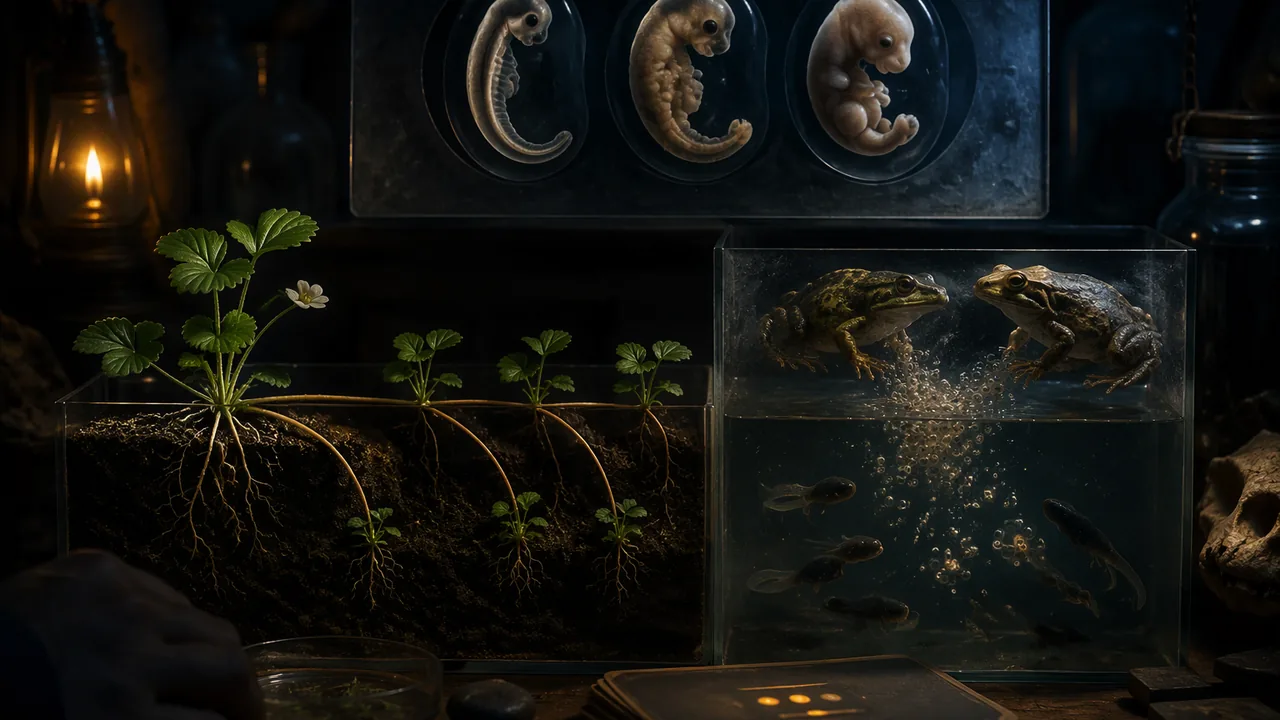
compare asexual and sexual reproduction in terms of the genetic information offspring receive and the variation among them, and compare pictures of embryos from several vertebrate species to identify shared features that reveal relatedness not obvious in the adults.
Instruction
Two ways to make offspring. Walk a Missouri woodland edge in April and you can watch both of life’s reproduction strategies at work. The Missouri Department of Conservation (MDC) field guide notes that mayapple “often grows in colonies from creeping, branching underground rhizomes,” and that wild strawberry roots from runners, stems that grow along the ground and root to form a new plant. A dandelion in a lawn makes seed “without any fertilization at all.” On a rosebush nearby, aphids that hatch in spring are all females that reproduce without mating, and MDC’s guide states plainly that their offspring are genetically identical to their mothers. Yet the same aphids switch strategy in autumn: males and females are born, mate, and lay the eggs that survive the winter. This lesson asks what each strategy gives the offspring, in genetic information and in variation, and then turns to a second kind of evidence that lives in the earliest stage of life: the embryo.
Asexual reproduction: copies. In asexual reproduction one parent produces offspring by mitosis or by growing a new body from part of its own. Each offspring receives a copy of the parent’s complete set of genetic information, so the offspring are clones: genetically identical to the parent and to one another, except for rare new mutations. The strategy is fast, needs no mate, and preserves a combination of genes that already works where the parent lives. Its cost is uniformity. A strawberry patch that spread from one plant shares one set of strengths and one set of weaknesses; a disease that can kill one plant can kill them all.
Sexual reproduction: new combinations. In sexual reproduction two parents each make gametes by meiosis, and each gamete carries one chromosome from every pair. Which chromosome of each pair goes into a gamete is independent of the others, so a human, with 23 pairs, can make 223 = 8,388,608 different combinations of chromosomes in eggs or sperm. Two parents can therefore produce about 8,388,608 × 8,388,608 ≈ 7.0 × 10¹³ different chromosome combinations in a child, before crossing over shuffles pieces of chromosomes and multiplies the number again. Offspring receive half of their genetic information from each parent, and no two siblings (apart from identical twins) receive the same half. The cost is time and the need for a mate; the benefit is variation, which gives a population a better chance that some individuals can survive a new disease, predator or change in climate.
Doing both. Many Missouri organisms use both strategies. Strawberry and mayapple plants spread as clones and also flower and set seed. Aphids multiply as clones while summer food is plentiful and produce varied offspring by mating before winter. A useful rule of thumb: copies are favored when conditions are steady, variation when conditions are about to change.
Embryos as evidence. An adult fish, chicken, snake and mouse look nothing alike. Their early embryos look surprisingly similar. Compare the pictures in this lesson and its reading, taken at a comparable stage of body formation: a mahi-mahi at 24 hours, a chick at 4 days, a corn snake about 2 days after its egg was laid and a mouse at 12 days. Look for four shared features. Each has a body curled into a C that ends in a tail extending past the hind end. Each has a large head with a developing eye. Each has repeated blocks of tissue along the back, called somites, that become vertebrae and muscles. The chick, snake and mouse show folds below the head, the pharyngeal arches: in fish these become gill supports, while in birds and mammals they become parts of the jaw, middle ear and throat. These shared features are not needed for adult life in the same way, so they are best explained by common ancestry: the species inherited the same early developmental program from a shared ancestor, and later changes in development produced the differences you see in adults.


Differences are evidence too. The same pictures show differences. The snake embryo has many more coils and far more somites than the mouse, matching the long backbone of the adult, and it shows no limb buds, while the chick already has small limb buds. The embryos are similar early and diverge later, which is the pattern common ancestry predicts.
Read pictures critically. In 1874 the biologist Ernst Haeckel published side-by-side drawings of embryos that later scientists, comparing real photographs, showed had exaggerated the similarities and left out differences. The lesson is not that embryos are unlike; it is that evidence must be checked. Compare photographs or careful drawings from named sources, note the species, age and scale of each, and record differences as honestly as similarities.
📖 Read for this lesson
The reading opens over the lesson; close it to come back to exactly where you were. The checks below draw on it.
Formative check
Work through these before moving on. They are not graded — they tell you whether the standard below has landed yet.
Missouri standard: 9-12.LS3.B.1
In spring, a female aphid on a Missouri rosebush gives birth to daughters without mating. What is true of the daughters’ genetic information?
Missouri standard: 9-12.LS3.B.1
Humans have 23 chromosome pairs, so independent assortment alone lets one parent make 223 = different chromosome combinations in eggs or sperm.
Missouri standard: 9-12.LS3.B.1
A patch of wild strawberries that spread by runners from a single plant holds more genetic variation than a patch grown from seeds collected from many plants.
Missouri standard: 9-12.LS4.A.2
Look at the chick embryo (4 days) and the mouse and corn snake embryos in the lesson’s pictures. Which feature can you see in all three?
Missouri standard: 9-12.LS4.A.2
Open the reading and use its three figures (mahi-mahi, chick, mouse and corn snake). Make a table with the four species as rows and these columns: curled body with tail, eye, somites visible, folds below the head, limb buds. Mark what you can actually see in each picture (write “not visible” rather than guessing). Then write three sentences: one claim about how these species are related, one piece of evidence from your table, and one reason the adults do not show this relationship as clearly. Finish with one sentence on why you used photographs and careful drawings from named sources rather than Haeckel’s 1874 drawings.
Practice
Work these on paper or in your notebook, then open Check your answer. Aim for all of Fluency and Application; try at least one Challenge.
Printable version: this unit’s practice workbook (PDF)
Fluency
Build speed and accuracy with the core skill.
- Name the type of reproduction: a mayapple colony spreading from underground rhizomes.
Check your answer
Answer: Asexual reproduction (the new shoots are clones of the parent).One parent; new plants grow from part of the parent’s body. - How many parents contribute genetic information to an offspring in sexual reproduction, and what fraction comes from each?
Check your answer
Answer: Two parents; about half from each.Each gamete carries one chromosome of every pair. - Name two features you can see in early vertebrate embryos that are hard to see in the adults.
Check your answer
Answer: Any two: pharyngeal arches (folds below the head), a tail extending past the hind end, rows of somites along the back.These form early in all vertebrates and change or disappear later.
Application
Use the skill in context. Show your reasoning.
- Assume (for illustration) that each spring aphid gives birth to 4 daughters per generation, all without mating. How many aphids descend from one founder after 5 generations, and how much genetic variation do they carry?
Check your answer
Answer: 45 = 1,024 aphids, all clones of the founder apart from rare new mutations.4 × 4 × 4 × 4 × 4 = 1,024; asexual offspring copy the mother’s genetic information. - A fruit fly has 4 chromosome pairs. How many chromosome combinations can independent assortment produce in one fly’s gametes?
Check your answer
Answer: 24 = 16.Each pair contributes one of two chromosomes: 2 × 2 × 2 × 2. - In the reading’s figures, the corn snake embryo has many more coils than the mouse embryo and no limb buds. What do these differences predict about the adults?
Check your answer
Answer: The adult snake has a very long backbone with many more vertebrae and no legs; the mouse has fewer vertebrae and four legs.Somites become vertebrae; limb buds become limbs. Development diverges after a similar start.
Challenge
Stretch problems. Expect to think before you write.
- A disease that kills one strain of strawberry plant arrives in two Missouri patches: one grown from runners of a single plant, one grown from wild seed. Predict the outcome in each and explain using the genetic information offspring receive.
Check your answer
Answer: The runner patch is likely to be wiped out, because every plant is a clone with the same susceptibility. In the seed patch some plants probably carry gene combinations that resist the disease and survive.Asexual offspring share one genotype; sexual offspring vary, so some may survive a new threat. - A website shows Haeckel’s 1874 embryo drawings as proof of common ancestry. Write two sentences evaluating this evidence and saying what better evidence looks like.
Check your answer
Answer: Haeckel’s drawings exaggerated similarities and omitted differences, so they are not reliable data. Better evidence is photographs or careful drawings from named, dated sources that state each embryo’s species, age and scale and show differences as well as similarities.The conclusion (shared early features) holds up with real photographs; the drawings do not.
Review
Keep earlier skills sharp.
- (Unit 3) Name two other kinds of evidence for common ancestry besides embryos.
Check your answer
Answer: Any two: the fossil record, homologous structures, vestigial structures, DNA and protein sequence comparisons, biogeography.Embryology is one line among several that agree. - (Biology A) What process makes gametes with half the chromosome number?
Check your answer
Answer: Meiosis.Meiosis halves the chromosome number; fertilization restores it.
Clones, Mixtures and Embryos: Missouri Examples and Four Real Embryo Pictures
MDC Field Guide pages for mayapple, wild strawberry, common dandelion and aphids (retrieved November 5, 2026); embryo images from Wikimedia Commons: Chick embryo 4d by PaulT (Gunther Tschuch), CC BY-SA 4.0; mouse and corn snake embryos from Woltering, Current Genomics 13(4), 2012, CC BY 2.5; mahi-mahi development figure from Xu et al., PLoS ONE 12(7): e0180454, 2017, CC BY 4.0 (retrieved November 5, 2026) · SLS original, with images under CC BY-SA 4.0, CC BY 2.5 and CC BY 4.0 credited in their captions
Why this reading. The lesson describes the four embryos; here are the pictures themselves, with their sources and licences, a feature table to fill in, and the MDC field-guide facts behind the lesson’s Missouri reproduction examples.
Part 1: Missouri organisms and how they reproduce
| Organism | What the MDC field guide says | Asexual, sexual or both |
|---|---|---|
| Mayapple | “Often grows in colonies from creeping, branching underground rhizomes”; also flowers and sets fruit. | Both |
| Wild strawberry | Roots from runners (stolons) that form new plants; also flowers and fruits. | Both |
| Common dandelion | Produces viable seed “without any fertilization at all.” | Asexual seed production |
| Aphids | Spring females reproduce without mating, and their offspring are genetically identical to their mothers; late in the season males and females mate and lay overwintering eggs. | Both, in one yearly cycle |
The numbers of sexual reproduction. With n chromosome pairs, independent assortment alone gives 2n kinds of gamete. Humans (n = 23): 223 = 8,388,608. Two parents: 8,388,608 × 8,388,608 = 70,368,744,177,664, about 7.0 × 10¹³ combinations, before crossing over. A clone, by contrast, has exactly one possible genotype: its parent’s.
Part 2: Embryos of four vertebrates
Each picture below is openly licensed and credited in its caption. Look at each one closely before reading the notes.


What to look for: at 24 hours the fish embryo is curled around its yolk, with somites labeled along the body, a notochord, a developing eye (optic vesicle), a three-part brain and a heart tube. By 96 hours it is a swimming larva with jaws and fins.
What to look for: the C-shaped body and tail, the large eye, the red heart below the head, small limb buds and the faint row of somites along the back.


What to look for: both have a large head with an eye and a body curled to a tail. The snake’s body is wound into many more coils (it is building far more somites, which become vertebrae), and it shows no limb buds; corn snakes do not form them.
Your feature table
| Species and age | Curled body with tail | Eye | Somites visible | Folds below head | Limb buds |
|---|---|---|---|---|---|
| Mahi-mahi, 24 hours | |||||
| Chick, 4 days | |||||
| Corn snake, about 2 days after laying | |||||
| Mouse, 12 days |
Write “not visible” when you cannot see a feature; that is honest data. Note that the ages differ because species develop at different speeds; the pictures were chosen at a comparable stage of body formation, not at the same number of days.
A note on Haeckel
Ernst Haeckel’s 1874 drawings, still reprinted, show embryos of many species looking nearly identical. Later comparisons with photographs showed the drawings exaggerated similarities and left out differences in size and shape. Shared early features such as pharyngeal arches, somites and tails are real; Haeckel’s pictures are not reliable evidence of them. Use pictures like the ones above, with named sources, species, ages and scale.
Sources: MDC Field Guide: Mayapple (mdc.mo.gov); MDC Field Guide: Wild Strawberry (mdc.mo.gov); MDC Field Guide: Common Dandelion (mdc.mo.gov); MDC Field Guide: Aphids (mdc.mo.gov); Wikimedia Commons: Chick embryo 4d.jpg (PaulT, CC BY-SA 4.0) (commons.wikimedia.org); Wikimedia Commons: Mouse and Snake Embryos.jpg (Woltering 2012, CC BY 2.5) (commons.wikimedia.org); Woltering, J. M., From Lizard to Snake; Behind the Evolution of an Extreme Body Plan, Current Genomics 13(4):289-299 (2012), CC BY 2.5 (ncbi.nlm.nih.gov); Wikimedia Commons: mahi-mahi pharyngula to larva figure (Xu et al. 2017, CC BY 4.0) (commons.wikimedia.org); Xu, E. G., et al., PLoS ONE 12(7): e0180454 (2017) (doi.org)