explain how interactions in a food web, and regular fire, keep an ecosystem relatively stable, describe how a chain of changes turned open Ozark glades into cedar thickets, and ask questions about whether the change can be reversed.
Instruction
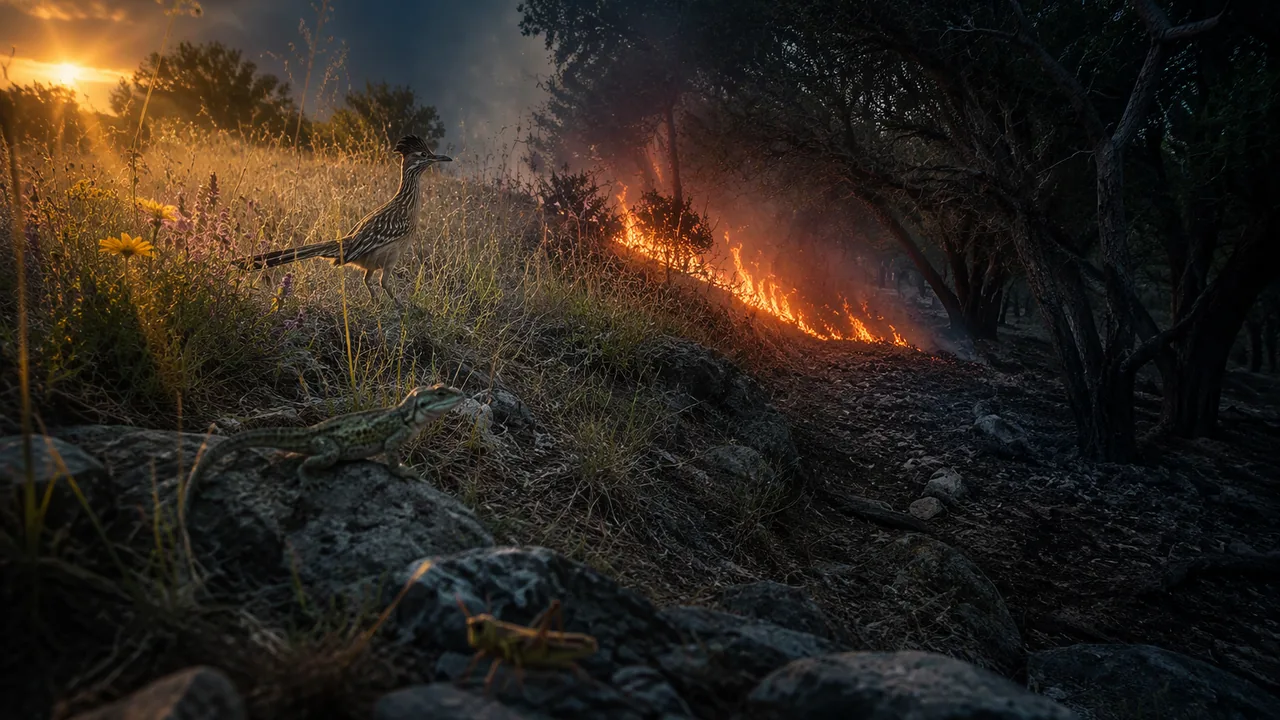
The phenomenon. Scattered through the Missouri Ozarks are glades: rocky, sunny openings on south- and west-facing slopes where bedrock pokes through thin soil and prairie grasses and wildflowers grow. The Missouri Department of Conservation (MDC) notes that a healthy glade often holds more than 100 species of plants, from pale purple coneflower to Missouri evening primrose, along with collared lizards, fence lizards and roadrunners. Today many glades look nothing like that. MDC reports that many glades on private land are overgrown with eastern red cedar, and federal soil scientists describe invaded glades whose cedar canopy approaches 100 percent, with little or no plant life on the ground. Our question for the unit: what keeps an ecosystem stable, what pushes it into a new state, and what can people do about it?
A food web in balance. On an open glade, grasses and wildflowers are the producers. Grasshoppers and other insects eat them; collared lizards eat the grasshoppers; snakes and roadrunners eat lizards. Eastern red cedar is a native tree, and birds that eat its berries drop its seeds everywhere they perch. What kept cedars from taking over was fire. Tree-ring scars from one southern Missouri glade show a fire about every 3.2 years from 1630 to 1870. Cedar has thin bark and cannot resprout, so each fire killed the young cedars that had sprouted since the last one. A species whose effect on a community is far larger than its numbers suggest is called a keystone species; ecologists call fire on a glade a keystone process for the same reason. In a stable ecosystem, these interactions keep the numbers and kinds of organisms roughly consistent from year to year, even as individuals are born and die. That is the first half of 9-12.LS2.C.1.
A chain of changes. The second half is that changing conditions can create a new ecosystem. Several changes arrived together. After 1870 fires on that glade came only about every 22 years, and in the early 1900s Missouri began suppressing wildfires. Livestock grazed glades continuously, eating the grass that would have carried a fire. And cedar seeds kept arriving. With fire rare, cedars grew past the size a fire can kill. Their shade thinned the grasses and wildflowers, the insects that fed on them declined, and the animals that ate the insects disappeared.
Why cedar thickets persist. Here is the puzzle that makes this a regime shift, not just a bad decade. Bringing fire back is not enough. In a Missouri glade, a spring burn killed every cedar under half a meter tall but only 7 percent of cedars taller than 2 meters. Worse, a dense cedar stand shades out the grass that fire needs to spread, so fires in a thicket burn weakly or go out. The thicket has its own stability. Returning to a glade needs a push, cutting most of the cedars and then burning, and that is where engineering comes in.
Lizards as evidence. In 1979 researchers found no collared lizards on Stegall Mountain in the Ozarks; its glades were overgrown with cedar. Cedars were cut and small burns began in 1982, and lizards were released in 1984. For ten years they stayed on their own glades, never crossing bands of woods as narrow as 50 meters. In 1994 the first landscape-scale burn included the woods between the glades. Grasshoppers increased by 650 percent in the burned units, and the lizards quickly colonized nearby glades. Comparing burned and unburned places like this is one way scientists test the keystone idea.
Asking questions. Can the glade come back? is a start. Do glades where cedars are cut and then burned regain more native plant species in five years than glades that are only burned? is testable, and land managers in Missouri are testing it.
📖 Read for this lesson
The reading opens over the lesson; close it to come back to exactly where you were. The checks below draw on it.
Formative check
Work through these before moving on. They are not graded — they tell you whether the standard below has landed yet.
Fire returns to a glade where most of the cedars are now taller than 2 meters. What do you predict happens?
Why do ecologists describe fire as a keystone process on Ozark glades?
Which set of changes together turned open glades into cedar thickets?
Draw two food-web models of an Ozark glade, one while fire still came every few years and one after cedar closed the canopy, showing the thickness of each arrow to indicate how strong the interaction is. Include fire as an arrow. Then write two testable questions your models raise.
How confident are you that you can explain how food-web interactions and regular fire keep an ecosystem stable and how changing conditions produced cedar thickets?
Practice
Work these on paper or in your notebook, then open Check your answer. Aim for all of Fluency and Application; try at least one Challenge.
Printable version: this unit’s practice workbook (PDF)
Fluency
Build speed and accuracy with the core skill.
- Write the food chain that links glade grasses, grasshoppers and collared lizards, with arrows pointing in the direction energy flows.
Check your answer
Answer: glade grasses → grasshoppers → collared lizardsArrows point from the organism eaten to the organism that eats it. - Define a keystone species, and name the keystone process on Ozark glades.
Check your answer
Answer: A species whose effect on its community is far larger than its abundance suggests; on Ozark glades the keystone process is fire, which kills young cedars every few years.Removing a keystone, or a keystone process, changes the whole community. - Fire scars from a southern Missouri glade show a fire about every 3.2 years from 1630 to 1870 and about every 22 years after 1870. By what factor did the interval between fires grow?
Check your answer
Answer: About 6.9 times22 ÷ 3.2 = 6.875.
Application
Use the skill in context. Show your reasoning.
- The Missouri Fire Needs Assessment estimates that Missouri should burn at least 2,635,008 acres a year to match its historical fire pattern, but burns about 125,000 to 150,000 acres a year. What percentage of the minimum is being burned?
Check your answer
Answer: About 4.7% to 5.7%125,000 ÷ 2,635,008 = 0.0474; 150,000 ÷ 2,635,008 = 0.0569. - After the first landscape-scale burn on Stegall Mountain, grasshoppers increased by 650 percent in the burned units. If an unburned unit held 20 grasshoppers per sweep-net sample (illustrative), how many would a 650 percent increase give? By what factor is that?
Check your answer
Answer: 150 grasshoppers per sample, 7.5 times as manyA 650% increase adds 6.5 × 20 = 130 to the original 20: 20 × 7.5 = 150. - Explain why fire suppression and continuous livestock grazing together had a bigger effect on Ozark glades than either would have alone.
Check your answer
Answer: Suppression stopped fires from starting or spreading, and grazing removed the grass that carries fire, so even fires that did start could not reach and kill young cedars. Each change removed a different part of what kept the glade open.Consider which part of the fire–grass–cedar interaction each change weakened.
Challenge
Stretch problems. Expect to think before you write.
- Evaluate the claim: “Now that prescribed burning is back, overgrown glades will recover on their own.” Use the idea of a regime shift.
Check your answer
Answer: Not well supported. A cedar thicket is itself a stable state: a burn kills only about 7 percent of cedars over 2 meters, and the closed canopy shades out the grass that fire needs to spread. Recovery usually requires cutting most cedars first, then burning, to push the system back past a threshold.A regime shift has feedbacks that keep the new state in place.
Review
Keep earlier skills sharp.
- Producers in an ecosystem capture 25,000 kJ of energy. Using the 10% rule, about how much energy reaches the secondary consumers?
Check your answer
Answer: ≈ 250 kJAbout 10% of the energy at one level is passed to the next; the rest is used or lost as heat.
From Open Glade to Cedar Thicket: The Ozark Fire and Lizard Record
Anderson, Juniperus virginiana, USDA Forest Service Fire Effects Information System (2003), citing Guyette and McGinnes 1982 and Martin and Crosby 1955; USDA NRCS Ecological Site Description R116BY024MO, Shallow Limestone Upland Glade/Woodland; MDC, Glades and Balds; NPS Ozark National Scenic Riverways, Fire Helps Collared Lizards and Wild Turkeys; Neuwald and Templeton, If You Burn It, They Will Come, Land 14:1696 (2025), abstract; retrieved Nov. 5, 2026 · Public domain (USDA Forest Service, USDA NRCS and National Park Service works); MDC and journal-abstract facts cited, with SLS summary tables
Why this reading. The lesson asks you to draw two food webs for an Ozark glade, one while fire still visited it every few years and one after eastern red cedar closed the canopy, with arrow thickness showing the strength of each interaction. You cannot weigh an arrow without a number. Here are the numbers: a fire-scar record from a Missouri glade, a Missouri burning test on cedars of different heights, the federal description of what a cedar-invaded glade looks like, and the forty-year record of collared lizards on Stegall Mountain in the Missouri Ozarks.
What a glade is
The Missouri Department of Conservation (MDC) describes glades, often called balds, as rocky openings in forest with exposed bedrock, native prairie grasses and wildflowers. They are most common in southern Missouri on south- and west-facing slopes, and they can be as small as a quarter acre or cover hundreds of acres. MDC notes that a healthy glade frequently has more than 100 species of plants, including pale purple coneflower, Missouri black-eyed Susan and Missouri evening primrose, and animals such as collared lizards, fence lizards, six-lined racerunners and roadrunners.
The fire record
Fire scars in tree rings date past fires. The Forest Service’s Fire Effects Information System (FEIS) summarizes two Missouri studies:
| Place and period | Mean interval between fires |
|---|---|
| A cedar glade in southern Missouri, 1630–1870 (Guyette and McGinnes 1982) | 3.2 years |
| The same glade after 1870 | 22 years |
| A post oak savanna in southern Missouri, 1700–1810 (Guyette and Cutter 1991) | 4.3 years; fire became less frequent after 1860, with European settlement |
Why fire controlled the cedars
FEIS states that eastern red cedar is easily killed by fire because of its thin bark, shallow roots, highly flammable foliage and its inability to sprout: it “does not sprout after complete cutting or burning.” Its seeds are spread by birds and small mammals, so seedlings appear near perches and fence lines. Size matters, though. In a Missouri cedar glade, spring burning killed all trees up to 0.5 m (1.5 feet) tall but only 7 percent of trees taller than 2 m (6.5 feet) (Martin and Crosby 1955). A Nebraska prescribed-fire study found the same pattern by height class:
| Cedar height | Killed by the burn |
|---|---|
| under 1 m | 88% |
| 1–2 m | 60% |
| 2–3 m | 35% |
| over 3 m | 10% |
A fire every three years or so meets every cedar while it is small. A fire every twenty-two years meets cedars that have had time to grow past the height fire can kill.
The cedar state
The Natural Resources Conservation Service describes Missouri’s shallow limestone glades as a set of states. The reference state is open grassland and scattered oaks with high plant and animal diversity. Prolonged fire suppression shifts the site, “generally over 20 years,” to a woody state dominated by eastern red cedar in which “canopy closures can approach 100% with little or no ground flora.” Getting back is not a matter of waiting: restoration “requires removing most of the eastern redcedar and other woody invaders, accompanied by prescribed fire.” MDC adds that many glades on private land are overgrown with cedar because of continuous livestock grazing and a lack of the periodic fire that once controlled cedar invasions, and it advises landowners to cut the cedars, let them cure for a year, and then burn.
FEIS explains why the cedar state holds itself in place: dense stands of large trees reduce the grass that serves as fine fuel, so fires that do start burn weakly or go out, and the big cedars survive them.
The lizard record from Stegall Mountain
| Year | What happened (NPS, Ozark National Scenic Riverways; Neuwald and Templeton 2025) |
|---|---|
| 1979 | Surveys on Stegall Mountain find no collared lizards; the glades are “too overgrown in trees, especially eastern red cedar.” |
| 1982 | Cedar removal and small prescribed fires begin on the glades. |
| 1984 | Collared lizards from a population about 40 miles away are released on restored glades. |
| 1984–1993 | The populations persist but do not colonize nearby glades, even glades separated only by bands of dense woods some 50 meters wide. |
| 1994 | The first landscape-sized burn: prescribed fire now covers the woodland between the glades, not just the glades. Lizards quickly colonize several nearby glades. In the burn units researchers record a 650 percent increase in grasshoppers, the lizards’ main food (and food for young wild turkeys). |
| 1999 onward | Landscape burns connect Stegall Mountain to three nearby mountains; all three are colonized, and marked lizards are seen dispersing from Stegall. |
| 2009 | The National Park Service, MDC and The Nature Conservancy complete over 5,000 acres of prescribed fire in the Stegall Mountain area. |
Weighing your arrows
- Fire → cedar seedlings. Before 1870: a fire every 3.2 years, killing every cedar under 0.5 m. After: a fire every 22 years, and a burn kills only 7 percent of cedars over 2 m. A thick arrow becomes a thin one.
- Cedar canopy → grasses and wildflowers (shading). Open glade: no arrow. Cedar state: canopy near 100 percent with little or no ground flora. The thickest arrow on the second page.
- Grasses → grasshoppers → collared lizards (food). Burned units held 7.5 times as many grasshoppers as before burning (a 650 percent increase). In the cedar state, both arrows nearly vanish, and so did the lizards.
- Grasses → fire (fuel). Not a feeding link, but a feedback: grass carries fire, fire keeps the glade grassy. Shade removes the grass, so the arrow back to fire disappears too.
Your turn
- Draw the two food webs. Beside each arrow, write the number from this reading that sets its thickness.
- Compute the factor by which the interval between fires lengthened after 1870 (22 ÷ 3.2 ≈ 6.9).
- Explain, using the 7 percent figure, why bringing fire back to a glade full of tall cedars does not by itself restore the glade.
- Write two testable questions the lizard record raises, each naming the measurement that would answer it.
Sources: Anderson, M. D. 2003. Juniperus virginiana. In: Fire Effects Information System, USDA Forest Service, Rocky Mountain Research Station (fs.usda.gov); USDA NRCS, Ecological Site Description R116BY024MO, Shallow Limestone Upland Glade/Woodland, state-and-transition model (edit.sc.egov.usda.gov); Missouri Department of Conservation, Glades and Balds (mdc.mo.gov); National Park Service, Ozark National Scenic Riverways, Fire Helps Collared Lizards and Wild Turkeys (nps.gov); Neuwald, J. L., and A. R. Templeton, If You Burn It, They Will Come: Collared Lizard Colonization of Ozark Mountains Under Prescribed Burns, Land 14(8):1696 (2025), abstract (cris.haifa.ac.il)