describe the pattern of variation between surface and cave fishes in Missouri, define species and speciation, and ask questions about how populations change and split over time.
Instruction
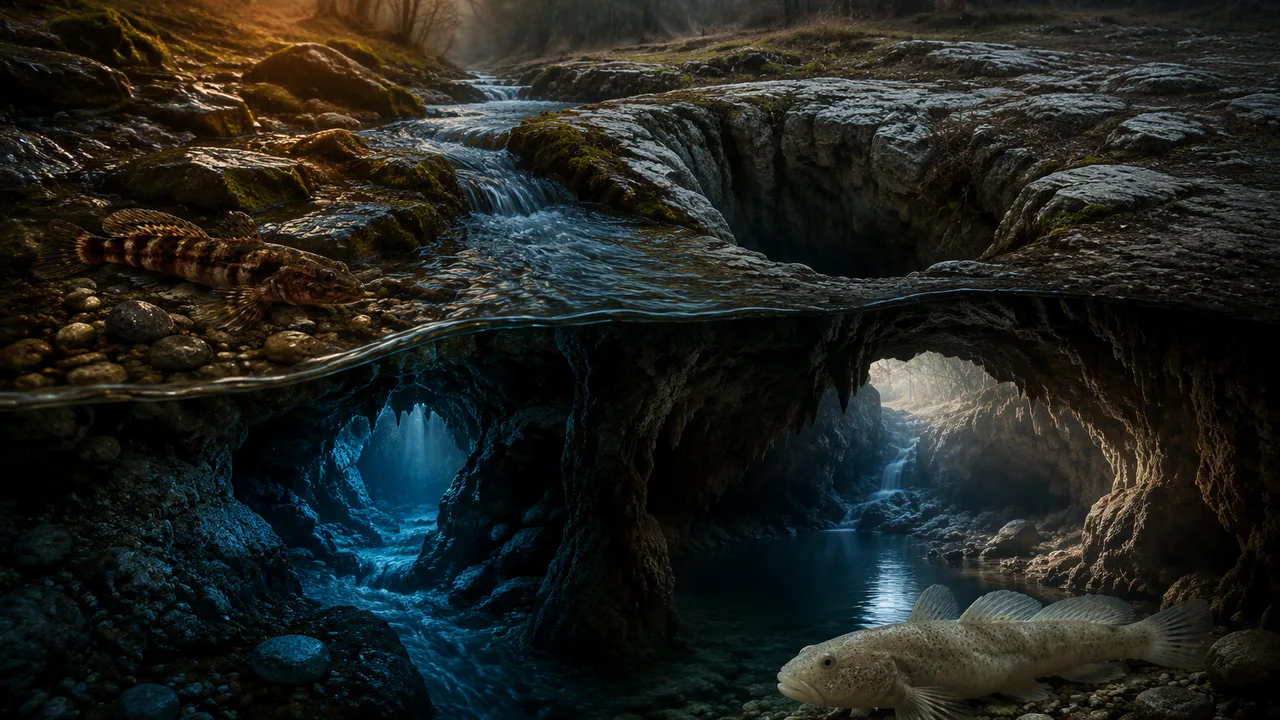
The phenomenon. Missouri is called the Cave State. In Perry County, in southeast Missouri, rain falls on a plain dotted with sinkholes and drains underground into cave streams that flow out again at springs. In 1991 biologists working in those caves documented sculpins unlike the ones in Ozark streams. Sculpins are small, bottom-dwelling fish with broad, flat heads. The banded sculpin, the most widespread sculpin in Missouri, is reddish brown with dark saddle bars, and the Missouri Department of Conservation (MDC) describes it as well camouflaged among the rocks of the stream bottom. The Perry County cave fish are pale tan with unpigmented undersides, with smaller eyes, larger sensory pores on the head, and brains with reduced optic lobes. Biologists searched more than 153 caves in five states; banded sculpins turned up in 25 of them, but only the fish in two karst areas of Perry County, about 222 km2, showed these cave traits. In 2013, combining body measurements with DNA, scientists named them a new species, the grotto sculpin (Cottus specus), and the U.S. Fish and Wildlife Service listed it as endangered. Missouri’s three cavefishes show a similar series: the Shawnee Hills cavefish of a single Scott County spring is brown with tiny eyes that only tell light from dark, while the Salem Plateau cavefish and the Ozark cavefish are blind and colorless, and their ranges do not overlap. Our question for the unit: how could a population living in caves change until it becomes a separate species?
What is a species? The most common definition, the biological species concept, says a species is a group of populations whose members can interbreed in nature and produce fertile offspring, and which cannot do so with other groups. Speciation is the process by which one species splits into two. It usually begins when populations are separated, by a mountain range, a river, a drainage divide, the walls of a cave system or simple distance, so that they stop exchanging genes. Each population then changes in its own way through mutation, natural selection and chance, until the differences stop them interbreeding even if they meet again.
Why Missouri’s cave fish matter. Speciation usually takes far longer than a human lifetime, so we rarely see it happen. Missouri’s cave fish let us see different stages side by side: the banded sculpin, which wanders into caves but remains a surface fish; the grotto sculpin, a close relative so recently split off that until 2013 it was counted as an unusual banded sculpin; and the cavefishes, whose ancestors moved underground millions of years ago. This is evidence for 9-12.LS4.C.2: changing conditions and separation can lead to the emergence of new species. It is also a good example of how science works. DNA studies keep revising the count: Missouri’s Salem Plateau cavefish was split from the wider-ranging southern cavefish, and the Shawnee Hills cavefish from the spring cavefish, because populations that look nearly identical turned out to be separate lineages. Biologists also debate how much of the eye loss was driven by natural selection and how much by mutations that pile up once eyes no longer matter. The debate is about how and how fast, not about whether the populations have evolved.
Evolution as a science. In this course you will study evolution as scientists do: through evidence, models and argument. Evolution is the unifying idea of biology, supported by many independent lines of evidence. Understanding the evidence does not require you to give up any belief, and you will never be asked to state your beliefs.
Asking questions. Why are the cave fish pale? is a start. Are mottled brown fish less likely than pale ones to be found by predators that hunt by sight on a rocky stream bottom? is testable, and the next lab tests a model of it.
📖 Read for this lesson
The reading opens over the lesson; close it to come back to exactly where you were. The checks below draw on it.
Formative check
Work through these before moving on. They are not graded — they tell you whether the standard below has landed yet.
Banded sculpins swim into caves in several states, yet only the sculpins of Perry County’s caves are pale, small-eyed and genetically distinct. What best explains this?
Under the biological species concept, two groups are separate species when they:
Why does geographic isolation often start speciation?
On an outline map of Missouri, mark Perry County and its two karst areas where grotto sculpins live, the Ozark streams where banded sculpins live, and the ranges of the three Missouri cavefishes (Ozark cavefish on the Springfield Plateau in the southwest, Salem Plateau cavefish in the central and southern Ozarks, Shawnee Hills cavefish at one spring in Scott County). Then write two testable questions the map raises.
How confident are you that you can describe Missouri’s cave fish and explain how isolation can lead to new species?
Practice
Work these on paper or in your notebook, then open Check your answer. Aim for all of Fluency and Application; try at least one Challenge.
Printable version: this unit’s practice workbook (PDF)
Fluency
Build speed and accuracy with the core skill.
- State the biological species concept in one sentence.
Check your answer
Answer: A species is a group of populations whose members can interbreed in nature and produce fertile offspring, and which are reproductively isolated from other such groups.The test is interbreeding in nature, not appearance. - Why are grotto sculpins found only where Perry County’s sinkhole plain drains into cave streams?
Check your answer
Answer: Those cave systems supply what the fish need: sustained water flow, plenty of organic matter washed in from the surface, and abundant invertebrate prey such as isopods and amphipods.Habitat requirements limit the range, and a small, separate range limits gene flow. - Put these stages of speciation in order: reproductive isolation; populations separated; populations change independently.
Check your answer
Answer: populations separated; populations change independently; reproductive isolationIsolation stops gene flow, differences accumulate, then the populations no longer interbreed.
Application
Use the skill in context. Show your reasoning.
- Assume (for illustration) that a Missouri cavefish has a generation time of about 5 years. How many generations pass in 1 million years?
Check your answer
Answer: 200,000 generations1,000,000 ÷ 5 = 200,000. - Grotto sculpins from several Perry County caves share one nuclear DNA haplotype; banded sculpins from Greasy Creek (Madison County) and the Current River (Ripley County) each carry a different one, and no other sculpin species lives within the grotto sculpin’s range. Can the biological species concept be tested directly on grotto and banded sculpins in nature? How did scientists decide they are separate species?
Check your answer
Answer: Not directly: the two do not meet in nature, so no one can watch whether they interbreed. Scientists combined DNA evidence that the cave fish form a separate lineage with consistent physical differences (smaller eyes, larger head pores) and named the grotto sculpin a species in 2013.Separated populations are exactly where species definitions become hard to apply. - Give two examples of barriers in Missouri that can separate populations and start speciation.
Check your answer
Answer: Sample: drainage divides between Ozark watersheds (for fish); the walls of separate cave and aquifer systems; the Missouri and Mississippi rivers (for small land animals); forest separating open, rocky glades (for glade lizards).Any barrier that stops gene flow can start speciation.
Challenge
Stretch problems. Expect to think before you write.
- Scientists keep revising how many cavefish species live in Missouri: the Salem Plateau cavefish was split from the southern cavefish, and the Shawnee Hills cavefish from the spring cavefish. Explain why these revisions do not cast doubt on the conclusion that the populations evolved.
Check your answer
Answer: The revisions are about where to draw species boundaries among populations that have diverged by different amounts. All sides agree the populations descend from common ancestors and have diverged; finding separate lineages that look alike is itself what evolution predicts for isolated populations.Distinguish disagreement about classification from disagreement about the process.
Review
Keep earlier skills sharp.
- In a trait where A (dominant) masks a (recessive), cross Aa × aa. Give the genotype ratio and the probability of the dominant phenotype.
Check your answer
Answer: Aa: 2/4, aa: 2/4; P(dominant phenotype) = 1/2Draw the 2 × 2 Punnett square.
Into the Dark: What Has Actually Been Measured on Missouri’s Cave Fish
U.S. Fish and Wildlife Service, grotto sculpin proposed rule 77 FR 59488 (2012) and final rule 78 FR 58938 (2013), public domain; Missouri Department of Conservation Field Guide entries for the banded sculpin, grotto sculpin, Ozark cavefish, Salem Plateau cavefish and Shawnee Hills cavefish; Adams, Burr and Starkey, Zootaxa 3609 (2013), Niemiller et al., Evolution 67 (2013), Hart et al., Proc. R. Soc. B 292 (2025), Brownstein et al., Mol. Biol. Evol. 42 (2025) and Culver, Kowalko and Pipan, Front. Ecol. Evol. 11 (2023), abstracts; retrieved Nov. 5, 2026 · SLS original, summarizing public-domain U.S. government documents and citing the Missouri Department of Conservation and published studies for their findings
Why this reading. The phenomenon lesson asks you to map Missouri’s cave fishes and write testable questions; the performance task asks you to explain how a cave population became a separate species and to say honestly what is debated. That needs the actual findings: where the fish live, how they differ, what the DNA shows, what life in a cave is like by the numbers, and what scientists still argue about. This reading gathers them from the U.S. Fish and Wildlife Service listing documents, the Missouri Department of Conservation (MDC) field guide and the published studies, with the numbers those sources report.
The surface fish: the banded sculpin
Sculpins are small, bottom-dwelling fish with broad, flat heads, large fan-shaped side fins and no swim bladder. MDC describes the banded sculpin (Cottus carolinae) as the most widely distributed sculpin in Missouri, found in all the major Ozark stream systems. Its back and sides are reddish brown with 4 or 5 dark saddle bars, its overall color tends to match the stream bottom where it lives, and MDC calls it well camouflaged by its pattern of light and dark among the rocks. It hides under rocks by day and feeds mostly at night on crayfish, insect larvae, snails and small fish. Adults are commonly 2½ to 5 inches long and may live 6 years or more. One more detail matters for this unit: unlike Missouri’s other stream sculpins, banded sculpins turn up rather commonly in caves, often far from any likely entrance.
The cave fish: the grotto sculpin
In 1991 biologists documented sculpins in the caves of Perry County, in southeast Missouri, that did not look like surface fish. The Fish and Wildlife Service summarizes what set them apart: greatly reduced eyes and skin pigment (the traits biologists call troglomorphic, typical of animals adapted to constant darkness), enlarged sensory pores on the head, and brains with reduced optic and olfactory lobes and enlarged regions linked to other senses. MDC describes the living fish as light tan to bleached tan with unpigmented undersides and smaller eyes than the banded sculpin, which it otherwise closely resembles.
To find out how widespread the cave form was, Burr and colleagues searched caves in five states with large karst areas. By the time of the 2012 listing proposal, more than 153 caves in Arkansas, Illinois, Indiana, Missouri and Tennessee had been searched. Banded sculpins were found in 25 of them, but only the fish in two karst areas of Perry County, the Central Perryville and Mystery-Rimstone karsts, showed the cave traits. Those two areas cover about 222 km2 (89 mi2). Within them the fish live in five cave systems (Moore, Crevice, Mystery, Rimstone River and Running Bull caves), the springs and “resurgences” where cave streams flow out, and two surface streams, Cinque Hommes Creek and Blue Spring Branch. No other sculpin species overlaps this range; banded sculpins live in the neighboring watersheds.
In 2013 Adams, Burr and Starkey named the cave fish a new species, Cottus specus, the grotto sculpin, distinguishable from every other Cottus by both genetic and physical characters, including eye size and the size of the head pores. It was the first cave species described in its genus. The Fish and Wildlife Service listed it as endangered the same year.
What the DNA shows
Adams and colleagues compared sculpins from three southeast Missouri drainages: the Bois Brule drainage in Perry County, Greasy Creek in Madison County and the Current River in Ripley County. Each area held its own evolutionary lineage, marked by a distinct nuclear DNA haplotype. One haplotype was shared by fish throughout the Bois Brule drainage, in Mystery, Running Bull, Rimstone River, Crevice and Moore caves and in Cinque Hommes Creek. The 2013 listing adds that the same study found genetic isolation even within the grotto sculpin’s small range, between northern sample sites (Moore, Crevice and Mertz caves, Blue Spring Branch, Cinque Hommes Creek) and southern ones (Mystery, Running Bull and Rimstone River caves, Thunderhole Resurgence). The fish of Running Bull Cave show the most extreme cave features and are the only ones in the Cinque Hommes drainage to carry a rare haplotype.
Life in the cave, by the numbers
From August 2005 to October 2008, researchers tagged and recaptured grotto sculpins at Mystery Cave, Running Bull Cave and their two resurgences. The Fish and Wildlife Service reports their results:
| Measure | In caves | At resurgences | Total |
|---|---|---|---|
| Captures | 2,684 (43%) | 3,581 (57%) | 6,265 |
| Different individuals | 1,642 | 2,576 | 4,218 |
| Mean recapture rate | 46% | 18% | |
| Density (fish per m2) | 0.037 | 0.225 |
Fish were about six times less dense in the caves (0.225 ÷ 0.037 ≈ 6.1). Growth rate and metabolism were lower in caves than at resurgences, yet fish in both places reached similar lengths, which suggests cave fish live longer. Caves have no light for plants, so nearly all food washes in from the surface; the fish do best where invertebrate prey such as isopods and amphipods are plentiful. Five nests of about 200 eggs each were found within 100 m of cave stream in Mystery Cave in December 1998. Water in the caves may reach spawning temperature 2 to 3 months before surface streams do, which could explain why spawning was not seen at the same time in both habitats. Young fish grow up in the resurgences, where adults, which are cannibalistic, are fewer; surface fish such as green sunfish, bluegill and channel catfish can enter caves through sinkholes and prey on eggs and young.
Missouri’s three cavefishes
A second group of Missouri cave fish, the cavefish family, shows the same pattern. MDC’s field guide describes three cavefishes (family Amblyopsidae) whose ranges do not overlap:
| Species | Where in Missouri | Eyes and color | Life history |
|---|---|---|---|
| Shawnee Hills cavefish (Forbesichthys papilliferus) | A single spring at the base of a limestone bluff in Scott County | Very small eyes that only tell light from dark; dark brown back, yellowish brown sides | Stays underground by day, comes out into surface water at dusk; finds food by taste; most live about 2 years. MDC calls it intermediate between cave-only fish and surface fish. |
| Salem Plateau cavefish (Typhlichthys eigenmanni) | Underground waters of the central and southern Ozarks | No eyes; unpigmented, whitish pink | Up to 50 eggs per female, carried in the gill chamber 4 to 5 months; a low metabolic rate lets it go without food for long periods; believed to live more than 10 years |
| Ozark cavefish (Troglichthys rosae) | Springfield Plateau of southwest Missouri; 13 known sites in Newton, Jasper, Lawrence, Greene, Stone and Barry counties | No eyes; small and colorless | About 20 eggs per female, and only about 20 percent of mature females spawn in a year; finds food with sense organs on the head, body and tail; lives 10 years or more. Federally threatened, endangered in Missouri. |
Genetic studies keep revising this list. MDC notes that Missouri’s Salem Plateau cavefish was split from the wider-ranging southern cavefish, which turned out to be several nearly identical (“cryptic”) species, and that the Shawnee Hills cavefish was split from the spring cavefish of neighboring states.
How many times did fish move into caves?
The cavefish family includes surface fish, part-time cave dwellers and blind cave-only species, so it is a natural test of whether cave traits evolved once or several times. Niemiller and colleagues (2013) found that at least three cave lineages independently picked up their own disabling mutations in rhodopsin, the light-sensing protein of the eye, over the last 10.3 million years. Hart and colleagues (2025), using more than a thousand genes and fossils, identified three independent cave colonizations, dated to about 18.5, 10.0 and 3.0 million years ago, and found more of the cave-related genes under relaxed selection than under strengthened selection. Brownstein and colleagues (2025), using whole genomes, concluded that the family colonized caves and lost its eyes independently at least four times. The studies agree that cave traits evolved repeatedly; they do not yet agree on the exact count.
What is settled and what is debated
- Settled: Missouri’s cave fish descend from surface ancestors; the differences between cave and surface forms are heritable and have a genetic signature; the grotto sculpin is a distinct lineage closely related to the banded sculpin; and eyes and pigment have been reduced independently in more than one cave lineage.
- Debated: why eyes and pigment shrink. One family of hypotheses is natural selection: in food-poor caves, an animal that does not build costly eyes saves energy, and genes that shrink eyes may also strengthen other senses. The other is neutral mutation: once eyes no longer affect survival, mutations that damage them are no longer removed and slowly pile up (relaxed selection). In a 2023 review, Culver, Kowalko and Pipan argue that the two are a false choice and that both most likely contribute. Scientists also continue to debate how many cavefish species to recognize; a further southern cavefish species was described in 2026. The debate is about how and how fast, not about whether these fish evolved.
Your turn
- On an outline map of Missouri, mark Perry County and its two karst areas, the Ozark streams where banded sculpins live, and the ranges of the three cavefishes.
- Use the density table to write one sentence about how much food a cave provides compared with a resurgence (0.037 against 0.225 fish per m2, about 6 times fewer).
- State the energy-saving hypothesis for small eyes as a claim, cite the lower growth and metabolism of cave fish as evidence, and name one observation or experiment that would test it further.
- Write two testable questions the cave fish raise, each naming what would be measured.
Sources: U.S. Fish and Wildlife Service, Endangered Status for Grotto Sculpin and Designation of Critical Habitat, proposed rule, 77 FR 59488 (Sept. 27, 2012), public domain (federalregister.gov); U.S. Fish and Wildlife Service, Determination of Endangered Species Status for the Grotto Sculpin (Cottus specus) Throughout Its Range, final rule, 78 FR 58938 (Sept. 25, 2013), public domain (federalregister.gov); Missouri Department of Conservation, Field Guide: Banded Sculpin (mdc.mo.gov); Missouri Department of Conservation, Field Guide: Grotto Sculpin (mdc.mo.gov); Missouri Department of Conservation, Field Guide: Ozark Cavefish (mdc.mo.gov); Missouri Department of Conservation, Field Guide: Salem Plateau Cavefish (mdc.mo.gov); Missouri Department of Conservation, Field Guide: Shawnee Hills Cavefish (formerly Spring Cavefish) (mdc.mo.gov); Adams, G. L., B. M. Burr and D. E. Starkey, Cottus specus, a new troglomorphic species of sculpin (Cottidae) from southeastern Missouri, Zootaxa 3609:484-494 (2013), abstract (PubMed 24699612) (doi.org); Niemiller, M. L., et al., Evidence for repeated loss of selective constraint in rhodopsin of amblyopsid cavefishes (Teleostei: Amblyopsidae), Evolution 67:732-748 (2013), abstract (PubMed 23461324) (doi.org); Hart, P. B., et al., Ancient climate changes and relaxed selection shape cave colonization in North American cavefishes, Proceedings of the Royal Society B 292:20242516 (2025), abstract (PubMed 40669076) (doi.org); Brownstein, C. D., et al., Convergent Evolution in Amblyopsid Cavefishes and the Age of Eastern North American Subterranean Ecosystems, Molecular Biology and Evolution 42:msaf185 (2025), CC BY, abstract (doi.org); Culver, D. C., J. E. Kowalko and T. Pipan, Natural selection versus neutral mutation in the evolution of subterranean life: A false dichotomy? Frontiers in Ecology and Evolution 11:1080503 (2023), CC BY, abstract (doi.org)