design and carry out a choice-chamber investigation of pill bug behavior, test whether the result differs from chance with chi-square, and explain how the behavior and grouping help the animals survive.
Instruction
Meet the pill bug. Pill bugs (roly-polies, Armadillidium vulgare) are not insects but land-dwelling crustaceans, relatives of crabs and shrimp. They breathe with gill-like structures that must stay moist, and they lose water quickly through their exoskeleton in dry air. They live under logs, stones and leaf litter in almost every Missouri yard, garden and park, feeding on decaying plant matter, which makes them important decomposers. Their behavior is easy to observe and harmless to test.
Kinds of behavior. Some behaviors are innate: they are inherited and appear without learning, such as a pill bug rolling into a ball when touched. Some are learned. Pill bugs show a simple innate behavior called a kinesis: in unfavourable conditions, such as dry air, they move faster and turn more, and in favorable conditions they slow down and stay. The result is that they end up where it is moist, without “choosing” in any human sense. Pill bugs also aggregate, clustering together. Studies have found that a cluster of pill bugs loses less water per individual than the same bugs kept apart, because each bug exposes less of its surface to dry air. That is a group behavior with a measurable survival benefit, the kind of evidence enrichment asks about.
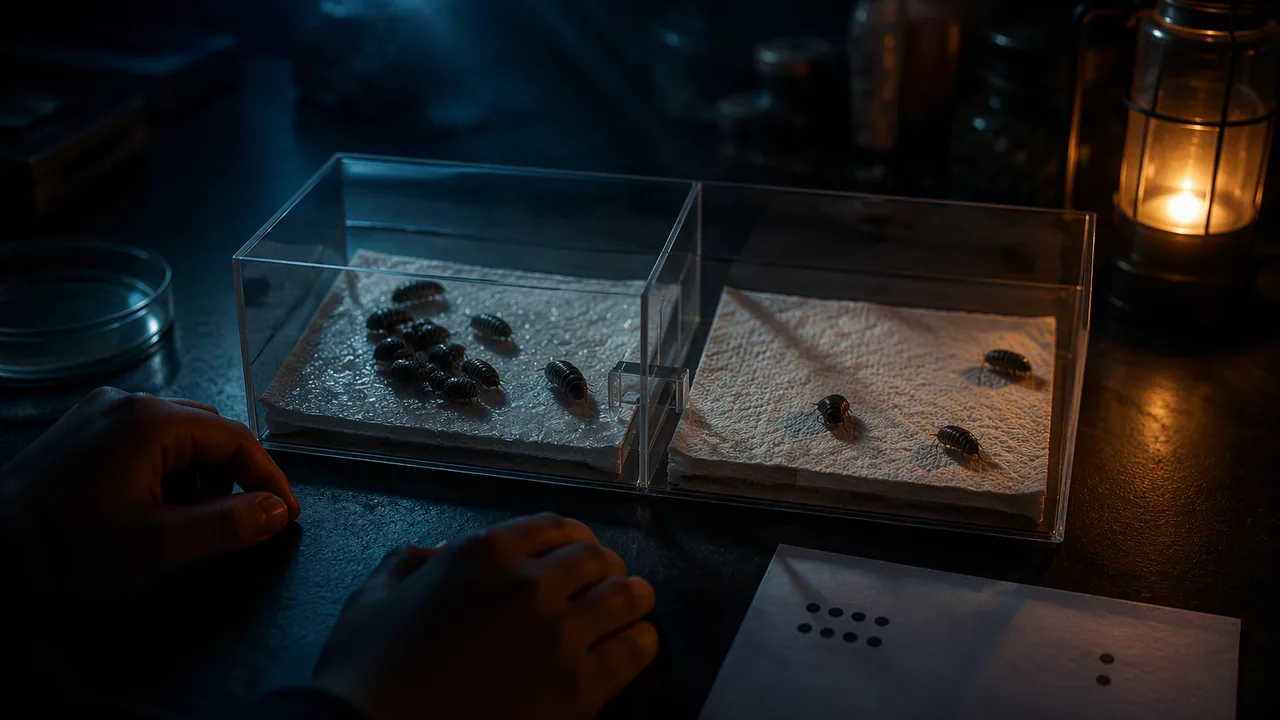
Designing a choice experiment. A choice chamber has two connected sides that differ in one condition only, such as a damp paper towel on one side and a dry one on the other. Place ten pill bugs in the center, wait, and count how many are on each side at regular intervals. To make the test fair, control everything else: light, temperature, the type of paper and the time. Swap which side is damp in a second trial, so that a preference for one end of the chamber is not mistaken for a preference for moisture.
Is the result more than chance? If pill bugs have no preference, we expect half on each side. Suppose ten counts of ten bugs give 72 observations on the damp side and 28 on the dry side, out of 100. Expected: 50 and 50. χ2 = (72 − 50)2/50 + (28 − 50)2/50 = 484/50 + 484/50 = 19.36. With 1 degree of freedom the critical value at the 0.05 level is 3.84; 19.36 is far larger, so we reject “no preference” (illustrative data). Compare a light-versus-dark trial that gives 44 and 56: χ2 = 36/50 + 36/50 = 1.44, below 3.84, so that difference could be chance. Counting the same bugs repeatedly means the observations are not fully independent, so treat the test as a guide rather than a proof, and pool several independent runs, each with fresh bugs.
Caring for animals. Ask a parent or guardian before you turn over logs or stones, wear gloves, and roll each one toward you and back into place afterward; in Missouri, brown recluse spiders and copperheads also shelter under objects. Handle pill bugs gently with a soft brush or spoon, keep them moist and out of the sun, keep trials short, and return them to where you found them the same day. Animal investigations in this course never cause pain or death.
📖 Read for this lesson
The reading opens over the lesson; close it to come back to exactly where you were. The checks below draw on it.
Lab: Choice chamber: moisture, light and grouping in pill bugs
Question. Do pill bugs prefer moist or dry habitat, and do they group together more in dry conditions?
Materials
- Ten pill bugs, collected from under leaf litter, boards or stones in a yard, garden or park near home and kept in a container with damp soil and leaves
- A choice chamber: two connected plastic food containers or a shoebox lid divided by a piece of cardboard, with paper towels
- Water in a spray bottle, a phone or kitchen timer, a soft paintbrush or plastic spoon, and a sheet of dark paper or cardboard
- Handle pill bugs gently with a brush or spoon and never squeeze them; keep them out of direct sun and heat.
- Wash hands with soap after handling animals and soil.
- Get a parent’s or guardian’s permission before collecting, wear gloves when turning logs or stones (brown recluse spiders and copperheads also hide under them in Missouri), and return every pill bug to the place it was collected the same day.
Procedure
- Line both sides of the chamber with paper towel. Spray one side until damp and leave the other dry. Keep light and temperature the same on both sides.
- Place ten pill bugs in the center, cover the chamber loosely, and wait two minutes.
- Every 30 seconds for five minutes, count the pill bugs on each side and record the counts.
- Swap which side is damp and repeat, to rule out a preference for one end of the chamber.
- In a separate dry chamber, record every minute how many bugs are touching at least one other bug (clustered). Repeat in a fully damp chamber and compare.
- Repeat the whole investigation on a second day with ten fresh pill bugs, pool your two runs, and carry out a chi-square test on the moist-versus-dry totals. If you could run only one trial, pool your counts with the data set in the reading.
Data
| Time (s) | Trial 1 damp side | Trial 1 dry side | Trial 2 damp side | Trial 2 dry side |
|---|---|---|---|---|
| 30 | ||||
| 60 | ||||
| … | ||||
| 300 | ||||
| Totals |
Grouping: number of bugs clustered each minute in the dry chamber ___ and in the damp chamber ___.
Analysis
- Carry out a chi-square test on your moist-versus-dry totals (your pooled runs, or your run pooled with the reading’s data set). State χ2, degrees of freedom and your decision.
- Did the bugs cluster more in dry or damp conditions? Explain how clustering could help them survive, citing your observations.
- Why was it important to swap the damp side in the second trial? What alternative explanation does this rule out?
- Identify two limitations of your design (for example, counting the same bugs repeatedly) and how you would improve it.
If you cannot do this lab in person: Use the illustrative data in the lesson (72 damp and 28 dry observations; 44 light and 56 dark) and the full time series in the reading, and complete the chi-square test and analysis; or, if you cannot collect pill bugs, watch any online video of a pill bug choice chamber and count the bugs on each side yourself at 30-second intervals.
Formative check
Work through these before moving on. They are not graded — they tell you whether the standard below has landed yet.
Out of 100 observations, 65 were on the damp side and 35 on the dry side. With expected counts of 50 each, χ2 = .
Why should the damp side be swapped between trials?
Clustering can benefit pill bugs because each bug in a group loses less water than it would alone.
A light-versus-dark trial gives 44 and 56 out of 100 (χ2 = 1.44). What should you conclude?
How confident are you that you can design a behavior investigation and use chi-square to decide whether a behavior differs from chance?
Practice
Work these on paper or in your notebook, then open Check your answer. Aim for all of Fluency and Application; try at least one Challenge.
Printable version: this unit’s practice workbook (PDF)
Fluency
Build speed and accuracy with the core skill.
- In 100 observations, 30 pill bugs were on the dry side and 70 on the damp side. Calculate χ2 against a 50 : 50 expectation.
Check your answer
Answer: 16.0(202/50) × 2 = 8 + 8 = 16. - In 100 observations, 58 were on one side and 42 on the other. Calculate χ2.
Check your answer
Answer: 2.56(82/50) × 2 = 1.28 + 1.28 = 2.56. - For each result above, decide at the 0.05 level (critical value 3.84) whether there is evidence of a preference.
Check your answer
Answer: 70 : 30: yes (16.0 > 3.84). 58 : 42: no (2.56 < 3.84).Compare each χ2 with the critical value for 1 degree of freedom.
Application
Use the skill in context. Show your reasoning.
- A three-way choice chamber (damp leaf litter, damp paper, dry paper) gives 40, 35 and 25 of 100 observations. Test for a preference (critical value 5.99 for 2 degrees of freedom).
Check your answer
Answer: χ2 = 3.5; below 5.99, so no convincing evidence of a preference among the three.Expected 33.3 each: (6.72 + 1.72 + 8.32) ÷ 33.3 = (44.4 + 2.8 + 69.4) ÷ 33.3 = 3.5. - Explain how a kinesis can bring pill bugs to damp places even though they do not move directly toward moisture.
Check your answer
Answer: In dry areas they move faster and turn more, so they leave quickly; in damp areas they slow down and stay. Over time they accumulate where it is damp.Different movement rates in different conditions produce aggregation. - Why does clustering help pill bugs survive in dry conditions, and how could you test this?
Check your answer
Answer: Each bug in a cluster exposes less surface to dry air, so it loses less water. Test: weigh groups of 10 clustered bugs and 10 bugs kept in separate compartments before and after an hour in dry air, and compare mass lost per bug.Measure water loss per individual in grouped versus isolated bugs.
Challenge
Stretch problems. Expect to think before you write.
- A student counts the same 10 pill bugs every 30 seconds for 5 minutes and treats the 100 counts as independent observations. Explain why this can overstate the evidence, and suggest a better design.
Check your answer
Answer: A bug that stays put is counted many times, so the counts are not independent and the effective sample is closer to 10 bugs than 100 observations; χ2 is inflated. Better: record each bug’s final position once, repeat with fresh bugs on several days, and pool the runs.Chi-square assumes independent observations.
Review
Keep earlier skills sharp.
- In fruit flies, where normal wings (A) are dominant to vestigial wings (a), and in a trait where A (dominant) masks a (recessive), cross Aa × aa. Give the genotype ratio and the probability of the dominant phenotype.
Check your answer
Answer: Aa: 2/4, aa: 2/4; P(dominant phenotype) = 1/2Draw the 2 × 2 Punnett square.
Ten Bugs, Every Thirty Seconds: The Choice-Chamber Record and the Chi-Square Table
SLS illustrative choice-chamber record (constructed teaching data, not measurements), chi-square critical values computed from the chi-square distribution, and the published finding of Broly et al. (2014) cited · SLS original
Why this reading. The lesson gives you totals (72 damp, 28 dry) and asks for a chi-square test, a decision about clustering, and a reason for swapping the damp side. Totals hide the time series, and the time series is where the behavior shows. Here is the full illustrative record for both trials and the grouping observations, plus the critical values you need to make a decision. These are constructed teaching data, not measurements; if you ran the lab, use your own counts; if you ran only one trial, pool your counts with these.
Procedure summarized
A shoebox-lid chamber divided by a piece of cardboard with a gap at the bottom; paper towel on both sides, one side sprayed damp. Ten pill bugs placed at the center, lid covered loosely, two minutes to settle, then a count of bugs on each side every 30 seconds for five minutes (ten counts). Trial 2 repeated with the damp towel moved to the other end. Room 22 °C, indirect light equal on both sides.
Trial 1 (damp side on the left)
| Time (s) | 30 | 60 | 90 | 120 | 150 | 180 | 210 | 240 | 270 | 300 | Total |
|---|---|---|---|---|---|---|---|---|---|---|---|
| Damp side | 5 | 6 | 7 | 7 | 8 | 8 | 8 | 8 | 7 | 8 | 72 |
| Dry side | 5 | 4 | 3 | 3 | 2 | 2 | 2 | 2 | 3 | 2 | 28 |
Trial 2 (damp side moved to the right)
| Time (s) | 30 | 60 | 90 | 120 | 150 | 180 | 210 | 240 | 270 | 300 | Total |
|---|---|---|---|---|---|---|---|---|---|---|---|
| Damp side | 4 | 6 | 6 | 7 | 8 | 8 | 8 | 8 | 9 | 8 | 72 |
| Dry side | 6 | 4 | 4 | 3 | 2 | 2 | 2 | 2 | 1 | 2 | 28 |
Read the rows before the totals. At 30 seconds the bugs are split almost evenly; by 150 seconds about eight of ten are on the damp side, and they stay there. That is what a kinesis looks like from outside: bugs on the dry towel keep moving and turning, bugs that reach the damp towel slow down and stop, so the damp side fills without any bug “choosing” it. And the damp side won in both trials even though it was at opposite ends of the chamber, which is what the swap was for: a preference for the left end would have given a damp-side count near 72 in trial 1 and near 28 in trial 2.
Grouping (separate chambers, counted every minute)
| Minute | 1 | 2 | 3 | 4 | 5 |
|---|---|---|---|---|---|
| Bugs touching at least one other bug, dry chamber | 3 | 5 | 6 | 7 | 8 |
| Bugs touching at least one other bug, damp chamber | 1 | 2 | 2 | 1 | 2 |
In dry air the bugs formed one growing cluster in a corner; in the damp chamber they stayed spread out. A published study of woodlice, Broly and colleagues (2014, Physiological Entomology), measured water loss of individuals alone and in groups of 10 to 100 and reported that aggregation reduces an individual’s rate of water loss whatever the group size, by more than half in large groups. Each bug in a cluster exposes less of its surface to dry air. That is the survival benefit behind the true-or-false check, and it is why the clustering rises when the towel is dry and not when it is damp.
Chi-square, worked
The null hypothesis is no preference: 50 expected on each side out of 100 observations. χ2 = Σ(observed − expected)2 ÷ expected.
- Trial 1 alone: (72 − 50)2 ÷ 50 + (28 − 50)2 ÷ 50 = 9.68 + 9.68 = 19.36.
- Both trials pooled (144 damp, 56 dry, expected 100 each): (44)2 ÷ 100 × 2 = 38.72.
- The check for understanding (65 and 35): (15)2 ÷ 50 × 2 = 4.5 + 4.5 = 9.0.
- Light versus dark (44 and 56): (6)2 ÷ 50 × 2 = 0.72 + 0.72 = 1.44.
Critical values of chi-square
Computed from the chi-square distribution. Reject “no difference” when your statistic exceeds the value for your degrees of freedom (categories minus one) at the level you chose.
| Degrees of freedom | P = 0.05 | P = 0.01 |
|---|---|---|
| 1 | 3.84 | 6.63 |
| 2 | 5.99 | 9.21 |
| 3 | 7.81 | 11.34 |
| 4 | 9.49 | 13.28 |
Two sides give one degree of freedom. 19.36 and 9.0 both exceed 3.84 (and 6.63), so the moisture preference is unlikely to be chance; 1.44 does not reach 3.84, so the light-dark data give no convincing evidence of a preference.
The limitation the test cannot fix
Chi-square assumes each observation is independent. Counting the same ten bugs ten times does not give 100 independent observations; a bug that settled on the damp towel at 90 seconds is counted there eight more times. The honest statistic is closer to a test on ten bugs than on a hundred, which is why the lesson calls the result a guide and why pooling many independent runs, each with fresh bugs (on different days, or from a different yard), is the real fix. Two more limits: two minutes may not be long enough to settle, and spraying one towel also cools it slightly, so moisture and temperature are confounded. A second trial with a cool dry towel would separate them.
Sources: Broly, P., C. Devigne, J.-L. Deneubourg and C. Devigne, Effects of group size on aggregation against desiccation in woodlice (Isopoda: Oniscidea), Physiological Entomology 39:165-171 (2014), abstract (resjournals.onlinelibrary.wiley.com)