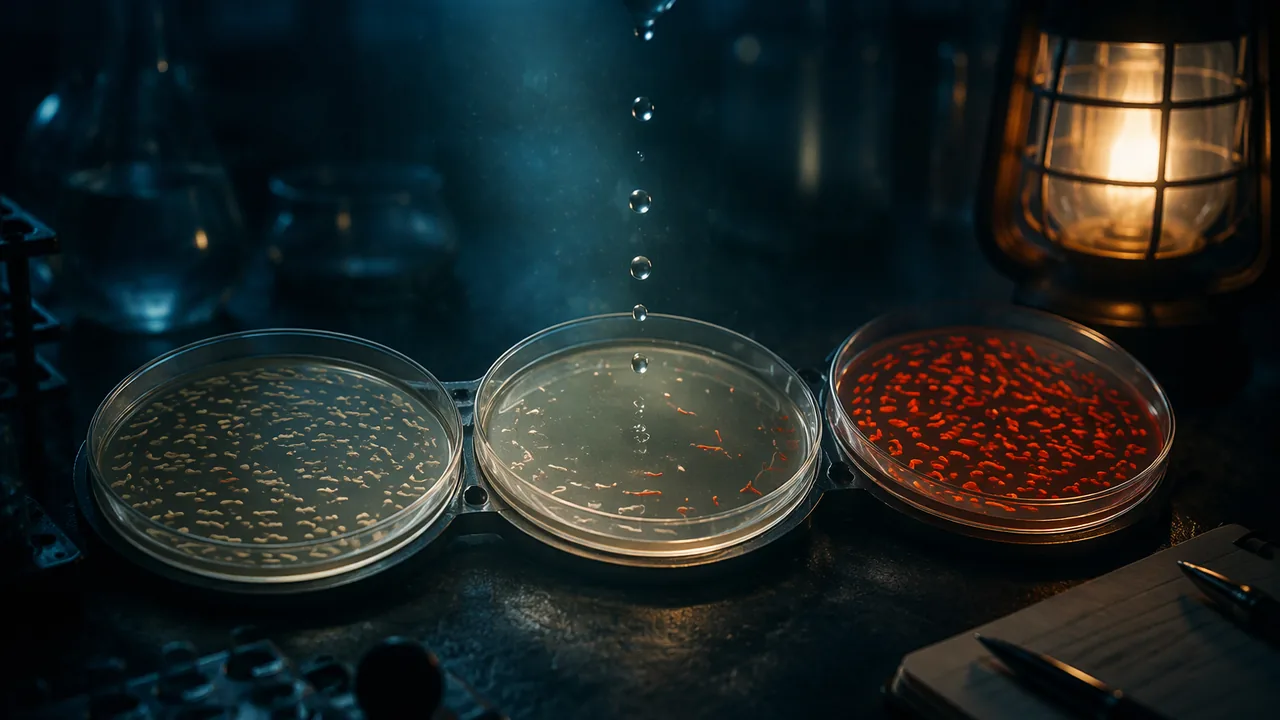
use a simulation and a calculation to explain how natural selection produces adaptation, including antibiotic resistance, and how environmental change can lead to the spread, emergence or extinction of species.
Instruction
Adaptation is a population-level result. An adaptation is a heritable trait that improves survival or reproduction in a particular environment. Adaptations are produced by natural selection over generations: variation arises by mutation and recombination, and the environment determines which variants leave more offspring. An adaptation is always relative to an environment. White fur helps a hare hide in snow and makes it conspicuous on brown ground.
A fast example you can calculate: antibiotic resistance. According to the CDC, its 2019 report showed more than 2.6 million antimicrobial-resistant infections and nearly 44,000 deaths each year in the United States. Here is why resistance evolves so fast. Suppose 1% of the bacteria in an infection carry a mutation that makes them resistant. A course of antibiotic kills 90% of the susceptible bacteria and none of the resistant ones. Out of every 1,000 bacteria, 10 resistant and 990 susceptible become 10 resistant and 99 susceptible. The resistant fraction is now 10 ÷ 109 ≈ 9.2%. If the survivors regrow and are treated again, the fraction rises to about 50%, and after a third round to about 91%. The antibiotic did not create the mutation; it selected the bacteria that already had it. This is why doctors ask patients not to take antibiotics for viral infections, where they do not help, and to follow the prescribed course.
Modeling with PhET. The Natural Selection simulation lets you run a bunny population across generations, add mutations (brown fur, long teeth, floppy ears), and add selection agents (wolves, limited food). Because you control each variable, you can test the four factors directly: turn the wolves off and fur color stops mattering, so the mutation neither spreads nor disappears; change the environment from arctic to equator and brown fur turns from a liability into an advantage. Treat the sim as a model: it simplifies genetics and the environment, and part of your job is to say what it leaves out.
Environmental change and species (9-12.LS4.C.2). When conditions change, three outcomes are possible, and all three appear in Missouri’s record. Some species increase: MDC reports that eastern red cedar was uncommon before European settlement, almost entirely restricted to bluffs and cliffs where fire could not reach it; once fires were suppressed it became commonplace and spread into glades, prairies and woodlands. New species can emerge: sculpins living in Perry County’s caves have diverged from surface banded sculpins into a separate species, the grotto sculpin. Some species go extinct: mastodons and giant ground sloths roamed Missouri as the last ice age ended, and the Kimmswick Bone Bed shows that people lived alongside mastodons; both animals disappeared as climates changed and humans spread across the continent, and scientists continue to debate the relative importance of these causes. Which outcome occurs depends on how fast the environment changes, how much heritable variation a population has, and whether it can move to suitable habitat.
Why speed matters. Bacteria can have a new generation in under an hour, so selection changes them in days. Missouri’s cavefishes are slow: MDC reports that an Ozark cavefish can live 10 years or more and that only about 20 percent of mature females spawn in a given year, each producing about 20 eggs, so the same process takes thousands of years. When human activity changes an environment faster than a slow-breeding species can adapt or move, extinction becomes more likely, which links this lesson back to the design work of Unit 2.
📖 Read for this lesson
The reading opens over the lesson; close it to come back to exactly where you were. The checks below draw on it.
Formative check
Work through these before moving on. They are not graded — they tell you whether the standard below has landed yet.
1% of 1,000 bacteria are resistant. An antibiotic kills 90% of susceptible bacteria only. Afterward, about % of the survivors are resistant (one decimal).
Simulation & tools
Test the four factors with bunnies
Open Natural Selection and choose the Lab screen. (1) Set the environment to arctic, add the brown fur mutation, and turn on wolves. Run until generation 8 and record the number of brown and white bunnies each generation from the population graph. (2) Reset, keep brown fur, but leave the wolves off. Run to generation 8 and record the same data. (3) Reset, switch the environment to equator, turn on wolves and repeat. Calculate the proportion of brown bunnies at generation 8 in each run, and write three sentences explaining which factor caused each difference. Choose one. All three earn full credit and answer the same questions. Option A is the simulation above. Option B, for no internet, is the record of the three runs below: constructed teaching data showing what the model produces, not real counts. Each cell gives white bunnies / brown bunnies.
| Generation | Run 1: arctic, wolves on | Run 2: arctic, wolves off | Run 3: equator, wolves on |
|---|---|---|---|
| 1 | 3 / 1 | 3 / 1 | 3 / 1 |
| 2 | 6 / 2 | 6 / 2 | 5 / 3 |
| 3 | 11 / 3 | 12 / 4 | 8 / 6 |
| 4 | 19 / 4 | 23 / 9 | 11 / 12 |
| 5 | 29 / 4 | 45 / 17 | 13 / 21 |
| 6 | 41 / 3 | 88 / 34 | 14 / 33 |
| 7 | 52 / 2 | 170 / 68 | 13 / 46 |
| 8 | 61 / 2 | 330 / 128 | 12 / 58 |
Compute the proportion of brown bunnies at generation 8 for each run (about 3%, 28% and 83%) and write the three sentences explaining which factor caused each difference.
Option C — run the model by hand. You need about 60 small objects in two colors and a coin. Start with 18 white and 2 brown bunnies. Each generation, first predation: in an arctic round flip once for every brown bunny and remove it on heads, and flip for every white bunny but remove it only on two heads in a row; in an equator round swap those two rules; in a no-wolves round remove nobody. Then reproduction: double whatever survives, up to 60. Run eight generations three times, once arctic with wolves, once arctic without and once equator with wolves, recording the counts each generation, and answer the same questions from your own numbers.
Open in a new tab ↗ · PhET Interactive Simulations, University of Colorado Boulder · CC BY 4.0
Why do antibiotics become less effective when they are overused?
A rapid environmental change is more likely to cause extinction in a species with a long generation time and little genetic variation.
How confident are you that you can explain how natural selection produces adaptation, using a simulation and a calculation?
Practice
Work these on paper or in your notebook, then open Check your answer. Aim for all of Fluency and Application; try at least one Challenge.
Printable version: this unit’s practice workbook (PDF)
Fluency
Build speed and accuracy with the core skill.
- Out of 1,000 bacteria, 10 are resistant. An antibiotic kills 90% of the susceptible bacteria and none of the resistant ones. What percentage of the survivors are resistant?
Check your answer
Answer: About 9.2%Survivors: 10 resistant + 99 susceptible = 109; 10 ÷ 109 = 0.092. - Bacteria divide every 30 minutes. How many generations can they pass through in a day?
Check your answer
Answer: 4824 × 60 ÷ 30 = 48. - Name the three possible outcomes for species when environmental conditions change, as listed in 9-12.LS4.C.2.
Check your answer
Answer: Increases in the number of individuals of some species; the emergence of new species over time; the extinction of other speciesWhich occurs depends on the species and the speed of change.
Application
Use the skill in context. Show your reasoning.
- Out of 1,000 bacteria, 2% are resistant. An antibiotic kills 95% of susceptible bacteria and no resistant ones. Find the resistant percentage after one treatment, and after a second treatment of the regrown survivors.
Check your answer
Answer: About 29% after one; about 89% after twoRound 1: 20 resistant, 980 × 0.05 = 49 susceptible; 20/69 = 0.290. Round 2: 0.290 ÷ (0.290 + 0.710 × 0.05) = 0.891. - The CDC reports that its 2019 report showed more than 2.6 million antimicrobial-resistant infections and nearly 44,000 deaths each year in the United States. Explain how prescribing antibiotics for viral colds contributes to this problem.
Check your answer
Answer: Antibiotics do not affect viruses, so they give no benefit, but they still kill susceptible bacteria in the body, leaving resistant bacteria to multiply. Unnecessary use increases selection for resistance.Every use is a selective pressure on bacterial populations. - In the PhET Natural Selection sim, brown fur spreads in the arctic when wolves are on, but not when wolves are off. Which of the four factors does this demonstrate most directly?
Check your answer
Answer: That individuals with a trait better suited to the environment survive and reproduce more: wolves are the selective agent, so without them brown fur gives no advantage.Remove the selective pressure and the advantage disappears.
Challenge
Stretch problems. Expect to think before you write.
- A species of salamander has a generation time of 5 years and little genetic variation; a species of fruit fly has a generation time of 2 weeks and much variation. A rapid warming event lasts 50 years. Compare the number of generations each experiences and explain which is more likely to adapt.
Check your answer
Answer: Salamander: 10 generations; fruit fly: about 1,300 generations. The fruit fly has far more generations and more variation for selection to act on, so it is much more likely to adapt; the salamander is more at risk unless it can move to suitable habitat.50 ÷ 5 = 10; 50 × 52 ÷ 2 = 1,300.
Review
Keep earlier skills sharp.
- (Unit 1) With r = 0.3 per day and K = 200, find the daily growth of a duckweed population of 100 fronds using the logistic model.
Check your answer
Answer: 15 fronds per day0.3 × 100 × (1 − 100/200) = 15.
Selection You Can Count: The CDC’s Resistance Figures, the Three-Round Calculation and the Bunny Runs
CDC, Antimicrobial Resistance Threats Report page (2019 report and 2026 update); Missouri Department of Conservation Field Guide, Eastern Red Cedar; U.S. Fish and Wildlife Service, 77 FR 59488 (2012) and 78 FR 58938 (2013); Missouri State Parks, Mastodon State Historic Site history; SLS worked calculations; retrieved Nov. 5, 2026 · SLS original, citing public-domain CDC and U.S. Fish and Wildlife Service figures and Missouri state agency pages with attribution
Why this reading. The lesson asks you to explain adaptation with a simulation and a calculation, and to say what the model leaves out. The CDC figures it cites are confirmed here against the CDC’s own page, the antibiotic calculation is carried through all three rounds so every step can be checked, the recorded bunny runs are turned into the proportions the task asks for, and the three outcomes of environmental change are tied to Missouri cases you can check.
1. The CDC figures, from the source
The CDC’s page on its Antimicrobial Resistance Threats Report states that the 2019 report showed more than 2.6 million antimicrobial-resistant infections and nearly 44,000 deaths each year in the United States. (Earlier summaries of the 2019 report gave 2.8 million and 35,000; quote the figure you use with its source.) The CDC’s 2026 update uses new methods and data sources and estimates that each year the bacteria and fungi on its threat list result in 9.7 million infections and 50,800 deaths; the CDC warns that, except for Candida auris, these numbers should not be compared directly with earlier reports. The 2026 update lists 19 bacterial and fungal threats, sorted as urgent, serious or concerning, plus a watch list of six. The CDC also reports that six drug-resistant infections that begin in hospitals rose by a combined 20 percent during the COVID-19 pandemic compared with before it.
2. The three-round calculation, every step
Start with 1,000 bacteria, 1 percent resistant. The antibiotic kills 90 percent of susceptible cells and none of the resistant ones. Between rounds the survivors regrow, keeping their proportions.
| Round | Susceptible before | Susceptible after (10% survive) | Resistant (unchanged) | Resistant share of survivors |
|---|---|---|---|---|
| 1 | 990 | 99 | 10 | 10 ÷ 109 = 9.2% |
| 2 | 99 | 9.9 | 10 | 10 ÷ 19.9 = 50.3% |
| 3 | 9.9 | 0.99 | 10 | 10 ÷ 10.99 = 91.0% |
The resistant count never changed. Only the susceptible count fell, so the resistant proportion rose from 1 percent to 91 percent in three treatments. This is the whole mechanism of selection in one table: the environment did not create the variant, it removed the alternative. A patient who stops a course early leaves a population that is partly selected and still large; that is why the advice is to finish the prescribed course and not to take antibiotics for viral infections, where there is nothing for them to kill and every dose still selects the bacteria the patient already carries.
3. The bunny runs as proportions
The lesson’s Option B record gives white and brown bunnies at generation 8 for the three runs. The proportions the task asks for:
| Run | White / brown at generation 8 | Proportion brown | Which factor changed |
|---|---|---|---|
| 1: arctic, wolves on | 61 / 2 | 2 ÷ 63 = 3.2% | A predator that hunts by sight on white ground selects against brown; brown nearly disappears |
| 2: arctic, wolves off | 330 / 128 | 128 ÷ 458 = 27.9% | No selective pressure; brown neither spreads nor vanishes, and the whole population grows unchecked |
| 3: equator, wolves on | 12 / 58 | 58 ÷ 70 = 82.9% | Same predator, brown ground: the same mutation is now the advantage |
Read across the rows and the lesson’s sentence becomes a measurement: the mutation is the same in all three runs; the environment decides whether it is a liability (3 percent), neutral (28 percent) or an adaptation (83 percent). Run 2 also shows why “adaptation” needs a selecting agent: without wolves the trait drifts and the population explodes toward the model’s limits.
4. What the simulation leaves out
- Inheritance is simplified to one gene with dominant and recessive alleles; fur color in real mammals involves several genes.
- Predation is the only cause of death, and every wolf hunts equally well in every season.
- Population size is bounded by the model, not by food, water, disease or space, so run 2’s growth is not a real population’s growth.
- Generation time is fixed and mutation arrives on command; real mutations are rare and random.
5. Three outcomes of environmental change, with Missouri cases
| Outcome (9-12.LS4.C.2) | Missouri case | The evidence |
|---|---|---|
| A species increases | Eastern red cedar after fire suppression | MDC reports that before European settlement red cedar was uncommon and almost entirely restricted to bluffs and cliffs, where fire could not reach it; with fires suppressed it has become commonplace and invades glades, prairies and woodlands |
| New species emerge | Grotto sculpins in Perry County’s caves | A cave population with smaller eyes, paler bodies and larger head pores, carrying its own DNA haplotype, was named a separate species from the banded sculpin in 2013; more than 153 caves in five states were searched and the cave form was found only in Perry County’s two karst areas (U.S. Fish and Wildlife Service) |
| A species goes extinct | The American mastodon at the Kimmswick Bone Bed | Mastodons and giant ground sloths roamed the Midwest as the last ice age (35,000 to 10,000 years ago) ended; a Clovis spear point found with mastodon bones in 1979 shows people were present too (Missouri State Parks); both animals are gone, and the relative roles of a warming climate and human hunting are still debated |
6. Why speed matters
The bacteria in the table went from 1 percent to 91 percent resistant in three treatments, which for a fast-dividing bacterium is days. The small-advantage model in the predation lesson took ten generations to move a trait from 10 to 51 percent; for an Ozark cavefish, which can live 10 years or more and whose females spawn only in some years, that is decades or longer; for a bacterium it is an afternoon. When people change an environment faster than a slow-breeding species can adapt or move, the third outcome becomes the likely one, which is the argument for the engineering work in Unit 2.
Worked check
1 percent of 1,000 is 10 resistant; 90 percent of the 990 susceptible die, leaving 99; 10 ÷ (10 + 99) = 0.0917, or 9.2 percent.
Sources: CDC, Antimicrobial Resistance Threats in the United States (AR Threats Report page: 2019 report and 2026 update) (cdc.gov); Missouri Department of Conservation, Field Guide: Eastern Red Cedar (mdc.mo.gov); U.S. Fish and Wildlife Service, Endangered Status for Grotto Sculpin and Designation of Critical Habitat, proposed rule, 77 FR 59488 (Sept. 27, 2012), public domain (federalregister.gov); U.S. Fish and Wildlife Service, Determination of Endangered Species Status for the Grotto Sculpin (Cottus specus) Throughout Its Range, final rule, 78 FR 58938 (Sept. 25, 2013), public domain (federalregister.gov); Missouri State Parks, Mastodon State Historic Site: Historic Site History (mostateparks.com)