analyze fossil, anatomical, embryological, molecular and biogeographic evidence, compare DNA sequences, and argue that independent lines of evidence support common ancestry.
Instruction
Why several lines of evidence? A conclusion supported by one kind of evidence could be wrong if that evidence is misleading. A conclusion supported by several independent kinds, gathered by different methods, is far stronger. Common ancestry, the idea that living species descend with modification from shared ancestors, is supported by at least five.
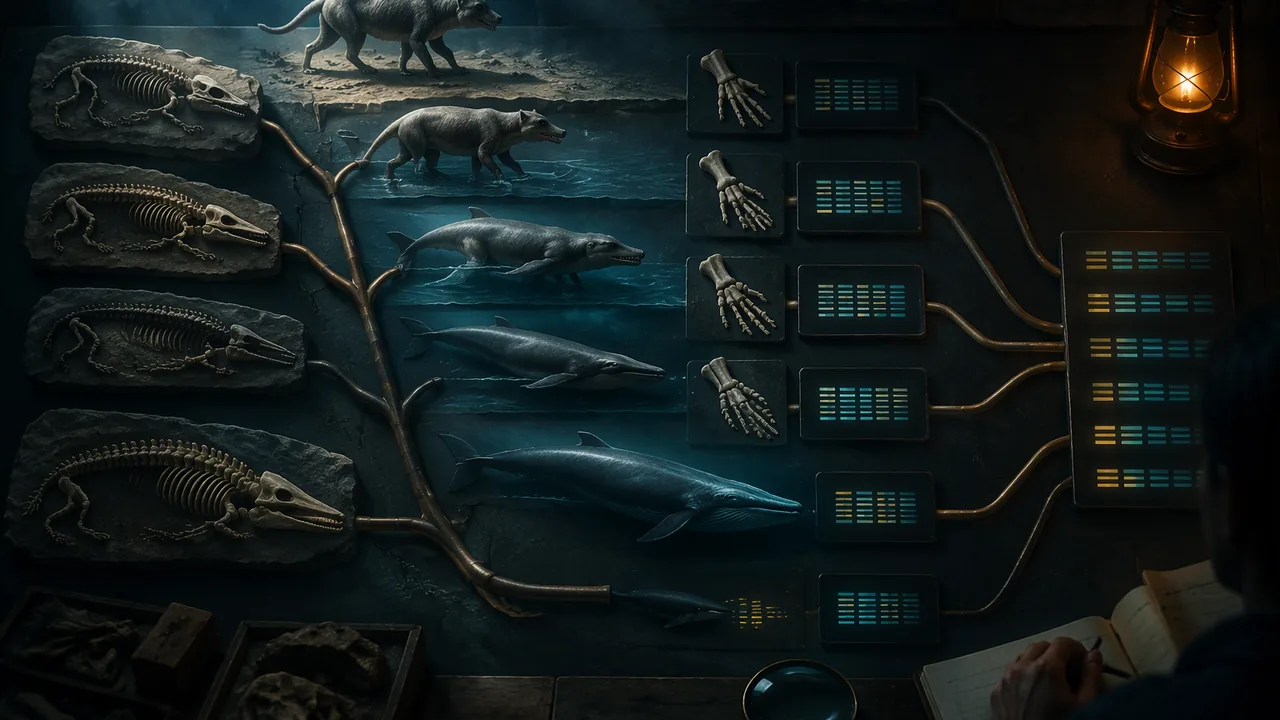
1. Fossils. Rock layers preserve a sequence, with older layers generally below younger ones. Fossils show that life has changed over time and include forms that link groups. The early whales are a well-studied example: Pakicetus, a land mammal with an ear structure found only in whales, from about 50 million years ago; Ambulocetus, which could walk and swim; Rodhocetus, with shorter legs; and Basilosaurus and Dorudon, fully aquatic whales about 40 million years old that still had tiny hind limbs. Missouri’s own record shows change over time too: at the Kimmswick Bone Bed, now Mastodon State Historic Site, the bones of American mastodons, animals that lived here at the end of the last ice age and are now extinct, were found together with a stone Clovis spear point.
2. Anatomy. Homologous structures have the same underlying pattern because they were inherited from a common ancestor, even when they now do different jobs. A human arm, a cat’s foreleg, a whale’s flipper and a bat’s wing all have one upper bone (humerus), two lower bones (radius and ulna), wrist bones and finger bones. Vestigial structures, reduced remnants of structures that were functional in ancestors, tell the same story: living whales have small pelvic bones embedded in their bodies. By contrast, analogous structures, such as a bird’s wing and a butterfly’s wing, do similar jobs but are built differently; they show similar environments, not close ancestry.
3. Embryology. Early embryos of fish, chickens and humans all have a series of pharyngeal arches in the neck region. In fish these develop into gill structures; in humans they form parts of the jaw, ear and throat.
4. Molecules. All living things use DNA and nearly the same genetic code, which you used in Biology A. The more closely related two species are, the more similar their DNA. The National Human Genome Research Institute notes that human and chimpanzee DNA is about 98.8% identical. Humans and other primates even share the same broken copy of a gene (the GULO gene) that other mammals use to make vitamin C, which is why we need it in our diet. Shared mistakes are hard to explain except by shared ancestry.
5. Biogeography. A cave system is an island of habitat. The grotto sculpin is found nowhere in the world except a few cave systems in Perry County, Missouri, and its closest relative is not a cave fish from another state but the banded sculpin of the surrounding Ozark streams. Missouri’s glades, hot and dry rocky openings in the Ozark woods, are islands too: their eastern collared lizards belong to a lizard family whose other species live mostly in the deserts of the Southwest and northern Mexico. Isolated species that most resemble the species of the nearest source area are what common ancestry predicts.
Comparing sequences (illustrative). Compare a 20-base stretch of the same gene in four species with species A. B differs at 1 base (95% identical), C at 2 (90%), D at 5 (75%). The simplest tree groups A with B first, then C, then D: the fewer the differences, the more recent the shared ancestor. Real studies compare thousands of bases and get trees that match the fossil and anatomical evidence, which is exactly the point: independent lines agree.
📖 Read for this lesson
The reading opens over the lesson; close it to come back to exactly where you were. The checks below draw on it.
Formative check
Work through these before moving on. They are not graded — they tell you whether the standard below has landed yet.
A bat’s wing and a whale’s flipper contain the same set of bones. This is evidence of:
Two 20-base sequences differ at 5 positions, so they are % identical.
A bird’s wing and a butterfly’s wing are strong evidence that birds and butterflies share a recent common ancestor.
Write your argument for common ancestry using at least three lines of evidence from the gallery. Explain why agreement among independent lines makes the conclusion stronger than any single line.
How confident are you that you can explain and communicate how several independent lines of evidence support common ancestry?
Practice
Work these on paper or in your notebook, then open Check your answer. Aim for all of Fluency and Application; try at least one Challenge.
Printable version: this unit’s practice workbook (PDF)
Fluency
Build speed and accuracy with the core skill.
- Two 20-base sequences differ at 3 positions. What percentage identical are they?
Check your answer
Answer: 85%(20 − 3) ÷ 20 = 0.85. - Two 40-base sequences differ at 7 positions. What percentage identical are they?
Check your answer
Answer: 82.5%33 ÷ 40 = 0.825. - Two 50-base sequences differ at 12 positions. What percentage identical are they?
Check your answer
Answer: 76%38 ÷ 50 = 0.76.
Application
Use the skill in context. Show your reasoning.
- Classify each pair as homologous or analogous: (a) human arm and whale flipper; (b) bird wing and butterfly wing; (c) bat wing and cat foreleg; (d) the streamlined body shape of a shark and of a dolphin.
Check your answer
Answer: (a) homologous; (b) analogous; (c) homologous; (d) analogous (the same shape evolved independently in a fish and a mammal because both swim fast)Homology is shared underlying structure from a common ancestor. - Compared with species A (illustrative sequences), species B differs at 1 of 20 bases, C at 2 and D at 5. Draw or describe the simplest tree and explain your reasoning.
Check your answer
Answer: A and B share the most recent ancestor; C branches off before them; D branches off first. Fewer differences indicate a more recent common ancestor.Group the most similar sequences first. - Arrange the early whale fossils from oldest to youngest and describe the trend: Basilosaurus (about 40 million years), Pakicetus (about 50), Ambulocetus (about 49), Rodhocetus (about 47).
Check your answer
Answer: Pakicetus, Ambulocetus, Rodhocetus, Basilosaurus. The trend is from a land mammal toward fully aquatic forms, with hind limbs becoming smaller.Order by age; note the change in limbs and lifestyle.
Challenge
Stretch problems. Expect to think before you write.
- Humans and other primates share the same broken copy of the GULO gene, which other mammals use to make vitamin C. Explain why shared mistakes in DNA are especially strong evidence of common ancestry.
Check your answer
Answer: A functional gene could be similar in two species because it does the same job. But the same inactivating mutation at the same place is very unlikely to arise independently in each species; the simplest explanation is that it happened once in a common ancestor and was inherited by its descendants.Compare the probability of one event inherited with that of identical independent events.
Review
Keep earlier skills sharp.
- (Biology A) Translate the mRNA AUG GCU UGG AAA UAG.
Check your answer
Answer: Met-Ala-Trp-Lys (then stop)GCU = Ala, UGG = Trp, AAA = Lys, UAG = stop.
The Evidence Gallery: Fossil Ages, Shared Bones, a Real Protein Compared Across Ten Species, and Missouri’s Cave and Glade Islands
UniProt cytochrome c entries P99999, P99998, P00002, P00004, P00011, P67881, P00020, P00022, P81459, P00044 (CC BY 4.0), differences recounted Nov. 5, 2026; NHGRI news release, Aug. 31, 2005; Gingerich et al., PLOS ONE 4:e4366 (2009); Thewissen et al., Evolution: Education and Outreach 2:272 (2009); Missouri State Parks, Mastodon State Historic Site history; MDC Field Guide (grotto sculpin, banded sculpin, eastern collared lizard); USFWS 78 FR 58938 (2013); retrieved Nov. 5, 2026 · SLS original, with sequence data from UniProt (CC BY 4.0), public-domain U.S. government sources, Missouri state agency pages and published fossil ages cited with attribution
Why this reading. The lesson asks for an argument “using at least three lines of evidence from the gallery.” This is the gallery. Each station carries real, cited evidence with its numbers: dated fossils, shared bones, embryos, a protein compared letter by letter across ten living species from sequences you can check yourself, and two kinds of Missouri “islands”: caves and glades. The lesson’s 20-base example was illustrative; the protein table below is not.
Station 1: fossils in order
Ages are those given by Thewissen and colleagues (2009) and by Gingerich and colleagues (2009); “Ma” means million years ago.
| Group and example | Age | What the bones show |
|---|---|---|
| Raoellids (Indohyus), India and Pakistan | about 55 to 45 Ma | A deer-like, hoofed land animal whose ear bone has the thickened inner wall (the involucrum) otherwise found only in whales; heavy limb bones like a wader’s |
| Pakicetids (Pakicetus) | about 50 Ma | Four-legged, whale ear bones, ankle bones of the even-toed hoofed mammals |
| Ambulocetids (Ambulocetus) | about 49 Ma | Shorter legs, large paddle-like hands and feet, long muscular tail: walked and swam |
| Protocetids (Rodhocetus, Maiacetus) | 49 to 37 Ma; Maiacetus about 47.5 Ma | Short limbs still able to bear weight on land; a Maiacetus fossil holds a fetus positioned head-first, as land mammals are born |
| Basilosaurids (Basilosaurus, Dorudon) | 41 to 34 Ma; Dorudon about 36.5 Ma | Fully aquatic, nostrils shifted back toward the eyes, hind limbs present but too small to carry the body |
The order in the rock matches the order of the changes: ear first, then limbs shortening, then hind limbs shrinking to remnants. Missouri’s own record shows change over time too. Missouri State Parks reports that giant ground sloths, peccaries and mastodons roamed the Midwest as the last ice age (35,000 to 10,000 years ago) ended, and at the Kimmswick Bone Bed, now Mastodon State Historic Site, a 1979 excavation found a stone Clovis spear point with mastodon bones: the first solid evidence in eastern North America that people and mastodons lived at the same time. The American mastodon is now extinct.
Station 2: the same bones, different jobs
| Bone | Human arm | Cat foreleg | Whale flipper | Bat wing |
|---|---|---|---|---|
| Humerus (one upper bone) | Present | Present | Present, short | Present |
| Radius and ulna (two lower bones) | Present | Present | Present, flattened | Present |
| Wrist bones | Present | Present | Present | Present |
| Finger bones | Five digits | Five digits, claws | Digits inside the flipper, some with extra bones | Four digits greatly lengthened to hold the wing membrane, thumb free |
Same plan, four uses. Living whales also keep small pelvic bones inside the body, not attached to any limb: a vestige of the hind limbs the basilosaurids still had. Set against this, a bird’s wing and a butterfly’s wing share no bones at all; the butterfly has none. They are analogous, shaped by the same job, not inherited from one ancestor.
Station 3: embryos
Early embryos of fish, chickens and humans all form a series of pharyngeal arches in the neck region. In fish they become gill supports; in humans they become parts of the jaw, middle ear and throat. Thewissen and colleagues note that modern whales, which have no hind limbs, still form the beginnings of hind limbs as embryos, then lose them.
Station 4: molecules, from the record
Cytochrome c is a small protein of about 104 amino acids used in cellular respiration by every organism with mitochondria. The table compares the human protein with nine others, position by position, using the sequences held in the UniProt database (each accession number is given so you can retrieve and count them yourself). The initiator methionine is omitted; the two fish and yeast are aligned on the shared heme-binding motif.
| Species | UniProt entry | Positions differing from human | Identical |
|---|---|---|---|
| Chimpanzee (Pan troglodytes) | P99998 | 0 of 104 | 100% |
| Rhesus macaque (Macaca mulatta) | P00002 | 1 of 104 | 99.0% |
| Dog (Canis lupus familiaris) | P00011 | 11 of 104 | 89.4% |
| Horse (Equus caballus) | P00004 | 12 of 104 | 88.5% |
| Duck (Anas platyrhynchos) | P00020 | 11 of 104 | 89.4% |
| Chicken (Gallus gallus) | P67881 | 13 of 104 | 87.5% |
| Snapping turtle (Chelydra serpentina) | P00022 | 15 of 104 | 85.6% |
| Albacore tuna (Thunnus alalunga) | P81459 | 20 of 103 | 80.6% |
| Baker’s yeast (Saccharomyces cerevisiae) | P00044 | 38 of 103, plus five extra residues at one end | 63.1% |
Build the tree from the numbers: human and chimpanzee join first (0 differences), then the macaque (1), then the mammals dog and horse (11 to 12), then the birds and turtle (11 to 15), then the fish (20), then yeast (38). That is the same order the fossils and the bones give, reached by a completely different method: counting letters in a protein. Notice also that duck and chicken differ from us by nearly the same amount (11 and 13) as dog and horse do; the protein records how long ago the lines split, not how much the animals resemble us.
At the level of whole genomes, the National Human Genome Research Institute’s 2005 announcement of the chimpanzee genome states that “the DNA sequence that can be directly compared between the two genomes is almost 99 percent identical,” that about 35 million single-base differences separate the shared portions of two genomes of about 3 billion bases each, and that “when DNA insertions and deletions are taken into account, humans and chimps still share 96 percent of their sequence.” The lesson’s 98.8 percent is the first of these figures rounded; quote whichever you use with its definition. Humans and other primates also share the same disabled copy of the GULO gene that other mammals use to make vitamin C. A shared working gene could be explained by shared need; a shared broken one is best explained by shared inheritance.
Station 5: biogeography, Missouri’s islands
An island does not have to be surrounded by sea; it can be any patch of habitat surrounded by places its animals cannot live. Missouri has two kinds.
Caves. The grotto sculpin lives nowhere in the world except a few cave systems and two short streams in Perry County, an area of about 222 km2. Its closest relative is not a cave fish from another state but the banded sculpin of the surrounding Ozark streams; until DNA and body measurements set it apart in 2013, it was counted as an unusual banded sculpin. The two share features found in no other Missouri sculpin, such as a complete lateral line running to the base of the tail fin and a broad, dark bar at the base of the tail.
Glades. MDC describes Missouri’s glades as open, rocky, south- or west-facing openings in the Ozark woods, hot and dry “like little deserts.” Their animals include the eastern collared lizard, the only Missouri member of a lizard family that ranges from eastern Missouri to the West Coast and northern Mexico, with many species native to the desert Southwest. The other glade species MDC lists, among them prickly pear cactus, the roadrunner, Texas and desert mice and the Texas brown tarantula, read like a list from much farther southwest.
Isolated habitats whose species most resemble those of the nearest source area, and that have begun to differ from them, are exactly what descent with modification predicts.
Worked check
Two 20-base sequences differing at 5 positions are 15 ÷ 20 = 75 percent identical. The same rule gives every percentage in the protein table.
Writing the argument
Choose three stations. State what each shows, then make the point that matters most: the stations are independent. A paleontologist dating rock, an anatomist comparing bones and a biochemist reading a protein use different methods on different material, and they arrive at the same branching order. One line could mislead; three that agree by accident would be a very large coincidence.
Sources: UniProt, cytochrome c entries P99999 (human), P99998 (chimpanzee), P00002 (rhesus), P00004 (horse), P00011 (dog), P67881 (chicken), P00020 (duck), P00022 (snapping turtle), P81459 (albacore), P00044 (yeast), CC BY 4.0 (uniprot.org); NHGRI, New Genome Comparison Finds Chimps, Humans Very Similar at the DNA Level (Aug. 31, 2005) (genome.gov); Gingerich, P. D., et al., New Protocetid Whale from the Middle Eocene of Pakistan: Birth on Land, Precocial Development, and Sexual Dimorphism, PLOS ONE 4:e4366 (2009), CC BY (journals.plos.org); Thewissen, J. G. M., L. N. Cooper, J. C. George and S. Bajpai, From Land to Water: the Origin of Whales, Dolphins, and Porpoises, Evolution: Education and Outreach 2:272-288 (2009) (link.springer.com); Missouri State Parks, Mastodon State Historic Site: Historic Site History (mostateparks.com); Missouri Department of Conservation, Field Guide: Grotto Sculpin (mdc.mo.gov); Missouri Department of Conservation, Field Guide: Banded Sculpin (mdc.mo.gov); Missouri Department of Conservation, Field Guide: Eastern Collared Lizard (mdc.mo.gov); U.S. Fish and Wildlife Service, Determination of Endangered Species Status for the Grotto Sculpin (Cottus specus) Throughout Its Range, final rule, 78 FR 58938 (Sept. 25, 2013), public domain (federalregister.gov)