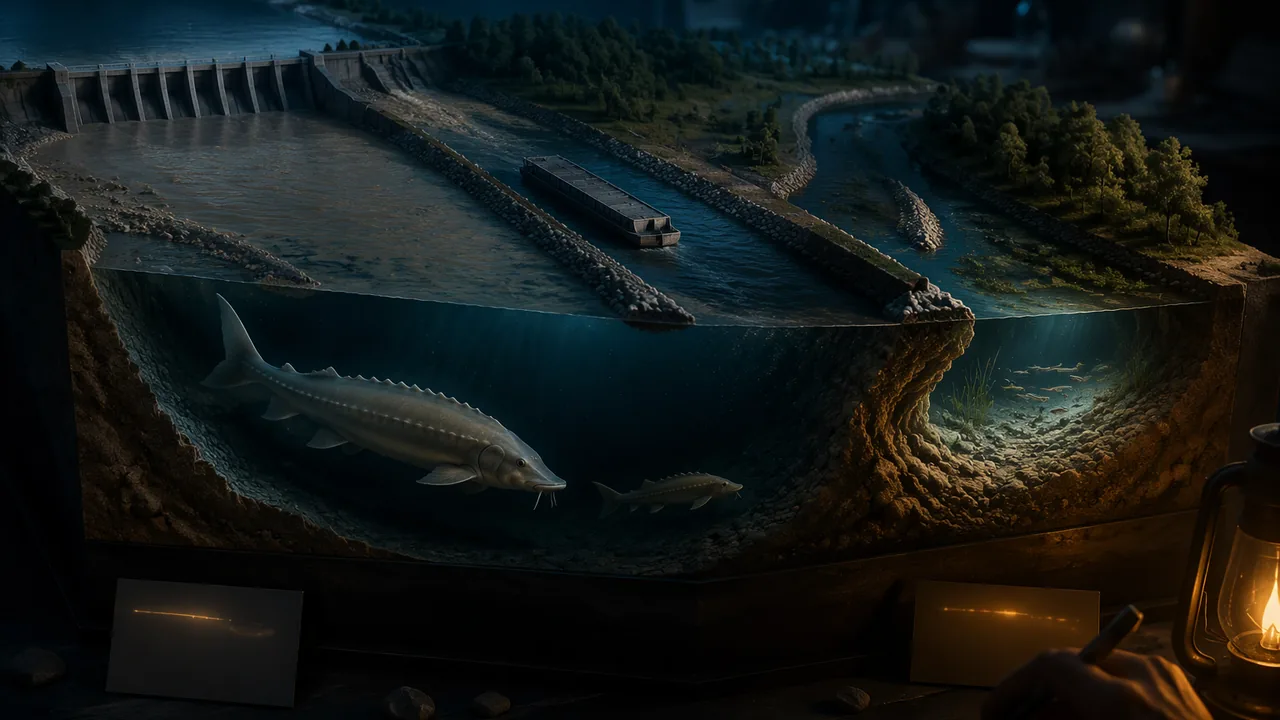
evaluate competing explanations for the decline of the pallid sturgeon in the Missouri River using evidence, and turn the strongest explanations into criteria and constraints for a solution.
Instruction
The river. The Missouri River crosses the state from Kansas City to its meeting with the Mississippi just north of St. Louis. Over the last century it was rebuilt for people. Six large dams upstream, built after the Flood Control Act of 1944, store water, generate power and hold back floods. Below them, the U.S. Army Corps of Engineers narrowed and deepened the river into a 9-foot-deep, 300-foot-wide navigation channel from Sioux City, Iowa, to the mouth, largely finished by 1967, so barges can carry grain and fertilizer. The river is also home to the pallid sturgeon, a fish from a family that dates back about 70 million years, which can grow to 6 feet, live 80 years or more, and does not breed until females are 15 to 20 years old. It was listed as endangered on September 6, 1990. Today the lower river’s population is kept going largely by hatchery-raised fish released since 1994.
Competing explanations. Scientists agree the sturgeon has declined; they have argued about how much each cause contributes. The U.S. Fish and Wildlife Service’s 2014 recovery plan supports several factors acting together:
- Dams and reservoirs. Dams block migrations, release cold, clear water, and trap the sediment that once made the river muddy. Young sturgeon drift downstream for days, 245 to 530 km, before they can feed; where a reservoir begins sooner than that, they settle into still water and die. About 28 percent of the historical range is now reservoir.
- Channelization. Dikes and stone banks closed off side channels, sandbars and shallow, slow water where young fish feed. Channelization halved the river’s surface area and doubled its current.
- Harvest by mistaken identity. Pallids look much like the smaller shovelnose sturgeon, which was fished commercially for meat and caviar, and pallids were caught by mistake. Since 2010 shovelnose are protected where the two live together.
- Invasive species and other stresses. Asian carps, which filter plankton, are spreading through the basin and may compete with young fish for food; pallids hybridize with shovelnose; and water quality adds stress.
Evaluating a claim. Suppose someone claims: channelizing the river for barges is the only reason the sturgeon declined. Evidence for: the lower river lost most of its shallow side channels, and wild young sturgeon are scarce there. Evidence against: in the upper river in Montana and North Dakota, which is not a channelized barge route, adults still spawn, yet young fish are not surviving, because the drift ends in a reservoir. A careful argument concludes that channelization matters but cannot be the whole explanation. Notice the move: we did not ask who is to blame. We asked what the evidence shows about each cause.
From causes to criteria (9-12.ETS1.A.1). Engineers turn a problem into criteria, what a solution must achieve, and constraints, the limits it must work within. For the lower Missouri, criteria might include: increase survival of young sturgeon; rebuild shallow, food-rich side channels (by 2011 about 3,443 acres had been built); evidence of wild-born young within ten years. Constraints might include: keep the navigation channel open for barges; do not reduce flood protection for farms and towns behind the levees; stay within a budget; respect the rights and knowledge of river communities and of the tribal nations of the Missouri River basin. Criteria can conflict, so engineers prioritize them, and the priorities are a societal choice informed by science. A solution that ranks well for fish but floods farmland will not be built; a solution that meets every constraint but does not help fish does not solve the problem.
📖 Read for this lesson
The reading opens over the lesson; close it to come back to exactly where you were. The checks below draw on it.
Formative check
Work through these before moving on. They are not graded — they tell you whether the standard below has landed yet.
Which evidence most weakens the claim that channelization is the only cause of the pallid sturgeon’s decline?
Which is a constraint rather than a criterion for a Missouri River habitat project?
When several causes act together, removing only one of them may not be enough to reverse a population’s decline.
Write a problem statement for one Missouri River sub-problem (for example, food and shallow water for young sturgeon). List three prioritized criteria and three constraints, and explain which evidence from the lesson led you to each.
How confident are you that you can evaluate evidence for several causes of a decline and turn them into criteria and constraints?
Practice
Work these on paper or in your notebook, then open Check your answer. Aim for all of Fluency and Application; try at least one Challenge.
Printable version: this unit’s practice workbook (PDF)
Fluency
Build speed and accuracy with the core skill.
- Classify as a criterion or a constraint for a Missouri River side-chute project: (a) increase insect food in the chute; (b) must not flood nearby farmland; (c) budget of $20 million; (d) increase survival of young pallid sturgeon.
Check your answer
Answer: (a) criterion; (b) constraint; (c) constraint; (d) criterionCriteria are goals; constraints are limits. - Name four factors linked by evidence to the decline of the pallid sturgeon.
Check your answer
Answer: Dams and reservoirs (blocked migration, cold clear water, cut-short larval drift); channelization and loss of shallow side channels; harvest by mistaken identity in shovelnose sturgeon fishing; invasive species, hybridization and water qualitySeveral causes act together. - Why does a pallid sturgeon population recover slowly once its numbers fall?
Check your answer
Answer: Females do not mature until about 15 to 20 years old and usually spawn only every two years, so each generation is long and few young are produced per year.Late maturity and infrequent spawning slow population growth.
Application
Use the skill in context. Show your reasoning.
- With weights effectiveness 0.40, cost 0.20, habitat benefit 0.25 and community support 0.15, compute the weighted totals for option A (3, 4, 3, 5) and option B (5, 2, 4, 3).
Check your answer
Answer: A = 3.50; B = 3.85A: 1.20 + 0.80 + 0.75 + 0.75 = 3.50. B: 2.00 + 0.40 + 1.00 + 0.45 = 3.85. - Evaluate the claim: “Releasing hatchery-raised sturgeon will fully restore the pallid sturgeon.”
Check your answer
Answer: Not supported. Stocking keeps the species present, but the 2014 recovery plan warns that if stocking stopped, the species would again face local extirpation, because the causes of failed natural reproduction (short drift distance, lost shallow habitat, altered flows) remain.Treating a symptom is not the same as removing the causes. - Rewrite this vague criterion so it can be measured: “make the Missouri River better for sturgeon.”
Check your answer
Answer: Sample: increase the catch of wild-born young pallid sturgeon per standard survey sample in restored side chutes by 50% within ten years, compared with nearby unrestored reaches.A criterion should name a measurable quantity, a target and a time frame.
Challenge
Stretch problems. Expect to think before you write.
- In the weighted matrix above, option B wins. How would the result change if community support were weighted 0.35 and effectiveness 0.20 (cost 0.20, habitat 0.25)? What does this show about decision matrices?
Check your answer
Answer: A = 0.60 + 0.80 + 0.75 + 1.75 = 3.90; B = 1.00 + 0.40 + 1.00 + 1.05 = 3.45, so A now wins. The outcome depends on the weights, which reflect values; a brief should justify its weights and test how sensitive the choice is to them.Recompute each total with the new weights.
Review
Keep earlier skills sharp.
- A population of 1000 grows exponentially with a per-capita rate of 0.2 per year (continuous). Estimate its size after 7 years.
Check your answer
Answer: ≈ 4,055N = N0ert.
A River Rebuilt: The Pallid Sturgeon Record and the Evidence for Four Causes
USFWS, Revised Recovery Plan for the Pallid Sturgeon (Scaphirhynchus albus), first revision, signed January 2014; Federal Register 79 FR 12213 (Mar. 4, 2014); USFWS species profile, Pallid Sturgeon; retrieved Nov. 5, 2026 · Public domain (works of the U.S. Fish and Wildlife Service), with SLS evidence tables
Why this reading. The lesson asks you to weigh four explanations for the decline of the pallid sturgeon and to say which evidence led you to each criterion. It describes the evidence in words. Here are the numbers and dates behind the words, taken from the U.S. Fish and Wildlife Service’s 2014 recovery plan. Argue from the tables, not from the summary.
The fish
The pallid sturgeon lives in the Missouri and Mississippi rivers. The Fish and Wildlife Service describes a fish that can reach 6 feet and about 80 pounds and live at least 80 years. Males mature at about 5 to 10 years, females not until about 15 to 20, and females usually spawn only every two years. After hatching, the young drift downstream for days. The species was listed as endangered on September 6, 1990. It was not even described by scientists until 1905, so early numbers are unknown; some fishermen in the lower Missouri around 1905 reported about one sturgeon in five as a pallid.
How the river was rebuilt
| Year | Change (recovery plan, citing Funk and Robinson 1974 and others) |
|---|---|
| 1832 | Congress approves removing snags for navigation. |
| 1912 | A 6-foot navigation channel approved from Kansas City to the Mississippi near St. Louis. |
| 1944–1945 | The Flood Control Act of 1944 leads to six main-stem dams upstream; the Rivers and Harbors Act of 1945 deepens the channel to 9 feet and 300 feet wide from Sioux City, Iowa, to the mouth. |
| 1967 | A self-scouring navigation channel largely completed. |
| 1990 | Pallid sturgeon listed as endangered. |
| 1994 | Release of hatchery-reared pallid sturgeon begins in the lower river (annual since 2002). |
| by 2011 | About 3,443 acres (1,393 hectares) of shallow-water habitat built back in the lower river: side chutes, reconnected backwaters, new side channels. |
What is left, in numbers
- About 28 percent of the historical range was lost to the reservoirs behind the dams.
- Downstream of the reservoirs, channelization halved the river’s water surface area and doubled current velocity. Even in a stretch below Gavins Point Dam that was never channelized, total side-channel area fell 77 percent because of the dams upstream.
- Young sturgeon drift 245 to 530 km (152 to 329 miles) before they can feed on their own. Upstream of Lake Sakakawea, spawning happens but the drift runs out in the reservoir, and recruitment there “remains undetected.”
- Wild fish: about 45 were estimated above Fort Peck Reservoir in 1995; only 3 were caught there in 2007–2013. About 125 wild fish remain between Fort Peck Dam and Lake Sakakawea. In one 50-mile stretch of the lower Missouri, researchers estimated 5.4 to 8.9 wild and 28.6 to 32.3 hatchery-raised pallids per river kilometer.
- The plan’s judgment: stocking “appears to be successful in maintaining the species’ presence,” but “if supplementation efforts were to cease, the species would once again face local extirpation within several reaches.”
The evidence behind the four explanations
| Explanation | Evidence in the record | What weakens it as the only cause |
|---|---|---|
| Dams and reservoirs | Block migrations; release cold, clear water; trap sediment; cut the drift distance larvae need; 28 percent of the range now lake. | The lower Missouri, more than 800 miles with no dams, also lacks a self-sustaining population. |
| Channelization | Side channels, sandbars and shallow slow water lost; surface area halved; current doubled. | The upper river above Lake Sakakawea is not a channelized barge route, yet young fish there still fail to survive because the drift ends in a reservoir. |
| Harvest by mistaken identity | Pallid sturgeon were taken in commercial fishing for the look-alike shovelnose sturgeon; since 2010 shovelnose are protected where the two live together. | The plan judges current rules adequate for this threat, yet natural recruitment has not returned. |
| Invasive species, hybridization and water quality | Asian carps, which filter plankton, are expanding in the basin; pallids hybridize with shovelnose; contaminants are a concern, studied mostly in the shovelnose sturgeon as a stand-in. | The plan calls the significance of hybridization “poorly understood,” and few studies have measured what the carps do to sturgeon. |
From evidence to criteria
A criterion has to be measurable against something. “Help the sturgeon” is not a criterion; “detect wild-born young pallid sturgeon in a restored reach within ten years” is. The drift numbers suggest a sub-problem, enough river for larvae to finish drifting, that habitat building downstream cannot fix upstream. And the river’s other jobs set the constraints: the same channel carries barges, the levees protect farms and towns from floods, and the dams supply hydropower and water.
Your turn
- Using the midpoints of the two ranges (7.15 wild and 30.45 hatchery fish per kilometer), what percentage of the pallid sturgeon in that lower-river stretch were hatchery-raised? (30.45 ÷ 37.6 ≈ 81 percent.)
- For each of the four explanations, name one fact from this reading that supports it and one that complicates it.
- Write a problem statement for one sub-problem, three prioritized criteria and three constraints, and cite the row of this reading that led you to each.
Sources: USFWS, Revised Recovery Plan for the Pallid Sturgeon (Scaphirhynchus albus), first revision (2014), PDF hosted by the Pallid Sturgeon Recovery Program (pallidsturgeon.org); Federal Register, Final Revised Recovery Plan for the Pallid Sturgeon, 79 FR 12213 (Mar. 4, 2014) (federalregister.gov); USFWS, Pallid Sturgeon species profile (fws.gov)