write and modify a rule-based pattern generator, and argue a reasoned position on who is the author of work made with rules, randomness and machine learning, using the human-authorship principle in U.S. copyright.
Instruction
Artists were writing rules for machines long before today’s image generators. Vera Molnar (1924-2023), a Hungarian-born artist working in France, began making drawings with a computer in the late 1960s, writing programs that placed and varied simple shapes and then selecting among the results. Harold Cohen’s AARON, which you met last semester, followed rules its author wrote. Today you will write a rule-based generator yourself, then use it to think about authorship.
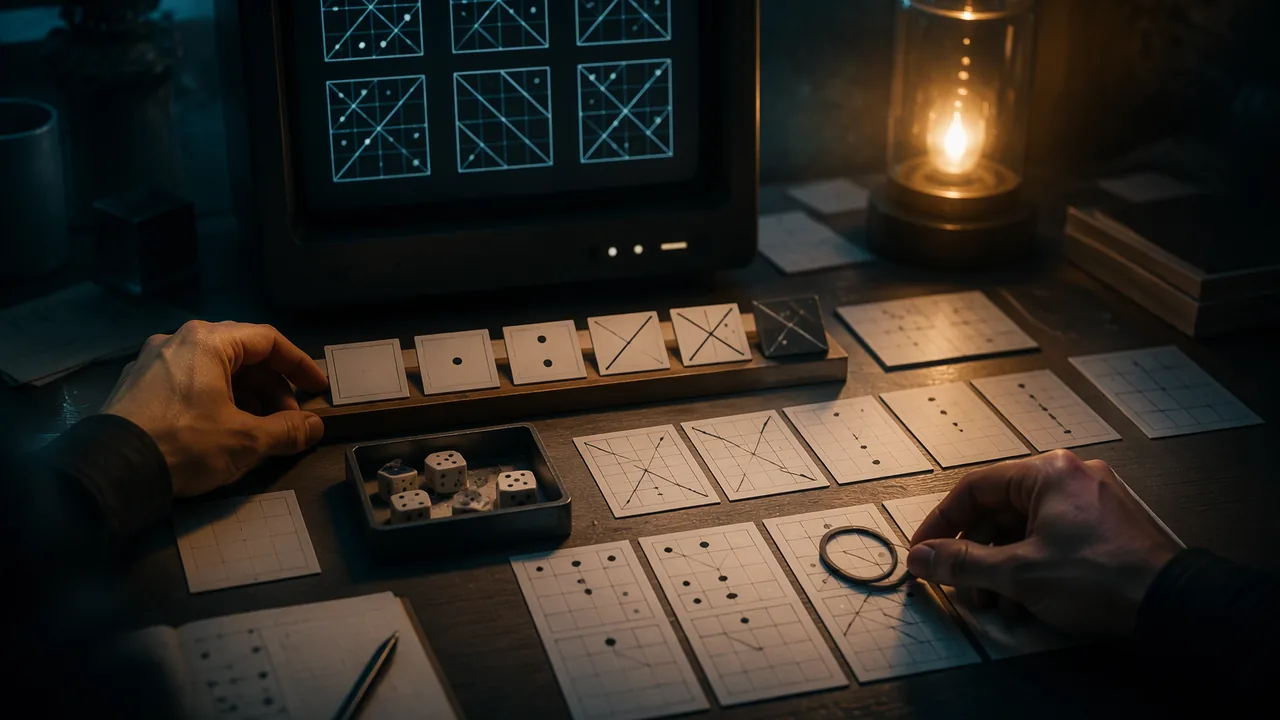
Rules, randomness, selection. A generative artwork usually has three human ingredients: the rules (what the program does), the randomness (where it is allowed to vary) and the selection (which outputs the artist keeps). The sketch in the activity below uses one of the simplest rules in computer art: in each square of a grid, draw one of two diagonal lines, chosen at random. A maze-like pattern appears that nobody drew line by line.
Three kinds of machine making. Compare three cases. (1) Your sketch: you wrote every rule and chose the settings; the computer only rolls dice inside limits you set. (2) A text-to-image model: you write a prompt, but the model — trained on other people’s images — determines most of how the picture looks. (3) A GAN portrait sold at auction: in 2018 Christie’s sold Portrait of Edmond de Belamy, made by the Paris collective Obvious with a generative adversarial network, for $432,500. It drew criticism in part because the collective had used code shared openly by another artist, Robbie Barrat. Who is the author in each case?
What U.S. law says. The U.S. Copyright Office registers only works of human authorship. In its 2025 report on copyrightability, the Office concluded that prompts alone do not give a person enough control over the output to make them its author, while human expression that is perceptible in the output, creative selection and arrangement, and modification of AI output can be protected. In 2023 it registered the graphic novel Zarya of the Dawn for its human-written text and the author’s selection and arrangement, but not for the individual images generated with Midjourney. In March 2025 a federal appeals court, in Thaler v. Perlmutter, upheld the rule that a work generated autonomously by a machine, with no human author, cannot be registered. These are summaries in our own words.
Applying the principle. The Office’s approach asks how much a human determined the expressive elements. That points to a spectrum: more control, more human authorship. Your rule-based sketch sits toward one end, a single prompt toward the other. Law is not the only lens, though; artists also argue about credit, skill and honesty, and those arguments do not always match the law.
Arguing fairly. This is a contested question. In your position statement, state each view in a form its holders would recognize before you answer it, and support claims with evidence from the cases.
📖 Read for this lesson
The reading opens over the lesson; close it to come back to exactly where you were. The checks below draw on it.
Formative check
Work through these before moving on. They are not graded — they tell you whether the standard below has landed yet.
Simulation & tools
A ten-line maze generator
Open the p5.js editor (no sign-in needed to run). Replace the starter code with this sketch and press play:
function setup() {
  createCanvas(400, 400);
  noLoop();
}
function draw() {
  background(255);
  stroke(0);
  strokeWeight(3);
  let s = 20;
  randomSeed(7);
  for (let y = 0; y < height; y += s) {
    for (let x = 0; x < width; x += s) {
      if (random() < 0.5) {
        line(x, y, x + s, y + s);
      } else {
        line(x + s, y, x, y + s);
      }
    }
  }
}
Change one thing at a time and record each result: (1) the seed (7) to three other numbers; (2) the probability 0.5 to 0.8 and then 0.2; (3) the square size s to 10 and 40. Record which setting changes the rhythm most and which only changes the details. Answer: which parts of the finished image did you decide, and which did the random numbers decide? No computer? Make the same pattern on graph paper, flipping a coin for each square (heads = one diagonal, tails = the other) for a 10 × 10 grid.
Open p5.js Web Editor ↗ · p5.js Web Editor, Processing Foundation · LGPL-2.1 open source
According to the U.S. Copyright Office’s 2025 report, which is most likely to be protected?
In Thaler v. Perlmutter (2025), a federal appeals court held that a work generated autonomously by a machine with no human author cannot be registered for copyright.
Position statement (200-250 words): Who is the author of your maze pattern, of a single-prompt AI image, and of Portrait of Edmond de Belamy? Place each on a spectrum of human control, use at least one Copyright Office or court source as evidence, state the strongest opposing view fairly, and say where law and artistic credit might disagree.
How confident are you that you can explain how authorship works for rule-based and AI-generated images, legally and ethically?
Rules, Randomness and Authorship: A Paper Generator, LeWitt’s Instructions, and the U.S. Legal Sources Quoted
88 Fed. Reg. 16190 (Mar. 16, 2023); Copyright and Artificial Intelligence, Part 2: Copyrightability (Jan. 29, 2025); Thaler v. Perlmutter, No. 23-5233 (D.C. Cir. Mar. 18, 2025); Art Institute of Chicago 2023.3257 and 2006.166; LeWitt, Artforum 5:10 (1967) · SLS original (paper generator, table and model statement), with public-domain U.S. government and court text; LeWitt’s two sentences and two record titles quoted briefly
Why this reading. The lab asks you to change a generator’s settings, say what the random numbers decided, place three cases on a spectrum of human control, use “at least one Copyright Office or court source as evidence” and state the opposing view fairly. It supplies the sketch but not the sources, and if you have no computer it points you to a coin. This reading gives you: a generator you can run by hand with the results printed so you can check yourself; the legal sources, quoted exactly; the record of Sol LeWitt’s instruction-based art; the facts of the third case; and a model position statement. Legal documents were read on 26 September 2026.
1. The generator on paper (SLS original)
Instead of coins, use one six-sided die and 64 rolls in an 8 × 8 grid. Rolls, read across:
ROLLS
3 2 4 6 1 1 5 1
3 5 1 5 2 1 1 4
4 1 2 1 5 4 1 5
1 2 6 6 5 1 5 5
4 1 2 1 5 2 3 4
2 5 1 5 3 5 6 2
1 5 5 6 2 3 1 5
6 1 5 1 5 2 4 6
Rule A (like probability 0.5): roll 1–3 draws a /, roll 4–6 draws a . Rule B (about 0.83): roll 1–5 draws /, roll 6 draws . Rule C (about 0.17): only a roll of 1 draws /. The same dice, three rules, gave these grids (these rolls were made by a computer with seed 7 for this page; they are not the p5.js sketch’s random numbers, so your p5.js pattern will differ):
RULE A (33 of 64 cells are /)
/ /   / /  /
/  /  / / /
 / / /   /
/ /    /
 / / /  / /
/  /  /   /
/    / / /
 /  /  /

RULE B (57 of 64 cells are /)
/ / /  / / / /
/ / / / / / / /
/ / / / / / / /
/ /   / / / /
/ / / / / / / /
/ / / / / /  /
/ / /  / / / /
 / / / / / /

RULE C (18 of 64 cells are /)
    / /  /
  /   / /
 /  /   /
/     /
 /  /
  /
/      /
 /  /
What to notice. Rule A gives short diagonal runs and small diamonds and boxes. Rule B and Rule C give an almost uniform field of one diagonal, so the rhythm becomes regular and the few exceptions stand out (in Rule B, look at the bottom left and right corners). The rule (which side of the die counts) changed the rhythm more than any single roll did. The cell size changes only the scale. Who decided what: you decided the rule, the grid and which output to keep. The dice decided each cell. Answer the lab’s question with numbers: under Rule A the dice decided all 64 cells, but only between the two choices you allowed; you decided how many diagonals were possible, how likely each was and which grid to keep.
2. Rules written by artists
Sol LeWitt (American, 1928–2007) wrote in 1967: “When an artist uses a conceptual form of art, it means that all of the planning and decisions are made beforehand and the execution is a perfunctory affair. The idea becomes a machine that makes the art.” (“Paragraphs on Conceptual Art”, Artforum 5, no. 10, 1967; two sentences quoted; text © the LeWitt Estate.)
The Art Institute of Chicago holds Wall Drawing #118: 50 randomly placed points connected by straight lines (1971, black pencil, dimensions variable, accession 2023.3257; © The LeWitt Estate). Its record shows that in December 1971 the work was drawn at the School of the Museum of Fine Arts, Boston, by five named people who were not LeWitt. It also holds Wall Drawing #274: The location of six geometric figures (the specific locations are determined by the draftsman) (1975, black pencil and crayon, 243.9 × 609.6 cm, accession 2006.166). Its exhibition history says the first drawing, in Copenhagen in 1975, was made by LeWitt and one other named person. In both, the artist wrote the rule and other people made the marks; the title of #274 says outright that the maker of the marks decides part of it. Ask what that says about who the author is.
3. What U.S. law says (public-domain government documents, quoted)
Registration guidance, U.S. Copyright Office, 88 Federal Register 16190 (16 March 2023). “When an AI technology receives solely a prompt from a human and produces complex written, visual, or musical works in response, the ‘traditional elements of authorship’ are determined and executed by the technology—not the human user.” It adds that “what matters is the extent to which the human had creative control over the work’s expression.” It also reports that in February 2023 the Office concluded that a graphic novel of human-authored text combined with Midjourney images was a copyrightable work, “but that the individual images themselves could not be protected.”
Copyright and Artificial Intelligence, Part 2: Copyrightability, U.S. Copyright Office (29 January 2025). “The Office concludes that, given current generally available technology, prompts alone do not provide sufficient human control to make users of an AI system the authors of the output.” And: “Human authors are entitled to copyright in their works of authorship that are perceptible in AI-generated outputs, as well as the creative selection, coordination, or arrangement of material in the outputs, or creative modifications of the outputs.”
Thaler v. Perlmutter, No. 23-5233, U.S. Court of Appeals for the D.C. Circuit (argued 19 September 2024; decided 18 March 2025). A machine, Thaler’s “Creativity Machine”, was named as the sole author of an image and registration was refused. The court held: “Because many of the Copyright Act’s provisions make sense only if an author is a human being, the best reading of the Copyright Act is that human authorship is required for registration.”
4. The third case: a portrait sold at auction
Reported facts (CNBC, 25 October 2018, and other news reports; SLS paraphrase): Portrait of Edmond de Belamy, made by the Paris collective Obvious using a generative adversarial network, sold at Christie’s in New York for $432,500. Its estimate had been $7,000 to $10,000. Robbie Barrat, a young artist and programmer, had published his network code online under an open-source license, and asked publicly whether Obvious had used it and sold the results. Answer for yourself where the rule, the randomness and the selection each came from.
Placing cases on the spectrum
| Case | Rules | Randomness | Selection and arrangement | Human control |
|---|---|---|---|---|
| Your dice pattern | You | Dice, inside your limits | You choose the output | High |
| LeWitt wall drawing | Artist | Small; the draftsman decides some marks | Artist chooses the instruction | High over concept, shared over execution |
| Single-prompt image | The model’s makers | The model | You choose from outputs | Low, per the 2025 report |
| GAN portrait | Shared code and training data | The network | The collective chose and printed | Contested |
A model position statement (SLS original, about 230 words)
“Case: a single-prompt AI image. I place it near the low end of human control. The prompt names a subject and a mood, but the model decides the arrangement, the lighting and every brushstroke-like detail. The Copyright Office’s 2025 report concludes that ‘prompts alone do not provide sufficient human control to make users of an AI system the authors of the output’, so under U.S. law the prompt writer is not the author of that image. That does not mean the person did nothing. If I choose among sixty outputs, redraw the composition by hand, and lay the result out with my own text, the same report says protection can reach my ‘creative selection, coordination, or arrangement’ and my modifications. The strongest opposing view is Thaler’s: that a machine can be an author and its owner can hold the rights. The D.C. Circuit answered that the statute ‘make[s] sense only if an author is a human being’. I think the law and artistic credit can disagree. A viewer may feel a prompt-writer deserves credit for an idea, and the law gives that no protection. So in my own work I will credit the tool, the prompt and the date, and I will claim only what my hands made.”
Check your own against it: it places the case on the spectrum with a reason, quotes a source exactly, states the opposing view in a form its holder would recognize, and says where law and credit differ.
Sources: U.S. Copyright Office, Copyright Registration Guidance: Works Containing Material Generated by AI, 88 Fed. Reg. 16190 (govinfo.gov); U.S. Copyright Office, Copyright and Artificial Intelligence, Part 2: Copyrightability (copyright.gov); Thaler v. Perlmutter, No. 23-5233 (D.C. Cir. 2025) (media.cadc.uscourts.gov); Art Institute of Chicago, Wall Drawing #118 (2023.3257) (artic.edu); Art Institute of Chicago, Wall Drawing #274 (2006.166) (artic.edu); CNBC, Portrait made by artificial intelligence sold for $432K at Christie’s (25 Oct 2018) (cnbc.com)