analyze how artists who work with machine learning describe the human part of their process, assess their impact on how people think about AI and art, and identify what makes an artist statement effective.
Instruction
Artists explain their work in statements, interviews and talks. A good statement does not tell you what to feel; it tells you what the artist did and why, so you can look, or touch, more closely. This lesson studies how artists who work with machines describe their practice, and uses them as models for your own statement.
Rules written by the artist. Harold Cohen (1928-2016) spent more than four decades developing AARON, a drawing program whose rules he wrote himself. He described the project as a way of understanding what drawing is: to teach a machine to draw, he had to make explicit what artists do without thinking. His work is often cited as one of the earliest sustained collaborations between an artist and an autonomous program.
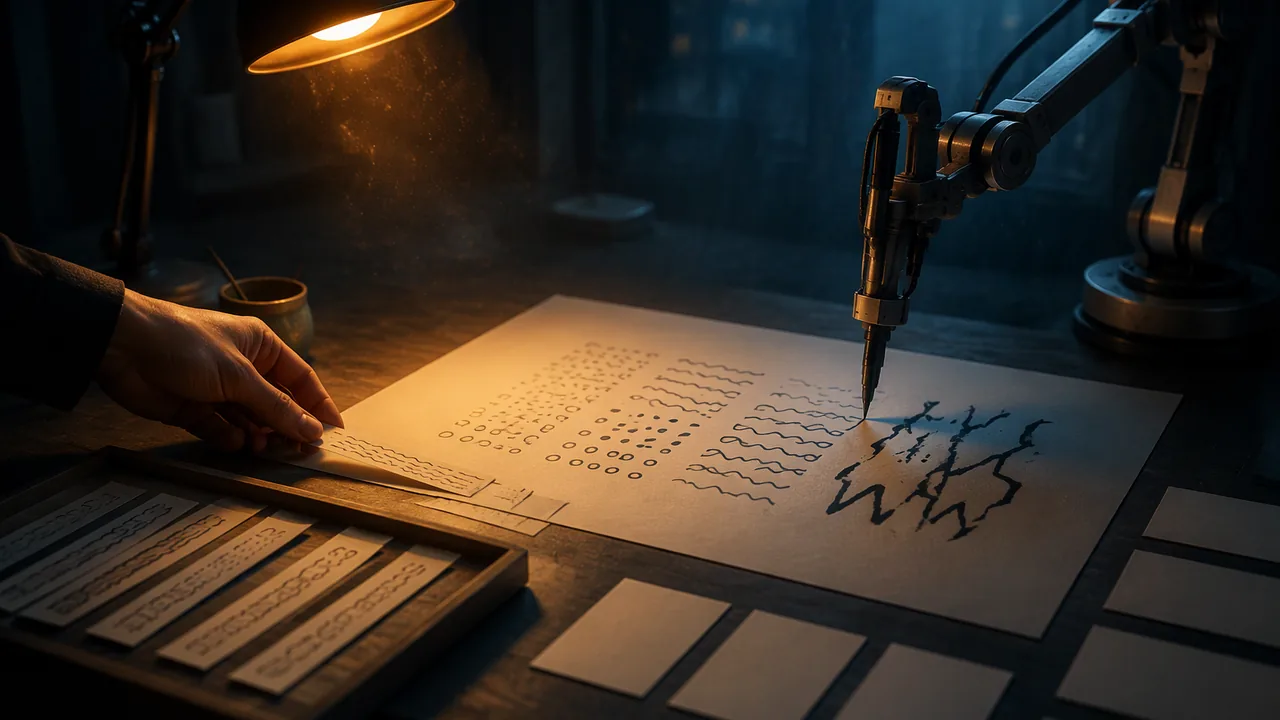
Training on your own work. Several living artists answer the consent problem by training models on material they made or gathered themselves. We describe their work rather than showing it. Sougwen Chung draws on large surfaces alongside robotic arms she has built, some of them driven by systems trained on her own drawing gestures; the performances make the collaboration, and its failures, visible. Anna Ridler photographed and hand-labeled thousands of tulips to build her own training dataset for a work about tulips, speculation and value, making the invisible labor of labeling part of the art. Refik Anadol makes very large projected installations generated from data sets; his 2022-23 work Unsupervised at the Museum of Modern Art was generated from data about the museum’s own collection. Critics have praised such works for their spectacle and questioned what they say beyond it — a debate worth having.
Also worth watching. Museums publish recorded talks in which artists explain how they use and confront machine learning. If you watch one, notice which artists describe the machine as a tool, which as a collaborator and which as a subject to critique.
Assessing impact. The Advanced standard for this lesson asks you to assess the impact of an artist or group of artists on a society’s beliefs, values and behavior. Ask: Did the work change how people think about AI — as creative, as threatening, as a mirror of data? Did it change practice, such as artists building their own datasets? Evidence might be exhibitions, debates, imitators or policy responses.
What makes a statement work. Effective statements share features: they begin with the work, not the artist’s feelings in general; they explain process and materials concretely; they name the idea or question the work explores; they are honest about sources and tools; and they are short — 100-200 words for a label. Weak statements use vague claims (“explores the human condition”), describe intentions the work does not show, or hide the process. For tactile work, a good statement also tells the reader how to approach the piece with their hands.
Your draft. Write a 150-word statement for the work you plan to exhibit. You will revise it after the critique.
📖 Read for this lesson
The reading opens over the lesson; close it to come back to exactly where you were. The checks below draw on it.
Formative check
Work through these before moving on. They are not graded — they tell you whether the standard below has landed yet.
How does Anna Ridler’s tulip work, as described in the lesson, respond to the problem of training data?
An effective artist statement tells the audience exactly what they should feel.
Compare two of the artists in the lesson: what is the human part of each practice, and what has each work’s impact been on how people think about AI and art? Then draft a 150-word artist statement for the work you plan to exhibit, including how a reader should approach it by touch.
How confident are you that you can assess an artist’s practice and impact and write an effective statement?
How Artists Talk About Their Work: Four Practices as Dated Facts, an Impact-Evidence Table and Three Model Statements
Computer History Museum, Harold Cohen and AARON: A 40-Year Collaboration (2016); Whitney, Harold Cohen: AARON (2024); NTT ICC, Drawing Operations Unit: Generation 2 (Memory) (2017); annaridler.com, Myriad (Tulips) and Mosaic Virus 2018; MoMA, Refik Anadol: Unsupervised (2022-23); all retrieved 26 September 2026 · SLS original (analysis, table and model statements), with brief credited quotations from copyrighted sources (two sentences from Cohen via the Computer History Museum and Ridler) and facts from public pages
Why this reading. The task asks you to compare two artists, name the human part of each practice and assess each one’s impact on how people think about AI and art, then write a 150-word statement. The lesson describes four artists in a paragraph each; it does not give you dated, checkable facts to build an assessment on, or any models of a statement to compare yours with. This reading gives both. Facts were checked on 26 September 2026 against the museum, artist and institution pages named; brief quotations are credited and are the artists’ and institutions’ own words (copyright held by them). The three model statements are SLS original and invented, and are not attributed to any real artist.
Four practices, as facts
Harold Cohen (1928–2016) and AARON. Cohen, a painter, began in the late 1960s to ask how artists process information and what makes marks work as an image. The Computer History Museum (Chris Garcia, 23 August 2016) lists among his questions: “What are the minimum conditions under which a set of marks functions as an image?” He worked with AARON, a program whose rules he wrote, from 1973 onward. The Whitney Museum of American Art exhibited Harold Cohen: AARON from 3 February to 19 May 2024, showing screen-based versions of the program and plotters operating live in the gallery. The human part: Cohen wrote every rule and served, in his own phrase quoted by the museum, as both knowledge engineer and resident expert.
Sougwen Chung and Drawing Operations Unit. Chung draws with a robotic arm at the same time as the arm draws. The NTT InterCommunication Center (Tokyo) records that in Generation 2 (Memory), 2017, the arm’s movements reflect a machine-learning process that memorizes the artist’s own drawing behavior, where in Generation 1 the arm imitated her hand in real time. The same text presents the project as an inquiry into collaboration between humans and machines and sets collaboration against the view of human and machine as opposing elements. The human part: her gestures are the training data, and she draws alongside the result.
Anna Ridler and Myriad (Tulips), 2018. Ridler’s own site describes an installation of thousands of hand-labeled photographs of tulips, later used as the dataset for Mosaic Virus (2018, 2019), a GAN-generated video in which the tulips’ colors, shapes and movements shift with the price of Bitcoin. In her words: “The process of making datasets is almost like craft – repetitive, time-consuming, often unauthored, but necessary in order to produce something beautiful.” The human part: she took, selected and labeled every photograph, and the collection stopped when the tulip season ended, not at a chosen number.
Refik Anadol and Unsupervised. MoMA presented Refik Anadol: Unsupervised from 19 November 2022 to 29 October 2023; the museum says Anadol used AI to interpret and transform more than 200 years of art at MoMA, training a model on publicly available data from MoMA’s collection. The work is also listed in MoMA’s collection. The human part: the choice of data, model and installation; how much of the resulting imagery he controlled is a question this reading does not answer, and your assessment should say so.
How to assess impact (with what you can point to)
| Kind of evidence | Examples from the facts above | What it can and cannot show |
|---|---|---|
| Institutions | A Whitney exhibition of AARON (2024); MoMA showing Unsupervised for eleven months | That major museums treated the work as art. It does not show what the public came to believe. |
| Changed practice | Ridler makes her dataset the artwork; Chung trains the arm on her own gestures | A different answer to who owns the training material. It does not show that others followed. |
| Debate | The lesson notes critics praise the spectacle of such work and ask what it says beyond it | That the work provoked an argument. The strength of the argument needs its own source. |
A careful assessment names its evidence type, says what it shows, and says what it does not.
Three model statements (SLS original, invented)
Weak. “Threads of Memory explores the human condition and the connection between technology and nature. I hope viewers will feel a sense of wonder.” Problems: it begins with the artist’s feelings in general, not the work; “explores the human condition” is vague; nothing on process or materials; nothing on AI; nothing on how to touch it.
Strong (about 145 words). “Three Arches, 32 × 40 cm, air-dry clay on a card and foil armature. Three arches grow from 6 to 8 to 11 cm; a smooth panel at the left gives a hand a flat place to compare against. I began from an AI-generated greenhouse image (tool and prompt on the label, 12 March) and kept only the arches and the broken-pane rhythm, discarding its centered symmetry. The question I was asking was whether a rhythm that speeds up can be read with the fingers alone; my first blind touch test said no, so I made the last arch taller. To read it, start at the smooth panel with flat fingers and move slowly right; press lightly on the ridged arch. The clay is sealed, but please do not scratch it. Made by me; the composition, scale, materials and making are my own.”
What makes the strong one work: it starts with the work (size, material), says a concrete process, names the question, is honest about the AI source and what was and was not taken, and tells the reader how to approach it by hand. It has 145 words, inside the 100–200 for a label.
Your draft
Write 150 words for the work you plan to exhibit: the work first; process and material; the question; the AI disclosure (tool, prompt, date, what you took); how to approach it by touch. Compare it with the strong model on each of those five features.
Sources: Computer History Museum, Harold Cohen and AARON: A 40-Year Collaboration (Chris Garcia, 2016) (computerhistory.org); Whitney Museum of American Art, Harold Cohen: AARON (whitney.org); NTT InterCommunication Center, Drawing Operations Unit: Generation 2 (Memory), Sougwen Chung (ntticc.or.jp); Anna Ridler, Myriad (Tulips) (2018) (annaridler.com); Anna Ridler, Mosaic Virus 2018 (annaridler.com); MoMA, Refik Anadol: Unsupervised (moma.org)