identify types of balance, rhythm, proportion and spatial arrangement in five works of relief, sculpture and print, and use contextual information to interpret why each maker composed as they did.
Instruction
Last semester you learned to make surfaces a hand can read. This semester asks how the parts of a work are arranged: its composition. In three dimensions composition is harder and richer than on paper, because the viewer moves, and a hand meets the work one part at a time.
Balance. Symmetrical balance mirrors the two halves; it feels stable and formal. Asymmetrical balance sets unequal parts against each other so they still feel settled — a large, plain area against a small, busy one. Radial balance spreads from a center, like a flower. In sculpture there is also actual balance: the work must physically stand.
Rhythm. Rhythm is repetition with a pattern: regular (the same element at equal intervals), alternating (two elements in turn), progressive (an element that grows or shrinks step by step) and flowing (curving repetition that carries the eye or hand along).
Proportion and scale. Proportion is the size relationship of parts to each other and to the whole; scale is size relative to us. A small object held in the hand and a life-size figure ask for different compositions.
Spatial arrangement. Where forms sit in space, how they overlap in depth, how much empty (negative) space surrounds them, and from how many viewpoints the work can be read.
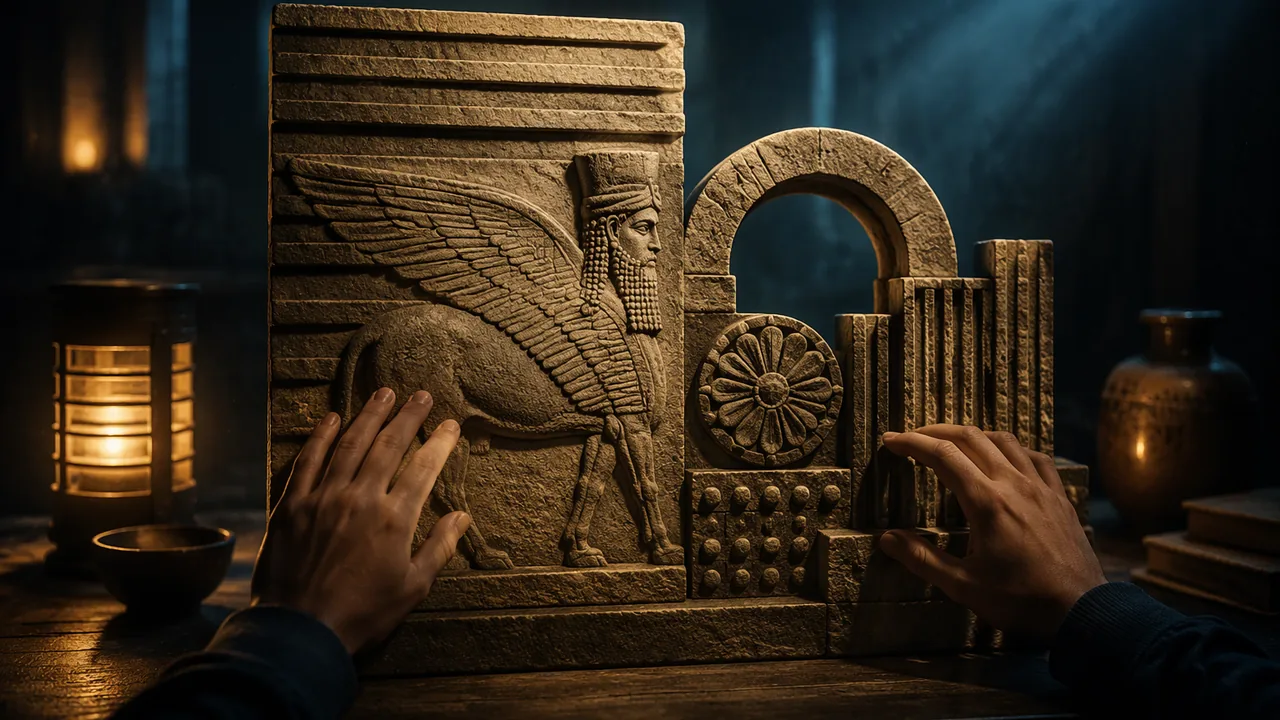
Five works. The Saluting Protective Spirit (883-859 BCE, Cleveland Museum of Art) is one of hundreds of gypsum reliefs from the palace of the Assyrian king Ashurnasirpal II at Nimrud. The winged figure strides forward in profile, and an inscription about the king’s conquests runs in horizontal lines straight across the carving — a regular rhythm of text laid over the figure. Hundreds of similar reliefs lined the palace, so the rhythm worked at the scale of architecture.
A sister relief in Missouri. Another relief from the same palace is in Kansas City. The Nelson-Atkins Museum of Art’s Winged Genie Fertilizing a Date Tree (884-860 BCE, about 232 × 181 cm and 454 kg) shows a winged figure tending a stylized date tree, a vital Assyrian crop, and the museum notes that its inscription, too, celebrates Ashurnasirpal II’s conquests. Its provenance record traces a journey to Missouri: from the palace to a British consul in Baghdad, who gave it to an American clergyman in Mosul, who in 1855 gave it to the St. Louis Mercantile Library; the museum bought it from the library in 1940. Put the two side by side and you see the palace’s rhythm at work: the same kind of figure, the same band of text, repeated wall after wall.
Auguste Rodin’s A Burgher of Calais (Jean d’Aire) (plaster, modeled 1889, Art Institute of Chicago) is one of six figures commemorating citizens who offered themselves as hostages to Edward III during the Hundred Years’ War. The figure’s weight sinks into planted feet; the heavy key he holds pulls the composition down. Balance here carries meaning: resolve under a terrible load.
Edmonia Lewis — a sculptor of Mississauga Ojibwe and African American ancestry who moved to Rome in 1866 — carved Indian Combat (1868, Cleveland Museum of Art). The museum describes it as a spiralling composition of three intertwined figures, her most dynamic and complex work. A spiral invites the viewer to walk around it; no single view shows everything.
Augustus Saint-Gaudens’s bronze relief portrait Robert Louis Stevenson (1887-88, cast 1910, The Metropolitan Museum of Art) is very low relief. Notice how much flat background he leaves and where he places the figure within it; in low relief, empty space is part of the design.
Finally, Hokusai’s Great Wave (1830-33, Art Institute of Chicago) is a model of asymmetrical balance: the huge wave on the left is answered by the tiny Mount Fuji low in the center, and the curling foam repeats in a flowing rhythm.
📖 Read for this lesson
The reading opens over the lesson; close it to come back to exactly where you were. The checks below draw on it.
Formative check
Work through these before moving on. They are not graded — they tell you whether the standard below has landed yet.
The Great Wave balances a huge wave on one side with a tiny mountain near the center. This is:
Regular rhythm
Tap to revealThe same element at equal intervals.
Alternating rhythm
Tap to revealTwo elements repeating in turn.
Progressive rhythm
Tap to revealAn element changing step by step, such as growing larger.
Flowing rhythm
Tap to revealCurving repetition that carries the eye or hand along.
Edmonia Lewis’s Indian Combat is composed so that a single front view shows everything important.
Choose two of the five works. For each, sketch the main compositional lines, name the type of balance and rhythm, describe the spatial arrangement, and use one piece of contextual information from the museum record to explain why the maker composed it this way.
How confident are you that you can analyze balance, rhythm and space in a three-dimensional work and connect it to context?
Five Works as Text, and a Sister Relief in Missouri: Records, Positions and What Makers Wrote (Assyrian Relief, Rodin, Lewis, Saint-Gaudens, Hokusai)
Cleveland Museum of Art Open Access API (accessions 1943.246, 2011.110); Art Institute of Chicago API (719, 24645); Met Collection API (12016); Rodin, Art, trans. Fedden, 1912 (Gutenberg #59799); The Nelson-Atkins Museum of Art collection record 40-17, Winged Genie Fertilizing a Date Tree (art.nelson-atkins.org/objects/24456), retrieved 9 November 2026 · SLS original (verbal descriptions and worked analysis), with CC0 museum record data, public-domain text (Rodin, 1912) and facts summarized from the Nelson-Atkins collection record
Why this reading. The open task asks you to sketch the main lines of two works, name their balance and rhythm, describe their spatial arrangement and use one fact from the museum record. You cannot touch any of the five through a lesson page, so this reading is the work as text: the museum record, a description of where things sit, and what people who knew the works wrote. Positions are estimated from the museum’s photograph, rounded to the nearest 5% and given as (% across from the left, % down from the top). They are SLS measurements, so treat them as ±5%. Every record below was checked against the museum’s open-access data on 26 September 2026.
The five records
| Work | Record | Size |
|---|---|---|
| 1. Saluting Protective Spirit | Neo-Assyrian, from the Northwest Palace of Ashurnasirpal II at Nimrud, 883–859 BCE. Gypsum. Cleveland Museum of Art, accession 1943.246. CC0. | 229.9 × 137 cm (about 1.7 : 1, upright) |
| 2. A Burgher of Calais (Jean d’Aire) | Auguste Rodin, French, 1840–1917. Modeled 1889. Plaster, painted to look like bronze. Art Institute of Chicago, 1893.187. Public domain. | 208.3 × 66 cm (about 3.2 : 1, very tall and narrow) |
| 3. Indian Combat | Edmonia Lewis, American, c. 1844–1907. 1868, signed on the base “EDMONIA LEWIS / FECIT A ROME 1868”. Marble. Cleveland Museum of Art, 2011.110. CC0. | 76.2 × 48.3 × 36.5 cm, on an oval base |
| 4. Robert Louis Stevenson | Augustus Saint-Gaudens, American, 1848–1907. 1887–88, cast 1910. Bronze. The Metropolitan Museum of Art, 12.76.1 (object 12016). Public domain. | One figure listed, 35 1/4 in. (89.5 cm), 116 lb. The photograph shows a circular bronze in a wide oak frame, so the figure most likely covers the whole framed object. Do not treat it as the bronze alone. |
| 5. Under the Wave off Kanagawa (“The Great Wave”) | Katsushika Hokusai, Japanese, 1760–1849, from Thirty-Six Views of Mount Fuji, 1830–33. Color woodblock print, publisher Nishimura-ya Yohachi. Art Institute of Chicago, 1925.3245. Public domain. | 25.4 × 37.6 cm (landscape, about 1 : 1.5) |
What each work looks like, in words
1. Saluting Protective Spirit. A single winged figure fills a tall slab of pale gypsum, carved in very low relief on a flat ground. He faces left in profile and strides left; both feet, in sandals, sit along the bottom edge at about (6–70%, 95%). His head is at about (45%, 12%), with a tiered beard and a headband of rosettes. His raised right hand is open at about (15%, 15%), on the left side. His lowered hand, at about (20%, 50%), holds a bundle of flowering branches whose tips reach the left edge. The wing rises from the shoulder to the top right corner and sweeps down the whole right third (65–100% across, from the top to about 78% down) as rows of parallel feathers. A band of small cuneiform lines runs the full width of the slab, roughly 45% to 65% down, straight across the body without regard for it. The slab is four stacked blocks with visible horizontal joins. Empty ground is small: a triangle behind the head and beyond the raised hand, and some at the lower right.
2. A Burgher of Calais (Jean d’Aire). One standing man, seen from the front, in a long heavy robe that falls from the shoulders to the base in deep vertical folds. His head, at the top (about 5–10% down), is small against the mass beneath it and tilted slightly down. His two clenched hands meet low, about 55–65% down, across a large key that runs sideways across the lower middle of the body. The widest parts of the figure are at the elbows and at the hem; the base is a rough, low block. There is a lot of empty space between the arms and the robe on both sides, and the silhouette changes as you walk round it. Rodin’s interviewer Paul Gsell describes one burgher of the group in these words: “Holding in his hand the key which he must deliver to the English, he stiffens his whole body in order to find the strength to bear the inevitable humiliation.” (Art, 1912, public domain). The museum notes that the statue belongs to a group of six who offered themselves as hostages to Edward III to end a siege of Calais that had been starving its inhabitants for nearly a year, and that this plaster was shown at the 1893 World’s Columbian Exposition in Chicago.
3. Indian Combat. Three figures interlock on an oval base. In the museum’s photograph, a standing man seen from behind is at the right; his head is at about (65%, 10%) and his weight is on one leg. To his upper left a second man with a feathered crest grips at the standing man’s arm; his head is highest, at about (15%, 5%). A third figure kneels at the lower left, head tipped back and looking up, about (15%, 60%). The three heads sit at three levels, and arms and bodies pass in front of and behind one another, so no single view shows all three faces. The museum calls it “a spiraling composition with three intertwined figures” and says it “ranks as Edmonia Lewis’s most dynamic and complex creation”. It also says this example appears to be unique, although her Native American subjects typically exist in multiple versions, and that Lewis, of Mississauga and African American ancestry, studied at Oberlin College and moved to Rome in 1866.
4. Robert Louis Stevenson. A circular field of dark bronze, set in a carved oak frame. Inside it the writer sits propped up in bed, in profile and facing left, with one raised hand holding a pen. His head is at about (65%, 30%), at the upper right of the circle. A diagonal runs from the head down through the shoulders and bent body to the knees and the papers on his lap at the lower left. Behind him at the right edge is the bolster. The relief is low, so the figure stands out only a little from the ground, and the left and bottom of the circle are left as smooth, almost empty background. Lines of inscribed text curve in the upper left, about (20–55%, 5–30%), across the space above the pen.
5. The Great Wave. The tall wave rises at the left to a peak at about (30%, 10%), then curls right and forward; its foam breaks into claw-like fingers that hang at about (55%, 30%). The wave fills the left half of the print from top to bottom. A second, lower wave climbs from lower center to the right edge at about (100%, 45%). Mount Fuji is small and white, at about (65%, 70%), just beyond the tip of the curl, and the upper right is open sky, close to 40% of the picture. At least two long narrow boats with rowers are pressed low into the troughs, one under the big wave at about (15%, 65%) and one at the lower right. The title label sits in the top left corner. The museum notes the artist’s wide use of the new, affordable Berlin blue pigment and that its three impressions of this design are all later than the first state.
A sister relief in Missouri
Winged Genie Fertilizing a Date Tree, Assyrian, from the Palace of Ashurnasirpal II at Nimrud (Room L), 884–860 BCE. Limestone (the museum’s description of the stone). 231.78 × 180.98 cm, 453.6 kg. The Nelson-Atkins Museum of Art, Kansas City, object number 40-17; on view (checked 9 November 2026). Museum text, in summary: a winged jinni, or genie, fertilizes a stylized date tree, a vital crop in Assyria; the figure’s exaggerated muscles symbolize strength; an inscription celebrates Ashurnasirpal’s conquests under divine favor. Provenance (museum record): Sir Henry Creswicke Rawlinson, Consul-General in Baghdad, by 1855; his gift to the Reverend Dwight Whitney Marsh in Mosul; Marsh’s gift to the St. Louis Mercantile Library on 23 July 1855; purchased from the library by the Nelson-Atkins in 1940.
Compare with Work 1. The Kansas City slab is wider (about 1.3 : 1, against 1.7 : 1 for Cleveland’s), because it holds a tree as well as a figure, but it shares the palace’s system: a single winged figure in profile, low relief on a flat ground, and the same horizontal inscription band carved across the image. Seen together, the two show the regular rhythm the museum describes for Work 1, in which one slab “once stood alongside hundreds of similar ones”, at the scale of a building, and they show it in two Midwestern museums a long way from Nimrud.
What a maker wrote
Rodin said he learned his method from a man named Constant, who worked in the studio where Rodin began as a sculptor. Watching Rodin model a leaf, Constant told him: “Henceforth, when you carve, never see the form in length, but always in thickness.” Constant added that he should treat a surface as “the extremity of a volume” (Art, 1912, Project Gutenberg #59799, public domain). Use it as a test: for any of the five, where is the surface the extremity of a volume, and where is it flat on purpose?
A worked analysis, so you can see the standard (SLS original)
Work 1. Balance: asymmetrical. The wing is a large dark mass on the right third; the raised hand, head and branches carry the left. The weight of the two sides is not equal, but they settle because the figure is one continuous body. Rhythm: regular, twice over. The feathers repeat as parallel rows, and the inscription repeats line after line across the middle. The inscription is a horizontal rhythm laid across the vertical figure. Space: almost no negative space. The figure fills the height, the relief is shallow and every part is nearly the same distance from the wall, so the work is read from one front position. Context: the museum says the slab “once stood alongside hundreds of similar ones” in the palace, and its inscription records the king’s conquests. That explains the composition: a repeated, upright, unhurried guardian figure meant to be walked past, with the king’s titles carved across it. Sketch: draw a 5 cm × 8.5 cm upright rectangle. Put the head at (45%, 12%), the wing as a diagonal wedge on the right, the hand and branches at the left, and a band across the middle.
Your task from this reading
- Choose two works other than Work 1, or Work 1 if you go further than the example.
- Draw the frame at the size ratio above and place the main lines from the position estimates.
- Name the balance (symmetrical, asymmetrical, radial or actual) and the rhythm (regular, alternating, progressive, flowing), each with the evidence from the description.
- Describe the spatial arrangement: depth, overlap, negative space and how many viewpoints work.
- Use one fact from the record, such as the size, medium, inscription, museum note or provenance, to explain why the maker composed it that way.
Sources: Cleveland Museum of Art, Saluting Protective Spirit, 1943.246 (CC0) (clevelandart.org); Cleveland Museum of Art, Indian Combat, 2011.110 (CC0) (clevelandart.org); Art Institute of Chicago, A Burgher of Calais (Jean d’Aire), 1893.187 (artic.edu); The Metropolitan Museum of Art, Robert Louis Stevenson, 12.76.1 (metmuseum.org); Art Institute of Chicago, Under the Wave off Kanagawa, 1925.3245 (artic.edu); Auguste Rodin, Art (1912), Project Gutenberg #59799 (gutenberg.org); The Nelson-Atkins Museum of Art, Winged Genie Fertilizing a Date Tree, 40-17 (art.nelson-atkins.org)