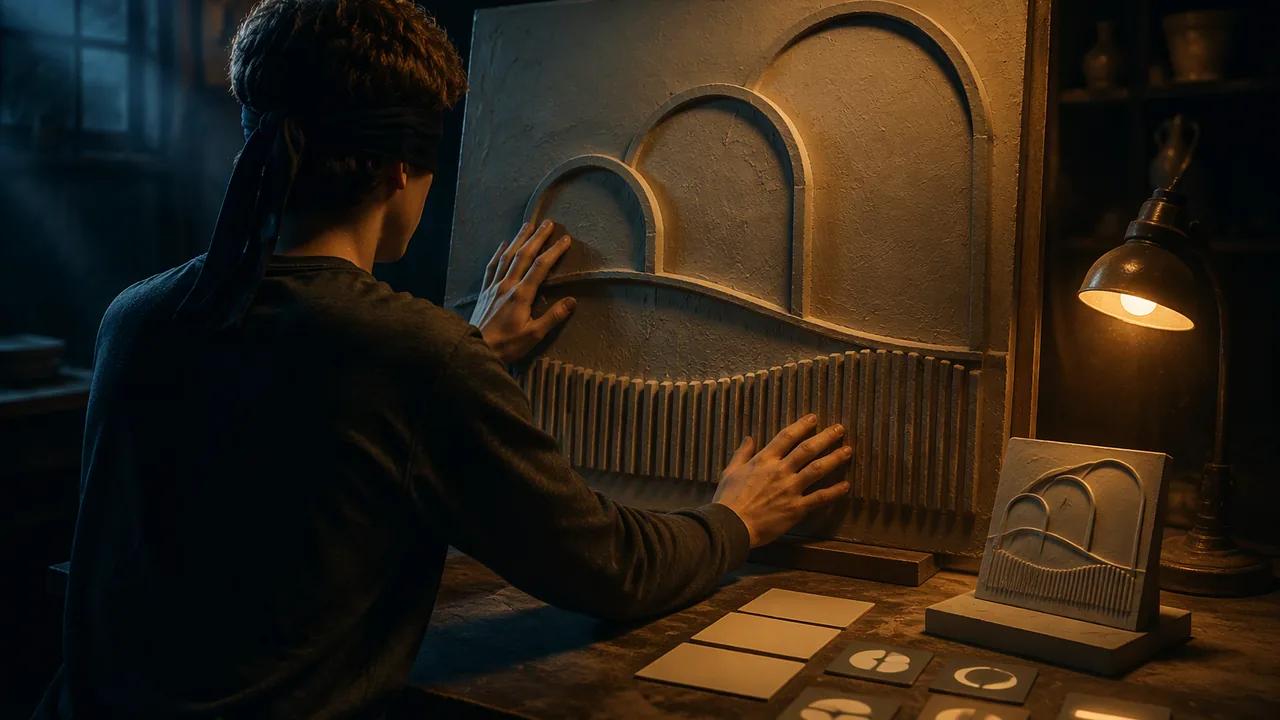
create, revise and defend a tactile artwork that deliberately uses balance, rhythm and spatial arrangement, inspired by an AI-generated image.
Instruction
This task is this course’s representative assignment for composition: a tactile artwork that incorporates balance, rhythm and spatial arrangement, inspired by an AI-generated image. You may work in relief or in the round, in any medium you used last semester or in this unit.
Building from the maquette. Enlarge by your scale factor. Use a proportional grid for a relief (draw a grid over the maquette photo and a larger grid on the base) or calipers and a ruler for a form in the round, measuring key points and multiplying. Build hollow or over an armature if your calculation showed a solid form would be too heavy.
Keeping composition in charge. Texture is seductive; it is easy to spend all your time on surfaces and lose the composition. Check your balance line, rhythm path and emphasis at the end of every session, looking and touching from each planned viewpoint.
Critique by principle and touch test. At the halfway point, put the work away for at least a day. Then critique it by principle (Lesson 1.3), using the rubric in the image-cards reading. Next, read it by touch without seeing it: close your eyes or wear a blindfold, and turn the work, or have it handed to you, so you do not know which side you start from. If a family member or another adult is willing, ask them to do the touch test too, without telling them what to look for. Ask: where did the hand go first? What repeated? Did any part feel crowded or empty? Write down the words exactly.
Revision. Make at least two compositional revisions — changes to arrangement, not only to surface — and document each with before and after photos. For example: the touch test found the three repeated arches but lost the progressive rhythm because the last two were the same size; you enlarge the final arch and open more negative space around it, and a second touch test finds the build-up.
Statement. In 300-400 words: credit the AI source image (tool, prompt, date); describe the source’s composition and its habits; explain your composition — balance, rhythm, spatial arrangement and emphasis — and how it departs from the source; describe the two revisions; and say how the composition serves what the work expresses.
Documentation and defense. Photograph the work from at least three viewpoints (or front and raking light for a relief). In a recording of about two minutes (a phone video is fine), defend one compositional decision and answer one question a viewer would be likely to ask.
📖 Read for this lesson
The reading opens over the lesson; close it to come back to exactly where you were. The checks below draw on it.
Formative check
Work through these before moving on. They are not graded — they tell you whether the standard below has landed yet.
Record your critique by principle and the touch test (your own after a day away, and a family member’s if you had one). Upload before-and-after photos of two compositional revisions, with one sentence explaining each.
Adding more texture to a crowded area is a compositional revision.
How confident are you that you can build a tactile work whose composition I planned, tested and can defend?
Submit: Balance, Rhythm and Space — finished work, statement (300-400 words) and defense
Task: Create a tactile artwork, in relief (at least 25 × 30 cm) or in the round (at least 20 cm in its largest dimension), inspired by an AI-generated image from the course’s image cards (or one you have a parent’s permission to generate), that deliberately uses balance, rhythm and spatial arrangement. Plan with thumbnails and a scaled maquette.
Submission workflow
- Stage 1 — Plan. Viewpoint thumbnails, maquette photos, scaling calculation and the composition plan from Lesson 1.4.
- Stage 2 — Critiqued work in progress. Your critique by principle, written after a day away, and a blind touch test (yours, or a family member’s), with a revision plan.
- Stage 3 — Final work and statement. Finished work photographed from three viewpoints, before-and-after photos of two compositional revisions, and a 300-400 word statement.
- Stage 4 — Defense. About two minutes defending one compositional decision, recorded.
How it is scored
| Criterion | What proficient looks like |
|---|---|
| Balance, rhythm and spatial arrangement (VA:Cr2A.II) | Principles are used deliberately and work from every planned viewpoint or by touch. |
| Planning and scaling (VA:Cr1B.II) | Thumbnails and maquette test the composition; scaling is correct. |
| Interpretation of the source (VA:Cn10A.II) | Departs from the AI image’s compositional habits with a clear reason. |
| Revision (VA:Cr3A.II) | At least two compositional revisions respond to critique. |
| Critique response (VA:Re9A.I) | Feedback is recorded and weighed against stated criteria. |
| Presentation and defense (VA:Pr4A.II) | Documentation from multiple viewpoints; statement and defense explain the composition with evidence. |
Portfolio Task 5: The Full Brief, Criteria at Four Levels, an Exemplar Entry and the Review Sheet
SLS original brief; the exemplar is invented and illustrative and is not attributed to any student or person · SLS original (constructed teaching material, illustrative)
Why this reading. This is the complete brief for Portfolio Task 5: the assignment, the criteria at four levels, an exemplar entry and the review sheet. Everything you need is here; you complete the task on your own, with a family member as an optional test reader. The exemplar is SLS original and invented, written to show a standard; it is not real student work and it is not attributed to any person.
The assignment
Make a tactile artwork, in relief at least 25 × 30 cm or in the round at least 20 cm in its largest dimension, that deliberately uses balance, rhythm and spatial arrangement. Your source is an AI-generated image: yours, or one of Cards A–D in the machine-image cards reading. Plan with three thumbnails and a scaled maquette (Lesson 1.4). At the halfway point, after at least a day away, critique the work by principle yourself and do a blind touch test (yours, or a willing family member’s), make at least two compositional revisions, and photograph the work from at least three viewpoints (for a relief, front and raking light). Write a 300–400 word statement and give a two-minute defense.
Criteria at four levels
| Criterion | 4 Exemplary | 3 Secure | 2 Developing | 1 Beginning |
|---|---|---|---|---|
| Balance, rhythm and space | Chosen deliberately; the work holds from every planned viewpoint and by touch | Clear; one weak view | Present but accidental | Not evident |
| Planning and scaling | Thumbnails marked; correct k, k2, k3 | One small error | Plan without numbers | No plan |
| Source interpretation | A named habit of the source is departed from, with a reason | Departs, thin reason | Copies the layout | Source unclear |
| Revision | Two or more changes to arrangement, shown before and after | Two changes, one surface only | One | None |
| Critique response | Recorded and weighed against stated criteria | Recorded, some weighing | Recorded only | Missing |
| Defense | Answers one question directly with evidence | Answers, thin evidence | Describes the work | Absent |
Exemplar entry (SLS original, invented)
Work: Three Arches, relief, 32 × 40 cm, air-dry clay skin on card and foil. Source: Card C, greenhouse at dawn (SLS illustrative card; prompt as printed there).
Statement (about 360 words). “Three Arches began as an image of a greenhouse at dawn. I used Card C, described in the course readings as six iron arches marching toward a central vanishing point at equal steps, with one broken pane in five. Its habits are centered symmetry, even spacing and an even light, which make a calm room with nothing to find. I wanted a hand to discover something. So I kept only the arches and the broken panes, and threw away the center. My relief has three arches at the right third, growing from 6 cm to 8 cm to 11 cm. The balance is asymmetrical: the tall arch on the right is answered by a wide, empty smooth panel on the left. The rhythm is progressive, since each arch is taller than the last, and a hand traveling left to right feels the build-up. Space is shallow at the left, where I left about a third of the base smooth, and deeper at the right, where the tall arch rises 3 cm from the base.
“I planned the work with a maquette 8 × 10 cm at k = 4, so the final is 32 × 40 cm. The surface grows 16 times and solid clay would have grown 64 times, from 40 to 2,560 cm3, so I built it on a card and foil armature. At the halfway point I put the relief away for two days, then my mother did a blind touch test. She found the three arches but lost the progression: the last two arches were nearly the same size and her fingers read them as a pair. My first revision made the last arch 11 cm instead of 9 cm. My second opened more smooth space around it, and a second touch test found the build-up. Texture was tempting, but I decided the composition mattered more than the surface, and the only texture is a row of ridges on the tall arch, to mark it as the emphasis.
“Credit: the source image was generated on 12 March with an image tool from the prompt ‘abandoned greenhouse at dawn’; I took the arched roof structure and the broken-pane rhythm, and the composition, scale, materials and making are my own.”
Critique record. Family member’s touch test, first: “My hand went to the tall arch first. I felt three arches. The last two felt the same.” My critique by principle, two days later: balance, asymmetrical, weight at the right; rhythm, progressive but the last step too small; space, the smooth left is calm but a little empty. Response: two revisions, as above.
Defense (about 2 minutes, notes). Recorded on a phone. Decision defended: leaving the left third empty. Reason: the touch test showed that the empty space made the arches easier to find. Question I expected a viewer to ask: “Would it work without the smooth panel?” Answer: it would be balanced, but the progression would be harder to notice, because a hand needs a flat place to compare against.
Review sheet for the halfway point (for you after a day away, or for a family member)
- Touch, eyes closed, with the work turned so the reader does not know which side comes first. Where did the hand go first? What repeated? What felt crowded? What felt empty? Write the exact words said out loud.
- By principle, one sentence each with a place: balance, rhythm, proportion, space, emphasis.
- Weakest viewpoint and one change that would fix it, with a reason.
- One thing that is working that the artist should not change.
Four Machine Image Cards and the Critique Kit: Method, a Worked Critique, a Sculpture Example and a Rubric
Constructed and illustrative: written for this course to stand in for AI-generated images; not real model output and not attributed to any tool, artist or museum · SLS original (constructed teaching material, illustrative)
Why this reading. The critique lab asks you to critique “an AI image” by principle and to recompose it. You cannot critique what you cannot see, and text alone must therefore carry the image. Below are four image cards: each describes, in measured positions, an image of the kind a text-to-image tool typically produces. They are SLS original, written for this course. They are not copies of any real output and are not attributed to any tool, person or museum. If you have your own AI image, use it instead and describe it the same way. The same four cards serve as sources in Lessons 1.4, 1.5, 2.4, 3.4 and 3.5. Positions are (% across from the left, % down from the top).
The four image cards (illustrative)
Card A — Lighthouse at sunset. Illustrative prompt: “a lighthouse on a cliff at sunset, dramatic sky, cinematic”. A white lighthouse stands at (50%, 50%) and fills a third of the picture height. Cliffs on both sides are near mirror images of each other, each about 30% wide. The sun sits exactly behind the tower at (50%, 60%). The horizon is at 65% down. The waves are evenly spaced, near-identical bands. The light is even, the far cliffs are softly blurred and the point of view is at eye level.
Card B — Dune field at dusk. Illustrative prompt: “sand dunes at dusk, golden hour, ultra detailed”. Three ridgelines curve across the picture like slow S-shapes: one runs from the lower left corner (0%, 95%) up to about (70%, 45%), a second lies behind it about 10% higher, and a third is a thin line at the horizon, 40% down. The sky is a smooth gradient and fills the top 40%. A small dark shrub sits at (52%, 60%). Sand ripples repeat across the foreground at equal spacing, about 6% apart.
Card C — Greenhouse at dawn. Illustrative prompt: “abandoned greenhouse at dawn, light through broken glass”. One-point perspective, vanishing point at (50%, 45%). Six iron roof arches march away from the viewer, each smaller than the last, at equal steps in perspective. About one pane in five is broken, in no pattern. A center aisle runs down the middle; plant benches line both sides in matching pairs. A shaft of pale light falls from the upper left across the right benches.
Card D — Terraced hillside at midday. Illustrative prompt: “terraced hillside village, midday sun, photorealistic”. Five terrace bands climb from the bottom edge to the top. Their heights get smaller as they rise: about 30%, 24%, 19%, 15% and 12% of the picture height from bottom to top. A white farmhouse sits at (72%, 40%) on the third band up from the bottom. A zigzag path links the bands, left to right to left. Shadows are short and the whole picture is sharp.
The critique method
Critique one principle at a time. For each of balance, rhythm, proportion, spatial arrangement and emphasis, answer three questions in a sentence each: What is here? (a fact you can point to, with a position or a count) How does it affect a viewer or a hand? What would change it? Then judge the image three ways and name the criteria each time: formal (does it create movement and emphasis?), purpose (what is it for: a calm poster, a dramatic print, a relief for touch?) and tactile (could a hand read it?).
The habits to watch for in machine compositions: a centered subject, near-symmetry, even light, blurred background, a horizon near the middle. These are averages, not errors. A recomposition changes at least one of them on purpose.
Worked critique, Card B (SLS original)
| Principle | What is here | Effect | What would change it |
|---|---|---|---|
| Balance | Asymmetrical. The long ridge sweeps from the lower left to the right; the tiny shrub sits near center. | The sweep pulls the eye right; the shrub is too small to answer it, so the picture leans. | Move the shrub to (75%, 50%) so it sits where the ridge ends. |
| Rhythm | Flowing: three curved ridges and ripples repeating about 6% apart, all alike. | Calm, but the equal spacing never speeds up or slows down. | Make the ripples progressive: 8%, 6%, 4%, 2%, so the eye accelerates toward the horizon. |
| Proportion | Sky 40%, dunes 60%; the shrub is about 2% of the height. | The shrub is too small to be the emphasis, so the sky is the largest thing. | Lower the horizon to 30% for less sky, or enlarge the shrub to about 8%. |
| Space | Deep space by overlapping ridges; the whole lower left is empty. | Open and quiet, with no place to stop. | Keep the empty left corner but add one overlap in front of the shrub. |
| Emphasis | No single strongest point; the eye lands on the sun-lit ridge edge. | Static, atmospheric. | Give the shrub the darkest dark and the sharpest edge. |
Three sets of criteria. Formal: weak to fair; it has flowing rhythm but no emphasis. Purpose (a calm poster): strong, because the even ripples and open sky are restful. Tactile: weak. Under a hand, three identical ripple ridges feel like one, and a 2% shrub disappears. To make it readable, raise the ridges to three different heights and make the shrub a distinct raised knot. One picture, three verdicts, and each verdict names its criteria. Recomposition (words): horizon at 35%; ridge from (0%, 95%) to (75%, 45%); shrub enlarged to about 8% at (75%, 50%); ripples progressive, 8% to 2%.
Critiquing a sculpture: a worked example (SLS original, invented)
Leaning Figure, an invented student sculpture for practice: 18 cm high; wire and foil armature under 6 mm of air-dry clay; a 6 × 6 cm wood base. Front: the figure leans forward about 25 degrees and reaches left; the head is the biggest, roughest form. Side: a clear diagonal from the base to the hand. Back: a flat clay slab, smooth and unmodeled. Balance test: it stays put when nudged from the back and sides, and tips forward when nudged from the front.
Responder’s critique. Balance: the physical balance fails forward because the center of gravity is outside the base at the front; visually the heavy head adds to the forward pull. Rhythm: the ridges on the sleeve repeat at equal spacing and then stop at the elbow. Space: the gap between the arm and the body reads well from the side. Weakest viewpoint: the back, a plain slab with nothing to find. One change: add a counterweight behind, such as a lump of clay for a cloak, widening the base to the rear; the same lump adds a form to the back view. Notice that the critique names a place, gives the reason and offers one action.
Rubric for your critique record
| 3 | 2 | 1 | |
|---|---|---|---|
| Specific | Every claim points to a place, position or count | Some claims point | General words such as “nice” |
| By principle | All five principles, three questions each | Three or four principles | One or two |
| Criteria named | Formal, purpose and tactile, each judged and named | Two sets | One set, unnamed |
| Actionable | A recomposition with positions, or a sculpture change with a reason | A change, no reason | No change offered |