create, revise and defend a tactile artwork that explores a theme through symbol, material and composition, inspired by an AI-generated image and honestly disclosed.
Instruction
This is this course’s representative assignment for conceptual depth and emotional impact: a tactile work that explores a theme that resonates with you, drawing inspiration from an AI-generated image. It is the most open task of the year, and the one where your decisions matter most.
Making. Build from your chosen sketch and emotion map, using any techniques from the year: relief, clay, impasto, fiber, collage, assemblage. Prioritize the symbols and the path a hand will take. Check durability as you go; a work about repair that falls apart when touched sends the wrong message.
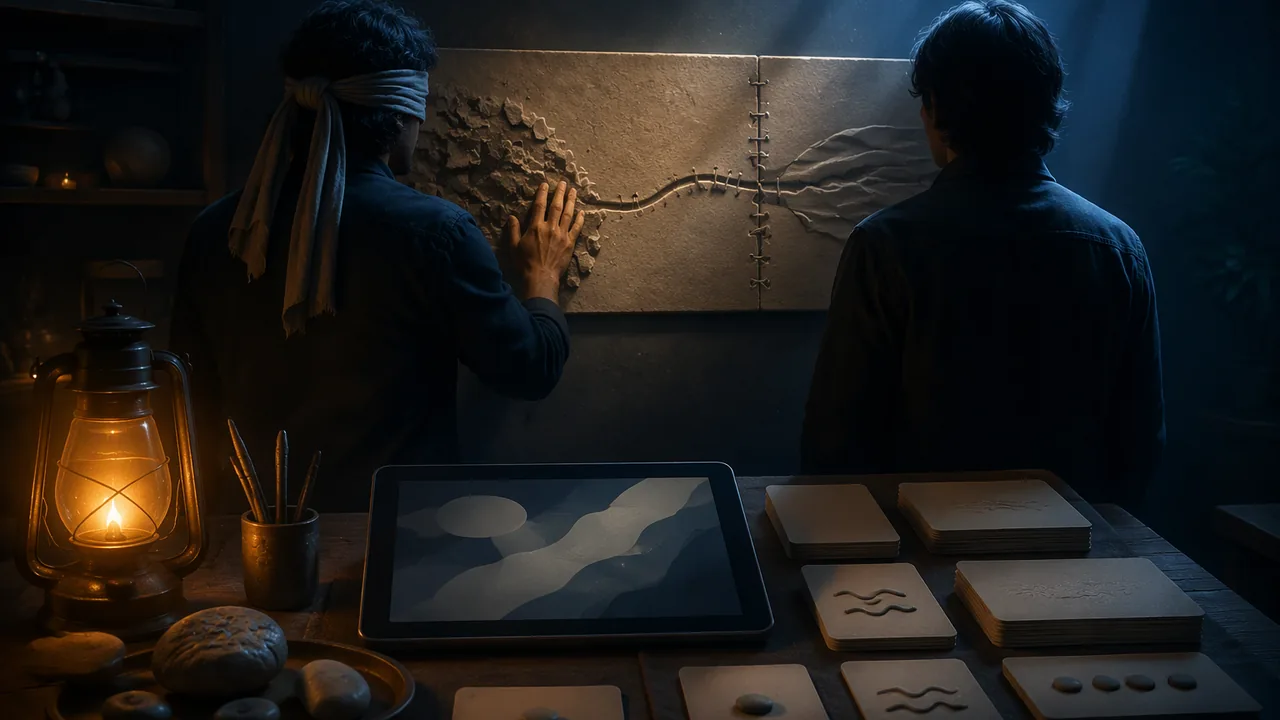
Blind interpretation critique. At the halfway point, two readers, family members or other adults who have not heard your plan, interpret your work before hearing anything from you: first by touch (eyes closed or under a cloth), then by sight. If only one reader is available, make the second reading yourself: cover the work and leave it for at least two days, then read it cold by touch and by sight, writing only what the work itself shows. Each writes what they think the work is about and what they felt, with the evidence that led them there. Only then do you share your theme statement. Compare their readings with your intent. Where they match, your symbols work. Where they differ, decide: is their reading a problem to fix, or a richer meaning to keep? Both are legitimate choices if you can explain them.
Revision. Make at least two revisions in response, documented with photos, and say which differing readings you chose to keep. For example, if you meant a stitched seam to stand for repair but both readers took it as a scar, you might keep that reading, because repair and injury belong to the same story, and add a second, gentler stitched area so the work moves from one to the other.
Statement and disclosure. In 400-500 words: your theme and route; how material, symbol and composition create emotional impact, with specific evidence from the work; what the blind interpretations showed and what you changed; and an exact disclosure of AI use — tool, prompt, date, what you took from the image, and what is wholly your own. You do not need to explain private experiences; a statement can be precise about the work without being confessional.
Defense. In a recording of about two minutes, defend one symbolic choice and answer one question a viewer would be likely to ask.
📖 Read for this lesson
The reading opens over the lesson; close it to come back to exactly where you were. The checks below draw on it.
Formative check
Work through these before moving on. They are not graded — they tell you whether the standard below has landed yet.
Record the two blind interpretations (touch first, then sight) with their evidence. Compare them with your theme statement, decide which differing readings to fix and which to keep, and document two revisions.
Which disclosure meets this course’s standard?
How confident are you that you can make a tactile work that carries a theme and disclose my process honestly?
Submit: Symbol and Story — finished work, statement with disclosure (400-500 words) and defense
Task: Develop a tactile artwork in collage, assemblage, relief or mixed media that explores a theme or concept that matters to you, drawing inspiration from an AI-generated image. The work must use at least three symbols or symbolic materials and be designed so a hand as well as an eye can follow its story or feeling.
Submission workflow
- Stage 1 — Plan. Theme statement, symbol plan, emotion map, AI image label and chosen sketch from Lesson 3.4.
- Stage 2 — Blind interpretation of the work in progress. Two readers (family members or other adults, or one reader plus your own cold reading after two days away) interpret by touch and then sight before hearing your intent; record and compare.
- Stage 3 — Final work and statement. Finished work documented from several angles and in raking light, with a 400-500 word statement including exact AI disclosure.
- Stage 4 — Defense. About two minutes defending one symbolic choice, recorded.
How it is scored
| Criterion | What proficient looks like |
|---|---|
| Conceptual depth (VA:Cn10A.III) | The theme is developed through connected symbols, materials and composition, not illustrated by a single image. |
| Emotional impact (VA:Re9A.I) | Readers’ interpretations show the work evokes a response the artist can account for. |
| Technique and durability (VA:Cr2A.III) | Techniques are controlled; joins and surfaces survive handling. |
| Revision (VA:Cr3A.III) | Revisions respond to blind interpretations, and kept differences are explained. |
| Ethics and disclosure (VA:Cr2B.III) | AI use and found-image sources are disclosed exactly and honestly. |
| Statement and defense | Specific evidence from the work; clear, direct answer to the question. |
Portfolio Task 7: The Full Brief, Criteria at Four Levels, an Exemplar Entry With Blind Readings and an Exact Disclosure, and the Blind-Reading Sheet
SLS original brief; the exemplar is invented and illustrative and not attributed to any student or person · SLS original (constructed teaching material, illustrative)
Why this reading. This is the complete brief for Portfolio Task 7: the assignment, the criteria at four levels, an exemplar entry with a blind-interpretation record and an exact disclosure, and the blind-reading sheet. Everything you need is here; you complete the task on your own, with family members or other adults as optional readers. The exemplar is SLS original and invented; it is not real student work and it is not attributed to anyone.
The assignment
Develop a tactile artwork in collage, assemblage, relief or mixed media that explores a theme that matters to you and draws on an AI-generated image (yours, or one of Cards A–D). It must use at least three symbols or symbolic materials and be built so that a hand, as well as an eye, can follow its story or feeling. Plan it as in Lesson 3.4 (see the theme-building kit). At the halfway point, two readers, family members or other adults who have not heard your plan, interpret it before hearing anything from you, by touch first, then by sight, each writing what they think it is about, what they felt, and the evidence that led them there. If only one reader is available, the second reading is your own: cover the work for at least two days, then read it cold, writing only what the work itself shows. Then compare the readings with your intent and decide which differences to fix and which to keep. Make at least two revisions. Photograph from several angles and in raking light. Write a 400–500 word statement that includes an exact disclosure, and give a two-minute defense of one symbolic choice.
Criteria at four levels
| Criterion | 4 Exemplary | 3 Secure | 2 Developing | 1 Beginning |
|---|---|---|---|---|
| Conceptual depth | Theme developed through connected symbols, materials and composition | Three symbols, loosely connected | One symbol illustrates the theme | Theme not evident |
| Emotional impact | Readers’ interpretations show a response the artist can account for | A response, partly accounted for | Response unrelated to intent | No response |
| Technique and durability | Controlled; joins and surfaces survive the handle test | One weak join | Several loosen | Fails on handling |
| Revision | Two or more revisions respond to the blind readings; kept differences explained | Two, thin reasons | One | None |
| Ethics and disclosure | Tool, prompt, date, what was taken, what is your own; found-image sources named | Most of these | “Made with AI” | None |
| Statement and defense | Specific evidence from the work; direct answer to a question | Some evidence | Describes only | Absent |
Exemplar entry (SLS original, invented)
Work: Held Together, shadow-box assemblage, 20 × 25 cm, air-dry clay pane cracked and re-stitched, thread, glass-free beads, cloth. Theme statement and emotion map as in the kit.
Blind interpretations (touch first, then sight). Reader 1 (my aunt), touch: “Soft at the start, then something cracked, like a plate. There is a thread across it. It feels like it broke and someone fixed it.” Sight: “Yes, a greenhouse, and the beads are the windows. It feels sad but hopeful.” Reader 2 (a neighbor, with my parent present), touch: “A scar. Something that was hurt. The thread is stitches on skin.” Sight: “A greenhouse with broken glass; the stitches make it look like an injury.” Comparison and decisions: both found broken-then-held; Reader 2 read the seam as a scar. I chose to keep that reading, since repair and injury belong to one story, and to fix the row of beads, which neither reader found until they looked, by making it larger and adding a gentle stitched patch at the right, so the work moves from injury to mending.
Statement (about 450 words). “Held Together explores repair, through the community route: a greenhouse at the edge of my town that nobody has looked after for years. My question was what it feels like to see something broken and to hold it together anyway. The work is a shadow box that a hand enters at the lower left. There the material is soft cloth and smooth wood, so the first thing a reader meets is welcome. In the center is a small clay pane I cracked on purpose and mended with a stitched seam. Its rough edge and the pull of the thread carry tension, and the seam is a symbol many cultures share for mending. Along the top edge runs a line of beads, one for each broken pane I counted in my source image. I invented that symbol, and I taught it by repeating it: the beads recur at equal steps, then stop where a pane is missing. I chose materials by testing them: in my swatch test with three readers from my family, crumpled foil was called tense or cold by all three and soft fabric was called comfort, so I used fabric at the entry and left the cracked clay bare at the center. Wire mesh split my readers between safe and trapped, so I left it out rather than let it argue with my theme. The hand’s path, calm to tense to resolved, is the emotional structure of the work.
“My composition follows the source’s arches but leaves out its strict center. The box works from the front and, through its open side, from the left. My blind readers taught me two things. Both found the broken-then-held story by touch alone, which told me the cracked pane and the seam work as symbols. But neither found the beads until they looked, because I had made them the same height as the box edge. My first revision enlarged the beads and raised them on thread. My second added a small stitched patch on the right, so that the last thing a hand meets is repair and not only damage. One reader called the seam a scar, and I kept that reading, because a mended break and an injury are the same story told at two moments.
“Disclosure. This work began from an image generated on 12 March with an image tool from the prompt ‘abandoned greenhouse at dawn’ (SLS Card C is a written stand-in for it). I took the arched roof structure and the broken-pane rhythm. The clay, seam, beads, cloth, layout and making are my own. No photograph by another person is used; the thread and beads came from my family’s sewing box.”
Defense notes (recorded): symbolic choice defended, the seam kept as a scar reading. Question I expected a viewer to ask: “Isn’t a scar the opposite of repair?” Answer: a scar is what repair leaves behind, so the seam holds both readings and the work moves from one to the other.
Blind-reading sheet (for each reader)
- Touch first (eyes closed or under a cloth). Write what it is about, what you felt, and the place on the work that led you there.
- Then sight. Write what changed.
- Do not ask the artist anything until both are written. (Reading your own work cold? Do not reread your plan until both are written.)
- The artist compares your reading with their theme statement and marks each difference fix or keep, with a reason.
Building a Theme: Image Sources, a Touch-Feeling Test With Worked Results, a Worked Emotion Map and a Model Theme Statement
SLS original kit; all results and the model statement are invented and illustrative · SLS original (constructed teaching material, illustrative)
Why this reading. The workshop asks you to choose a theme, three symbols, an emotion map and an AI image, to test what materials and touch qualities carry, and to write a 100–150 word theme statement. It sends you to the course’s image cards, and it cites an evidence base (your matching-collage test) that you may not have run. This kit supplies image sources you can use now, a protocol for testing touch and feeling, a worked emotion map and a model theme statement. All of it is SLS original; results are invented and illustrative.
Three routes to a theme (examples)
| Route | Example | Strong when |
|---|---|---|
| Personal, kept general | A place you left and still carry | You choose how much to say |
| Community | A greenhouse at the edge of town that nobody tends any more | A real local thing anchors it |
| Universal | Repair: what it means to mend something that was broken | Anyone can enter it |
The strongest works join two: a universal idea seen through one particular thing (repair, seen through a greenhouse). You never have to disclose a private experience.
Image sources you can use now
Use Cards A–D from the machine-image cards reading, or your own AI image (made only with a parent’s permission, within the tool’s age rules, and never from a photo of a real person) described the same way. Treat the image as a sketch someone else drew for you. A model take-and-leave list:
| Card | Could take | Could leave |
|---|---|---|
| A Lighthouse | The tower as a single upright form; light against dark | The mirrored cliffs; the centered sun |
| B Dunes | The flowing curve; large empty space | The even ripples |
| C Greenhouse | The arches; the broken panes (one in five) | The strict center and even spacing |
| D Terraces | Bands that shrink as they rise; the zigzag path | The sharp midday realism |
Record the label exactly (tool or card, prompt, date) and what you took. That is the start of your disclosure.
Testing what materials and touch qualities carry
Common associations: rough or sharp with tension or danger, smooth and warm with calm, soft with comfort, cold and hard with distance. They are tendencies, not laws. Protocol: make five 5 × 5 cm swatches (sandpaper or crumpled foil, smooth card, soft fabric, wire mesh, cork or wood). Ask up to three readers (family members or other adults), eyes closed, to touch each and say one feeling-word aloud. Record it exactly. With fewer readers, add your own reading: have the swatches mixed up in a bag, touch each with eyes closed and say the first word that comes. Your own words count as one reader, and the worked result below gives you three more to compare with. Worked result (invented):
| Swatch | Reader 1 | Reader 2 | Reader 3 | Pattern |
|---|---|---|---|---|
| Foil, crumpled | tense | cold | noisy | Tense or cold in all three |
| Smooth card | calm | plain | calm | Mostly calm |
| Soft fabric | comfort | comfort | sleepy | Comfort |
| Wire mesh | safe | trapped | tense | Splits: protective or trapping |
| Cork | warm | rough | natural | Warm and natural |
Reading it. Foil, card and fabric agreed. Wire mesh split (safe against trapped), so if you use mesh you must decide which reading you are designing for, or use the split on purpose. The associations vary between people, so test them on your readers.
The emotion map, worked (invented)
Theme: repair. Work: a 20 × 25 cm shadow box. Path: a hand enters at the lower left and moves to the center, then to the right.
| Zone | Meets first? | Material | Intended feeling | Reader reported |
|---|---|---|---|---|
| Lower left edge | Yes | Soft cloth, smooth | Calm, welcome | “Comfortable” |
| Center | Second | A cracked clay pane with a stitched seam | Tension, then care | “Something broken, but held” |
| Right side | Last | Smooth wood, a bead line | Quiet resolution | “A path out” |
The work changes feeling as it is explored: calm, tension, resolution. That is a narrative told by touch.
Choosing between two sketches
Score each sketch 0–2 against the emotion map: does the hand meet the right thing first? does the feeling change where planned? does each symbol have its material? Add up. Worked: Sketch 1 (a flat panel, all zones the same texture): 0 + 0 + 1 = 1. Sketch 2 (three zones): 2 + 2 + 2 = 6. Choose Sketch 2 and write the reason as its scores.
Model theme statement (SLS original, invented; about 130 words)
“Theme: repair, from a community route: a greenhouse at the edge of town. I want a reader to feel something broken that is being held together. Symbols: a stitched seam through a cracked clay pane (repair); a line of small beads along the edge (the broken panes, counted); soft cloth at the entry (welcome). The seam is a symbol shared by many cultures, the beads I invented and will teach through repetition. Image: Card C, greenhouse at dawn (SLS illustrative); I am taking the arched roof and the broken-pane rhythm and leaving the strict symmetry. Made with my own hands and materials; disclosure to follow in the statement.”