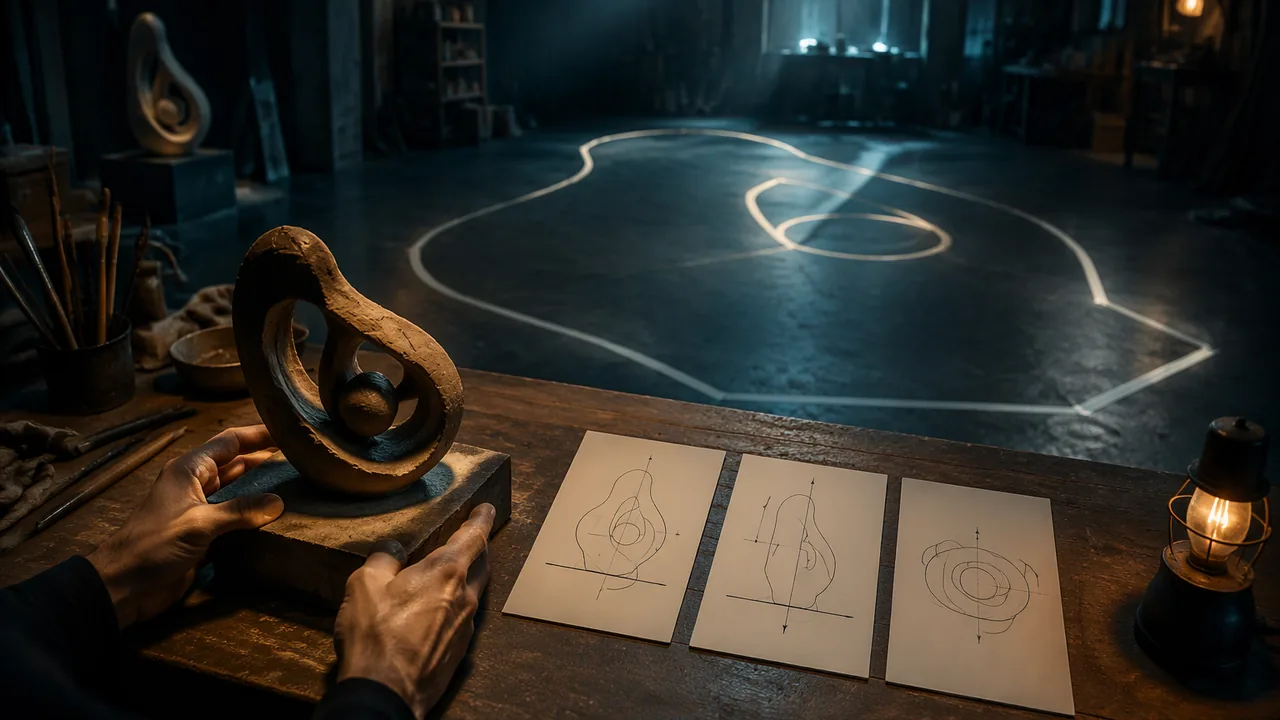
plan a composition with viewpoint thumbnails and a scaled maquette, and use scale factors to predict the size, surface and material a full-size work will need.
Instruction
Sculptors rarely begin at full size. They make a maquette — a small model — to test the composition cheaply, then enlarge it. Rodin made small studies before his monuments; public artists still present maquettes to commissioning committees. The Missouri painter Thomas Hart Benton modeled his mural compositions in clay before he painted them; the Harry S. Truman Library in Independence holds photographs of the clay model he used for his mural there (January 1960). When the Nelson-Atkins Museum of Art in Kansas City commissioned Claes Oldenburg and Coosje van Bruggen in 1994, the artists worked through small studies too: the museum holds their Study for Presentation Model of Shuttlecocks (1992), made of paper, polystyrene foam and resin, just 19 cm tall. For your composition piece you will do the same, and you will use proportional reasoning to plan the enlargement.
Thumbnails from three viewpoints. Before the maquette, sketch the idea from the front, side and top (or, for a relief, front and a side section showing the levels). For each, mark the balance (a vertical line through the center of visual weight), the rhythm (arrows along what repeats) and the emphasis (circle the first thing the eye or hand will meet).
The maquette. Make it quickly from foil, card, plasticine or clay at a fixed fraction of the final size — say one quarter. It should answer compositional questions, not show finish. Turn it, touch it with eyes closed, and change it. It is far cheaper to rearrange a maquette than a finished work.
Scale factors. If you enlarge every length by a scale factor k, areas grow by k × k = k² and volumes by k × k × k = k³. This matters in the studio:
- A maquette 8 cm tall enlarged by a factor of 4 becomes 32 cm tall.
- Its surface area — how much texture you must make, how much paint or sealant you need — grows 4² = 16 times.
- Its volume — how much clay a solid form would need, and how much it weighs — grows 4³ = 64 times. A solid maquette using 50 g of clay would need 3,200 g (3.2 kg) at full size. That is why full-size sculptures are built hollow or over armatures.
- Each finished Shuttlecock on the Nelson-Atkins lawn is about 585.6 cm tall and, the museum says, weighs 5,500 pounds. If the 19.05 cm study were enlarged exactly to that height, k = 585.6 ÷ 19.05 ≈ 30.7: the surface would grow about 945 times and the volume about 29,000 times. That is why the real shuttlecocks are hollow shells of aluminum and fiberglass-reinforced plastic, not solid forms.
Doubling the height (k = 2) multiplies the surface by 4 and the volume by 8. Even a modest enlargement changes the engineering.
Proportion is not only size. A tactile work at hand scale can be explored all at once by two hands; at arm’s-length scale a reader must move along it. Decide the final size from how it will be read, then derive the scale factor.
Composition plan. Write 150-200 words: the AI source image label; the type of balance and rhythm you are using and why; how the eye or hand will travel through the work; what you changed from the source composition; your maquette scale and the full-size dimensions; and your material estimate from the scaling calculation. Keep the maquette — it is evidence of your process.
📖 Read for this lesson
The reading opens over the lesson; close it to come back to exactly where you were. The checks below draw on it.
Formative check
Work through these before moving on. They are not graded — they tell you whether the standard below has landed yet.
A solid maquette uses 50 g of clay. You enlarge it by a scale factor of 3. About how much clay would a solid full-size version need?
If a sculpture’s height is doubled, its surface area is multiplied by and its volume by .
Upload your viewpoint thumbnails (with balance lines, rhythm arrows and emphasis circles), photos of your maquette from three sides, your scaling calculation for height, surface and clay, and your 150-200 word composition plan.
How confident are you that you can plan a composition with a maquette and scale it correctly?
Scaling a Maquette: Worked Scale Factors From Real Sizes (Including the Nelson-Atkins Shuttlecocks), and a Model Composition Plan
Museum open-access records: Cleveland 1943.246 (CC0), Art Institute of Chicago 1893.187; National Park Service, Statue of Liberty statistics; worked examples and plan are SLS original; The Nelson-Atkins Museum of Art collection records F94-41/47 and F94-1/1-4 (Shuttlecocks), and Harry S. Truman Library photograph records 60-286-01 and 60-286-03 (Benton clay model), retrieved 9 November 2026 · SLS original (worked examples), with CC0 museum record data and public-domain U.S. National Park Service figures, and facts summarized from Nelson-Atkins and Truman Library records
Why this reading. The workshop asks you to scale a maquette and to “predict the size, surface and material” of the full work. That needs real numbers to practice on, a worked method you can check against, and a model of the 150–200 word composition plan. Museum sizes are from the open-access records of the Cleveland Museum of Art (accession 1943.246, CC0) and the Art Institute of Chicago (1893.187), checked 26 September 2026. The Statue of Liberty figures are from the U.S. National Park Service “Statue Statistics” page (public domain), retrieved 26 September 2026.
The rule
Enlarge every length by k. Areas grow by k2. Volumes and weights grow by k3. To find k, divide a full-size length by the same length on the maquette.
| k | lengths | areas (k2) | volumes (k3) |
|---|---|---|---|
| 2 | ×2 | ×4 | ×8 |
| 3 | ×3 | ×9 | ×27 |
| 4 | ×4 | ×16 | ×64 |
| 10 | ×10 | ×100 | ×1,000 |
| 100 | ×100 | ×10,000 | ×1,000,000 |
Worked example 1: a real relief at 1 : 10 (real data)
Saluting Protective Spirit is 229.9 × 137 cm. A maquette at 1 : 10 is 229.9 ÷ 10 = 23.0 cm tall and 137 ÷ 10 = 13.7 cm wide. The full face is 229.9 × 137 = 31,496 cm2, about 3.15 m2. The maquette’s face is 23.0 × 13.7 = 315 cm2. The ratio is 31,496 ÷ 315 = 100, which is 102, as the rule says. Going from maquette to full size, k = 10: texture to carve, and paint or sealer to buy, grow 100 times.
Worked example 2: a real monument at 1 : 100 (real data)
The National Park Service lists the Statue of Liberty at 111 ft 1 in from heel to top of head (33.86 m), a hand 16 ft 5 in long (5.00 m), and a head 17 ft 3 in from chin to cranium (5.26 m). Its copper skin is 3/32 in thick, about 2.4 mm. Make a maquette at 1 : 100, so k = 100 going up: the figure is 33.9 cm tall, the hand 5.0 cm, the head 5.3 cm. The head is 5.26 ÷ 33.86 = 0.155 of the height, which is a proportion that holds at every scale. Areas grow ×10,000 and volumes ×1,000,000, so a solid monument could not be a scaled-up clay solid: it is a thin skin over a frame. The skin also shows what does not scale: at 1 : 100 the copper would be 2.4 ÷ 100 = 0.024 mm thick, thinner than any material you can work, so a maquette must simplify a thickness that the real work cannot.
Worked example 2b: a study and a monument in Kansas City (real data)
The Nelson-Atkins Museum of Art records Claes Oldenburg and Coosje van Bruggen’s Study for Presentation Model of Shuttlecocks (1992; paper, expanded polystyrene and resin; object F94-41/47) as 19.05 × 13.02 × 11.91 cm, and each finished Shuttlecock (1994; aluminum, fiberglass-reinforced plastic and paint; F94-1/1–4) as 585.63 × 487.36 cm overall. The museum’s label says each one weighs 5,500 pounds and stands nearly 18 feet tall. (Records checked 9 November 2026.) The study is a study, not necessarily an exact scale model, so treat this as “what if”: if it were enlarged exactly to full height, k = 585.63 ÷ 19.05 ≈ 30.7. Surface: ×k2 ≈ ×945. Volume: ×k3 ≈ ×29,000. A solid shuttlecock at that size would be absurdly heavy, which is why the real ones are hollow shells of aluminum and fiberglass. The Missouri painter Thomas Hart Benton used small models in the same way: the Harry S. Truman Library in Independence holds photographs (January 1960, public domain) of the clay model he made before painting his mural for the library.
Worked example 3: find k from two lengths
Your maquette figure is 12 cm tall and you want the final at 1.8 m (180 cm). k = 180 ÷ 12 = 15. Surface: ×152 = ×225. Volume: ×153 = ×3,375. If a solid maquette used 40 g of clay, a solid full-size figure would need 40 × 3,375 = 135,000 g = 135 kg. That is the reason to build over an armature or hollow.
Worked example 4: a grid for a relief
Draw 1 cm squares over a 10 × 12 cm photo of your relief maquette. To enlarge by k = 3, draw 3 cm squares on a 30 × 36 cm base. Copy what is in each square into the matching larger square. The base is 30 × 36 cm, which meets the task minimum of 25 × 30 cm.
Your practice set
- The Rodin plaster is 208.3 cm tall and 66 cm wide. Find both dimensions at 1 : 8.
- A maquette of the Statue of Liberty is 25 cm tall. Find k to full height (33.86 m).
- Your relief maquette has a face of 80 cm2 and an average depth of 0.5 cm. At k = 4, find the face and the clay volume.
Check: (1) 26.0 × 8.3 cm. (2) 3,386 ÷ 25 = 135.4, so k is about 135. (3) Face 80 × 16 = 1,280 cm2; volume 80 × 0.5 = 40 cm3 and 40 × 64 = 2,560 cm3.
The thumbnails, marked
Three thumbnails (front, side, top; for a relief, the front and a side section). On each mark balance with a vertical line through the center of visual weight, rhythm with arrows along what repeats, and emphasis with a circle around the first thing a hand or an eye will meet.
Model composition plan (SLS original, invented student work)
“Source: Card C, greenhouse at dawn (SLS illustrative card, machine-image cards reading). Composition: a relief of three arches. The balance is asymmetrical: the tallest arch stands at the right third and the two smaller arches lead to it from the left. The rhythm is progressive: the arches grow from 6 to 8 to 11 cm. My hand moves left to right, from the smooth low arch to the tall ridged one, which is the emphasis. From the card I changed the strict center and the even spacing. Scale: the maquette is 8 × 10 cm, k = 4, so the final is 32 × 40 cm. The surface grows 42 = 16 times, from 80 to 1,280 cm2. With an average relief depth of 0.5 cm, solid clay would go from 40 to 2,560 cm3 (64 times), so I will build the relief over a card and foil armature and cover it with a 5 mm skin.”
Check any plan you write against this: it names the source, says the type of balance and rhythm, says how the hand travels, says what changed from the source, and gives the maquette scale, the full-size dimensions and a material estimate from a scale factor.
Sources: NPS, Statue of Liberty statistics (nps.gov); Cleveland Museum of Art, Saluting Protective Spirit, 1943.246 (clevelandart.org); Art Institute of Chicago, A Burgher of Calais (Jean d’Aire), 1893.187 (artic.edu); The Nelson-Atkins Museum of Art, Study for Presentation Model of Shuttlecocks, F94-41/47 (art.nelson-atkins.org); The Nelson-Atkins Museum of Art, Shuttlecocks, F94-1/2 (art.nelson-atkins.org); Harry S. Truman Library, Photograph of the clay model used for Benton’s mural, 60-286-03 (trumanlibrary.gov)