present my final tactile artwork in an exhibition I curate, run a structured critique of it, and complete a reflective essay on my artistic journey.
Instruction
This is the representative assignment of this course’s final unit: present your final tactile artwork, run a structured critique of it, and write a reflective essay about your artistic journey. It also completes the year’s portfolio.
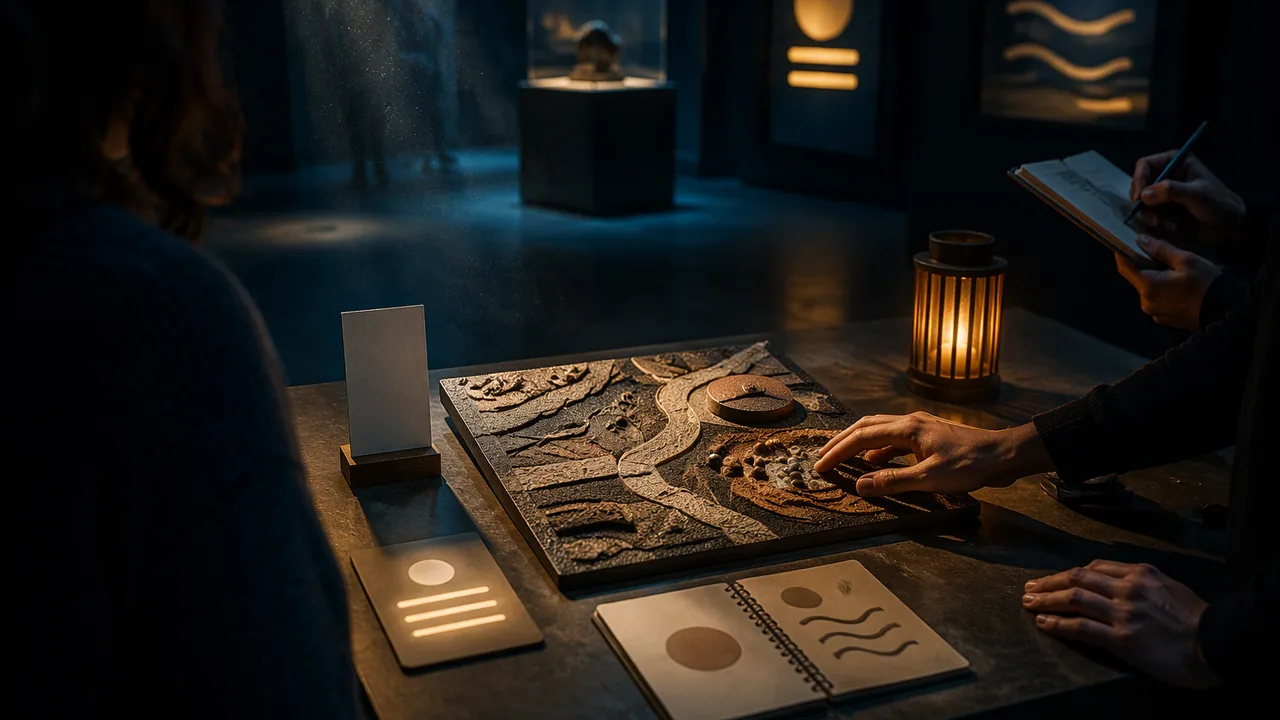
Curating the exhibition. Decide your exhibition’s title and organizing idea. You present one final work: the Symbol and Story piece at exhibition standard, or another portfolio work substantially reworked. Justify your choice in two sentences; selecting and justifying is itself part of the Advanced presenting standard. Then plan the layout using what you learned last semester: a reachable table, a clear route, a label, a spoken description, a handling card. Hold the exhibition at home for family, friends or neighbors. You may instead, or also, show it online, but only with a parent’s or guardian’s permission, and without your full name, school or other personal details. If you can, invite a blind or low-vision visitor to try the spoken description.
Your display. Each work has a large-print label (title, name, materials, AI disclosure), the 150-word statement, a care-and-handling card and a 60-90 second spoken description. If the work cannot be touched, a touchable sample or tactile graphic sits beside it.
The critique. During or after the exhibition, run a Critical Response Process session on your work (Lesson 4.3), with a family member or visitor as responder, or written as a self-dialogue after a day away. Act as responder at least once to one of the course’s exemplar works. Record what you hear and what you decide to do with it.
The reflective essay. Revise your draft from Lesson 4.4 into a final essay of 900-1,200 words. It must include a thesis about your development, evidence from at least four portfolio works and at least three pieces of critique or test data, a challenge you have not yet solved, how your understanding of AI and art changed, and at least two concrete goals. Add anything the exhibition critique taught you.
Gallery talk. In a recording of about three minutes (you may record it during your exhibition), talk about your final work: what it began from, the key decisions, what the critique showed, and where you will go next.
A final point about AI. Look back through your portfolio. Every work began with a machine-made image, and none of them is one. That difference — made by your choices, your materials and your hands — is what this course has been about.
📖 Read for this lesson
The reading opens over the lesson; close it to come back to exactly where you were. The checks below draw on it.
Formative check
Work through these before moving on. They are not graded — they tell you whether the standard below has landed yet.
Record the Critical Response Process session for your work: statements of meaning, your questions and the answers, neutral questions, and permissioned opinions. Sort each into act, test or set aside with a reason.
Which justification for choosing an exhibition work best meets the presenting standard?
How confident are you that you can present, defend and reflect on my work with evidence of growth?
Submit: Final Exhibition, Critique and Reflection — exhibited work, critique record, reflective essay (900-1,200 words) and gallery talk
Task: Present your final tactile artwork in an exhibition you curate (at home, or online only with a parent’s permission) with a label, statement, care card and spoken description; run a structured critique of it using the Critical Response Process, with a family member as responder or as a written self-dialogue, and respond to one of the course’s exemplar works; and write a reflective essay on your artistic journey through the year, with areas of growth and future goals.
Submission workflow
- Stage 1 — Plan. Evidence inventory, essay outline, selection justification and the exhibition layout plan.
- Stage 2 — Reviewed draft and critiqued work. The essay draft from Lesson 4.4, reviewed after a day away (or by a family member), and the Critical Response Process record for your exhibited work.
- Stage 3 — Final essay and exhibited work. The 900-1,200 word reflective essay and the finished, mounted work with its label, statement, care card and spoken description.
- Stage 4 — Gallery talk. About three minutes on your final work, recorded.
How it is scored
| Criterion | What proficient looks like |
|---|---|
| Final work (VA:Cr3A.III) | Refined to exhibition standard; revisions respond to the year’s critiques. |
| Selection and presentation (VA:Pr4A.III) | Selection justified with criteria; display serves touch, sight and hearing. |
| Critique participation (VA:Re9A.III) | Gives specific, neutral and permissioned feedback; records and sorts feedback received with reasons. |
| Reflective essay: evidence of growth (VA:Cn10A.III) | A clear thesis supported by at least four works and three pieces of critique or test data. |
| Reflective essay: AI, art and goals (VA:Pr6A.III) | Explains how understanding of AI and art changed, with reference to the course’s ethics and law; goals are concrete. |
| Gallery talk | Clear account of origins, decisions, critique and next steps. |
Portfolio Task 8: The Full Brief, Criteria at Four Levels, and Models of the Selection Justification, Label, Spoken Description and Gallery Talk
SLS original brief; models are invented and illustrative and not attributed to any student or person · SLS original (constructed teaching material, illustrative), with two public-domain ADA Standards figures
Why this reading. This is the complete brief for Portfolio Task 8. It gives the assignment, the criteria at four levels, and models of everything you must produce for the exhibition that the lesson names but does not show: the selection justification, the label, the spoken description and the gallery talk. It points to the two readings that carry the critique protocol and the essay exemplar. Everything you need is here; you complete the task on your own, with family members as your audience and optional responders. All models are SLS original and invented; they are not real student work and are not attributed to anyone.
The assignment
Present your final tactile artwork in an exhibition you curate, at home for family or, only with a parent’s or guardian’s permission, online, with a label, a statement, a care-and-handling card and a spoken description. Run a Critical Response Process session on your work (with a family member as responder, or written as a self-dialogue) and act as responder to one of the course’s exemplar works, using the four steps in the Critical Response Process reading. Write a 900–1,200 word reflective essay on your year using the exemplar and criteria in the Reflective Essay reading. Record a gallery talk of about three minutes. Your final work is the Symbol and Story piece at exhibition standard, or another portfolio work substantially reworked.
Choosing and justifying the work (model, two sentences)
“I chose Held Together because it shows my strongest control of symbol and texture, and its blind-interpretation results show that readers find its story of breaking and mending by touch alone. I rejected Three Arches because its composition was strong, but its story is simpler.” A good justification names criteria and evidence connected to the work’s purpose. “It’s my favorite” is not one.
Planning the exhibition
- Choose a title and an organizing idea (for example “Made by Hand from a Machine”). You may show more than one of your portfolio works, with the final work as the centerpiece.
- Layout: tables whose tops are between 71 and 86 cm (28 to 34 inches) above the floor, so a seated visitor can reach them, and a clear route at least 91.5 cm (36 inches) wide, with no cords across it (both figures are from the 2010 ADA Standards for Accessible Design, sections 902.3 and 403.5.1, ada.gov, read 26 September 2026); works in one direction of travel; the same label position on every table.
- Every work has a large-print label, the 150-word statement, a care-and-handling card (model in the Finishing and Mounting sheet) and a spoken description. A work too fragile to touch has a touchable sample or a tactile graphic beside it.
- Invite family, and friends or neighbors if your parent agrees; if you can, invite a blind or low-vision visitor and ask them to try the spoken description. Online instead? Only with a parent’s or guardian’s permission: post photographs in raking light, the label and statement as text, and the spoken description as audio, using your first name or initials only, with no school, town or photographs of people.
The label (model)
Held Together · by [first name or initials] · 2026 · shadow box, air-dry clay, thread, glass-free beads and cloth, 20 × 25 cm. AI disclosure: begun from an image generated on 12 March with an AI image tool from the prompt “abandoned greenhouse at dawn”. I took the arched roof and the broken-pane rhythm; the clay, seam, beads, cloth, layout and making are my own. Large print (at least 18 point) and a plain typeface.
The spoken description, 60–90 seconds (model, about 150 words)
“This is a shadow box, about the size of a sheet of paper, 20 centimeters wide and 25 tall. It stands upright on the table, open on the front. Begin at the lower left with flat fingers: you will find soft cloth. Move to the center. There is a small square of clay with a crack running across it, and a line of thread stitched across the crack like a seam. Press gently; the clay is rough and the thread is raised. Move right. At the top edge runs a row of small round beads on thread, spaced evenly, then stopping where one is missing. At the right edge is a small stitched patch. The whole piece is about being broken and held together. Take your time, and tell me what you felt.” A description gives the size, the layout and a route for the hand, and what the work is about.
The gallery talk, about three minutes (model, about 340 words)
“This work began with an image I asked an AI tool to make: an abandoned greenhouse at dawn. I liked its arched roof and the pattern of broken panes, one in five. I did not like its strict symmetry, so I left that out. I wanted to make something a hand could read, so I turned the greenhouse into a small box about mending. The key decisions were the seam, the beads and the path. The seam is a thread across a cracked clay pane. It stands for repair, and two blind readers found it by touch alone; one called it a scar, and I kept that, because a mend and an injury are two moments of one story. The beads mark the broken panes. My readers missed them until they looked, so I raised them on thread. The path runs from soft cloth, through the crack, to a small patch, so a hand moves from welcome, to tension, to quiet.
“In the critique, my aunt, as responder, asked me a neutral question: what guided my choice of a shallow box? Answering it, I realized I wanted a hand to reach in and find corners, and that the corners were empty. So I will place a single bead in the left corner to test whether a hand finds it. My mother told me, when I gave permission, that the beads were the same height as the frame. That was the comment I acted on.
“My AI disclosure is on the label. The image gave me a roof and a rhythm; everything else is mine. This year I learned that what I own in my art is what I decide and make, and that most of my decisions came from leaving things out. Next, I want to build a hollow form larger than 40 centimeters, and start it with a blind reader. Thank you. I would be glad to take a question.”
The critique record (template)
| Step | What was said (exact words where possible) | Act, test or set aside | Reason |
|---|---|---|---|
| Statements of meaning | |||
| My questions and the answers | |||
| Neutral questions | |||
| Permissioned opinions |
A filled example is in the Critical Response Process reading.
Criteria at four levels
| Criterion | 4 Exemplary | 3 Secure | 2 Developing | 1 Beginning |
|---|---|---|---|---|
| Final work | Exhibition standard; revisions respond to the year’s critiques | Finished; some revisions | Unfinished areas | Not presentable |
| Selection and presentation | Chosen with criteria and evidence; label, statement, card and description serve touch, sight and hearing | Chosen with a reason; most parts | Chosen without a reason | Parts missing |
| Critique participation | Specific, neutral and permissioned; feedback sorted with reasons | Mostly so | General | Absent |
| Essay: growth | Thesis, at least four works, at least three pieces of critique or test data | Thesis, some evidence | Adjectives | None |
| Essay: AI, art and goals | Changed view tied to the ethics and law studied; concrete goals | Changed view; goals | Restates lessons | None |
| Gallery talk | Origin, decisions, critique and next steps, clearly | Most parts | Description only | Absent |
The reflective essay itself must include: a thesis; evidence from at least four portfolio works; at least three pieces of critique or test data; one unsolved challenge; how your understanding of AI and art changed; at least two concrete goals. The exemplar essay is in the Reflective Essay reading.
Sources: 2010 ADA Standards for Accessible Design, sections 403.5.1 and 902.3 (ada.gov)
Writing the Reflective Essay: An Evidence Inventory, a Full Exemplar Essay, Model Criteria and a Sample Review
SLS original exemplar, invented and illustrative (no real student or person); one sentence quoted from Copyright and Artificial Intelligence, Part 2: Copyrightability (U.S. Copyright Office, 29 Jan. 2025) · SLS original (constructed exemplar, illustrative), with one public-domain U.S. Copyright Office sentence quoted
Why this reading. The workshop says a reflective essay must be “an argument about your own development, supported by evidence”, and a review after a day away (yours, or a family member’s) checks for a thesis, supported claims and concrete goals. It does not show you what such an essay looks like, or the standard it will be judged by. This reading gives a complete exemplar essay, the evidence inventory behind it, the model criteria, and a sample review. Everything here is SLS original and invented. The student, the works and the test results are made up to show a standard; nothing is attributed to a real person. The two quotations from public sources are credited.
The evidence inventory behind the exemplar
| Task | A decision I’m proud of | Critique or test data that changed something | What I’d do differently |
|---|---|---|---|
| 1 Clay translation | Cutting the stars and clouds | My father, testing blind: “There’s a lake. Where’s the moon?” The moon was 2 mm deep | Start at 4 mm |
| 2 Texture panel | Five textures that feel distinct | Tester confused sand paint with crushed eggshell; I swapped in cork; 5 of 5 found | Test before gluing |
| 3 Medium study | Sgraffito for the outlines | Reader: “The scratched lines are the only thing I could follow” | Use it for more than outlines |
| 4 Touchable exhibit | A raised key for the tactile graphic | Tester 1 found 4 of 6 elements in 2 minutes; after revision tester 2 found 6 of 6 in under a minute | Ask a blind reader first |
| 5 Balance, rhythm, space | Leaving the left third smooth | Touch test read the last two arches as a pair; I enlarged the last to 11 cm | Build hollow above 40 cm |
| 6 Rhythm in fiber | Making the change structural | Tester found 5 of 6 rhythm changes; missed plain to twill; second test 6 of 6 | Weave the chart before charting the finish |
| 7 Symbol and story | Keeping the “scar” reading of the seam | Two blind readers found beads only by sight | Design the beads for touch |
| 8 Exhibition | Choosing this work for its blind-reading results | Thread at the seam loosened after about forty touches | Stitch through the base, not the clay |
Exemplar essay (about 930 words)
In September my father ran his fingers over my clay translation of a moon above a lake, with his eyes closed, and said, “There’s a lake. Where’s the moon?” The moon was there. I had carved it 2 mm deep and a fingertip slid across it. That sentence started everything I did this year. Over the year I learned that the most important decisions in my work happen when I leave something out, and that touch testing taught me which omissions matter.
Leaving out for the hand. My first clay tile copied everything in the AI image: stars, clouds, a reflection. Under a hand, that was noise. After the moon test I removed the stars and clouds and raised the moon to 4 mm, and he found it in under ten seconds. The texture panel taught the same lesson from the other side. I had five textures, but my sister confused sand paint with crushed eggshell, so I swapped the eggshell for cork; then all five were found. The tactile graphic in Unit 4 put the two together. My first tester found four of six elements in two minutes. After I simplified the shapes and added a raised key, the second tester found all six in under a minute. My work improved not because I added skill but because I stopped putting in what a hand could not use.
Choosing a medium. In the medium study I compared impasto and sgraffito on matching tiles. The impasto ridges were pleasant, but a reader could not tell where one shape ended and the next began. Of the scratched lines a reader said, “The scratched lines are the only thing I could follow.” Sgraffito gave me edges and impasto gave me areas, so I learned to give each what it does well instead of using one for everything. My mistake was to use sgraffito only for outlines. Next time I would use it to carry the rhythm as well as the edge, because a line a finger can follow is the strongest thing I found for a hand.
Composition and rhythm: what should a hand meet first? In Three Arches I planned a progressive rhythm of arches at 6, 8 and 9 cm. My mother’s touch test found three arches but read the last two as a pair, because 8 and 9 cm were too close. I enlarged the last to 11 cm and opened more smooth space around it, and a second test found the build-up. I also left the left third of the base smooth, on purpose. That empty space was an omission too: it gave a finger a flat place to compare the rhythm against. In the fiber work I met a related problem. My brother found five of the six rhythm changes in Leaning Ribs but missed the switch from plain weave to twill, because both were the same dark color. A change that only color carries disappears under the fingers. I lightened the plain section and raised a row of loops at the join, and the second test found all six.
A challenge I have not solved. In Held Together two blind readers reached the same story, broken then mended, but one read my seam as a scar. I kept that reading, because a mend and an injury are one story at two moments. What I have not solved is how to know when a reader’s difference is a richer meaning and when it is a failure of my symbols. At my home exhibition, the thread of the seam loosened after about forty touches. I found out that a work about repair needs joins that survive the hands that read it, and I still do not know how many touches a mounted work should be built to bear.
How my view of AI and art changed. At the start I treated an AI image as a finished idea to translate. Later I treated it as a sketch someone else drew, and took only what I could name. What changed my mind was the law and the ethics, not the technology. The U.S. Copyright Office concluded in January 2025 that “prompts alone do not provide sufficient human control to make users of an AI system the authors of the output.” That means what I own in my work is what I made: my selection, my arrangement and my hands. It is also why I now record the tool, the prompt and the date and say what I took. In the ethics debate I could not settle whether the training was fair to the artists whose images were collected, because the lawsuits are still pending and even the government’s reports say the answer depends on the facts. So I moved from excited to careful. In the fiber task I chose to use a rule I wrote and a die, because I could say exactly where every part of the pattern came from. That was the most honest work I made this year, and it is not the most polished.
Goals. First, I will build a hollow form larger than 40 cm: a 14 cm maquette scaled by k = 3 gives 42 cm, so I will predict its surface to grow 9 times and its volume 27 times and then check my clay against the estimate. Second, I will begin my next work with a blind reader before I build the maquette, so that the omissions I make are decided by a hand, not by me alone. Third, I will test any join by at least fifty gentle touches before I call a work finished.
Evidence used: seven of the eight portfolio works, eight pieces of test or critique data, one unsolved challenge, two concrete goals, one credited quotation.
Model criteria for a reflective essay
| Criterion | 4 Exemplary | 3 Secure | 2 Developing | 1 Beginning |
|---|---|---|---|---|
| Thesis | One arguable claim about development, stated through a specific moment | A claim, general opening | A topic | None |
| Evidence | At least four works and three pieces of critique or test data, quoted or counted exactly | Some works, some data | Adjectives (“I improved a lot”) | None |
| Honesty | An unsolved challenge and what failed | Mentions a difficulty | Only successes | None |
| AI and art | Changed view, tied to the law and ethics studied, with a credited quotation | Changed view, thin sources | Restates lessons | None |
| Goals | Two or more, specific enough to act on | Two, general | One | None |
| Writing and vocabulary | Course terms used accurately; clear structure | Minor errors | Frequent errors | Unclear |
A sample review (after a day away, or by a family member)
The reviewer, you with fresh eyes or a family member, checks three things: a thesis; every claim of growth supported by specific evidence; goals that are concrete. Strongest paragraph: “Leaving out for the hand”, because it gives three counts (4 of 6 in two minutes, then 6 of 6 in under a minute) and a reason. Paragraph needing most work: “Challenge”, because “I still do not know how many touches” is honest but has no plan; add the fifty-touch test to the goal or say how you will find out.
Revising your exhibition statement
Before: “Held Together explores repair. It has a stitched seam and beads. The AI image was a greenhouse.” After the critique: “Held Together, 20 × 25 cm shadow box. Enter at the soft cloth on the lower left, move to the cracked clay pane with its stitched seam, then to the raised bead line and the small patch on the right. The beads are raised on thread because two readers missed them at first. Begun from an image made with an AI tool on 12 March from the prompt ‘abandoned greenhouse at dawn’; I took the arched roof and the broken-pane rhythm, and the making is my own.” Notice how the second version tells the reader where to begin, and why the beads are raised.
Sources: U.S. Copyright Office, Copyright and Artificial Intelligence, Part 2: Copyrightability (29 Jan. 2025) (copyright.gov)
The Structured Critique: The Critical Response Process Step by Step, With a Family Member or as a Self-Dialogue, a Worked Round, Two Evaluations and a Rubric
Steps paraphrased from Liz Lerman’s Critical Response Process one-page summary (lizlerman.com, 2020/2025), read 26 September 2026; worked round, self-dialogue, evaluations and rubric are SLS original, invented and illustrative · SLS original (worked round and rubric, illustrative), with a paraphrase and one short credited quotation of Liz Lerman’s published summary
Why this reading. The lesson describes the four stages of the Critical Response Process and asks you to run it on your own work (with a family member, or as a written self-dialogue), respond to one of the course’s exemplar works, write two evaluations from different criteria and sort feedback. It does not give the full protocol in one place, the criteria sets you would judge by, a worked example to copy, or a way to check your responses. This reading does. The process is Liz Lerman’s; the four steps below are paraphrased from her published one-page summary (lizlerman.com, read 26 September 2026), and the worked example and rubric are SLS original and invented.
The process
Roles: the artist, who presents a work and questions it; responders, who are committed to the artist’s aim of making excellent work; a facilitator, who starts each step and keeps the order. Lerman designed it for groups, but the roles can be shared by two people. In this course: on your own work you are the artist and facilitator, and the responder is a family member or another adult, or yourself writing after at least a day away; on an exemplar work you are the responder. Record the session on a phone, or write it down as you go. Lerman describes good feedback as “the kind that makes you want to go back to work.”
- Statements of meaning. Responders say what was meaningful, striking or memorable. Doubts and negative opinions wait.
- Artist as questioner. The artist asks questions about the work; responders answer the question asked, and may give opinions only in direct response to it.
- Neutral questions. Responders ask questions with no opinion hidden inside. “Why is the center so cluttered?” hides a judgment; “What led you to place the objects in the center?” does not. The artist answers.
- Permissioned opinions. Responders offer opinions only with the artist’s permission, in the form “I have an opinion about the edges; would you like to hear it?” The artist may say no. Lerman also notes that suggestions for changes (“fix-its”) work best if the artist says up front that they want them.
A worked round with two responders (SLS original, invented)
Work: Held Together, a shadow box on a mending theme (the exemplar in Portfolio Task 7), with the artist’s aunt as Responder A and a parent as Responder B. 1. Statements of meaning. Responder A: “When my hand reached the stitched seam in the center, the whole piece felt like it was being held together.” Responder B: “The soft cloth at the start made me feel welcome.” 2. Artist as questioner. Artist: “Did you find the line of beads?” A: “Not until I looked. My fingers went straight past them.” Artist: “What did the cracked pane make you think of?” B: “A plate. Or a bone.” 3. Neutral questions. A: “What guided your choice of a shallow box?” Artist: “I wanted a hand to reach in and find corners… I hadn’t thought that the corners are empty.” B: “What were you hoping the last thing a hand meets would be?” 4. Permissioned opinions. A: “I have an opinion about the beads; would you like to hear it?” Artist: “Yes.” A: “They are the same height as the frame, so they vanish under the fingers. Raising them might help.” B: “I have an opinion about the right edge; would you like to hear it?” Artist: “Not yet.”
The same process as a self-dialogue (SLS original, invented)
No responder available? Write the session as a script, two days after you last touched the work. 1. Meaning (as responder, touch first): “The soft cloth at the lower left is the first thing my hand meets, and it is welcoming. The seam in the center is the strongest moment.” 2. Artist’s questions (written before the two days away): “Can the beads be found by touch?” Responder: “Not easily; my fingers passed over them before I knew they were there.” 3. Neutral question (as responder): “What should the last thing a hand meets be?” Artist: “Repair, but right now it is the plain box edge.” 4. Opinion (as responder, after asking): “I have an opinion about the right edge; do I want to hear it? Yes: it needs a final, gentle texture.” The self-dialogue is weaker than a real second person, because you know your own intent, so keep to what the work itself shows and say so in your notes.
Sorting what the artist heard:
| Comment | Act, test or set aside | Reason |
|---|---|---|
| Beads vanish under the fingers | Act | Two readers missed them; raise them on thread |
| Cracked pane felt like a plate or a bone | Set aside | Both fit my theme; nothing to change |
| Corners of the box are empty | Test | Put a bead in one corner and see whether a hand finds it |
Two evaluations from different criteria (worked)
By the artist’s stated goal (“a hand should feel something broken, then held”): strong. Both blind readers reported the broken-then-held story by touch. By tactile readability (could every planned element be found by hand?): fair. The seam and the pane were found; the beads were not. The two evaluations disagree because the artist’s goal did not mention the beads, and readability asks about every element. Notice where evaluations agree (the seam works) and where they split (the beads).
The course’s own criteria (rate each 1–4 with a reason): originality; interpretation of the AI image; technical skill; composition; emotional impact; experimentation.
Rubric for your critique notes
| 3 | 2 | 1 | |
|---|---|---|---|
| Statement of meaning | Names a place in the work and what it did to you | A place, no effect | “I liked it” |
| Neutral question | No judgment hidden inside | Mostly neutral | A judgment as a question |
| Permissioned opinion | Asks, names the topic, specific and actionable | Asks, general | Does not ask |
| As artist | Asks questions, listens without defending, sorts every comment with a reason | Sorts some | Argues back |
Sources: Liz Lerman, Critical Response Process in Brief (lizlerman.com); Liz Lerman and John Borstel, Liz Lerman’s Critical Response Process (Dance Exchange, 2003) (archive.org)