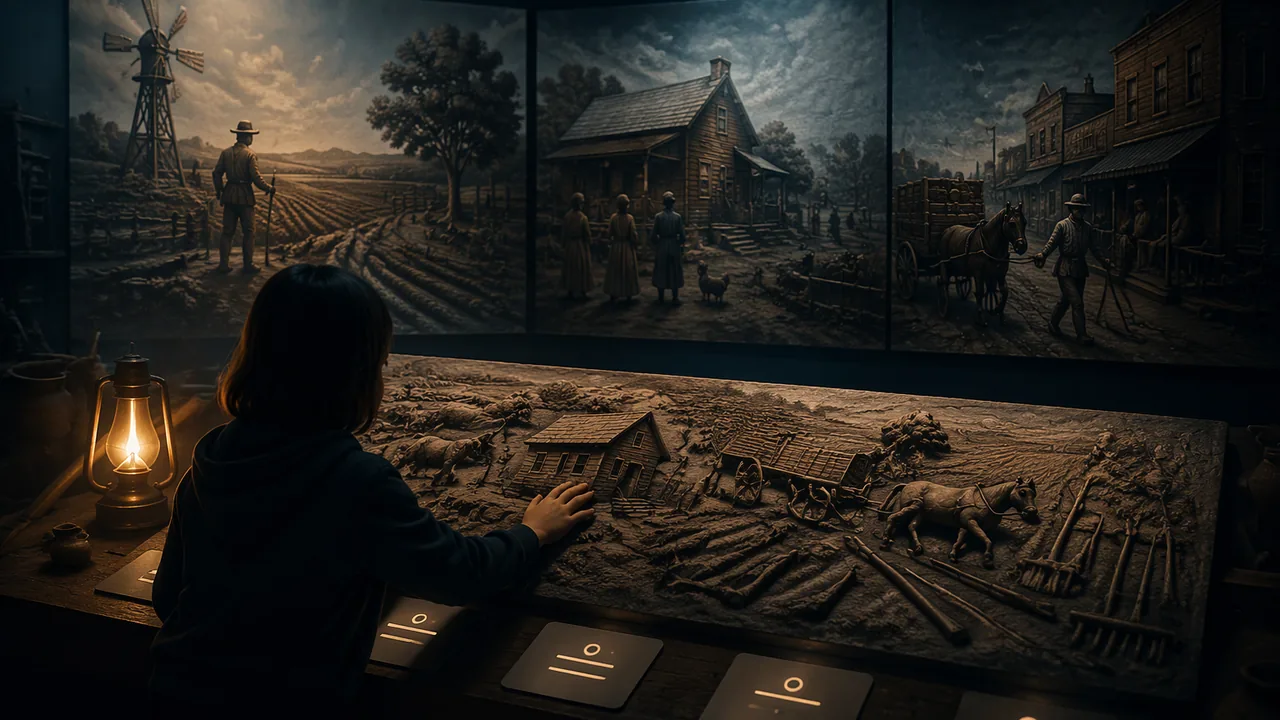
determine, with evidence from museum records, the commonalities among works attributed to the Regionalists Thomas Hart Benton, Grant Wood and John Steuart Curry, and demonstrate in a tactile object of your own how visual and material culture defines, shapes, enhances, inhibits or empowers people’s lives.
Instruction
Two questions about one Missouri room. Walk into the House Lounge of the Missouri State Capitol in Jefferson City and you are surrounded by Thomas Hart Benton’s A Social History of the State of Missouri, a mural covering three walls that Benton painted in 1936. The Missouri State Capitol Commission notes that it has been open for public viewing since its completion. This lesson asks two questions about pictures and objects like it. First: when art historians group artists together, as they group Benton with Grant Wood and John Steuart Curry under the name Regionalism, what do the works actually have in common, and how do you know? Second: how do the images and objects people live with define, shape, enhance, limit or empower their lives? You will answer the first from museum records and the second by making an object yourself.
Determining commonalities from evidence. A label such as “Regionalist” is a claim, and a claim needs evidence. The Art Institute of Chicago’s record for Curry’s Hogs Killing a Snake (c. 1930) calls Wood, Benton and Curry the three most important Regionalist painters of the 1930s. The Nelson-Atkins Museum of Art in Kansas City adds a date range: its label for Benton’s Open Country (1952) says that after Wood died in 1942 and Curry in 1946, and as abstract styles rose in American art, many felt that Regionalism had passed its prime. To test the label, put several works side by side and look for traits that appear in most of them, not just one. In the records for this lesson, four traits recur. Subject: rural and small-town life in the Midwest and South, such as farmers, farm animals, fields and windmills. Representation: recognizable people and places; the Art Institute says Benton’s modernism was “firmly rooted in figuration.” Story: each picture implies a narrative, from the hogs converging on a snake to the windmill choked by weeds. Time: most were made in the 1930s and 1940s, during and after the Great Depression; the Art Institute notes that Wood meant American Gothic (1930) as a reassuring image of rural values at the start of the Depression. A commonality is only half the finding, so also record a difference: Benton’s figures are sinuous and curving, Curry’s brushwork is short and choppy, and Wood’s figures are smooth and stiffly posed.
Visual culture shapes how people see themselves. Visual culture is the images a society makes and lives among: murals, posters, signs, screens. In a paper published by the National Park Service, historian Joan Stack of the State Historical Society of Missouri compares two sets of Capitol murals. In the rotunda murals painted shortly after the current Capitol was built, she counts fewer than 3 percent of the figures as Black and finds no images of slavery or violence. In Benton’s mural, by her count, 17 percent of the 96 primary figures are Black, and slavery and violence are major themes, alongside farming, mining, the Pony Express and the factories, offices and music of St. Louis and Kansas City. When Benton’s mural was unveiled, a few legislators threatened to have it whitewashed. Stack’s point is that both sets of murals define who counts as a Missourian: one by leaving people out, which limits how they are seen, the other by placing them in the story, which can empower.
Material culture shapes how people live. Material culture is the objects people make and use. Osage ribbonwork is a strong Missouri example. The Osage Nation’s own cultural history places the Osage in southwest and south-central Missouri when the written record begins, on the 1673 Marquette and Jolliet maps; Missouri’s governments later displaced almost all of the state’s Native peoples by the mid-1800s. Osage women make ribbonwork by cutting and folding silk ribbon into shapes and stitching them onto wool cloth. The Denver Art Museum’s record for an early-1900s Osage wearing blanket explains that the art is learned from female relatives, each ribbonworker creates her own patterns, horses can symbolize prosperity or a family’s name, and every Osage who dances the I-loⁿ-shka wears ribbonwork. The Nelson-Atkins label for a blanket of about 1910 adds that the human hands along its lower border are thought to stand for family relations, spiritual power or friendship. These are not decorations added to a life; they carry family, belonging and ceremony from one generation to the next. They are also the cultural heritage of a living nation, so in your studio work you study how they work but do not copy their designs.
Your studio work. You will make a small object for a real use in your own life or household, built from your own symbols, and test whether it does what you claim: define, shape, enhance or empower, and, honestly, whom it might leave out.
📖 Read for this lesson
The reading opens over the lesson; close it to come back to exactly where you were. The checks below draw on it.
Studio: A belonging object
Question. Can a small object you design and make change how someone in your household feels, acts or is seen, and whom might it leave out?
Materials
- A base about 15 × 15 cm: a fabric scrap, felt, an old T-shirt panel or cereal-box card
- Contrasting fabric scraps, ribbon, felt or colored paper for cut shapes
- Scissors, a pencil, scrap paper for templates and a ruler
- PVA (white) glue or fabric glue; or a blunt tapestry needle and embroidery thread or yarn
- Optional: buttons, string, a safety pin or a loop of cord so the object can be worn, hung or attached
- Use a blunt tapestry needle; count it out and back in, and keep it in a pincushion or taped to card when not in use.
- Cut on a table with the blades moving away from your fingers; ask an adult to help with thick card.
- Let glue dry flat in a ventilated room; keep glue and small parts away from young children and pets.
Procedure
- Choose a real use and a real person: for example a bag tag for a younger sibling starting somewhere new, a cover for a family recipe box, a welcome hanging for a door, or a patch for your own jacket. Write one sentence on what you want the object to do for that person (define, shape, enhance or empower).
- Sketch three symbols that come from your own life or household, such as a family name, a pet, a place in your town or a shared joke. Do not copy designs from Osage ribbonwork or another community’s cultural objects; study how they carry meaning, then invent your own.
- Make paper templates, trace them on your shape materials, and cut. Fold or layer at least two colors so one shape sits on top of another, as in appliqué.
- Attach the shapes to the base by stitching (running stitch or whipstitch) or by gluing, and add a way to wear, hang or attach the object.
- Use test: give the object to its person, or use it yourself, for at least two days. Record what they did with it and what they said, in the table below.
- Leave the object for a day, then photograph it flat and in raking light, and write a 150-200 word statement.
Data
| Day | Who used it, and where | What they did with it | What they said or how they reacted | Define, shape, enhance, inhibit or empower? |
|---|---|---|---|---|
| 1 | ||||
| 2 |
Analysis
- Which of the five verbs (defines, shapes, enhances, inhibits, empowers) best describes what your object actually did in the use test? Quote one piece of evidence from your table.
- Whom could your object leave out or limit? For example, would a family symbol make a visitor feel welcome or like an outsider? How would you change the design in response?
- Compare your object with the Osage wearing blanket or the Capitol mural: name one way each carries belonging, and one way your object is different in scale, use or meaning.
If you cannot do this studio in person: No fabric or thread? Make the object entirely from paper and card with glue: a folded paper badge, a card bookmark or a door hanger cut from a cereal box, with layered cut-paper shapes. If no one at home can take part in the use test, carry or use the object yourself for two days and record your own reactions and those of anyone who notices it.
Formative check
Work through these before moving on. They are not graded — they tell you whether the standard below has landed yet.
Missouri standard: VA:Re7B.III
Which statement is a commonality supported by the museum records for Benton’s Cotton Pickers, Wood’s American Gothic and Curry’s Hogs Killing a Snake?
Missouri standard: VA:Re7B.III
Finding one trait in a single Regionalist painting is enough to call that trait a commonality of the whole movement.
Missouri standard: VA:Re7B.III
Open the reading. Make a table with five rows (Benton’s Cotton Pickers, Benton’s Open Country, Benton’s Capitol mural, Wood’s American Gothic, Curry’s Hogs Killing a Snake) and four columns: subject, how figures and places are represented, the story implied, and date. Fill it only from the records. Then (1) state three commonalities, each supported by at least three rows; (2) state one difference between two of the artists; and (3) in two sentences, use the Nelson-Atkins label to explain why Regionalism was seen as fading after 1946. Optional: if you use an AI image tool, ask it for “a Regionalist painting” (no photos of real people) and say which of your three commonalities it reproduced and which it reduced to a cliché.
Missouri standard: VA:Cr2C.III
Joan Stack counts fewer than 3 percent Black figures in the Capitol rotunda murals and 17 percent of the 96 primary figures in Benton’s House Lounge mural. What does her comparison show about visual culture?
Missouri standard: VA:Cr2C.III
According to the museum records, an Osage ribbonwork blanket is purely decorative and plays no part in family or community life.
Missouri standard: VA:Cr2C.III
Upload two photos of your belonging object (flat and in raking light), your use-test table and a 150-200 word statement. In the statement: name the person and use the object was made for; say which verb (defines, shapes, enhances, inhibits or empowers) the evidence supports, quoting your table; name one way the object could leave someone out and the change you would make; and explain how your own symbols differ from the Osage designs you studied and why you did not copy them.
How confident are you that you can determine what a group of artists has in common from evidence, and show in my own object how visual and material culture shapes people’s lives?
The Regionalists and Missouri’s Material Culture: Records for Comparison
SLS original descriptions; Art Institute of Chicago open-access API (data CC0, descriptions CC BY 4.0); Nelson-Atkins Museum of Art and Denver Art Museum online collections; Missouri State Capitol Commission; State Historical Society of Missouri; National Park Service; Osage Nation (all retrieved 9 Nov 2026) · SLS original, with CC0 museum metadata and paraphrased CC BY 4.0 descriptions from the Art Institute of Chicago, and factual catalog data and short quotations from the Nelson-Atkins Museum of Art, Denver Art Museum, State Historical Society of Missouri, National Park Service and Osage Nation
Why this reading. The lesson asks you to determine what a group of artists has in common from evidence, and to study how images and objects shape lives before you make your own. Here are the records you need, in plain words with short quotations, and a clear line between what each source says and what you are asked to decide. Records come from the Art Institute of Chicago open-access API (data CC0; descriptions CC BY 4.0, paraphrased here), the Nelson-Atkins Museum of Art and Denver Art Museum online collections, the Missouri State Capitol Commission, the State Historical Society of Missouri, the National Park Service and the Osage Nation, all retrieved 9 November 2026. The artworks themselves are still under copyright or held by their owners, so this reading describes them rather than reproducing them; follow the source links to see each image on the museum’s site.
Part 1. Five works attributed to the Regionalists
1. Thomas Hart Benton, Cotton Pickers, 1945. Oil on canvas; Art Institute of Chicago, 2013.4. The museum says: Benton first saw laborers working cotton on a trip to Georgia in the late 1920s; he painted the figures in a sinuous, curving style that shows the effort of their movement; sharecropping kept farm workers poor and became a symbol of a racially and economically unjust system; and Benton’s modernism was “firmly rooted in figuration,” often centering African Americans in shared U.S. history. About the artist: the State Historical Society of Missouri records that Benton was born in Neosho, Missouri, on April 15, 1889, and died January 19, 1975, and that his paintings are famous for showing ordinary people doing common things.
2. Thomas Hart Benton, Open Country, 1952. Oil and tempera on canvas, mounted on panel, 69.2 × 89.5 cm; Nelson-Atkins Museum of Art, Kansas City, F89-33. The museum says: a cowboy lets his horse drink in a sprawling western landscape, cattle graze in the distance, and a weed-choked windmill and fence show age and neglect. The label reads the painting as Benton’s recognition that he was the last surviving leader of the Regionalist movement: Grant Wood died in 1942 and John Steuart Curry in 1946, and with new abstract styles emerging, many felt Regionalism had passed its prime.
3. Thomas Hart Benton, A Social History of the State of Missouri, 1936. Mural in the House Lounge, Missouri State Capitol, Jefferson City. The sources say: the Missouri State Capitol Commission records that the mural has been open for public viewing since its completion in 1936, and in 2015 it funded a condition assessment of the mural. Joan Stack (State Historical Society of Missouri), in a paper published by the National Park Service, describes three walls, each a “chapter”: colonial Missouri, with traders, homesteaders and, in the lower bands (predellas), slavery and the expulsion of the Mormons; Missouri’s first hundred years, with a campaign rally, a courtroom, farming, logging, mining, the Pony Express and a steamboat, and Jesse James above the door; and the St. Louis and Kansas City of the 1930s, with office workers, chemists, factory laborers and musicians, and the St. Louis story of Frankie and Johnny above the door. Over the Speaker’s door, Mark Twain’s Huck and Jim appear, with Jim towering over Huck.
4. Grant Wood, American Gothic, 1930. Oil on Beaver Board, 78 × 65.3 cm; Art Institute of Chicago, 1930.934. Grant Wood, American, 1891–1942. The museum says: a farmer and his daughter pose stiffly outside a house in the 1880s Carpenter Gothic style, dressed, in Wood’s words, like “tintypes from my old family album”; Wood had seen a similar farmhouse in Eldon, Iowa. Many viewers read it as satire of Midwesterners, but Wood meant a positive image of rural values, reassuring at the start of the Great Depression.
5. John Steuart Curry, Hogs Killing a Snake, c. 1930. Oil on canvas; Art Institute of Chicago, 1947.392. John Steuart Curry, American, 1897–1946. The museum says: with Wood and Benton, Curry was one of the three most important Regionalist painters of the 1930s. The hogs converge from all angles on a writhing snake; Curry used short, choppy brushstrokes and even scratched the paint to suggest bristling hair; the subject came from a childhood experience.
Part 2. Your commonality table
| Work | Subject | How figures and places are represented | Story implied | Date |
|---|---|---|---|---|
| Benton, Cotton Pickers | 1945 | |||
| Benton, Open Country | 1952 | |||
| Benton, Capitol mural | 1936 | |||
| Wood, American Gothic | 1930 | |||
| Curry, Hogs Killing a Snake | c. 1930 |
How to decide. A trait counts as a commonality only if at least three rows support it. Write the trait, then list the rows. Then find one difference between two artists, for example brushwork or mood. The dates span about 1930 to 1952, so note which works fall in the 1930s and 1940s, and why the 1952 painting looks back on the movement.
Part 3. Visual culture: two sets of Capitol murals
Stack compares Benton’s mural with the rotunda murals by the British painter Frank Brangwyn, part of the program planned for the current Capitol (built about 1917–1924). By her count, fewer than 3 percent of the rotunda figures are Black and none of its images show violence or the realities of slavery; in Benton’s mural, 17 percent of the 96 primary figures are Black, and slavery and violence are major themes. When Benton’s mural was unveiled, it was criticized by many politicians and newspapers, and a few legislators threatened to have it whitewashed. Ask yourself: what does each set of murals tell a Missourian walking through the Capitol about who belongs in the state’s story?
Part 4. Material culture: Osage ribbonwork
The Osage in Missouri. The Osage Nation’s cultural history places the Osage in southwest and south-central Missouri when the written record begins, on the 1673 Marquette and Jolliet maps, south of the Missouri River near the Osage River. Stack notes that Missouri’s territorial and state governments displaced almost all of the state’s Native peoples by the middle of the 1800s.
Ribbon appliqué wearing blanket, early 1900s. Osage, maker not recorded; Denver Art Museum, 1953.131; 59 × 70.75 in. The museum says: an Osage woman sewed it for the I-loⁿ-shka dance; the Osage traded with the French for wool cloth and silk ribbon; ribbonworkers are women who learn the art from female relatives, and each creates her own patterns; she traced a design on ribbon with a template, cut and folded it into arrowhead and horse shapes, stitched them onto a second ribbon and sewed that onto the blanket. Every Osage who dances the I-loⁿ-shka wears ribbonwork, blankets like this are often given as gifts at the dance, and horses often symbolize prosperity and may indicate a family’s name. Ribbonwork is still made, and such blankets are still worn on ceremonial occasions.
Woman’s blanket, about 1910. Osage or Otoe, Oklahoma; wool cloth, silk ribbon and glass beads, 149.9 × 185.4 cm; Nelson-Atkins Museum of Art, 89-38. The museum says: silk ribbon appliqué was first developed by women of the Great Lakes region in the late 1700s and spread to the Eastern and Southern Plains; Osage and Oto women’s blankets often have appliquéd or beaded human hands along the lower border, thought to symbolize family relations, spiritual power or friendship, which is why they are often called friendship blankets. The Nelson-Atkins also holds an Osage skirt of the late 1800s (F83-57/9), wool with cut ribbonwork appliqué in geometric motifs and a sawtooth edge.
Respect. These designs belong to Osage families and the Osage Nation, and the tradition is alive. In your studio work, study how the objects carry meaning, through who makes them, how they are given and when they are worn, and then invent symbols from your own life. Do not copy Osage designs.
Part 5. Five verbs for your statement
The standard asks how visual and material culture defines (says who someone is or where they belong), shapes (changes what people do), enhances (makes an experience richer), inhibits (limits or leaves people out) and empowers (gives people confidence, voice or standing). Example: a team jersey defines who is on the team, shapes how fans behave on game day, and can make someone who is not wearing one feel outside the crowd. Use the verb your use-test evidence actually supports, not the one you hoped for.
Sources: Art Institute of Chicago, Thomas Hart Benton, Cotton Pickers, 2013.4 (artic.edu); Art Institute of Chicago, Grant Wood, American Gothic, 1930.934 (artic.edu); Art Institute of Chicago, John Steuart Curry, Hogs Killing a Snake, 1947.392 (artic.edu); Nelson-Atkins Museum of Art, Thomas Hart Benton, Open Country, F89-33 (art.nelson-atkins.org); Missouri State Capitol Commission, condition assessment of A Social History of the State of Missouri (capitol.mo.gov); Joan Stack, “Who’s at Home in Missouri?” (National Park Service) (nps.gov); State Historical Society of Missouri, Historic Missourians: Thomas Hart Benton (historicmissourians.shsmo.org); Osage Nation, Osage cultural history (osagenation-nsn.gov); Denver Art Museum, Ribbon Appliqué Wearing Blanket, 1953.131 (denverartmuseum.org); Nelson-Atkins Museum of Art, Woman’s Blanket, 89-38 (art.nelson-atkins.org); Nelson-Atkins Museum of Art, Skirt, F83-57/9 (art.nelson-atkins.org)