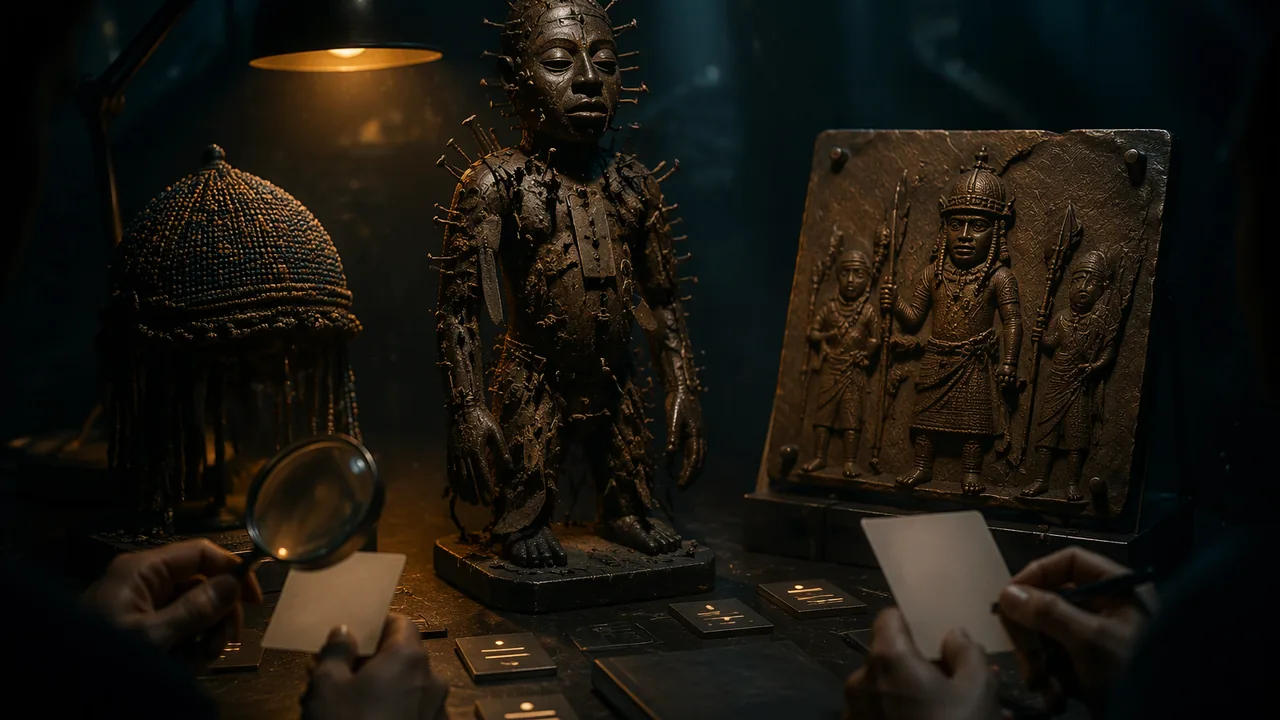
analyze how five objects carry meaning through their materials and making, compare differing interpretations of them, and defend a plausible reading using museum evidence and provenance.
Instruction
Some objects do not simply show a story; they are one, built into their materials. This lesson studies five, and practices an Advanced-level skill: comparing differing interpretations and defending the most plausible one with evidence.
A Kongo power figure. The Male figure (nkisi nkondi) (late 1800s-early 1900s, Cleveland Museum of Art) was carved by a Kongo sculptor and activated by an nganga, a ritual specialist, who placed empowering substances in it. Its surface is covered with nails, blades and screws, both locally made and imported. Minkisi of this kind were widely used to seal agreements and oaths and to seek justice; driving in a nail marked an act of that kind. The museum’s record adds two things a first look would miss: this figure has been stripped of most of its empowering materials and is no longer spiritually active, and Kongo people sometimes removed those materials as acts of anti-colonial resistance, disempowering minkisi before Europeans seized them. Early European collectors called such figures “fetishes” and read them as evidence of superstition; that interpretation tells us more about the collectors than about Kongo law and religion.
A Yorùbá crown. The beaded Crown (adéńlá) (1900s, Cleveland Museum of Art) is, in the museum’s words, the most important of Yorùbá royal regalia. A royal bird sits on top; a veil of beaded strings masks the king’s face, protecting his subjects from the power that radiates from it; and no one may look inside the crown. Glass beads, cloth and reed become a statement about kingship, ancestry and sacred power. Meaning here depends on who may see, wear and touch.
A Benin plaque. Brasscasters of the royal guild, the Igun Eronmwon, modeled this Plaque (1500s-1600s, Cleveland Museum of Art) in wax and cast it in copper alloy. Its bent sides once fixed it to wooden beams in the palace of the Oba of Benin, where plaques recorded court life. The museum’s provenance record traces it to the palace of Oba Ovọnramwẹn and, possibly, to Admiral Rawson, who commanded the British force that attacked Benin City in 1897 and removed thousands of objects. Several museums have since returned Benin works to Nigeria. Where an object is now, and how it got there, is part of its meaning.
Kurt Schwitters. Little Dance (1920, Cleveland Museum of Art) is a small collage of scraps of printed paper gathered from daily life. Schwitters called his work Merz, a fragment of the German word for commerce cut from a bank advertisement. One interpretation reads his collages as formal compositions, in which, as the museum notes, the red scraps seem to dance among quieter tones. Another reads them historically: Germany after the First World War, a broken society, and an artist rebuilding something whole from its debris. Both readings use evidence; the strongest analysis weighs them together.
A Mississippian vessel from Missouri. The Nelson-Atkins Museum of Art in Kansas City holds a small earthenware Vessel in the Form of a Conch Shell (Mississippian, 1200-1500, about 9 × 19 × 26 cm). The museum’s record lists Missouri among its terms but gives no find site and no interpretation, so every reading of it needs evidence from outside the record. Here is some. The Illinois State Museum describes Cahokia, the great Mississippian city across the Mississippi River from present-day St. Louis, as a marketplace where marine shell could be obtained; whelk shells from the Atlantic Ocean and the Gulf of Mexico became cups, beads and ornaments. The archaeologist Laura Kozuch has studied clay copies of whelk-shell cups found around Cahokia and connects shell cups with rituals of purification, renewal and war. One interpretation reads a clay shell as a substitute: a local, easier-to-make version of a precious imported cup. Another reads it as a deliberate translation that carried the shell’s meaning into a local material. Here meaning lies in one material imitating another, which is a tactile question: a fired clay shell and a real shell feel different in the hand.
Your method. For your chosen object, state two interpretations, list the evidence each uses (materials, making, context, provenance), and defend the reading best supported by the evidence, acknowledging what it cannot explain.
📖 Read for this lesson
The reading opens over the lesson; close it to come back to exactly where you were. The checks below draw on it.
Formative check
Work through these before moving on. They are not graded — they tell you whether the standard below has landed yet.
According to the Cleveland Museum of Art, why might a nkisi nkondi reach a museum without its empowering materials?
The Benin plaque’s provenance is irrelevant to interpreting it, since only its imagery matters.
Choose one of the five objects. State two differing interpretations, list the evidence each relies on (materials, making, context, provenance), and in 250-300 words defend the reading best supported by the evidence, acknowledging what it cannot explain.
How confident are you that you can compare interpretations of an object and defend the most plausible one with evidence?
Five Objects That Carry Meaning: Records, Provenance, Photograph Descriptions and a Worked Two-Interpretation Analysis
Cleveland Museum of Art Open Access API: 2010.432, 1995.22, 1953.425, 1963.1 (CC0), retrieved 26 September 2026; Smithsonian Institution press release, 11 Oct 2022; The Nelson-Atkins Museum of Art collection record 32-73/19 (art.nelson-atkins.org/objects/18607); Illinois State Museum, MuseumLink Illinois, Mississippian trade; Kozuch, L. (2013), Ceramic effigies of lightning whelk shell cups, Illinois Antiquity 48(3): 14-16 (abstract); retrieved 9 November 2026 · SLS original (descriptions, method and worked example), with CC0 museum record text, facts summarized from the Nelson-Atkins record and a short credited quotation from the Illinois State Museum
Why this reading. The task asks you to pick one of five objects, state two differing interpretations, list the evidence each uses (materials, making, context, provenance) and defend the better-supported reading in 250–300 words. That needs the evidence in front of you. Each record below is from the Cleveland Museum of Art Open Access API (CC0), checked on 26 September 2026, with a description of what the museum’s photograph shows. Where the record says nothing, this reading says so: an interpretation that needs a fact the record does not supply is a claim to flag, not evidence.
1. Kongo power figure
Male figure (nkisi nkondi), Kongo artist and nganga (priest), Democratic Republic of Congo or Cabinda (Angola), late 1800s–early 1900s. Wood, metalized glass, iron, organic material, ivory or plastic, and natural fiber. 46 × 25.7 × 19.2 cm. Cleveland Museum of Art, 2010.432. Provenance: Jean Willy Mestach, Brussels; René and Odette Delenne, Brussels, 1962–2010; sold to the museum in 2010. The photograph: a standing figure with a raised right arm, a small round head under a resin cap, round mirrored eyes and an open mouth with dark lips. A rectangular chamber is cut in the stomach, empty and open. Iron nails project from the shoulders, chest and arm like spines. The feet stand on two rectangular blocks, symmetrical. Museum text: it “lacks most of the materials that transformed it into a vessel for a spirit”. Priests placed substances inside carved figures to empower them. The eyes, resin cap and stomach chamber once held empowering materials. After the figure had served its purpose the nganga removed them, “stripping it of its spiritual power”. “Sometimes, Kongo people removed materials as acts of anti-colonial resistance, disempowering minkisi before Europeans seized them.” And: “While we don’t know why it was disempowered, this sculpture is no longer spiritually active.”
2. Yorùbá crown
Crown (adéńlá), Yorùbá-style maker, Nigeria, 1900s. Cloth, glass beads, reeds, cardboard, wood, plant fiber, cotton and quills. Height about 105.9 cm overall, of which the cone is 35.1 cm and the bead fringe 55.3 cm; diameter 26.8 cm. Cleveland Museum of Art, 1995.22. The photograph: a tall cone covered in small beads in diamonds, triangles and rectangles in white, red, blue and yellow, with faces on the cone. A small beaded bird crowns the top. Around the bottom edge hang dozens of long strings of beads, which would cover the wearer’s face. Museum text: “The most important of all regalia, topped with the ‘royal bird’ Okin, this headdress connects the king to Oduduwa, the mythical founder of the Yoruba. The veil of beaded strings masks the identity of the wearer and protects his subjects from the supernatural powers that radiate from his face.” It signifies the king’s “inner head”, the source of a life force called ase. A museum note adds that no one, not even the king who wears it, may look inside the crown, because that is where it is most powerful.
3. Benin plaque
Plaque, made by members of the Igun Eronmwon (royal brasscasters’ guild), Benin Kingdom, Nigeria, 1500s–1600s. Copper alloy. 49.4 × 30.6 cm. Cleveland Museum of Art, 1953.425. The photograph: a standing warrior in high relief, upright and facing front, in a tall crested cap, a necklace and a patterned tunic. He holds a long staff at the left and a broad sword across his body at the right. Fine engraved patterns of flowers and lines cover the background and the skirt; small round holes pierce the plate near the edges. The plate is cracked and worn. Museum text: craftsmen modeled plaques in wax before casting them with hot metal. Molds pushed out the general shapes and details, such as the warrior’s staff and court sword (ẹbẹn), were added by hand. The incised flowers, ebe-amẹn (“river leaves”), are identified with Olókun, god of the waters, and “may have Islamic or European origins”. The palace plaques were in storage before the 1897 Siege of Benin. Provenance: commissioned from the Igun Eronmwon; by descent to Ọba Ovọnramwẹn (c. 1857–1914, reigned 1888–97), Royal Palace, Benin City, until the Siege of Benin in 1897; “possibly Sir Admiral Rawson”; sold by John Wise Ltd., New York, to the museum in 1953. Context: on 11 October 2022 the Smithsonian’s National Museum of African Art transferred ownership of 29 Benin bronzes to Nigeria’s National Commission for Museums and Monuments, the first return under its new ethical returns policy (Smithsonian press release).
4. Kurt Schwitters
Little Dance, Kurt Schwitters, German, 1887–1948; 1920. Collage. Sheet 13.1 × 10.4 cm, mounted 23 × 17 cm. Cleveland Museum of Art, 1963.1. The photograph: a small, dense rectangle of overlapping torn and cut scraps in ochre, brown and gray wrapping paper, with a few red scraps at the upper left and left edge, and printed fragments (numbers, one label reading “21.00”, part of a blue-and-white printed slip at the lower right). There is no empty space: the edges of the scraps make sharp diagonals. On the mount, pencil handwriting appears to give a number, the title in German and Schwitters’s name and the year (my reading of the photograph). Museum text: “collages of densely interwoven scraps of paper gleaned from daily life”, in which “the interaction of the materials becomes a kind of dance”, and the color red “dances” among white, gray and ochre tones. The record lists no provenance beyond the Sidney Janis Gallery, New York.
5. A Mississippian vessel from Missouri
Vessel in the Form of a Conch Shell, Mississippian, 1200–1500. Earthenware. 8.89 × 19.37 × 26.04 cm. The Nelson-Atkins Museum of Art, Kansas City, object number 32-73/19 (Purchase: William Rockhill Nelson Trust); not on view; checked 9 November 2026. The record’s terms: Mississippian, Ceramics, Missouri. What the record does not say: where exactly it was found, how it was used, or what it meant. Treat every claim beyond its form and material as outside evidence, and flag it.
Outside evidence you can use. (1) The Illinois State Museum’s MuseumLink pages describe Cahokia, the Mississippian city across the Mississippi River from present-day St. Louis, as “a Mississippian marketplace where one might obtain marine shell”, and say that whelk shells from the Atlantic Ocean and the Gulf of Mexico were made into cups, beads and other ornaments. (2) The archaeologist Laura Kozuch, in “Ceramic Effigies of Lightning Whelk Shell Cups” (Illinois Antiquity 48, no. 3, 2013), studied clay copies of whelk-shell cups found in Illinois, mostly tempered with freshwater shell and made with fine grog from Cahokia, and connects shell cups with rituals involving purifying liquids (the “Black Drink”), renewal ceremonies and war. She does not discuss this particular vessel.
Two readings to weigh. A. A substitute: a clay version of a precious imported shell cup, made because real shells had to travel hundreds of miles. B. A translation: a deliberate remaking of the shell in local clay that carried the shell’s meaning into a local material. Notice that both rely on outside evidence, and neither can be confirmed from this record. A strong analysis says so.
Method, with a worked example
Write two readings, each with the evidence it relies on, then judge which the evidence supports better and say what it cannot explain. Worked example on the crown (SLS original).
| Reading | Evidence used | Type |
|---|---|---|
| A. The crown is a statement of political rank and lineage. | “the most important of all regalia”; it “connects the king to Oduduwa, the mythical founder of the Yoruba”; the royal bird on top | Context and iconography (museum text) |
| B. The crown is a container and a shield for a dangerous sacred power. | The veil “protects his subjects from the supernatural powers that radiate from his face”; the inside may not be looked into; the “inner head” holds ase | Function and belief (museum text) |
Weighing. Both readings use the same museum text, so they are compatible rather than rival: rank is why the power is dangerous. B explains a feature that A does not, the veil and the rule about looking inside, since a rank symbol alone needs neither. A explains the bird and the link to Oduduwa. A defensible view is that B is the stronger explanation of the object’s making (materials arranged to conceal and protect), and A of its context. What neither can explain: what particular bead patterns, the diamonds and triangles, mean; the record is silent, and a claim about them would be a guess. Use the same layout for your object: two readings, evidence with its type (material, making, context, provenance), a verdict, one honest gap.
Sources: Cleveland Museum of Art, Male figure (nkisi nkondi), 2010.432 (clevelandart.org); Cleveland Museum of Art, Crown (adeńlá), 1995.22 (clevelandart.org); Cleveland Museum of Art, Plaque (Benin), 1953.425 (clevelandart.org); Cleveland Museum of Art, Little Dance (Kurt Schwitters), 1963.1 (clevelandart.org); Smithsonian, Smithsonian Returns 29 Benin Bronzes to the National Commission for Museums and Monuments in Nigeria (si.edu); The Nelson-Atkins Museum of Art, Vessel in the Form of a Conch Shell, 32-73/19 (art.nelson-atkins.org); Illinois State Museum, MuseumLink Illinois: Mississippian trade (museum.state.il.us); Kozuch, Ceramic effigies of lightning whelk shell cups (Illinois Antiquity, 2013) (experts.illinois.edu)