create, revise and defend a fiber work whose rhythm derives from my own pattern generator or an AI image, readable by touch, and take a position on its authorship.
Instruction
Fiber work is slow, and that is part of its meaning. A pattern a computer produced in a fraction of a second will take you hours to weave or stitch. Keep that contrast in mind: it may become part of what your work says.
Pacing. Divide your chart into sections and set a target for each session. Weaving and stitching go faster after the first few rows as your hands learn the rhythm. If you fall behind, reduce the size by changing the cells-per-centimeter, not by abandoning the rhythm change — the change is the point.
Tension and finish. Keep warp tension even and leave the weft slightly slack at the edges so the sides stay straight. Secure all loose ends by weaving them back into the work. For stitching, keep the fabric taut in a hoop or on a frame. Knotted work should be tied to a dowel or card header so it hangs straight.
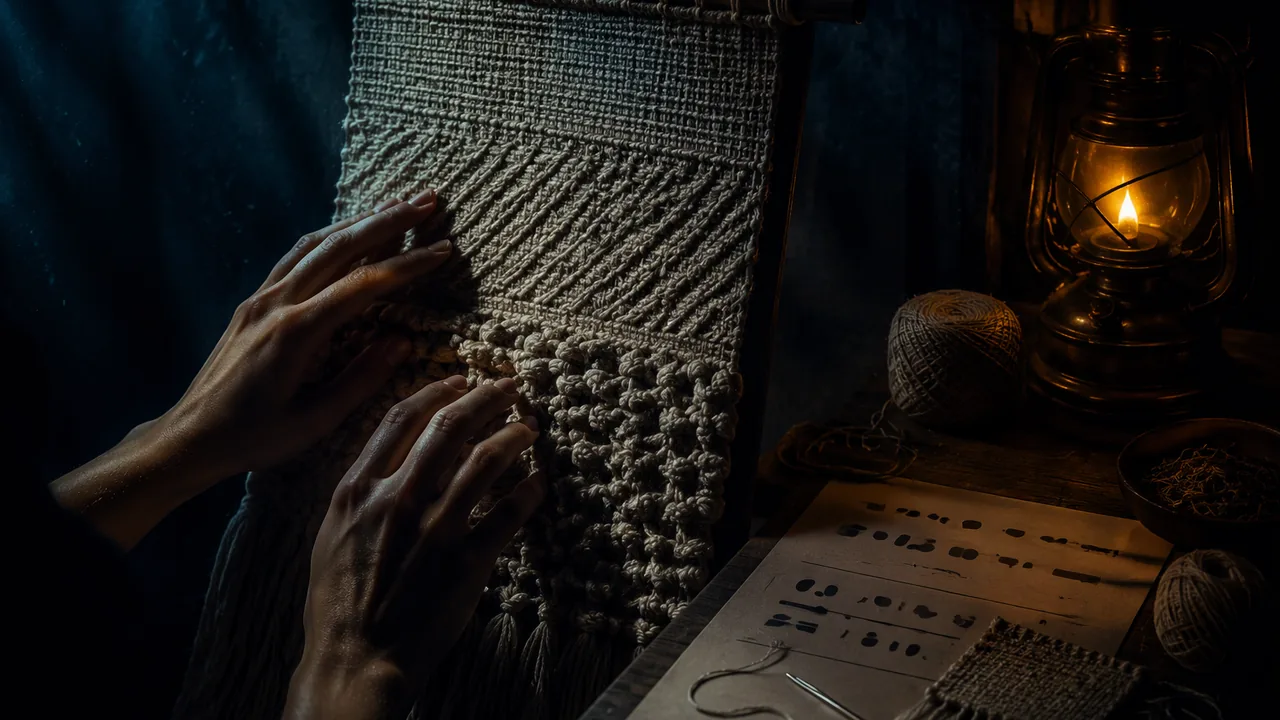
The touch test. At the halfway point, put the work away for at least a day. Then explore it with eyes closed, starting from an edge you did not choose (have it handed to you, or turn it over several times in a bag), and say aloud every place where the rhythm changes before you look at your chart. If a family member is willing, ask them to do the same without being told how many changes there are. Record where the changes were found, where one was missed, and the exact words used. A missed change means the structural difference is too small: exaggerate it.
Revision. Revise with evidence, documenting each change with photos. If you unpick a section, keep a note of why; unpicking is a normal part of fiber work. A typical revision: the touch test found the change from plain weave to twill but missed the progressive section where your knots grew closer together, because the steps were too small; you respace them so each gap halves, and a second touch test finds the acceleration at once.
Statement. In 300-400 words: name your source (generator settings or AI image label); explain your translation rule and how code or image became structure in cloth; describe the rhythms and where they change; describe a revision; and state your position on who is the author of the pattern — you, the code, the model, the artists behind the training data — using what you learned in Lesson 2.3.
Defense. In a recording of about two minutes, defend one decision and answer one question a viewer would be likely to ask.
📖 Read for this lesson
The reading opens over the lesson; close it to come back to exactly where you were. The checks below draw on it.
Formative check
Work through these before moving on. They are not graded — they tell you whether the standard below has landed yet.
Record your touch test (yours after a day away, or a family member’s): where the rhythm changes were found, where one was missed, and the exact words used. List your revisions with before-and-after photos.
Your touch test misses a rhythm change where you switched from blue plain weave to red plain weave. The best revision is:
How confident are you that you can make a fiber work whose rhythm can be felt and explain its authorship?
Submit: Rhythm in Fiber — finished work, statement (300-400 words) and defense
Task: Create a woven, stitched or knotted fiber work at least 20 × 25 cm whose rhythm derives from your own p5.js pattern generator or an AI-generated image from the course’s image cards. It must include at least two kinds of rhythm and at least one rhythm change that a reader can find by touch.
Submission workflow
- Stage 1 — Plan. Source record, chart, translation key, size calculation, float rule and rhythm plan from Lesson 2.4.
- Stage 2 — Touch-tested work in progress. A blind touch test (yours after a day away, or a family member’s) finds the rhythm changes without sight; record results and a revision plan.
- Stage 3 — Final work and statement. Finished work photographed flat and in raking light, with a 300-400 word statement including your authorship position.
- Stage 4 — Defense. About two minutes defending one decision, recorded.
How it is scored
| Criterion | What proficient looks like |
|---|---|
| Fiber technique (VA:Cr2A.II) | Even tension, secure ends, controlled structure; the work holds its shape. |
| Rhythm and composition (VA:Cr1B.II) | At least two kinds of rhythm; changes are deliberate and felt by touch. |
| Translation from source (VA:Cn10A.II) | The chart and translation rule clearly turn the source into structure; calculations are correct. |
| Revision (VA:Cr3A.II) | Changes respond to the touch test with evidence. |
| Authorship reasoning (VA:Cr2B.II) | A clear position on authorship, supported by the lesson’s sources and fair to other views. |
| Presentation and defense (VA:Pr4A.II) | Documentation and statement explain decisions; the defense answers the question directly. |
Portfolio Task 6: The Full Brief, Criteria at Four Levels, an Exemplar Entry and the Touch-Test Sheet
SLS original brief; the exemplar is invented and illustrative, and quotes two short phrases from U.S. Copyright Office and Sol LeWitt sources credited in the authorship reading · SLS original (constructed teaching material, illustrative)
Why this reading. This is the complete brief for Portfolio Task 6: the assignment, the criteria at four levels, an exemplar entry and the touch-test sheet. Everything you need is here; you complete the task on your own, with a family member as an optional tester. The exemplar is SLS original and invented: it shows a standard, and it is not real student work and not attributed to anyone.
The assignment
Make a woven, stitched or knotted fiber work at least 20 × 25 cm whose rhythm comes from your own generator or from an AI-generated image (yours, or Card B or D in the machine-image cards reading). It needs at least two kinds of rhythm and at least one rhythm change a reader can find by touch. Work from the chart, key, size calculation and float rule of Lesson 2.4 (see the worked example reading, including its loom-width check). At the halfway point, after at least a day away, the rhythm changes are found with eyes closed, without the tester being told how many there are: by you, starting from an edge you did not choose, or by a willing family member. Photograph the finished work flat and in raking light. Write a 300–400 word statement that includes your position on who is the author of the pattern, using the sources in the Rules, Randomness and Authorship reading. Give a two-minute defense of one decision.
Criteria at four levels
| Criterion | 4 Exemplary | 3 Secure | 2 Developing | 1 Beginning |
|---|---|---|---|---|
| Fiber technique | Even tension, ends secured, straight edges, holds its shape | Minor unevenness | Sags, snags or pulls in | Falls apart |
| Rhythm | Two or more rhythms; every change found by touch | Two rhythms; one change missed | One rhythm, or changes only in color | No rhythm |
| Translation from source | Chart, key and correct size calculation visibly become the work | One calculation slip | Chart without a key | No chart |
| Revision | Changes respond to the touch test, with photos and reasons | Changes, thin reasons | One change | None |
| Authorship reasoning | Clear position, uses a quoted source, states the opposing view fairly, notes where law and credit differ | Position and a source | Position only | None |
| Presentation and defense | Documented flat and in raking light; answers a question directly | Documented, answers | Describes only | Absent |
Exemplar entry (SLS original, invented)
Work: Leaning Ribs, plain-and-twill weave, 21 × 25 cm, cotton warp, wool and T-shirt strips. Source: Rule A grid, seed 7 (the die-rolled grid in the authorship reading), cropped to the first 10 columns and 25 rows of a larger grid I extended with the same rule. Cells 4 warps by 4 picks; 40 warps at 2 per cm is 20 cm; 100 picks at 4 per cm is 25 cm. Float rule: no float longer than 3.
Statement (about 370 words). “Leaning Ribs is a weaving whose pattern I did not draw. I wrote a rule: roll a die for each square of a grid, and on 1 to 3 make a diagonal that leans right; on 4 to 6 make one that leans left. The dice filled the grid. I chose the rule, the grid size and which of three grids to keep, and I kept the one where the diagonals sometimes formed diamonds. I turned it into cloth by charting each square as a block of twill, four warps wide and four picks tall, stepping right or left. A finger moving across the finished cloth feels ribs lean one way, then the other, and at each place where they meet the ribs make a V. That is the first rhythm, regular within each block. The second rhythm is the change: I wove the first third in plain cotton and the rest in wool twill, so the surface goes from flat to ribbed, and the ribs get closer because I beat the last quarter tighter.
“A computer could have made this pattern in a fraction of a second. It took me about eleven hours, and I think that difference is part of the meaning. At the halfway point my older brother did the touch test. He found the twill ribs and the V-turns but missed the change from plain weave to twill, because both were the same dark color. I revised by changing the plain section to a lighter yarn and raising a row of loops at the join, and the second test found it at once.
“Authorship. I place myself near the high end of human control: I wrote the rule, and the U.S. Copyright Office’s 2025 report says human authors keep ‘the creative selection, coordination, or arrangement of material in the outputs’. The dice are only inside limits I set. Someone could argue the dice are the author, but a die has no intent and cannot choose a rule. Sol LeWitt called the idea ‘a machine that makes the art’, and I agree that the person who writes the machine matters, even if the law and the art world might not always credit it in the same way.”
Touch-test record: tester (a family member) found 5 of 6 changes; missed plain-to-twill; said “the ribs lean left, then right, and there is a sharp turn where they meet”. Revision: lighter yarn and a row of loops at the join; second test found 6 of 6. Defense notes: decision defended, tightening the last quarter; question I expected a viewer to ask, “Would it work at the same spacing all through?” Answer: it would be regular, but a hand would lose the sense of speeding up.
Touch-test sheet (for you after a day away, or for a family member)
- Eyes closed, do not ask how many changes there are. Say out loud each place where the surface changes. If you are testing your own work, record yourself on a phone and mark the places on a copy of the chart afterward; if a family member is testing, you mark them as they speak.
- Count: places found, places missed, places you thought were changes but were not.
- For each missed change, say what is too small to feel, and a structural way (ribs, loops, knots, spacing) to exaggerate it, not a color change.
- Check the edges and ends: straight? Any loose ends or floats that catch?
- Ask about the statement: does it name the source, the translation rule, the rhythms, one revision and a position on authorship?