analyze how rhythm is built into the structure of woven, embroidered, appliquéd, quilted and basketry works from several cultures, and connect textile patterning to the history of computing.
Instruction
In most art forms a pattern is placed on a surface. In fiber, the pattern is the structure. A weaver makes an image by choosing, thread by thread, which threads pass over and which pass under. Rhythm is not decoration here; it is how the thing holds together.
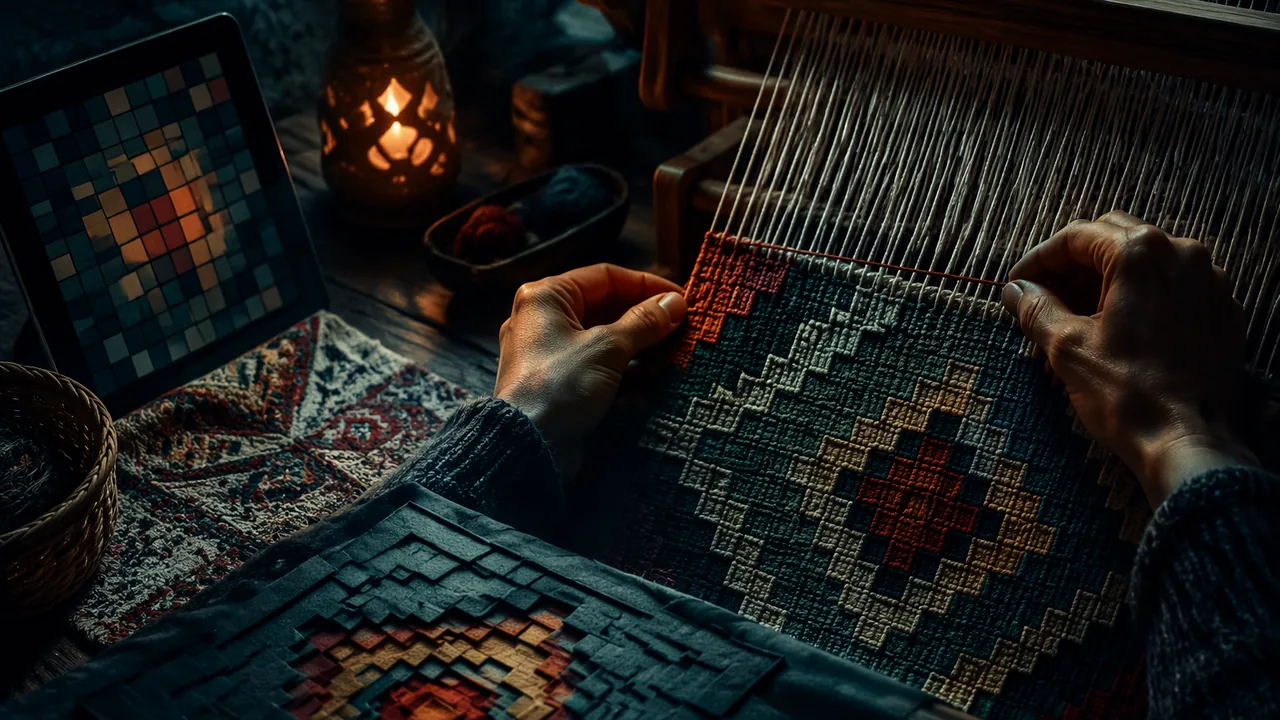
Warp and weft. On a loom, the warp threads are stretched lengthwise and held under tension; the weft is passed across them, over and under. In plain weave the weft alternates over one, under one — an alternating rhythm. In tapestry weave the weft does not run edge to edge: each color area is woven separately, back and forth, so the weaver builds the image in a grid of small units, rather like pixels.
Wari tapestry (Peru). The Tunic with Profile Animal and Human Heads (about 700-1100, Cleveland Museum of Art) was made by weavers of the Wari culture in camelid fiber and cotton tapestry weave. Motifs repeat in columns, and in many Wari tunics they are flipped, compressed or stretched across the garment, so a regular rhythm is deliberately disturbed. Such tunics took enormous labor and were worn by people of high status.
Paracas embroidery (Peru). The earlier Mantle (about 300 BCE-200 CE, Cleveland Museum of Art) is a plain-weave cloth embroidered with camelid fiber, its figures repeated across the field in alternating colors — a large, slow rhythm meant to be seen around a body.
Guna molas (Panama). Guna women make molas by reverse appliqué: layers of colored cloth are stacked, and the top layers are cut and their edges turned under and stitched to reveal the colors below. The Labyrinth Mola Panel (before 1960, Cleveland Museum of Art) uses a technique the museum identifies as bisu-bisu: a maze of evenly spaced lines that makes figure and ground hard to separate. Panels like it are sewn into women’s blouses. Every channel in the maze is a raised, stitched edge you can trace with a finger.
Embroidery samplers and quilts. A Moroccan embroidery sampler (1700s, Cleveland Museum of Art) collects stitches and motifs in a grid — a textile version of your texture library. The ‘Crazy Quilt’ Parlor Throw (1887-88, Art Institute of Chicago), made in Chicopee Falls, Massachusetts, pieces irregular scraps of silk and velvet and covers the seams with embroidery: an irregular rhythm held together by stitching.
Osage ribbonwork (Missouri’s first peoples). In the early 1800s the Osage controlled much of what is now western Missouri, northern Arkansas and eastern Kansas; a series of treaties beginning in 1808 took their land, until they were forced into what is now Oklahoma, where the Osage Nation’s reservation was established in 1870. Osage artists are known for ribbonwork: silk ribbon cut into shapes and appliquéd onto wool cloth. A late nineteenth-century Osage Skirt at the Nelson-Atkins Museum of Art in Kansas City (wool and silk ribbon appliqué, about 144 × 226 cm) is decorated, in the museum’s description, with cut ribbonwork appliqué in geometric motifs and a sawtooth edge at the top: a regular rhythm of points a fingertip could count. Like the mola, ribbonwork builds its pattern from cut and stitched layers of cloth, so every edge is a slightly raised line.
Pomo twining (California). Sally Burris, a Pomo weaver (1840-1912), made the Twined Basketry Bowl (about 1870-1900, Art Institute of Chicago). In twining, pairs of weft strands twist around each other between the warps, and each twist is both a stitch and a unit of the pattern.
Looms and computers. In 1804 Joseph-Marie Jacquard introduced a loom controlled by chains of punched cards: each card’s holes decided which warp threads lifted for one pass of the weft. The idea of storing a pattern as holes in cards influenced Charles Babbage’s designs for a calculating engine, and Ada Lovelace compared that engine’s work with the Jacquard loom weaving patterns. The pattern generators you write in Lesson 2.3 belong to this long history.
📖 Read for this lesson
The reading opens over the lesson; close it to come back to exactly where you were. The checks below draw on it.
Formative check
Work through these before moving on. They are not graded — they tell you whether the standard below has landed yet.
How is a Guna mola made?
The Jacquard loom’s punched cards influenced early designs for calculating machines.
On a loom, the lengthwise threads under tension are the and the thread passed across them is the .
Choose two textiles from the lesson. For each, draw a small structure diagram (how threads or layers go over, under or through), name the kinds of rhythm, and use the museum record to connect the work to the people and purpose it served. Finish with one way a hand would experience each rhythm differently from an eye.
How confident are you that you can explain how rhythm is built into fiber structures from different cultures?
Rhythm in Seven Textiles: Records, Photograph Descriptions and a Structure-Diagram Vocabulary
Cleveland Museum of Art Open Access API (1949.12, 1946.226, 2021.153, 1929.831; CC0); Art Institute of Chicago API (5610, 191214); retrieved 26 September 2026; The Nelson-Atkins Museum of Art collection record F83-57/9 (art.nelson-atkins.org/objects/4523) and National Park Service, Gateway Arch National Park, “The Osage” (nps.gov/jeff), retrieved 9 November 2026 · SLS original (descriptions, diagrams and worked example), with CC0 museum record data, facts summarized from the Nelson-Atkins collection record and public-domain National Park Service text
Why this reading. The task asks you to choose two textiles, draw a structure diagram of each, name the rhythms, connect the work to the people and purpose it served, and say how a hand would feel each rhythm differently from an eye. You cannot handle a textile through a lesson page, so this reading gives the record, a description you can chart, the museum’s own words and a diagram vocabulary. Records were checked against the Cleveland Museum of Art Open Access API (CC0) and the Art Institute of Chicago API on 26 September 2026; the seventh, an Osage skirt in Kansas City, against the Nelson-Atkins Museum of Art’s online collection on 9 November 2026. Positions are approximate readings of the museum’s photograph. None of these makers left written statements, except the words stitched on the quilt; the museum text is the published account.
How to draw a structure diagram
Use a grid: each row is one pass of the weft, each column one warp. Write O where the weft passes over a warp and U where it passes under. Read the rhythm along a row and down a column.
Plain weave (alternating)     2/2 twill (steps one warp each row)
row 1  O U O U O U O U        row 1  O O U U O O U U
row 2  U O U O U O U O        row 2  U O O U U O O U
row 3  O U O U O U O U        row 3  U U O O U U O O
row 4  U O U O U O U O        row 4  O U U O O U U O
Tapestry weave: each color is woven only in its own area, the weft turning back at the area’s edge, so the picture builds up in small units. Draw it as colored blocks, and mark where two areas meet. Twining: two weft strands twist around each other between each pair of warps; draw the pair as a cross, ×, at every step. Reverse appliqué: draw a cross-section: layers of cloth stacked, with the top layer cut through and its raw edge turned under and stitched so the layer below shows. Embroidery: draw the stitch as a line lying on the ground cloth.
Six records
1. Wari tunic. Tunic with Profile Animal and Human Heads, Wari culture, south coast of Peru, c. 700–1100. Camelid fiber and cotton, tapestry weave. About 97.8 × 99.1 cm. Cleveland Museum of Art, 1949.12. In the photograph: the top half and side columns are a tapestry of interlocking six-sided and hourglass-shaped compartments in pink, maroon, tan, brown and blue-gray, each holding a small profile head; they stack in vertical columns. Below, three plain maroon vertical bands stand between patterned columns. The colors change from one compartment to the next, so the repeat is regular in shape and irregular in color. Museum text: the tunic is two long panels, woven on looms about 80 × 20 inches with the warps across the short dimension, so the warps run horizontally in the garment as worn. The two heads alternate, one human and one an animal that may be a deer or a bat. “Such tunics were luxury goods worn only by privileged individuals.”
2. Paracas mantle. Mantle, Paracas (Cavernas) style, south coast of Peru, c. 300 BCE–200 CE. Camelid fiber, plain weave with embroidery. 154.9 × 292.1 cm. Cleveland Museum of Art, 1946.226. In the photograph: a dark field carries about six rows of embroidered bird figures, each row shifted half a step from the next, like the squares of a checkerboard. A border of dense small motifs and a red fringe frame all four sides. Museum text: the dead were buried in shaft-tombs wrapped in layers of cloth; the mantle was probably worn like a cloak; its double-headed bird motifs are embroidered in red, blue, yellow and green yarns, and “the specific meaning remains unknown.”
3. Guna labyrinth mola. Labyrinth Mola Panel, Guna people, Gunayala, Panamá, before 1960. Cotton; reverse appliqué and appliqué. 42 × 53 cm. Cleveland Museum of Art, 2021.153. In the photograph: narrow yellow-green channels run through a red field, forming nested V shapes and hooks with short parallel strokes. The design is mirrored about a vertical line and, nearly, a horizontal line, giving four matching quarters. About five small plus signs, placed off the mirror lines, interrupt the symmetry. Channel width is even, so figure and ground are hard to tell apart. Museum text: it is made in bisu-bisu, “one of the most prestigious of Guna mola-making techniques”, a maze of evenly spaced lines.
4. Moroccan sampler. Embroidery sampler (chelliga/shelliga), Morocco, c. 1700s. Cotton, silk, dye. 58.4 × 59.1 cm. Cleveland Museum of Art, 1929.831. In the photograph: three panels sewn together in columns. The left panel has a large red, green and blue striped arch. The middle column has rows of plant motifs between border bands. In the right column the rows of small trees get smaller from top to bottom: a progressive rhythm. Museum text: floral designs, protective open-palm khamsa motifs and patterns in double-running, straight and long-armed cross stitches in dyed silk; young women learned these skills from a master craftswoman in her home.
5. Crazy quilt. ‘Crazy Quilt’ Parlor Throw, Chicopee Falls, Massachusetts, 1887–88. Silk in a variety of weaves including cut velvet, pieced, embroidered in silk and chenille, backed in satin. 164.1 × 137.4 cm. Art Institute of Chicago, 1957.174. Inscribed “M.D.B. 1887” and “Chicopee Falls, Mass. 1888”. In the photograph: irregular patches of many sizes and colors meet at odd angles; every seam is covered with embroidery, and small flowers and animals are stitched inside some patches. The lower edge is scalloped, one scallop after another at an even interval, each bearing a small embroidered flower. The patchwork is irregular and the scallops are regular.
6. Pomo twined bowl. Twined Basketry Bowl, Sally Burris (Pomo, 1840–1912), northern California, c. 1870–1900. Plant fibers. 17.8 × 44.5 cm. Art Institute of Chicago, 2007.213. In the photograph: a wide, low bowl with a tan ground. Dark triangular blocks are set on the body. Two bands of stepped checks cross the body on diagonals in a zigzag, with small crossed motifs between the bands. Every mark is made of twined stitches, so the pattern is the structure.
7. Osage ribbonwork skirt. Skirt, Osage, late 19th century. Wool and silk ribbon appliqué. 144.46 × 226.38 cm. The Nelson-Atkins Museum of Art, Kansas City, object number F83-57/9, gift of Donald and Fifi White. Museum description: a skirt decorated with cut ribbonwork appliqué in geometric motifs, with a sawtooth edge at the top; ribbonwork in white, yellow, green, purples and blue, with some fading. Context: the National Park Service (Gateway Arch National Park) records that in the early 1800s the Osage ruled the region of western Missouri, northern Arkansas and eastern Kansas, that treaties beginning in 1808 took large areas of their land, and that the Osage were eventually forced into what is now Oklahoma, where their reservation was established in 1870. Structure: like the mola, ribbonwork is appliqué: ribbon is cut into shapes and stitched down onto the cloth, so each shape has a slightly raised edge. Draw it as a cross-section, as for reverse appliqué, but with the colored layer on top of the ground. Rhythm: the sawtooth edge is a regular rhythm of points; the geometric motifs repeat along the skirt. (The museum’s online record gives no photograph description, so positions are not estimated here.)
Worked example (SLS original): the mola
Diagram: a cross-section at one channel: red top layer cut through, edge turned under and stitched, yellow-green layer showing in the slot. Rhythms: a regular rhythm of evenly spaced parallel channels; a reflected (mirrored) repeat in the four quarters; a break in the rhythm at the plus signs. People and purpose: the museum places it among the most prestigious Guna techniques; the record says Marjorie Tomchuk of New Canaan, Connecticut, owned it from 1960 until it was given to the museum in 2021, so it was made before 1960. The record does not say what the panel was for; find that out only from a source that says so. Eye and hand: the eye reads the color contrast in a second; a hand can follow only the raised stitched edge of each channel, so the maze becomes a path, and the mirroring that the eye sees at once is hard for a hand to find. Color contrast with no raised edge would disappear under the fingers.
Sources: Cleveland Museum of Art, Tunic with Profile Animal and Human Heads, 1949.12 (clevelandart.org); Cleveland Museum of Art, Mantle, 1946.226 (clevelandart.org); Cleveland Museum of Art, Labyrinth Mola Panel, 2021.153 (clevelandart.org); Cleveland Museum of Art, Embroidery sampler (chelliga/shelliga), 1929.831 (clevelandart.org); Art Institute of Chicago, ‘Crazy Quilt’ Parlor Throw, 1957.174 (artic.edu); Art Institute of Chicago, Twined Basketry Bowl, 2007.213 (artic.edu); The Nelson-Atkins Museum of Art, Skirt (Osage), F83-57/9 (art.nelson-atkins.org); National Park Service, Gateway Arch National Park, The Osage (nps.gov)