4.01 Minerals, Rocks and the Rock Cycle
The Burned Slope Plan
How can we protect a creek and a road below a burned hillside through the rainy season, and explain, with evidence, how water and rock shaped this landscape and how one change to the surface ripples through Earth’s systems?
The mystery: After a wet winter a steep coastal hillside collapsed onto a highway and pushed new land into the sea, while in a glacier-carved valley inland, granite that crystallized kilometers underground sheds blocks from cliffs nearly a kilometer high every year.
identify minerals and rocks by their properties, including density, and use the rock cycle to explain how internal and surface processes make and remake Earth materials.
- I can identify and describe examples of continental features (like mountains, valleys, and plateaus) and ocean-floor features (like trenches, ridges, and seamounts), including where they are found.
- I can show the relative sizes or extents of continental and ocean-floor features using a geographic scale in my model.
- I can describe how internal processes (such as volcanism and tectonic uplift) and surface processes (such as weathering and erosion) shape Earth’s features, and explain the time scales over which these processes act.
- I can explain how internal processes like volcanism, mountain building, and tectonic uplift build up Earth’s surface over time, and how surface processes like weathering and erosion wear it down.
- I can describe how internal and surface processes interact and affect each other, such as how mountain building can change weather patterns and influence erosion rates.
- I can relate the rate of change in Earth’s features to the time scales of the processes involved, identifying which features change slowly or quickly based on the processes acting on them.
Phase 1: Spark
Warm-Up ~5 min
Do Now. Two photos are on the board: a steep coastal hillside where a huge slide of rock and soil has buried a road and pushed new land into the sea, and a glacier-carved valley with granite cliffs nearly a kilometer high and a fan of broken blocks at their base. Write one thing the two places share and one question about what tore them down.
A river carries a quartz grain and a gold flake of the same size. When the water slows, which settles first?
Instruction ~10 min
The phenomenon. On a steep stretch of coast, a hillside gave way after a wet winter. Millions of tonnes of rock and soil slid onto the coastal highway, buried the road and built new land out into the sea; the road stayed closed for many months. Inland, in a glacier-carved granite valley, blocks of granite fall from cliffs nearly a kilometer high every year. Both landscapes are made of rock that formed deep underground, and both are being torn down at the surface. This unit explains how. (Reading: Earle, Physical Geology, chapters 3–7.)
Minerals. A mineral is a naturally occurring, inorganic solid with a definite chemical composition and an ordered crystal structure. Quartz (SiO2), feldspar, mica and calcite are common ones. Geologists identify minerals by properties that come from their structure: hardness (quartz, 7 on the Mohs scale, scratches glass; calcite, 3, does not), cleavage or fracture, luster, streak color, reaction with dilute acid (calcite fizzes) and density.
Worked example 1: density as evidence. A pale grain has mass 26.5 g and volume 10.0 cm3: density 26.5 / 10.0 = 2.65 g/cm3, matching quartz. A yellow metallic grain of 96.5 g displaces 5.0 cm3 of water: 96.5 / 5.0 = 19.3 g/cm3. That is gold; fool’s gold (pyrite) is only about 5.0. Gold is about 7.3 times as dense as quartz, so when a mountain river slows down, gold drops out first and collects in gravel and cracks in bedrock: a placer deposit. The gold from Unit 1 got into those streams by the processes you study now.
Three families of rock.
- Igneous rocks crystallize from magma. Cooled slowly underground they have large crystals (granite, the rock of the valley cliffs); cooled quickly at the surface they have tiny crystals or glass (basalt, obsidian).
- Sedimentary rocks form when weathered fragments or dissolved minerals are deposited, buried, compacted and cemented (sandstone, shale, limestone). They form in layers and can hold fossils.
- Metamorphic rocks form when heat and pressure change existing rocks without melting them (marble from limestone, schist from shale). The jumbled rocks of the coastal hillside include metamorphic rocks formed in a subduction zone like the one in Unit 3.
The rock cycle. Any rock can become any other. Internal processes, driven by Earth’s interior heat (Unit 3), melt, deform and uplift rock. Surface processes, driven by the Sun’s energy and gravity, weather, erode and deposit it. The valley’s granite crystallized several kilometers underground roughly 100 million years ago. Uplift and erosion removed the rock that once covered it, and glaciers, rivers and rock falls are now breaking it into sand that the valley’s river carries toward the lowlands, where it may become sandstone. Water is at work in almost every surface step: it freezes in cracks, dissolves minerals, carries grains and lubricates slopes.
Worked example 2: different scales. If granite formed about 8 km down and was exposed over 90 million years (illustrative figures), the average exhumation rate is 8,000,000 mm / 90,000,000 yr ≈ 0.09 mm per year, yet a single landslide can move millions of tonnes in minutes. Your questions today should aim at that contrast: What makes a slope suddenly fail? What does water do to rock?
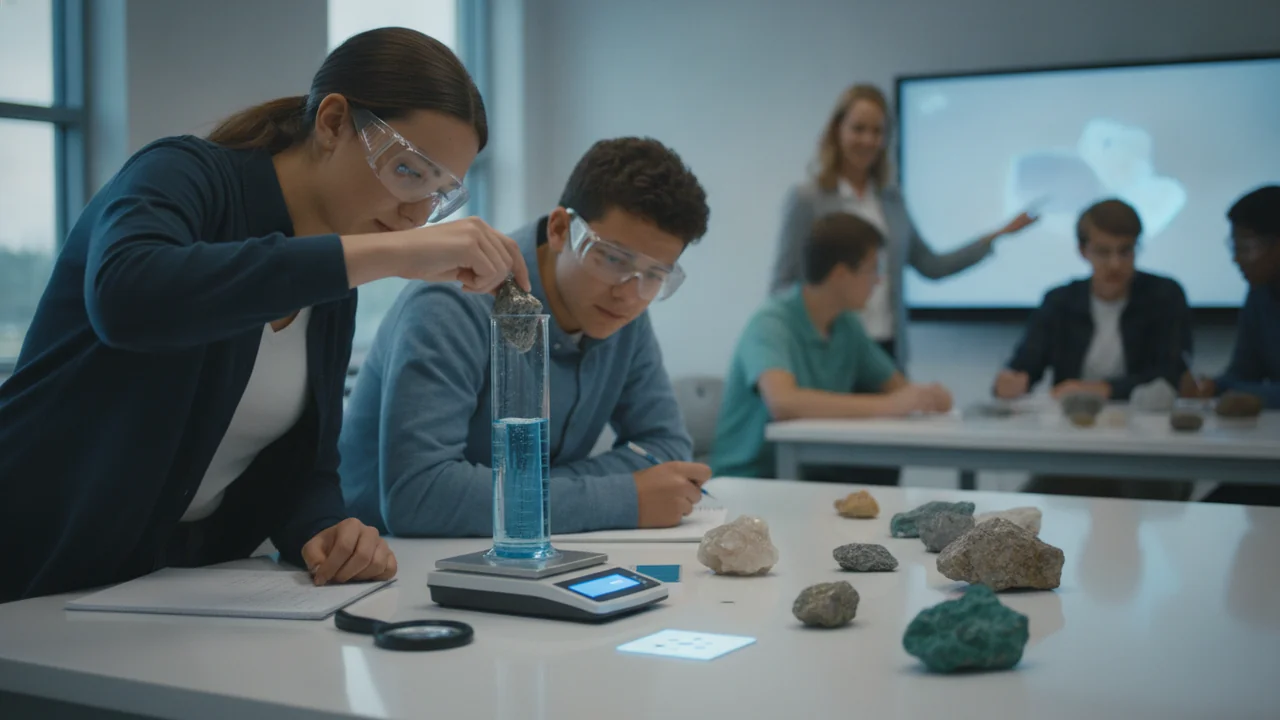
Lab: Identifying Minerals and Rocks by Their Properties. Choose one option; all three end in the same identification table, at least four densities, one percent difference and the same analysis. Option A, a rock kit: (1) record luster, color, streak and hardness against glass and a steel nail; (2) add two drops of vinegar to calcite, limestone, marble and one other sample; (3) find mass on the balance and volume by water displacement in a tilted cylinder; (4) compute density and compare with the reference values; (5) sort the rocks by texture and classify each. Option B, the sample cards below (constructed teaching data). Option C, PhET Density (in guided practice).
| Card (sample) | Luster, color, streak | Hardness | Fizz? | Mass (g) | Volume (cm³) | Density | Identification |
|---|---|---|---|---|---|---|---|
| 1 | Glassy, colorless, white streak | Scratches glass | No | 34.6 | 13.1 | ||
| 2 | Pearly, salmon pink, white streak | Just scratches glass | No | 30.8 | 12.0 | ||
| 3 | Glassy, white, white streak | Scratched by a nail | Yes, strongly | 27.3 | 10.1 | ||
| 4 | Metallic, brass yellow, greenish-black streak | Not scratched by the nail | No | 61.0 | 12.2 | ||
| 5 | Metallic, black, black streak, attracts a magnet | Not scratched by the nail | No | 57.8 | 11.1 | ||
| 6 | Rock: large interlocking pink, white and black crystals, no layers | — | No | 81.2 | 30.1 | ||
| 7 | Rock: dark gray, crystals too small to see, scattered gas bubbles | — | No | 90.4 | 30.2 | ||
| 8 | Rock: rounded sand grains cemented together in visible layers | — | Weakly, on the cement | 63.9 | 27.0 |
Reference densities (g/cm3): quartz 2.65; orthoclase feldspar about 2.56; calcite 2.71; pyrite about 5.0; magnetite about 5.2; granite about 2.7; basalt about 3.0.
Guided Exercises ~15 min
Work with your rock kit, the sample cards or the sim.
Independent Practice ~10 min
Finish the identification in your Landscape Notebook.
Complete the identification table for at least four samples. Claim: which property was most useful for telling similar-looking samples apart? Support it with two densities or test results. Then compute the percent difference between your quartz density (or card 1) and 2.65 g/cm³, and name the largest source of error for a small sample.
Write two questions about the coastal hillside that collapsed for the class question board.
Closure ~5 min
Rocks record how they formed, and water helps tear them down. Next class we meet the client who has a slope to protect.
How confident are you that you can I can identify minerals and rocks by their properties and explain the rock cycle.
Exit ticket: explain why granite has large crystals and basalt small ones, and what that tells you about where each formed.
Teacher notes
Timing: Poly ran this lesson over two 50-minute periods. Day 1: phenomenon and mineral tests; day 2: densities, rock textures and the rock-cycle model.
Materials: a school rock and mineral kit (quartz, feldspar, calcite, pyrite or magnetite, mica, granite, basalt, sandstone, shale, limestone, marble), a 0.1 g balance, a 100 mL graduated cylinder, streak plate, steel nail, taped glass plate, white vinegar in a dropper bottle (in place of dilute acid), hand lenses, goggles.
Data note: the eight sample cards are constructed teaching data, not measurements of real specimens. Expected densities: 2.64, 2.57, 2.70, 5.0, 5.2, 2.70, 2.99, 2.37.
Listen for: “rocks are always the same forever”; confusing minerals with rocks; “heavier means denser” without volume.
Support / stretch: give a density formula card and a flow chart for the three rock families. Stretch: estimate how many years it would take to exhume the granite at 0.09 mm/yr if the cover were 12 km thick.