1.01 Why the Sun Shines
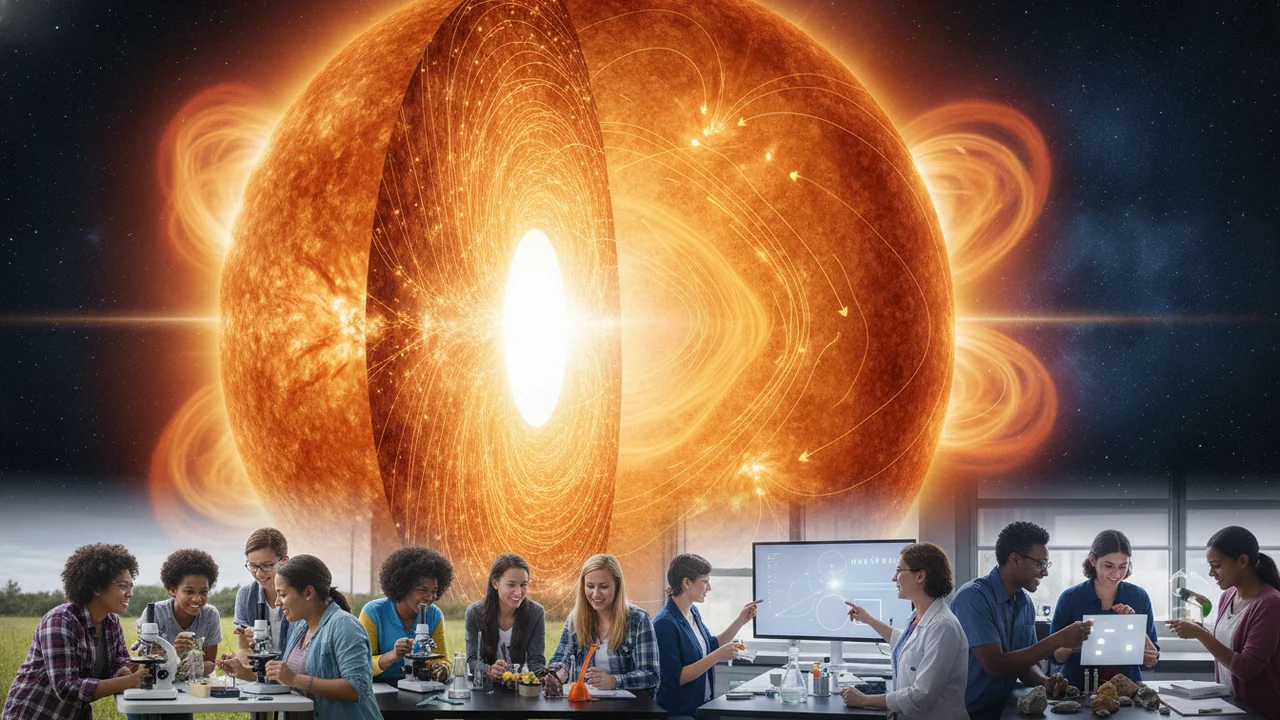
The Cosmic Origins Gallery
How can we show museum visitors, with evidence, how the atoms in a gold ring were made long before the Sun existed?
The mystery: Every atom of gold in a ring, panned long ago from a mountain stream, is older than the Sun. Fusion explains why the Sun shines, but the Sun cannot make gold.
explain how nuclear fusion in the Sun’s core releases energy, use E = mc² to connect the Sun’s luminosity to its mass loss, and describe the Sun’s life span from its birth to a white dwarf.
- I can identify hydrogen as the main fuel for the sun.
- I can explain that nuclear fusion in the sun produces helium and releases energy.
- I can describe how the sun’s lifespan depends on its initial mass and estimate that the sun will last about 10 billion years.
- I can model and explain how energy released in the sun’s core travels through space as radiation and eventually reaches Earth.
- I can use evidence from my model to explain why chemical processes alone cannot produce the sun’s energy over billions of years, and why fusion is necessary.
Phase 1: Spark
Warm-Up ~5 min
Do Now. A jeweler weighs a small gold ring on a lab scale. A geologist tells the class something strange: every atom of gold in that ring is older than the Sun. Write one sentence saying whether you believe it, and one question you would need answered before you could decide.
Suppose the Sun were a giant ball of coal burning in oxygen. About how long could it shine at its present brightness?
Instruction ~10 min
The phenomenon. Gold has been mined and panned from mountain streams on every inhabited continent. Geologists can show that every atom of that gold is older than the Sun. By the end of this unit you will be able to explain how that can be true, and you will build a museum exhibit that explains it to the public. We start with the star we know best. (Reading: OpenStax Astronomy 2e, chapter 16, “The Sun: A Nuclear Powerhouse.”)
What the Sun does. The Sun gives off about 3.83 × 1026 watts, its luminosity. At Earth’s distance (1.496 × 10¹¹ m) that power is spread over a sphere, so each square meter facing the Sun receives L / (4πd2) ≈ 1,361 W. This is the solar constant, and it drives weather, climate and life.
Where the energy comes from. Chemical burning cannot explain it: a Sun made of coal would burn out in a few thousand years. The answer is nuclear fusion. In the core, at about 15 million K, hydrogen nuclei (protons) move so fast that they overcome their electric repulsion and fuse. Through a chain of steps, four hydrogen nuclei become one helium-4 nucleus. Four hydrogen atoms have a mass of 4 × 1.007825 = 4.031300 u; one helium atom has 4.002603 u. About 0.7% of the mass is missing, and it leaves as energy, E = mc2.
Worked example 1: how much mass does the Sun lose? Divide the power by c2: 3.828 × 1026 W / (2.998 × 10⁸ m/s)2 ≈ 4.26 × 10⁹ kg every second, about 4.3 million metric tons. Since only 0.7% of the fused mass disappears, the Sun fuses about 4.26 × 10⁹ / 0.0071 ≈ 6 × 10¹¹ kg of hydrogen per second. That sounds enormous, but the Sun’s mass is 2 × 1030 kg, so it can keep this up for billions of years.
Worked example 2: fusion versus chemistry, per kilogram. Fusing 1 kg of hydrogen releases 0.007 × (3.0 × 108)2 ≈ 6.3 × 10¹⁴ J. Burning 1 kg of coal releases roughly 3 × 10⁷ J. The ratio is about 2 × 10⁷: fusion gives tens of millions of times more energy per kilogram, which is why only fusion can power the Sun for billions of years.
From core to Earth. Energy released in the core moves outward first by radiation, as photons are absorbed and re-emitted countless times, then by convection in the outer third of the Sun, where hot gas rises and cool gas sinks. The energy leaves the surface (about 5,800 K) as light and takes only about 8.3 minutes to cross the 150 million km to Earth, although it spent many thousands of years working its way out of the interior.
The Sun’s life span. The Sun is about 4.6 billion years old and is roughly halfway through its hydrogen-burning life of about 10 billion years. It is stable because outward gas pressure from fusion heat balances inward gravity. As helium builds up in the core, the core contracts and heats, and the Sun slowly brightens. In about 5 billion years it will swell into a red giant, fuse helium into carbon and oxygen, shed its outer layers as a planetary nebula, and leave a white dwarf about the size of Earth. It is not massive enough to explode.
Your questions. A good scientific question can be investigated. “Why is the Sun hot?” becomes “What reaction could release this much energy for 4.6 billion years?” Your question board should hold questions like that about the Sun, the stars and the gold.
Guided Exercises ~15 min
Work in pairs. Show every calculation with units.
Independent Practice ~10 min
Start your Cosmic Notebook.
The Sun has about 2 × 1030 kg of mass and loses about 4.26 × 10⁹ kg each second. What fraction of its mass would it lose in 10 billion years (3.15 × 10¹⁷ s)? Show the calculation, then explain why the answer means the Sun will not run out of mass before it runs out of core hydrogen.
Write two investigable questions about the Sun or the gold in the ring for the class question board.
Closure ~5 min
Fusion explains why the Sun shines, but the Sun only makes helium. So where did gold come from? Next class, we meet the client who wants that answer.
How confident are you that you can I can explain how fusion powers the Sun and describe the stages of its life.
Exit ticket: in two sentences, explain why chemical burning cannot account for the Sun's energy over 4.6 billion years.
Teacher notes
Materials: a photo or a real piece of gold jewelry (optional), chart paper for the question board, calculators.
Setup: post the question board for the whole unit; 1.02 sorts it into need-to-knows and 1.09 returns to it. OpenStax Astronomy 2e chapter 16 supports this lesson.
Listen for: “the Sun is on fire” (burning is chemical); “mass is destroyed in fusion” (it is converted to energy); confusion between the 8-minute light trip and the long trip out of the interior.
Support / stretch: give a scientific-notation reference card and a labeled Sun outline. Stretch: compute the solar constant from L and d yourself, then estimate the power falling on a 2 m2 solar panel facing the Sun.