1.07 Three Exhibit Concepts and a Decision Matrix
sketch competing exhibit concepts, define measurable criteria and constraints, and choose one concept with a weighted decision matrix.
- I can use mathematical or computational representations of Kepler’s second law to predict how the orbital velocity of a body changes as its distance from its star changes.
- I can describe how helium and small amounts of other light elements formed from protons and neutrons in the early universe before stars existed.
- I can explain how stars produce elements up to iron through nuclear fusion in their cores, and how this process releases energy.
- I can describe how supernova explosions of massive stars create elements heavier than iron.
Phase 4: Build
Warm-Up ~5 min
Do Now. The museum’s floor plan shows our station: a 2 m by 2 m space against a wall, with one power outlet. Write two things the space lets us do and one thing it rules out.
Which criterion is measurable enough to test?
Instruction ~10 min
Class criteria and constraints. From the client brief and our need-to-knows, the class fixes these. Criteria: (1) at least 8 of 10 test visitors can name where gold was made after five minutes; (2) every fact is accurate and cited; (3) visitors do something hands-on; (4) it includes one scale or math element. Constraints: a 2 m by 2 m footprint; a materials budget of 40 sample “museum points”; one power outlet; label text readable by a 12-year-old.
Three concepts. Teams sketch all three before choosing.
- A. The Element Timeline Wall: a long illustrated timeline from the Big Bang to a gold ring, with flip panels for evidence.
- B. The Orbit Table: a pins-and-string table where visitors draw a comet orbit and a planet orbit, with a panel tracing the gold to the gas cloud that made the Sun.
- C. The Spectrum Window: three lamps behind gratings so visitors see line spectra, with a panel on how starlight shows where elements were made.
Worked example 1: a scale element for the Orbit Table. The table is 1.6 m long. To fit Halley’s Comet (aphelion 35.3 AU), the team picks a scale of 1 cm = 0.25 AU, so 35.3 AU is 141 cm and the long axis (35.9 AU) is about 144 cm. At that scale Earth’s orbit is a circle only 8 cm across and Mercury’s is about 3 cm across. The team writes on the panel: “Halley moves about 60 times faster near the Sun than at its far end.” That is Kepler’s second law, from 0.586 AU and 35.3 AU.
Worked example 2: a weighted decision matrix (sample scores). Score each concept 1–5 on each criterion, multiply by the weight, and add.
| Criterion (weight) | A Timeline | B Orbit Table | C Spectrum Window |
|---|---|---|---|
| Visitors explain gold’s origin (3) | 4 | 3 | 3 |
| Accuracy and citations (3) | 5 | 4 | 4 |
| Hands-on (2) | 2 | 5 | 4 |
| Scale or math element (1) | 4 | 5 | 2 |
| Fits budget and space (2) | 4 | 4 | 2 |
| Weighted total |
Totals: A = 12 + 15 + 4 + 4 + 8 = 43; B = 9 + 12 + 10 + 5 + 8 = 44; C = 9 + 12 + 8 + 2 + 4 = 35. B wins narrowly, but its weakest row is “visitors explain gold’s origin.” A smart team combines ideas: the Orbit Table plus a short timeline strip along its edge. Trade-offs are normal; the matrix makes them visible.
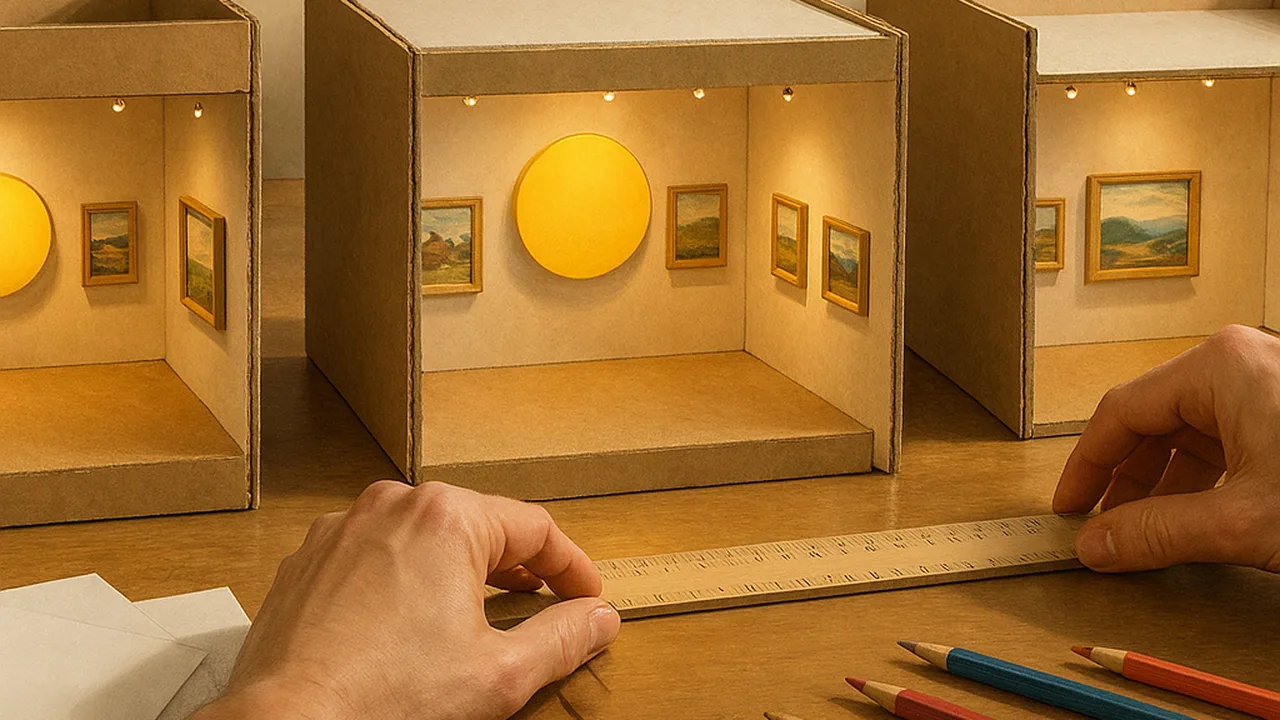
Prototype. Each team builds a tabletop version 1 at one-quarter scale: cardboard, string, printed labels and a timeline strip. Version 1 should be quick and cheap, because it exists to be tested.
Guided Exercises ~15 min
Complete your team’s decision matrix, then check these cards.
Independent Practice ~10 min
Build version 1.
Build your quarter-scale version 1. Photograph or sketch it, list its materials and their cost in museum points, and write the label text for one panel (60 words or fewer) with a citation.
Closure ~5 min
Version 1 exists. Next class, other teams and test visitors will tell us what works and what does not.
Exit ticket: which criterion do you think version 1 is most likely to fail, and why?
Teacher notes
Materials (per team): cardboard, string, push pins, a cheap diffraction grating or old CD, printed timeline strips, markers, tape, a “museum points” price list (sample: cardboard sheet 2, string 1, lamp 10, grating 5, printing 1 per page).
Setup: the class fixes the four criteria and four constraints at the start; 1.08 and 1.09 test against these exact values. Point out that this follows HS-ETS1-1 (specify criteria and constraints) and HS-ETS1-3 (evaluate with trade-offs).
Listen for: choosing by excitement instead of the matrix; scale errors from using diameter instead of semi-major axis.
Support / stretch: give a half-filled matrix. Stretch: add a sensitivity check: change the hands-on weight from 2 to 3 and see if the winner changes.